
.webp)
Claims management is the process of receiving, evaluating, and resolving customer claims, including warranty claims, defect reports, shipping damage, and product complaints. For ecommerce brands, claims management consumes support hours, erodes margins, and shapes customer perception more than any other operational function.
Most brands handle claims through email threads, spreadsheets, and manual review. This approach works at 50 claims per month. At 500, it breaks. At 5,000, it becomes a full-time team. The alternative is automation: AI-powered systems that receive claims, assess evidence, apply rules, and execute resolutions without human intervention for routine cases.
This guide explains what claims management involves, where the costs accumulate, and how to automate it with Claimlane.
- • Claims management = receiving, evaluating, and resolving warranty/defect/damage claims.
- • Manual processing: $15-$40 per claim, 3-7 days resolution.
- • AI automation: 60-80% cost reduction, resolution in hours.
- • Claimlane is the first AI agent purpose-built for ecommerce warranty claims management.
What Is Claims Management?
Claims management is the end-to-end process of handling customer claims against a product or service. In ecommerce, this typically involves:
- Claim intake: Customer reports an issue (defective product, shipping damage, missing item, warranty failure).
- Evidence collection: Photos, videos, order details, purchase date, and problem description are gathered.
- Assessment: The claim is evaluated against warranty terms, return policies, and product-specific rules.
- Resolution: A decision is made: repair, replace, refund, exchange, or reject. The resolution is communicated and executed.
- Recovery: If the defect is the supplier's responsibility, the claim is forwarded to the supplier for reimbursement.
Each step requires different data, different rules, and different actions. Manual claims management means a support agent handles every step for every claim. Automated claims management means software handles steps 1-5 for routine claims, and only routes exceptions to humans.
Types of Claims in Ecommerce
Warranty Claims
A customer reports a product defect within the warranty period. The claim requires proof of purchase, evidence of the defect (usually photos), and assessment against warranty terms. Warranty claims are the most complex claim type because they involve product-specific rules, supplier agreements, and legal obligations.
Shipping Damage Claims
A product arrives damaged due to shipping. The claim requires photos of the packaging and product, plus carrier documentation. Resolution typically involves replacement or refund. Shipping damage claims often require coordination with the carrier for reimbursement.
Missing Item Claims
A customer reports that an item is missing from their order. These claims require order verification and warehouse picking records. Resolution is usually re-shipment or refund.
Wrong Item Claims
A customer receives the wrong product. These claims require photos of the received item and order details. Resolution involves shipping the correct item and arranging return of the wrong one.
Quality Complaints
A customer is dissatisfied with product quality but the product isn't technically defective. These claims require judgment about whether the complaint falls under the return policy or warranty terms.
The Cost of Manual Claims Management
Manual claims management is expensive in ways that aren't always visible:
Direct Labor Costs
A support agent handling claims manually spends 15-30 minutes per claim: reading the email, requesting photos, evaluating the evidence, checking warranty terms, deciding on resolution, communicating the decision, and processing the action. At 20 claims per day, that is one full-time employee dedicated exclusively to claims.
Back-and-Forth Communication
Manual claims require an average of 4-6 email exchanges. The customer reports the issue. The agent requests photos. The customer sends photos. The agent needs a different angle. The customer sends more photos. The agent approves the claim. Each exchange adds 12-48 hours to resolution time.
Inconsistent Decisions
Without automated rules, different agents make different decisions on identical claims. One agent approves a replacement for a scratch. Another agent rejects it. This inconsistency creates customer complaints and internal confusion.
Lost Supplier Recovery
When claims are processed manually, supplier forwarding often gets deprioritized. Claims that should be reimbursed by the supplier are absorbed by the brand. Manual supplier recovery rates sit at 30-40%. Automated recovery reaches 70-90%.
Hidden Costs
- Training costs: New agents need weeks to learn warranty rules for hundreds of products.
- Quality assurance: Supervisors review decisions, adding management overhead.
- Data loss: Claim patterns that could identify product quality issues go untracked.
How Automated Claims Management Works
Automated claims management replaces manual steps with AI-powered processing:
Step 1: Self-Service Claim Submission
Instead of email, customers submit claims through a branded self-service portal. The portal guides them through structured data collection: order number, product selection, issue category, and photo uploads. This eliminates the back-and-forth communication that adds days to manual processing.
Step 2: AI Evidence Analysis
Claimlane's AI agent analyzes submitted photos and descriptions. Image recognition identifies defect types (cracks, discoloration, wear patterns, manufacturing defects) and assesses severity. The AI determines whether the evidence supports the claimed issue.
Step 3: Rule-Based Assessment
Configurable workflows apply the correct rules for each claim:
- Product category and warranty duration
- Supplier-specific warranty agreements
- Return policy conditions
- Claim value thresholds for auto-approval
- Geographic and regulatory requirements
Step 4: Automatic Resolution
For claims that meet auto-approval criteria, the system executes the resolution immediately: generating a return label, issuing a refund or store credit, sending a replacement order, or initiating an exchange. Complex claims route to a human agent with full context and a recommended resolution.
Step 5: Supplier Recovery
Claims attributed to supplier defects are automatically compiled with evidence (photos, defect descriptions, claim volumes) and forwarded to the responsible supplier. Automated tracking ensures follow-up happens and recovery rates improve.
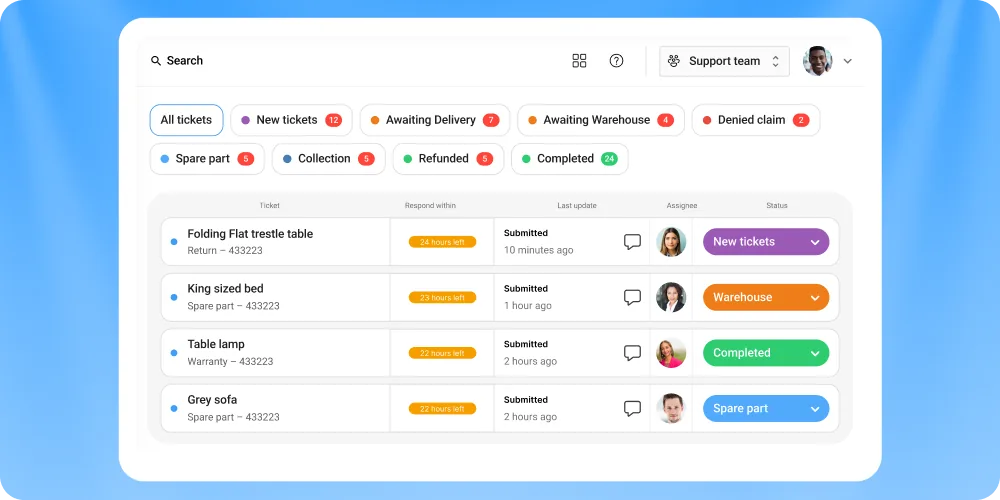
Claimlane: Purpose-Built Claims Management Software
Claimlane is the first AI agent designed specifically for warranty claims management in ecommerce. Unlike general helpdesk tools that treat claims as regular support tickets, Claimlane understands the unique requirements of product claims.
Key capabilities:
- AI image analysis that identifies defect types across product categories
- Product-specific warranty rules configurable per SKU, category, or supplier
- Auto-resolution for claims meeting defined criteria (value, defect type, warranty status)
- Self-service portal with guided photo upload and instant decisions
- Supplier forwarding with automated evidence compilation
- Analytics dashboard showing claim patterns, defect trends, and supplier performance
- 75+ integrations with Shopify, WooCommerce, Zendesk, Business Central, and more
Onyx Cookware, known for premium cast iron and ceramic products, used Claimlane to automate their warranty claims workflow. With products that carry multi-year warranties, the volume of claims grew alongside revenue. Claimlane's AI now evaluates photos of cookware damage, applies product-specific warranty rules, and auto-resolves routine claims.
Before Claimlane, our customer could expect their claim to involve back-and-forth emails and be quite time-consuming, now a claim will be submitted at 8:00 AM and resolved at 10:00 AM.
Rasmus Andersen · Chief Operating Officer, Onyx Cookware
Claims Management vs General Helpdesk Software
General helpdesk platforms like Zendesk and Gorgias treat claims as tickets. They provide a workspace for agents to read emails, attach notes, and track status. But they don't:
- Analyze product photos to identify defect types
- Apply product-specific warranty rules automatically
- Auto-approve claims based on configurable criteria
- Compile evidence for supplier forwarding
- Track defect patterns across products and suppliers
The difference is the gap between a filing system and an automation engine. A helpdesk files claims. Claimlane processes them.
| Capability | General Helpdesk | Claimlane |
|---|---|---|
| Claim intake | Email/form (unstructured) | Guided self-service portal |
| Evidence analysis | Manual agent review | AI image recognition |
| Warranty rules | Agent knowledge/training | Automated rule engine |
| Resolution | Manual agent action | Auto-resolve + human escalation |
| Supplier recovery | Separate process (often skipped) | Automated forwarding with evidence |
| Analytics | Ticket volume metrics | Defect patterns, supplier performance |
Claims Management Best Practices
Set Clear Warranty Terms
Vague warranty language creates disputes. Define warranty duration, covered defects, exclusions, and resolution options for every product category. Use these definitions to configure automated workflows.
Collect Evidence Upfront
The biggest time-waster in claims processing is back-and-forth for missing information. A self-service portal that requires photos, order details, and issue selection before submission eliminates this. Claimlane's portal guides customers through exactly what is needed.
Automate the Routine, Escalate the Exceptions
Not every claim needs human judgment. A clearly defective product under warranty with supporting photos can be auto-approved. A borderline case with ambiguous photos needs human review. Configure auto-approval thresholds that handle 60-80% of claims automatically.
Track Supplier Performance
Claims data reveals which suppliers produce the most defects, which product batches have quality issues, and which warranty agreements need renegotiation. Claimlane's analytics surface these patterns automatically.
Prioritize Exchange Over Refund
Exchanges retain revenue while still resolving the customer's issue. Automated claims management can default to exchange-first flows that offer exchanges before refunds, recovering 20-30% of revenue that would otherwise be lost.
Industries That Need Claims Management Automation
- Consumer electronics: High warranty claim rates, complex product-specific rules, multi-tier supplier relationships.
- Fashion and apparel: Quality complaints about materials, sizing issues, seasonal volume spikes.
- Home goods and furniture: Shipping damage, assembly defects, long warranty periods.
- Baby products: Strict safety requirements, sensitive customer expectations, multi-brand retailers.
- Sporting goods and outdoor equipment: Wear-and-tear vs defect distinctions, expensive products.
- Kitchenware and cookware: Warranty claims on premium products, material-specific defect assessment.
Measuring Claims Management Performance
Key Metrics
- Cost per claim: Total claims management cost divided by claims processed. Target: under $5 with automation.
- Resolution time: From claim submission to resolution execution. Target: under 24 hours for routine claims.
- Auto-resolution rate: Percentage of claims resolved without human intervention. Target: 60-80%.
- Supplier recovery rate: Percentage of supplier-attributable claims successfully forwarded and reimbursed. Target: 70-90%.
- Customer satisfaction (CSAT): Post-claim survey scores. Target: above 4.0/5.0.