
.webp)
Customer experience software for ecommerce connects the dots between marketing, support, fulfillment, and post-purchase operations. The right platform turns scattered customer interactions into a coherent experience that drives repeat purchases. The wrong one adds complexity without improving outcomes.
This guide compares the leading customer experience software platforms for ecommerce in 2026. The focus is the post-purchase phase. That is where most CX failures happen, and where the biggest improvements are available.
TL;DR
- Customer experience software spans the full journey: acquisition, conversion, support, and post-purchase.
- Most CX platforms are strong on marketing automation and support ticketing but weak on returns and warranty management.
- Post-purchase CX, including returns, warranty claims, and delivery issues, drives the majority of support volume and has the biggest impact on retention.
- Claimlane is the leading platform for post-purchase CX automation, handling warranty claims and returns with AI-powered analysis.
- • CX software spans acquisition, conversion, support, and post-purchase.
- • Most platforms are strong on marketing and ticketing, weak on returns and warranty.
- • Post-purchase CX drives the majority of support volume and impacts retention most.
- • Claimlane leads post-purchase CX: AI-powered warranty claims and returns automation.
What Is Customer Experience Software?
Customer experience software is any tool that helps brands manage and improve customer interactions across the buying journey.
- Pre-purchase: Personalization engines, product recommendation tools, on-site search
- During purchase: Checkout optimization, payment processing, cart recovery
- Support: Helpdesk platforms, live chat, AI chatbots
- Post-purchase: Order tracking, returns management, warranty claims, delivery issue resolution
The category is broad, which is part of the problem. No single platform covers every touchpoint well. The best ecommerce CX stacks combine dedicated tools for each phase.
What Is Customer Experience in Ecommerce?
Customer experience in ecommerce is the sum of every interaction a customer has with an online brand. Discovering the product. Receiving it. Using it. Sometimes returning it. Physical retail is shaped by store design and in-person service. Ecommerce CX is shaped by site usability, communication, shipping speed, and how problems get handled.
The post-purchase phase is where ecommerce CX differs most from physical retail. In a store, returns happen face-to-face. Online, they happen through forms, emails, and portals. The quality of that digital experience directly impacts whether the customer comes back.
Best Customer Experience Platforms Compared
| Platform | CX Focus | Post-Purchase | Best For | Price |
|---|---|---|---|---|
| Claimlane | Returns & warranty | Purpose-built AI | Warranty/returns volume | Custom |
| Zendesk | Omnichannel support | Ticket routing | Enterprise | $55/agent |
| Gladly | Customer-centric | Limited returns | DTC brands | Custom |
| Gorgias | Ecommerce helpdesk | Macro-based | Shopify brands | $10/mo |
| Klaviyo | Marketing CRM | Email sequences | Email/SMS | Free tier |
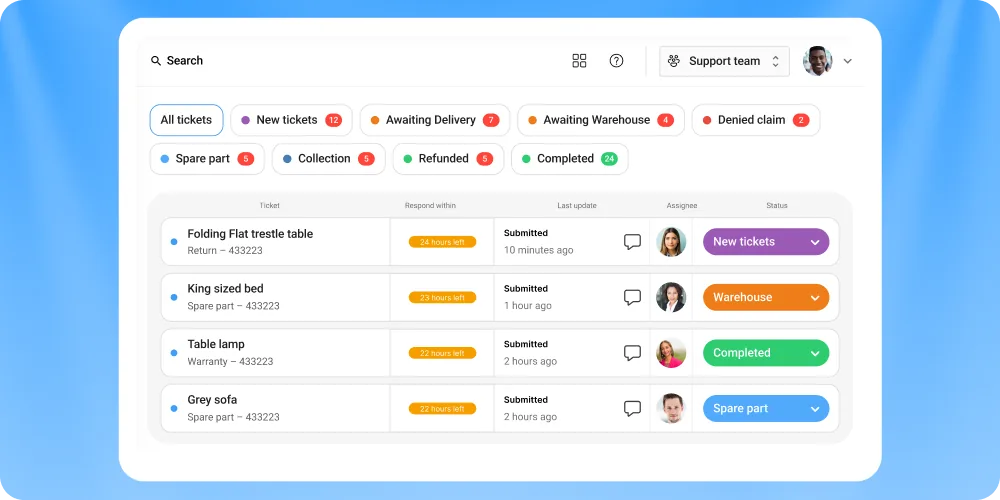
Claimlane: Best for Post-Purchase Customer Experience
Claimlane is the first AI agent purpose-built for warranty claims and returns. Other CX platforms focus on pre-purchase marketing or general support tickets. Claimlane handles the most complex and highest-volume post-purchase interactions.
Key features:
- AI-powered claim analysis: Image and video recognition identifies defect types and assesses damage severity automatically.
- Rule-based resolution: Custom workflows apply warranty terms, product-specific rules, and supplier agreements to determine the correct resolution.
- Self-service portal: Customers submit claims through a branded portal with guided photo uploads and instant decisions.
- Supplier forwarding: Claims that fall under supplier responsibility are automatically compiled and forwarded with full documentation.
- Analytics: Dashboards surface patterns across claims to identify product quality issues and process slowdowns.
- 75+ integrations: Connects with Shopify, WooCommerce, Zendesk, Business Central, and more.
Luksusbaby, a premium baby products retailer, implemented Claimlane to handle their growing volume of warranty claims across hundreds of brands. The AI agent now processes routine claims automatically, freeing the support team to focus on complex cases.
Claimlane gives us a full view of a customer's claim history and integrates with our Shopify data. That helps us judge: is this a loyal customer or a one-time buyer?
Tanja Munch · Head of Customer Service, Luksusbaby

Zendesk: Best for Enterprise Omnichannel Support
Zendesk is the most widely deployed customer service platform. It handles ticketing, live chat, phone, email, and social media support in a unified interface. Zendesk AI adds automated responses and ticket routing.
Strengths: Massive integration ecosystem, enterprise-grade security, extensive reporting, AI-powered ticket classification.
Post-purchase limitations: Zendesk is a general helpdesk. It does not have warranty workflows, image-based claim review, or automated resolution rules. Brands pair Zendesk with Claimlane to get both. Zendesk handles general support. Claimlane handles claims. Brands using Zendesk alongside Claimlane get the best of both: Zendesk for general support ticketing and Claimlane for dedicated claims handling.
Gladly: Best for Customer-Centric DTC Brands
Gladly organises support around customers, not tickets. Every interaction lives in one conversation thread. Agents get full context every time.
Strengths: Customer-first architecture, native voice and messaging, strong for DTC brands that prioritize personalization and relationship-building.
Post-purchase limitations: Returns and warranty handling relies on agent actions rather than automated workflows. No AI-powered claim assessment or product-specific warranty rules.

Gorgias: Best for Shopify-Native Ecommerce Support
Gorgias is built for ecommerce. The Shopify integration pulls order data straight into support conversations. Agents view order history, issue refunds, and create return labels without leaving the helpdesk.
Strengths: Shopify-native, order data in tickets, macro-based automation, affordable entry price.
Post-purchase limitations: Returns are handled through macros (template responses), not automated workflows. No warranty claim assessment, image analysis, or supplier forwarding.

Klaviyo: Best for Post-Purchase Marketing Automation
Klaviyo is the leading email and SMS marketing platform for ecommerce. Its strength is in customer segmentation, triggered flows, and revenue attribution.
Strengths: Advanced segmentation, predictive analytics, strong Shopify integration, post-purchase email sequences.
Post-purchase limitations: Klaviyo handles communication (emails, SMS), not operations (returns, claims). It can trigger post-purchase sequences but can't process a warranty claim or initiate a return.
Voyado: Best for Omnichannel Retail Loyalty
Voyado combines CRM, loyalty programs, and marketing automation for omnichannel retailers. The platform is designed for brands that sell both online and in physical stores.
Strengths: Unified customer data across channels, loyalty program management, personalization at scale.
Post-purchase limitations: Focused on marketing and loyalty rather than operational CX. Returns and warranty handling not included.
The Post-Purchase CX Gap
Here is the pattern across all CX platforms except Claimlane:
- Strong: Pre-purchase personalization, marketing automation, general support ticketing
- Weak: Returns processing, warranty claim assessment, automated resolution, supplier management
This gap matters because post-purchase interactions are 60-70% of all support volume. Returns and warranty are the interactions that drive retention. They are also the ones general CX platforms handle worst.
Building the Right CX Stack for Ecommerce
The most effective ecommerce CX stacks combine dedicated tools for each phase:
Pre-Purchase Layer
Personalization engines (Nosto, Dynamic Yield), on-site search (Algolia), and product recommendation tools drive discovery and conversion.
Marketing Layer
Klaviyo or Omnisend for email/SMS automation, loyalty programs, and customer segmentation.
Support Layer
Zendesk, Gorgias, or Gladly for general customer support ticketing, live chat, and phone.
Post-Purchase Operations Layer
Claimlane for returns and warranty automation, AfterShip or Narvar for order tracking, and Claimlane Analytics for post-purchase insights.
Feedback Layer
Customer feedback tools like Yotpo, Trustpilot, or Delighted for reviews, NPS, and satisfaction measurement.
How to Evaluate Customer Experience Software
Integration Requirements
Every CX tool must connect with existing ecommerce platforms, payment processors, and shipping carriers. Check for native integrations vs API-only connections. Claimlane offers 75+ integrations including Shopify, WooCommerce, Zendesk, and Business Central.
Automation Depth
Basic automation means template responses and simple routing. Real automation means AI-powered claim review, rule-based resolution, and supplier forwarding. The second one delivers measurably higher ROI.
Data and Analytics
CX software should produce insights you can act on, not just dashboards. Look for tools that tie customer interactions to business outcomes. Which products generate the most complaints. Which return reasons are most common. How post-purchase experience moves repeat purchase rates.
Scaling
A CX tool that works for 100 tickets/month may buckle at 10,000. Check how platforms handle volume spikes (holiday season, product launches) and whether pricing scales linearly or has breakpoints.
Time to Value
How long from contract signing to seeing results? General helpdesks (Zendesk, Gorgias) can be live in days. Purpose-built tools like Claimlane need 2-4 weeks for warranty rule configuration but deliver faster ROI through automation.
Customer Experience Consulting vs Software
Customer experience consulting firms help brands design CX strategies: journey mapping, persona development, experience audits. Software executes those strategies at scale.
For ecommerce brands, the consulting-first approach often stalls at setup. A journey map that identifies "returns experience" as a pain point doesn't fix the problem. Software that automates returns and warranty claims does.
The practical path: start with software that fixes the highest-volume pain points. That is usually returns and warranty claims. Add strategic consulting on top for experience design once the operational layer works.