.webp)
A damaged-in-transit claim is one of the fastest ways to lose a customer.
The customer did nothing wrong, but the product arrived broken. If the team responds slowly, the customer blames the brand, not the carrier.
At the same time, teams cannot treat shipping damage like a normal return. The workflow needs tight evidence collection, clear resolution rules, and a recovery path with carriers or suppliers.
This guide lays out an end-to-end damaged-in-transit process that is fast for customers and properly documented for operations and finance.
What “Damaged in Transit” Actually Means
A damaged-in-transit claim is any case where the product or its contents were damaged between the moment it left the warehouse and the moment it reached the customer.
Typical examples:
- Outer box crushed, product broken
- Water damage or moisture exposure
- Item missing because packaging was torn or opened
- Impact damage to fragile components
This is different from:
- Manufacturing defects (should route to warranty)
- Change-of-mind returns (should route to returns)
- Wrong item shipped (warehouse error)
The Goals of a Strong Damaged-in-Transit Workflow
A good workflow hits four goals at once.
- Fast customer resolution so the customer does not churn.
- Repeatable rules so agents do not improvise.
- Evidence quality that meets carrier standards.
- Root-cause visibility so the same SKUs do not keep breaking.
The End-to-End Process (7 Steps)

1. Capture the claim with strict evidence requirements
Damage claims get denied for one main reason.
The evidence does not meet carrier requirements.
The easiest fix is to set evidence rules at intake.
Minimum evidence checklist
Request:
- Photo of the outer box (all sides)
- Photo of the shipping label (tracking visible)
- Photo of inner packaging
- Close-up photo of the damaged item
- One wide photo of the item showing the full context
- Short description of what the customer sees
For higher value items, add a 10 to 15 second video.
The cleanest way to collect this is a guided form.
A self-service portal ensures customers submit the required photos up front, instead of sending them one by one through email.
Evidence rules that prevent disputes
- Require photos within [X] days of delivery.
- Require that the shipping label is visible in at least one photo.
- Require packaging photos even if the product damage is obvious.
2. Classify the claim and route it to the right workflow
A damage claim should not sit in a general inbox without a route.
A simple routing model works well:
- Clear transit damage: fast resolution path
- Unclear cause: manual review path
- Not transit damage: route to the correct flow (warranty, wrong item, return)
Claimlane’s workflows exist for this exact reason: they turn a “ticket” into an operational path.
3. Decide the customer resolution using a decision framework
The customer resolution should be consistent.
It should also avoid defaulting to refunds.
Resolution options
- Replacement shipped
- Best when inventory is available.
- Often the fastest path to customer satisfaction.
- Refund
- Best when the product is out of stock.
- Often used when the customer does not want a replacement.
- Spare parts
- Best when only one component is broken or missing.
- Often the lowest cost resolution.
- See: Spare parts workflow.
- Repair
- Best for high value categories.
- Often paired with a structured warranty path.
- See: Repair vs replace.
The decision inputs
The decision should consider:
- Product value
- Stock availability
- Cost of return shipping
- Fraud risk
- Customer history
- Safety constraints
A return can take weeks to process for large items, and that creates unnecessary churn. Furniture damage claims are a common example.[1]
4. Decide whether the damaged item must be returned
Many teams apply one rule to every order.
That is expensive.
A better approach uses thresholds.
A practical return requirement model
- If item value < [X], allow keep-and-resolve when evidence is strong.
- If item value >= [X], require return or pickup.
- If the item is regulated or hazardous, require return and follow the correct handling.
This decision impacts both cost and carrier recovery.
Carriers may require inspection of the damaged item for some categories.
5. Build the carrier claim packet
A carrier claim packet should be assembled the same way every time.
Claim packet contents
- Tracking number
- Shipment date
- Declared value and invoice proof
- Weight and dimensions
- All photos from the evidence checklist
- Internal case ID and notes
- Description of damage and packaging used
Many carriers publish guidelines for damage claims and required documentation.[2][3]
If the business sells internationally, local carrier rules can vary. The process still needs a consistent internal checklist.
6. Track carrier recovery like a real receivable
Carrier reimbursement is often slower than customer expectations.
The customer should not wait on it.
The finance team still needs the recovery tracked.
Track:
- Carrier claim submitted date
- Carrier claim ID
- Status (submitted, requested info, approved, denied, paid)
- Expected reimbursement amount
- Paid amount
- Denial reason
This is also important for supplier recovery when suppliers are responsible for packaging standards.
See: Forward to supplier.
7. Close the loop and reduce repeat damage
Damaged-in-transit volume is not fixed.
It can be reduced with operational feedback.
What to change when damage repeats
- Change packaging spec for the SKU (corner protection, void fill, double wall)
- Change pack-out instructions
- Add “packaging check” steps in the warehouse
- Run carrier performance reviews by lane and region
- Revisit dimensional weight and labeling practices
If the warehouse is disconnected from the claim workflow, these fixes never happen.
Claimlane’s Warehouse Module is designed to bring warehouse actions into the same after-sales loop.
Customer Communication Templates
First reply (fast and clear)
Thanks for reporting this. Please upload photos of the outer box, shipping label, inner packaging, and the damaged item. Once received, a resolution will be confirmed within [X] business hours.
Approval message
The claim has been approved. [Brand] will [ship a replacement / issue a refund / send the missing part]. Updates will be shared as the case moves forward.
Request more info (specific)
One photo is missing: the shipping label on the box with the tracking number visible. Please upload that photo to proceed.
The KPIs That Matter Most
1) Time to customer resolution
This is the customer experience KPI.
It is the main driver of repeat contacts.
It also impacts brand trust.
2) Recovery rate
This is the financial KPI.
Low recovery rate usually means poor documentation or weak packaging standards.
3) Damage rate by SKU
This is the operational KPI.
It tells the team which products need packaging changes.
Claimlane’s analytics helps connect claims to SKU and supplier patterns.
Where AI Fits
AI should not be treated as magic.
It helps most when the workflow is already structured.
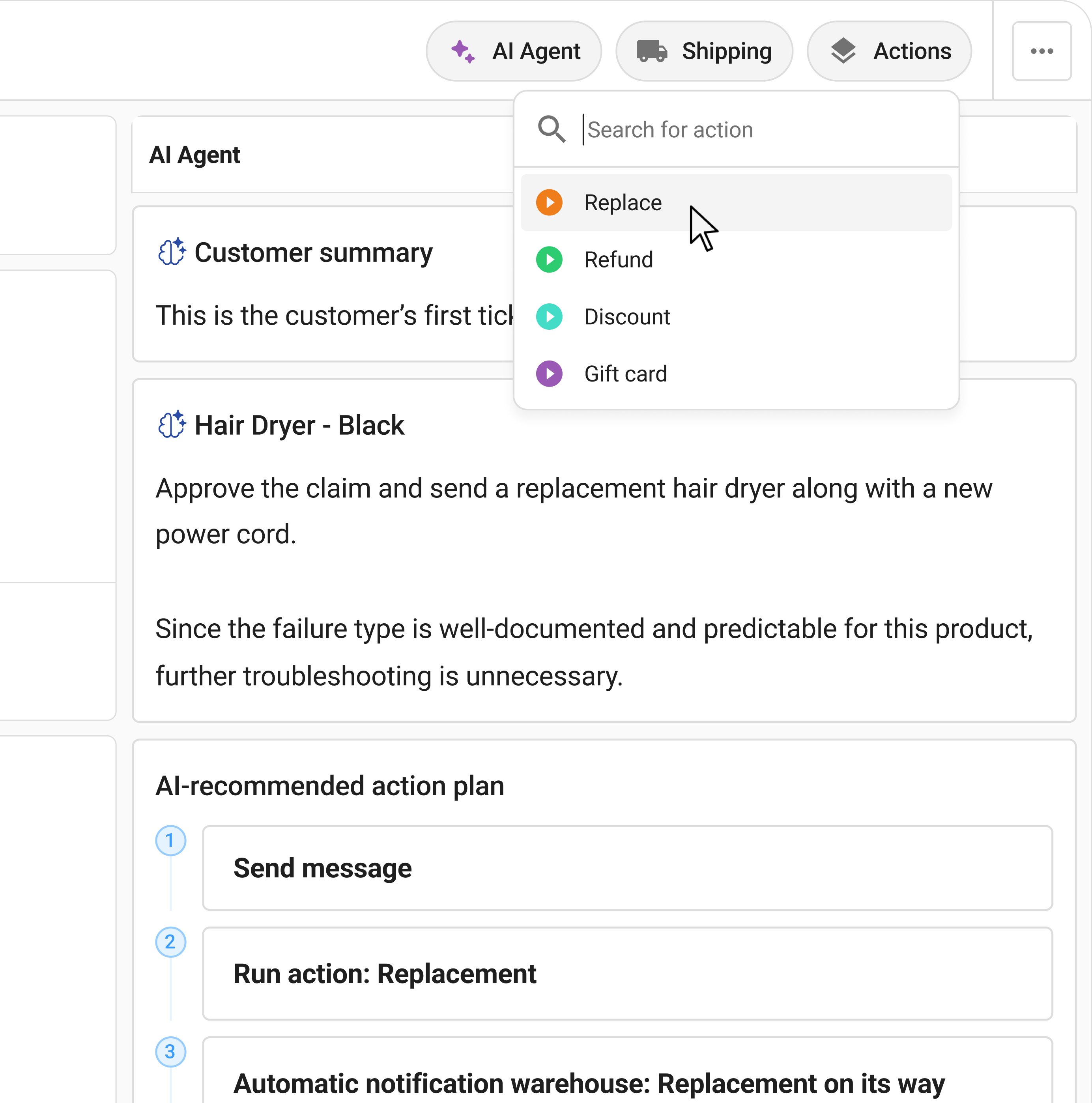
Claimlane's AI Agent, the first AI agent purpose-built for warranty claims and returns, can review claim photos and recommend the next action based on rules and patterns.
This is useful for:
- Identifying missing evidence
- Flagging unclear cases for review
- Routing to spare parts vs replacement vs refund