.webp)
Phantom inventory is stock a system shows as available when the shelf or warehouse does not actually have it. The records say twelve units. The bin holds nine. Those three missing units are phantom inventory.
It sounds like a small gap. It is not. Phantom inventory costs retailers sales, margin, and customer trust every day, because decisions get made on numbers that are wrong. A reorder gets skipped. A customer gets told an item is available when it is not. A returned product sits in a back room and never makes it back into the count.
This article covers what phantom inventory is, what causes it, what it costs, and the part most guides miss: how returns and warranty claims create phantom inventory faster than almost anything else.
- Phantom inventory is a mismatch between what the system says is in stock and what is physically there.
- Common causes are receiving errors, theft, misplaced stock, and returns that are processed late or not at all.
- Returns are one of the fastest ways to create phantom inventory, because a returned unit lives in limbo until someone inspects, grades, and restocks it.
- A returns and warranty platform like Claimlane keeps every returned and claimed unit visible, so it never becomes a phantom record.
Phantom inventory, defined
Phantom inventory, sometimes called ghost inventory or phantom stock, is any item that a system counts as available but that cannot actually be picked, sold, or shipped. The data record exists. The physical unit does not, or it is somewhere nobody can find.
The term comes from supply chain research on inventory record inaccuracy. Studies of retail stock records have repeatedly found that a large share, often cited around 60 to 65 percent accuracy, do not match what is physically on the shelf. Auburn University's RFID Lab has published similar findings across apparel and general merchandise retail.
Phantom inventory is not the same as being out of stock. Out of stock is honest. The system says zero, the shelf has zero. Phantom inventory is worse, because the system is confident and wrong at the same time. That false confidence is what does the damage.
How phantom inventory happens

Phantom inventory rarely comes from one big mistake. It builds up from small errors that nobody catches. Here are the usual sources.
Receiving and put-away errors
A delivery arrives. The count on the packing slip is entered into the system, but the physical put-away does not match. A case is short. A label is wrong. The system now believes in stock that never reached the shelf.
Theft and shrinkage
Stolen or damaged goods leave the building but stay in the records until a physical count finds the gap. This overlap with inventory shrinkage is one reason the two terms get confused. They are related, but not identical, and the next section breaks down the difference.
Misplaced and misallocated stock
The unit exists. It is just in the wrong bin, the wrong store, or allocated to an order that was later cancelled. The count is technically correct at the company level and useless at the location level.
System sync gaps
Most retailers run several systems: a commerce platform, a warehouse tool, an ERP, a point-of-sale. When they do not talk to each other in real time, every delay is a window where the numbers drift apart. Disconnected systems are one of the most common warehouse challenges brands report.
Returns processed late, or not at all
This is the one most guides skip, and it deserves its own section.
The returns blind spot

Forward logistics has had years of attention. Reverse logistics has not. When a product comes back, it does not snap straight into the count. It enters a queue.
A returned unit has to be received, inspected, graded, and then either restocked, refurbished, sent to a supplier, or written off. Until that whole sequence finishes, the unit is real but invisible. The system either still shows it as sold, or shows it as available before anyone has confirmed it can actually be sold again.
Both states are phantom inventory. One hides a real unit. The other promises a unit that may be damaged. Brands running structured reverse logistics close that gap. Brands running returns through email and spreadsheets widen it every single day.
"Claimlane helps us capture every customer issue, resolve it for the customer, and feed that back to the supply chain to drive continuous improvement."— Henry Currer, Head of Operations, Swoon Furniture
Where returned stock goes missing
Returned stock disappears at predictable points. Each one is a place where a real unit turns into a phantom record.
The handoff from carrier to warehouse is the first. A return is in transit, then received, but the receiving scan happens hours or days after the parcel physically lands. During that window the unit is nowhere.
The inspection bench is the second. A unit waits to be graded. Nobody knows yet if it is A-grade resellable, B-grade for recommerce, or scrap. It cannot be counted as sellable, so it often gets counted as nothing.
The supplier handoff is the third. A faulty unit gets forwarded to a supplier for credit or repair. If that movement is tracked in an email thread instead of a system, the unit leaves the building with no record of where it went.
The write-off that never happens is the fourth. A unit is damaged beyond resale but nobody closes the record. It stays in the count as available forever. These returns data silos are where phantom inventory hides longest.
Phantom inventory vs inventory shrinkage

These two terms get used as if they mean the same thing. They do not.
| Aspect | Phantom inventory | Inventory shrinkage |
|---|---|---|
| What it is | System shows stock that is not really sellable | Physical stock that is lost from the count |
| Direction of the error | System count too high, or hiding a real unit | Physical count lower than the record |
| Main causes | Sync gaps, slow returns processing, misplaced stock | Theft, damage, administrative error |
| When you notice | When an order cannot be fulfilled | At the next physical or cycle count |
| Main fix | Real-time data across systems | Loss prevention plus accurate counts |
The short version: shrinkage means a unit is gone and the record is too high. Phantom inventory means the record is wrong about what can actually be sold, in either direction. Returns create the second kind faster than anything else.
What phantom inventory costs
The cost shows up in three places: lost sales, wasted working capital, and damaged trust.
Lost sales come from false stockouts. A customer wants an item the system shows as available, the order fails or gets cancelled, and the sale goes to a competitor. The reverse also happens: the system understates real stock, so units sit in a back room while marketing pushes a different product.
Wasted working capital comes from bad reorder decisions. A buyer reorders stock that already exists in a returns queue. Cash gets tied up in duplicates. Cross-channel brands feel this hardest, since cross-channel returns move units between locations the central system cannot see.
Damaged trust is the quiet one. Every cancelled order, every wrong promise date, every "actually that is not available" email chips at the customer relationship. The hidden costs of returns and claims are mostly trust costs, and they do not show up on a single line in a report.
How phantom inventory breaks the returns operation
Phantom inventory and returns feed each other. Returns create phantom records, and phantom records make returns harder to handle.
When a returned unit is not visible, the support team cannot tell a customer where their case stands. When a refurbished unit is not graded, it cannot be offered as a replacement, so a brand new unit gets shipped instead. When a faulty unit is not tracked to a supplier, the brand never recovers the cost.
Every one of those is a returns problem caused by missing data. Fixing the returns process and fixing phantom inventory turn out to be the same job. A structured returns management system treats every returned unit as a tracked record from the moment it is requested, not from the moment someone finally scans it.
How to detect phantom inventory
Most brands discover phantom inventory by accident, when an order cannot be filled. There are better signals to watch.
Cycle counts that keep finding the same discrepancies point at a process gap, not a one-off error. Orders that fail at the pick stage after the system said the unit was available are a direct symptom. A gap between the return rate and the restock rate is one of the clearest signs: if 18 percent of orders come back but only 12 percent of units reappear in sellable stock, the difference is sitting in phantom limbo.
Pulling those signals together needs returns analytics that track the full lifecycle of a returned unit, not just the refund. Without that view, phantom inventory stays invisible until it blocks an order.
How to fix phantom inventory in returns

Fixing phantom inventory is less about a single tool and more about removing the gaps where units go dark. Five steps handle most of it.
- Capture the return as a record at request, not at receipt. The moment a customer files a return or warranty claim, the unit should exist as a tracked case. That closes the carrier-to-warehouse blind spot.
- Grade every unit before it moves. Inspection should produce a structured outcome: resellable, refurbish, supplier, or scrap. A graded unit can be counted correctly. An ungraded one cannot.
- Connect returns to the systems that hold the count. The returns process has to write back to the commerce platform, the warehouse tool, and the ERP. Real-time integrations are what stop the numbers from drifting.
- Track supplier handoffs as movements, not emails. When a faulty unit goes to a supplier, that has to be a recorded movement with a status, handled through a forward-to-supplier flow rather than an inbox.
- Close every record. A unit that is scrapped has to be written off in the system, not left as available. A unit that is restocked has to be confirmed back into sellable stock. No open-ended records.
Brands that handle returns this way also find it easier to reduce returns overall, because the same data shows which products keep coming back.
Where a returns management system fits
A returns management system is the layer that keeps returned and claimed units visible from request to resolution. That visibility is what stops returns from generating phantom inventory.
Claimlane handles warranty registration, claims, repairs, replacements, returns, and spare parts from one system. A customer files a case through the self-service portal with photos, videos, and order details. The unit becomes a tracked record straight away. Inspection, grading, supplier handoff, and restock all update the same record, and the analytics layer shows where units sit at any moment.
Claimlane is rated 4.8/5 on G2, and the brands using it report the same pattern: fewer surprises in the count, faster resolutions, and a returns process that feeds clean data back to the supply chain instead of hiding it.
"With Claimlane, we can process the cases significantly faster than before, and at the same time, we get the right data per claim and thus valuable insight for improvement."— Benny Kristiansen, Former Chief Sales Officer, Sebra
AI and phantom inventory

The hardest part of phantom inventory is the inspection step. Grading a returned unit takes a trained person, and trained people are a bottleneck. This is where AI changes the math.
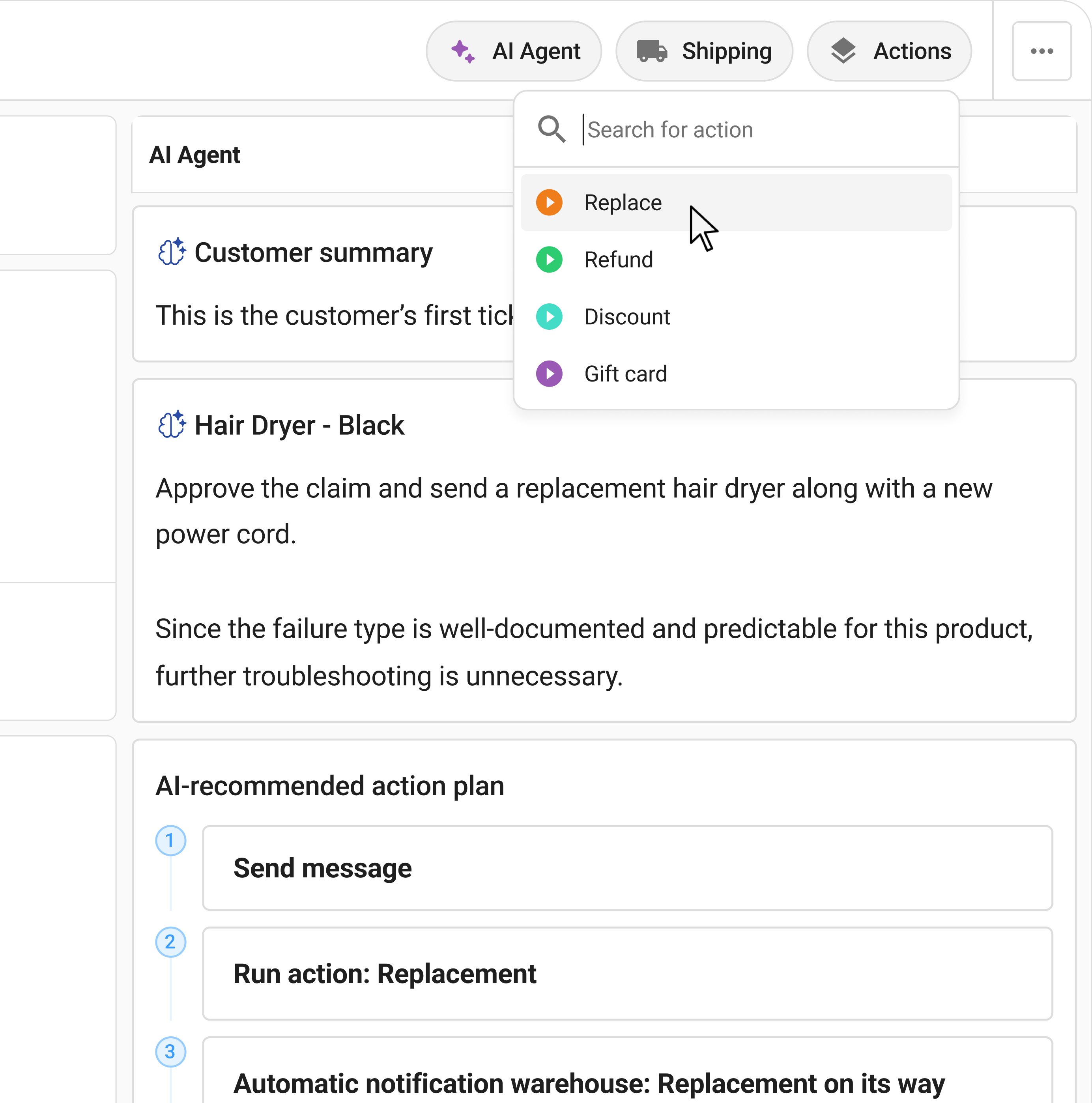
Claimlane's AI Agent, the first AI agent purpose-built for warranty claims and returns, reviews product images and videos, applies warranty rules per product and supplier, and recommends or auto-approves a resolution. A returned unit gets graded in seconds instead of waiting in a queue. The faster a unit is graded, the less time it spends as a phantom record.
MaxGaming, the largest gaming and e-sports e-commerce in Scandinavia, resolves complex RMA cases 77 percent faster using Claimlane's AI Agent. Faster resolution is not just a service metric. Every case that closes faster is a unit that returns to an accurate count faster. The same pattern shows up in predictive returns analytics, where AI helps brands forecast return volume before it floods the warehouse.
Phantom inventory KPIs to track
Phantom inventory is a number, so it should be measured like one. Four metrics give a clear picture.
Inventory record accuracy is the baseline: the share of records that match a physical count. Restock rate against return rate shows how much returned stock is being lost in the reverse pipeline. Time-to-restock measures how long a returned unit stays invisible. Open returns records older than a set threshold flags units that have gone dark.
These sit naturally alongside the wider set of returns and warranty KPIs a brand should already be watching. Tracked together, they turn phantom inventory from a vague frustration into a problem with a size and a trend.
Frequently asked questions
Conclusion
Phantom inventory is what happens when a system is confident and wrong at the same time. It costs sales, ties up cash, and erodes customer trust, and most of it builds quietly from small gaps nobody owns.
Returns are the gap that grows fastest. A returned unit stays invisible until someone receives it, grades it, and closes the record, and every hour in that queue is an hour of phantom inventory. The fix is to treat every returned and claimed unit as a tracked record from the moment it is filed.
To see how Claimlane keeps returned and warranty stock visible from request to restock, book a demo or explore the returns management platform.