
.webp)
Supplier feedback fails when it travels through email chains, gets buried in spreadsheet tabs, or arrives without the evidence needed to act. Quality issue reporting tools solve this by creating a structured path from defect discovery to supplier corrective action, with every step documented, tracked, and measurable.
Claimlane is the quality issue reporting tool built specifically for ecommerce brands, retailers, and wholesalers who need to turn returns and warranty claims into actionable supplier feedback. This page explains how it works, what it replaces, and why structured supplier feedback changes the quality conversation.
TL;DR
- Unstructured supplier feedback via email loses evidence, misses deadlines, and produces no trend data, letting the same defects recur.
- Quality issue reporting tools create a structured path from defect discovery to supplier corrective action, fully documented and tracked.
- Claimlane captures defect data at the point of return or warranty claim, then forwards structured evidence to suppliers with AI classification and CAPA deadlines.
- The result is a tight, evidence-based feedback loop where supplier quality improves because data is structured and scorecards have consequences.
The Problem With Unstructured Supplier Feedback
What Happens Without Quality Issue Reporting Tools
Without quality issue reporting tools, supplier feedback follows a predictable pattern:
- A customer returns a product or files a warranty claim.
- The returns team processes the refund or replacement.
- Someone emails the supplier: "We're seeing quality issues with product X."
- The supplier asks for specifics. The returns team digs through records.
- Weeks pass. The email thread grows. Nobody tracks whether the supplier actually fixed anything.
This workflow creates three problems:
- No structured evidence. The supplier receives vague descriptions instead of photos, batch numbers, and defect categorizations.
- No accountability. There is no deadline, no tracking, and no consequence for non-response.
- No trend data. Each quality issue is treated as an isolated incident. The pattern across hundreds of returns never surfaces.
The Cost of Unstructured Feedback
Unstructured supplier feedback costs brands in multiple ways:
- Repeated defects. Without formal corrective actions, the same quality issues recur quarter after quarter.
- Higher return rates. Products keep failing because the root cause was never addressed.
- Warranty claim costs. B2B warranty claims accumulate when suppliers do not fix the underlying problem.
- Lost negotiating leverage. Without data, brands cannot hold suppliers accountable during contract negotiations or claim supplier chargebacks for quality failures.
How Claimlane Works as a Quality Issue Reporting Tool
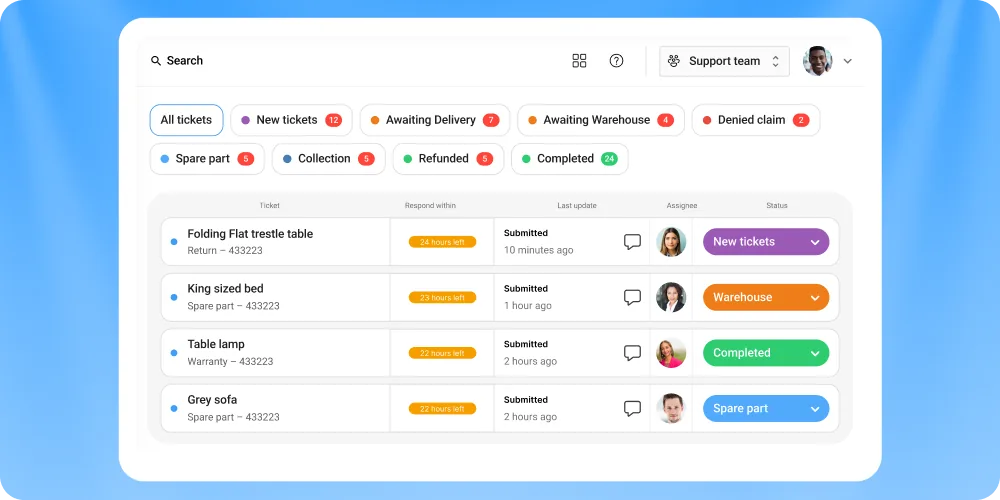
Step 1: Capture Structured Defect Data at the Source
Every quality conversation needs evidence. Claimlane's self-service portal captures structured defect data at the moment a customer reports an issue:
- Photos and videos of the defect.
- Defect category selected from a standardized taxonomy.
- Product details: SKU, order number, purchase date, batch/lot number.
- Customer description of what happened.
This data is not buried in a support ticket. It is stored as a structured claim record that feeds into quality workflows and supplier communication.
Step 2: AI-Powered Defect Classification
Claimlane's AI Agent, the first AI agent purpose-built for warranty claims and returns, analyzes every incoming claim:
- Classifies the defect from customer-submitted images and descriptions.
- Applies product-specific warranty rules.
- Recommends or auto-approves resolutions for straightforward cases.
- Flags high-severity defects for immediate escalation.
This eliminates the manual triage bottleneck where agents review every claim to determine severity and defect type.
Step 3: Forward to Supplier With Full Context
Forwarding claims to suppliers through Claimlane is not the same as forwarding an email. The supplier receives:
- All defect evidence (photos, videos, measurements) in a structured format.
- Product identification: SKU, batch number, order details.
- Defect classification and severity level.
- A clear corrective action request with a deadline.
- A trackable link for the supplier to respond, upload evidence, and update status.
No more "Can you send the photos again?" or "Which batch are you referring to?" The supplier has everything needed to investigate from day one.
Step 4: Track Corrective Actions and Measure Effectiveness
Claimlane's workflow engine tracks every corrective action from assignment through implementation to verification:
- Automated reminders when CAPA deadlines approach.
- Escalation alerts when deadlines pass.
- Effectiveness tracking: did the defect rate for the affected SKU actually drop after the corrective action?
- Supplier scorecard updates that reflect CAPA performance.
Features That Make Claimlane Different
Returns-First Quality Data
Most quality issue reporting tools are built around manufacturing inspections. They assume the quality team discovers defects at the factory or warehouse. But for brands selling through ecommerce and retail channels, the customer finds the defect first.
Claimlane captures quality data where defects actually surface: at the point of return or warranty claim. This means:
- Quality data reflects real-world product performance, not just factory inspection results.
- Defects that pass inspection but fail in customer use are captured and tracked.
- Customer return reasons become quality intelligence.
AI Agent for Returns and Warranty
Claimlane's AI Agent is not a generic chatbot bolted onto a quality platform. It is purpose-built for returns and warranty claims:
- Trained on product defect images across multiple categories.
- Applies supplier-specific and product-specific warranty rules.
- Handles multi-language customer interactions.
- Recommends resolutions that balance customer satisfaction with cost optimization.
- Captures structured defect data even when auto-resolving claims.
Unified Analytics Across Returns, Warranty, and Suppliers
Claimlane's analytics combine data that typically lives in three separate systems:
- Returns data: Which products get returned most? What are the defect categories? Which suppliers are responsible?
- Warranty data: Which products fail after extended use? What is the cost per warranty claim by supplier?
- Supplier data: How fast do suppliers respond to quality issues? What is their CAPA closure rate? How has their defect rate trended over time?
This unified view is what enables AI-powered supplier quality scoring and predictive warranty analytics.
Before Claimlane, every case required manually digging around to find the best solution. Now we move faster and with real confidence. You can feel the impact within our support team and in every customer interaction.
Nick Magnusson, Head of Customer Service — MaxGaming
Integration Ecosystem
Claimlane does not replace existing business systems. It connects to them:
Ecommerce Platforms
- Shopify and Shopify Plus: Automatic order lookup, product matching, and return creation.
- WooCommerce: Same automatic order integration for WordPress-based stores.
- Magento and custom platforms: API-based integration.
ERP Systems
- Microsoft Dynamics 365 Business Central: Two-way sync for claims, credit notes, and inventory adjustments. As Konges Sløjd demonstrated, resolving a claim in Claimlane automatically triggers the necessary ERP processes.
- Other ERPs: API integration for financial and inventory data.
Support Platforms
- Zendesk: Claims created from support tickets flow into Claimlane's quality workflow.
- Freshdesk and other tools: Webhook and API integration.
Shipping and Logistics
- Return label generation through integrated shipping providers.
- Tracking visibility for returned products.
Who Uses Claimlane?
Claimlane serves ecommerce brands, retailers, and wholesalers across multiple industries:
- Fashion and apparel: Track fabric quality, stitching defects, sizing issues.
- Electronics and consumer tech: Manage warranty claims, component failures, firmware issues.
- Furniture and home: Handle furniture returns with photo evidence and damage documentation.
- Outdoor and sports equipment: Process warranty claims for performance products with complex use conditions.
- Children's products: Ensure GPSR compliance with structured defect reporting for safety-critical items.
- B2B and wholesale: Manage supplier chargebacks and bulk quality claims.
From Reactive to Proactive: The Supplier Quality Shift
The Old Way
Brands discover quality problems reactively: return rates spike, warranty costs climb, customers complain on social media. By the time the supplier hears about it, hundreds of defective products are already in customers' hands.
The Claimlane Way
Structured defect data from every return and warranty claim feeds into real-time analytics. Quality teams see defect patterns forming before they become crises. Predictive analytics flags products and suppliers trending toward problems.
Suppliers receive structured feedback with evidence attached, not vague complaints. Corrective actions have deadlines. Scorecards have consequences.
The result: supplier quality improves because the feedback loop is tight, evidence-based, and tracked.
Before Claimlane, our customer could expect their claim to involve back-and-forth emails and be quite time-consuming, now a claim will be submitted at 8:00 AM and resolved at 10:00 AM.
Rasmus Andersen, Chief Operating Officer — Onyx Cookware
Pricing and Getting Started
Claimlane pricing is based on claim volume and feature requirements. Every plan includes:
- Self-service portal for customer claim submission.
- Supplier forwarding with evidence management.
- Workflow automation for claim routing and escalation.
- Analytics dashboards.
- Integration support.
AI Agent, advanced analytics, and enterprise features are available on higher tiers.
Book a demo to see how Claimlane fits the team's quality workflow.
Claimlane is rated 4.8/5 on G2 (read reviews) with consistent praise for ease of implementation, supplier communication features, and customer support.