.webp)
Why warranty fraud is bigger than most brands think
Warranty fraud rarely shows up as a line item on the P&L. It hides inside refund spend, replacement costs, and supplier recovery losses. The Insurance Information Institute pegs property and casualty fraud at around $45 billion a year in the US, and warranty fraud sits inside that envelope along with return fraud and claims fraud across categories.
This piece covers what warranty fraud means in practice, the five fraud types brands face today, the real cost of each, the manual vs AI detection split, and the operating pattern that catches fraud before payout. For broader context on adjacent surfaces, return fraud in ecommerce and return fraud prevention cover the returns side, and payment reversals and chargebacks covers the financial side.
What warranty fraud actually means
Warranty fraud is any claim that recovers value the claimant is not entitled to under the brand's warranty terms. The legal definition varies by market, but the operating definition is consistent across brands.
Three conditions have to apply
First, the claim has to misrepresent a fact. The customer says the product failed under normal use, when in fact they dropped it. Second, that misrepresentation has to be material. It changes the case outcome. Third, the brand has to act on it. The fraud is complete when the payout, replacement, or credit goes out.
Most brands carry policies that cover the gray area: accidental damage, customer-side wear, modification, and unauthorised repair. Without warranty management best practices at the case team level, gray-area calls trend toward approval, and that approval bias is what fraud rings exploit.
The 5 main types of warranty fraud
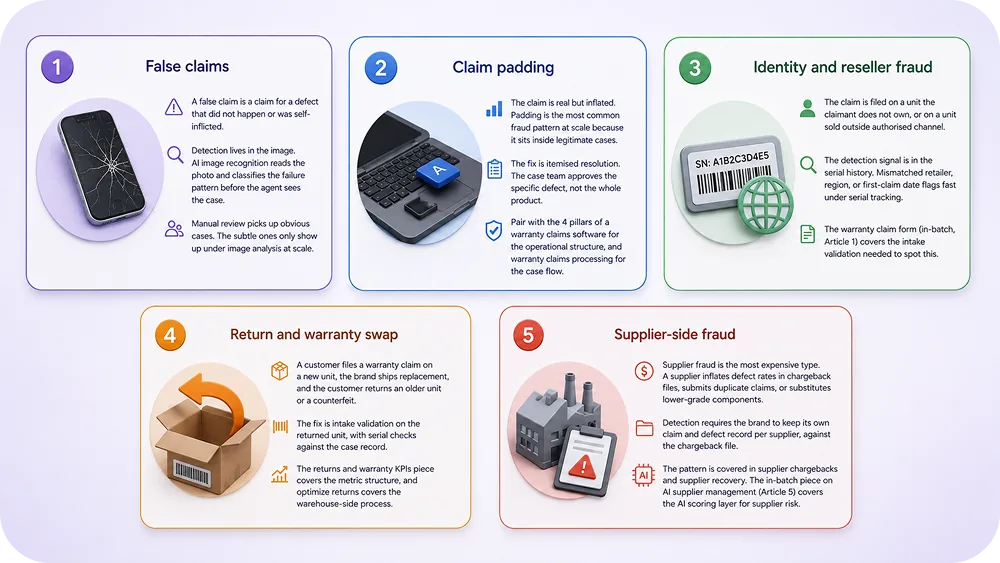
Type 1: False claims
A false claim is a claim for a defect that did not happen or was self-inflicted. The customer drops a phone and reports a screen failure. The customer wears apparel past the return window and reports a seam defect. The case looks normal at intake. The fraud sits in the evidence.
Detection lives in the image. A drop-damaged screen looks different from a manufacturing defect. The AI image recognition for warranty claims layer reads the photo and classifies the failure pattern before the agent sees the case. Manual review picks up obvious cases. The subtle ones only show up under image analysis at scale.
Type 2: Claim padding
The claim is real but inflated. A laptop with one defective key gets reported as a full keyboard failure. A jacket with a stuck zip gets a new lining requested as well. Padding is the most common fraud pattern at scale because it sits inside legitimate cases.
The fix is itemised resolution. The case team approves the specific defect, not the whole product. Pair with the 4 pillars of a warranty claims software for the operational structure, and warranty claims processing for the case flow.
Type 3: Identity and reseller fraud
The claim is filed on a unit the claimant does not own, or on a unit sold outside authorised channel. Identity fraud often pairs with stolen serials. Reseller fraud is grey-market units claimed under brand warranty when the brand only honours warranty for authorised channel purchases.
The detection signal is in the serial history. A serial registered at a different retailer, in a different region, with a different first-claim date, flags fast under serialized product defect tracking and the in-batch piece on serial number tracking software.
Type 4: Return and warranty swap
A customer files a warranty claim on a new unit, the brand ships replacement, and the customer returns an older unit or a counterfeit. The fraud closes when the returned unit hits the warehouse and nobody checks the serial against the case.
The fix is intake validation on the returned unit, with serial checks against the case record. The returns and warranty kpis piece covers the metric structure, and optimize returns covers the warehouse-side process.
Type 5: Supplier-side fraud
Supplier fraud is the most expensive type. A supplier inflates defect rates in chargeback files, submits duplicate claims, or substitutes lower-grade components and pushes the cost to the brand. The fraud is hard to detect because the brand depends on the supplier's own data for chargeback validation.
Detection requires the brand to keep its own claim and defect record per supplier, against the chargeback file. The pattern is covered in supplier chargebacks recovering warranty costs and supplier recovery how to get credit notes faster.
The cost of warranty fraud in 2026
The cost lives in three places. Direct payout cost (refunded, replaced, repaired without entitlement). Operational cost (agent time per case, plus quality review on rejected fraud). Reputational cost when the brand denies a legitimate claim because the fraud pattern poisons the case team's threshold.
How brands detect warranty fraud manually
Manual fraud detection follows four steps. The agent reads the case, checks the order history, compares the photo against the issue description, and decides. This works at low volume. It breaks above 100 cases a month per agent because the agent's attention degrades.
Manual detection also misses pattern fraud. A single customer filing five claims looks like a regular customer to the agent. The same customer flagged against the brand-wide claim history looks like a fraud ring. Without pattern matching, the case team is blind to the bigger picture.
The 16 most frequent questions about Claimlane piece covers the related question of agent triage at scale.
How AI changes warranty fraud detection
Claimlane's AI Agent, the first AI agent purpose-built for warranty claims and returns, runs four detection layers at intake. Image classification reads the failure pattern against known defect and non-defect categories. Serial validation checks the claim history against the unit record. Customer pattern scoring flags claim frequency, region, and language signals. Supplier-side cross-check compares brand records against supplier chargeback files.
The in-batch piece on AI customer service automation for aftersales (Article 4) covers the AI layer at intake more broadly.
“The team used to need five agents to handle claims volume. Now one to two run the same load with the AI doing the first read, and the fraud cases stop at intake instead of at warehouse.— Davidsen, Nordic building supplies retailer (case study)
Red flags every case team should watch
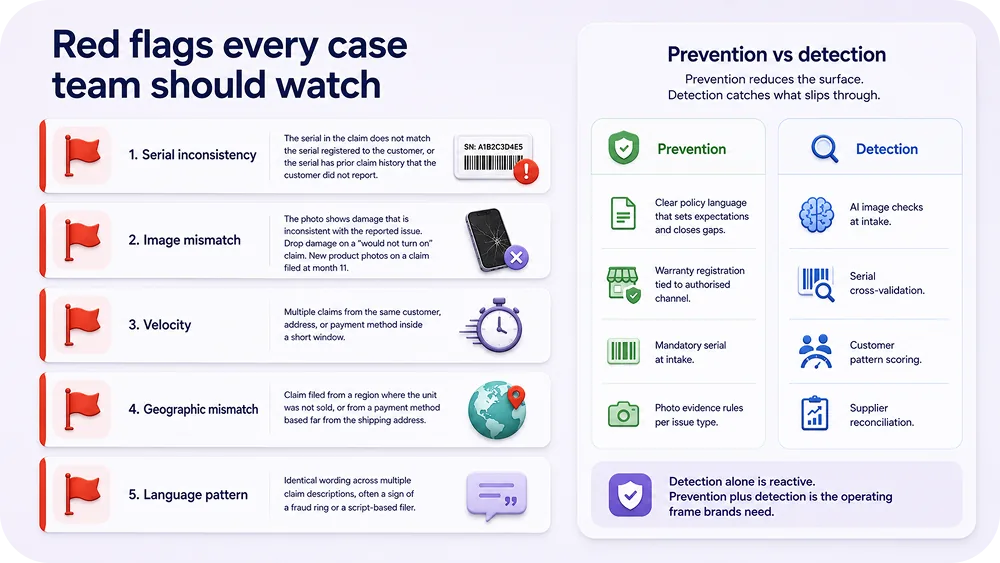
Five signals point to a likely fraudulent claim.
Serial inconsistency
The serial in the claim does not match the serial registered to the customer, or the serial has prior claim history that the customer did not report.
Image mismatch
The photo shows damage that is inconsistent with the reported issue. Drop damage on a "would not turn on" claim. New product photos on a claim filed at month 11.
Velocity
Multiple claims from the same customer, address, or payment method inside a short window.
Geographic mismatch
Claim filed from a region where the unit was not sold, or from a payment method based far from the shipping address.
Language pattern
Identical wording across multiple claim descriptions, often a sign of a fraud ring or a script-based filer.
Prevention vs detection
Prevention reduces the surface. Detection catches what slips through.
Prevention
Clear policy language, warranty registration tied to authorised channel, mandatory serial at intake, and photo evidence rules per issue type.
Detection
AI image checks at intake, serial cross-validation, customer pattern scoring, and supplier reconciliation. Detection alone is reactive. Prevention plus detection is the operating frame brands need.
The role of serial tracking in fraud prevention
Serial is the unit-level identity. Without it, the brand cannot tell whether a claim is on a real unit, an authorised unit, or a unit with prior claim history. The in-batch piece on serial number tracking software (Article 3) covers the software category. The serialized product defect tracking piece covers the data structure.
Brands running serial-validated intake see fraud rate drop fast. Brands without it sit at the upper end of the 3 to 15% fraud band.
Industry view: where warranty fraud sits in 2026
The broader fraud envelope is growing as AI-generated evidence becomes cheaper. Fraudsters can generate believable damage photos, swap timestamps, and write convincing claim descriptions. The brand-side response is also AI: image authenticity checks, claim history models, and supplier reconciliation tools.
Best warranty management software and best claims management software cover the broader platform category. The warranty analytics for product quality and customer-centric warranty analytics pieces cover the analytics layer that feeds fraud signals back into prevention.
The product page on Claimlane analytics shows the warranty-quality dashboards. The self-service portal covers intake validation. Forward-to-supplier covers the supplier reconciliation side.
Frequently asked questions
Conclusion
Warranty fraud is a 3 to 15% problem hiding inside legitimate claim volume. Manual detection catches the obvious cases. The bigger pattern fraud (serial reuse, image generation, customer rings, supplier inflation) only shows up at AI scale. Brands that run prevention plus AI detection at intake cut fraud rate fast and protect their case team from approval bias.
To see how Claimlane runs warranty fraud detection at intake, book a demo or walk the live setup on the interactive demo.