.webp)
Below are the questions Claimlane prospects ask most often before booking a demo. The list has been updated for 2026 to cover the AI Agent, current pricing tiers, integrations, and the realities of implementation. If a question isn't covered here, book a demo and the team will answer directly.
1. What is a standard return compared to a complex return?
A standard return is the typical "I changed my mind" of a simple product, like a piece of clothing. Customer initiates it, the brand approves, the product comes back, and a refund or exchange is processed.
A complex return covers everything else. Delivery damage, faulty products, warranty claims, repair workflows, missing parts, supplier handoffs, and B2B returns all fall under this category. Each adds steps, evidence requirements, and decisions that simple returns don't have.
Claimlane handles both, but the platform is purpose-built for the complex side. That's where most returns software falls short.
2. What are B2C and B2B returns?
B2C returns happen between a consumer and a brand or retailer. Most returns software is built around this case.
B2B returns happen between two businesses. A retailer returning stock to a brand, a distributor returning to a manufacturer, or a brand returning damaged inventory to a supplier. B2B returns involve multiple sales channels, varied return policies per partner, and bulk volumes that B2C tools can't handle cleanly.
Claimlane handles both in one platform. The B2B returns module is purpose-built for the complexity that consumer returns software ignores.
3. How does Claimlane compare to other returns solutions?
Three things separate Claimlane from most returns software:
Built for complex returns. Most out-of-the-box returns tools (Loop Returns, Happy Returns, Zigzag) are built to automate simple B2C returns. They work well for that. They struggle when the return involves warranty claims, supplier handoffs, repair workflows, or multi-line B2B cases. Claimlane handles complex cases as a first-class workflow, not a workaround.
Genuine B2B returns support. Most platforms ignore B2B entirely. Claimlane has a dedicated B2B returns portal for retailers and brands handling returns to and from each other. Different policies per partner, structured supplier handoffs, automated chargeback recovery.
A network of 8,000+ brands and retailers. Claimlane users are part of a network where their existing partners are likely already on the platform. Returns and claims between Claimlane users flow as structured data instead of email threads.
Brands selling complex products (furniture, electronics, outdoor goods, B2B wholesale) typically see the biggest difference.
4. What do other customers say about Claimlane?
Three sources are worth checking:
- G2 reviews: Claimlane earned two G2 badges in the Spring 2024 report, with reviews from customers across furniture, electronics, fashion, and B2B distribution
- Customer case studies: detailed stories on /resources/case-studies, covering Davidsen, MaxGaming, Swoon, BabySam, Black Diamond, Onyx Cookware, F. Engels, Coolshop, and others
- Direct customer references: if speaking with a current customer in the same industry would help, email info@claimlane.com and the team will connect you with one
5. How do I get started with Claimlane?
The fastest path is a short call with the sales team. They'll review how returns are handled today and what changes after Claimlane is in place.
Implementation timelines depend on the plan:
- Core and Plus plans: most customers go live within 2 weeks, typically with less than 2 days of developer time
- Custom plan: full implementation usually runs 2 weeks to 2 months after kickoff, depending on the complexity of integrations and workflows
6. How can I test Claimlane or see it in action?
Two options:
- Interactive demo: try the interactive demo on the homepage to walk through the platform on your own
- Live demo with the team: book a demo to see Claimlane configured against your specific use case, products, and supplier setup
The bespoke live demo is usually the better starting point for buyers comparing platforms or building an internal business case.
7. What ROI can I expect from Claimlane?
ROI depends on return volume, current process maturity, and product category. Rather than quote a generic range, here's a real customer example.
Onyx Cookware documented a 9x return on their Claimlane investment within the first year. The return came from three sources combined: agent time saved, faster supplier chargeback recovery, and reduction in lost margin from poorly-handled cases.
Other examples in the same range:
- Davidsen: same warranty case volume handled by 1-2 agents instead of 5 (3-5x labor reduction)
- Swoon: supplier chargeback recovery from 60% to 85% (~40% lift on a meaningful financial line)
- MaxGaming: 77% faster complex RMA resolution
For a custom ROI estimate against your specific volumes, the team can build a business case in 30 minutes (see Q8).
8. Can you help us build a business case for Claimlane?
Yes. Most prospects book a 30-minute working session with the Claimlane team. The session covers:
- Current return and warranty volumes by category
- Time spent per case across the customer service and warehouse teams
- Recovery rates from suppliers (if applicable)
- Cost per return and where the cost concentrates
The team uses these inputs plus industry benchmarks to put together a business case suitable for internal review. Most customers use this directly with their finance team.
9. How will Claimlane change our current returns and claims process?
Claimlane is software, but implementation includes process design. Most customers see three changes:
Customer-facing: a clear, branded self-service portal replaces email-based intake. Customers see status updates without contacting support.
Internal: the support team handles cases inside one system instead of switching between five. Manual handoffs to warehouse, finance, and suppliers become structured workflows.
Data: return and warranty data lives in one place, with analytics for resolution time, defect patterns by SKU, supplier performance, and recovery rates. Most customers use the data to renegotiate supplier terms within the first six months.
The implementation team works through this with you. The end result is a defined process, not just configured software.
A guide on how to automate returns covers what's worth automating in the first phase.
10. How many IT resources does Claimlane implementation need?
Depends on the plan:
- Core and Plus plans: most customers spend little to no developer time. Off-the-shelf integrations cover Shopify, Magento, Webshipper, Zendesk, and Business Central among others.
- Custom plan: if custom integrations are needed, typical developer effort is less than one week. Larger or more specific scopes can extend to 2 weeks to 2 months depending on what's being integrated.
The Claimlane team handles all platform-side configuration. The customer's IT team is mainly involved in providing API access to existing systems.
11. Do our partners need to use Claimlane before we can use Claimlane?
No.
Partners are not required to use Claimlane after onboarding. As part of your setup, you invite your retail or brand partners to the network. Whether each partner uses Claimlane or receives standard email handoffs is decided per partner.
A partner can opt out of using Claimlane at any time. That doesn't affect how you submit returns and claims to them. The system formats the handoff to match what each partner accepts.
The 8,000+ brand and retailer network means most partners are already in the system. For new partners, the network grows naturally as more brands and retailers join.
12. Will Claimlane replace my ticketing system, like Zendesk?
Usually not. The two systems handle different jobs.
A ticketing system or help desk like Zendesk, Gorgias, or Freshdesk handles general customer conversations: tickets, replies, response time, sentiment.
Claimlane is purpose-built for returns and warranty operations: structured intake, approval logic, supplier handoffs, refund calculation, photo evidence, and analytics.
Most customers run both. General customer inquiries flow through their help desk. Returns and warranty cases run through Claimlane. Both systems sync via integration so agents have full context wherever they're working.
If most of your support tickets are returns or warranty related, Claimlane can replace the help desk. Most brands with a real customer service operation keep both. For a deeper comparison, see Zendesk alternatives or the Gorgias alternatives breakdown.
13. Does Claimlane integrate with other systems?
Yes. Claimlane has 75+ integrations across four categories:
The full list lives on the integrations page. For specific integrations not on the standard list, the Custom plan supports tailored builds.
14. What languages does Claimlane support?
The Claimlane platform itself runs in English, German, Spanish, French, and Danish.
The B2C self-service portal supports a longer list: English, German, Spanish, French, Danish, Swedish, Dutch, Finnish, Chinese, Norwegian, Korean, Arabic, Italian, and Polish. Additional languages can be added on request.
15. What level of support is included in my plan?
All Claimlane customers get:
- Email and phone support during business hours
- Full documentation, manuals, and training during onboarding
- Access to the help center and ongoing product updates
Customers on the Custom plan get a dedicated Account Manager for ongoing relationship management, business case reviews, and roadmap input.
16. How do I get help?
The help center covers most questions. For anything not in the docs, email support@claimlane.com or call +45 70 60 57 33.
For sales or business case questions, book a demo and the team will help directly.
7. Does Claimlane have AI for warranty claims and returns?
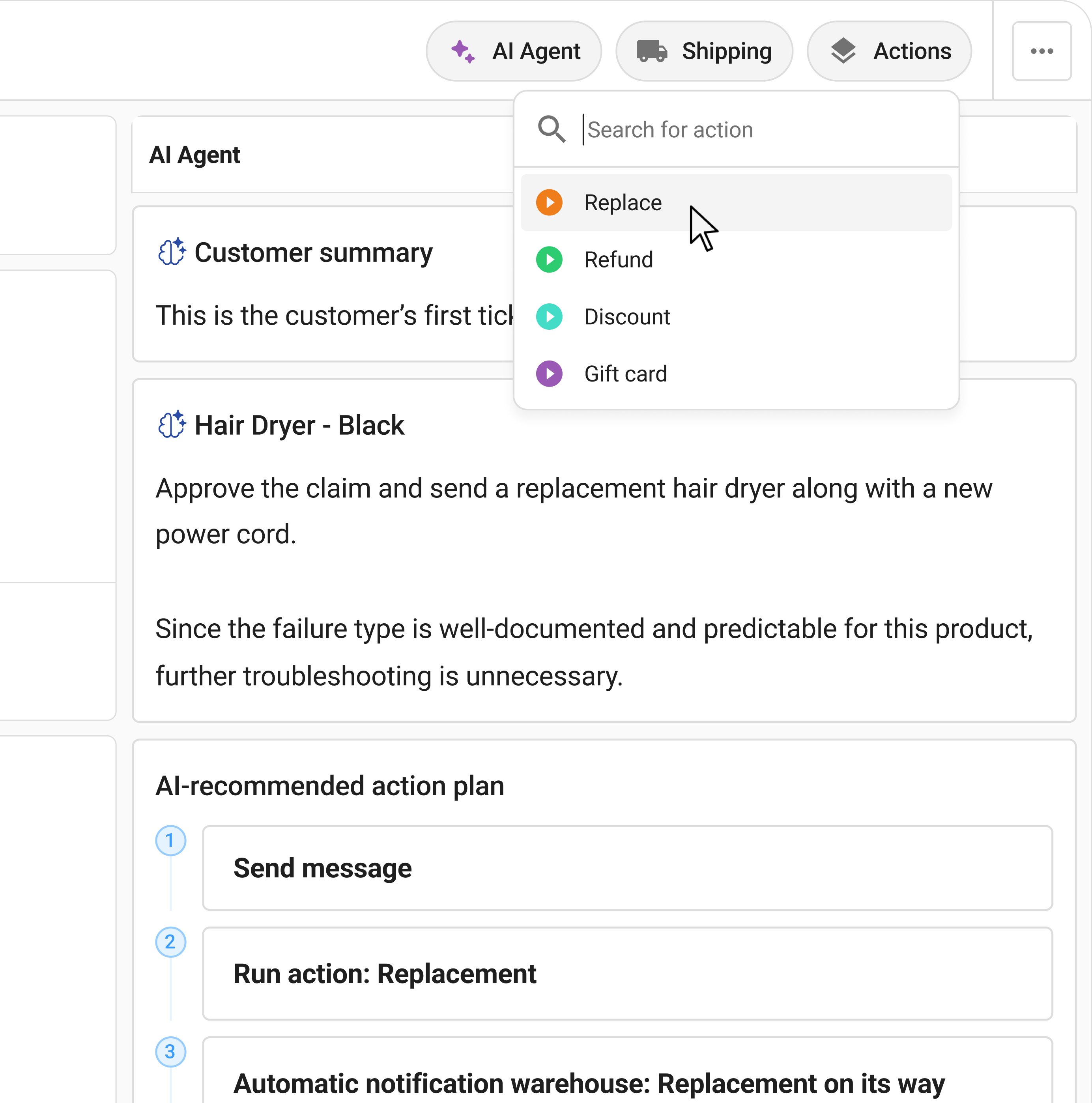
Yes. Claimlane's AI Agent is the first AI agent purpose-built for warranty claims and returns. It's the most significant addition to the platform in 2026.
The AI Agent works inside every ticket. It reads customer-submitted photos and videos, applies brand-specific and supplier-specific rules, summarises the case, suggests an action (refund, replace, or manual review), and explains its reasoning. The agent decides whether to approve the suggestion or override it.
Three things separate the AI Agent from chatbots and AI add-ons:
- It's a copilot, not a chatbot. It works inside the support team's existing workflow, not a separate customer-facing chat
- It learns from your historical Claimlane data. Customer behaviour patterns, product defect history, and supplier rules build automatically
- You control it through rules in plain markdown. Update the rules, the AI adapts
MaxGaming, running 30,000+ SKUs across 200+ brands, cut complex RMA resolution time by 77% after deploying the AI Agent. Their support team handles cases without months of product training because the AI handles the product-knowledge layer.
A deeper read on the AI Agent and the rollout phases for 2026 lives in the announcement post.
Anything else not covered here? Book a demo and the Claimlane team will answer it directly. Most prospects who reach this page are within a few weeks of making a decision. The fastest way to move forward is a short conversation with someone who can speak to your specific use case.