
Most retailers underestimate how much money supplier claims leave on the table. Industry estimates put the share of uncollected supplier credits at 1 to 5 percent of total supplier spend, depending on category and how the process gets run. For a brand with 50 million euros of supplier spend, that is 500,000 to 2.5 million euros leaking out the back door every year. Not because the credits are not owed. Because nobody has the time or the data to chase them properly.
That is the gap. Customer returns and warranty claims get treated as a customer experience problem, with portals and automation. Supplier claims often get treated as a back-office task somebody handles between other tasks, in an inbox, on a spreadsheet. The cost is invisible until somebody actually adds up the credits the supplier owes but never paid.
This guide covers the six supplier-claim problems retailers hit most often, the practical fix for each, and a 90-day plan to clean up the process. Brands using Claimlane's supplier forwarding flow already have most of this running on autopilot.
Why Supplier Claims Are the Quietest Margin Leak in Retail
A customer claim that does not get processed shows up in the support inbox the next day, loud. A supplier claim that does not get processed shows up nowhere. The supplier does not chase it. The retailer's accounting team does not see what should have been recovered. The credit just disappears.
The math is straightforward. Three numbers matter:
- Claim eligibility rate. What share of supplier deliveries had a defect, damage, or short-ship that qualifies for a credit. Typically 1 to 3 percent for goods retailers, higher for furniture, electronics, and DIY.
- Claim submission rate. What share of eligible claims actually got submitted to the supplier. For retailers running this on email, often 40 to 70 percent.
- Claim recovery rate. Of the claims submitted, what share actually got paid as credits. Often 60 to 80 percent without good supplier accountability.
Multiply the gaps together and the leak gets large fast. A retailer running 60 percent submission and 70 percent recovery is collecting around 42 percent of the credits they are owed. The other 58 percent is supplier margin that should have been retailer margin.
The fix is not heroics. The fix is treating supplier claims as a real workflow with the same discipline applied to customer claims.
6 Supplier Claim Challenges Retailers Run Into
How to Actually Fix Each Challenge
The cards above are the summary. Here is what each fix looks like in practice.
Building a Single Source of Truth
The first challenge — no clear overview — gets solved by replacing the email inbox with a database. Every claim becomes a record with status, supplier, product, evidence, and ageing date. The team works from a filtered list, not a thread.
The hard part is data migration in week one. Most retailers have years of email-based claims that need triaging into "still open", "actually resolved", and "drop it, it's been a year". After that, every new claim opens as a structured record from day one. The returns management system guide covers the database model in more depth.
Creating Real Supplier Accountability
Slow supplier response is rarely about supplier laziness. It is usually about supplier visibility. A supplier who gets emails on Mondays sees the email Tuesday, intends to reply Wednesday, forgets, gets reminded the next week, and then it is in the queue with 30 other things.
A supplier who logs into a portal and sees three claims marked overdue with their team's name attached responds the same day. Same supplier. Same workload. Different incentive. The forward to supplier flow is built for this dynamic.
Standardising Supplier Rules
Supplier-specific evidence requirements are real. Photos for furniture damage. Serial numbers for electronics. Batch numbers for consumables. The mistake retailers make is keeping those rules in their own head or in a spreadsheet.
The cleaner setup is a rules table where each supplier's evidence requirements live alongside their contact details and SLA expectations. Every new team member sees the same rules. Suppliers can update their own rules when their process changes, so the retailer is not maintaining outdated requirements on every claim. The warranty registration flow captures the serial and batch numbers at point of sale, which solves half this problem before the claim is even filed.
Removing the Manual Work
Manual work in supplier claims falls into four categories: filling forms, attaching evidence, writing repeat explanations, and chasing follow-ups. All four are automatable.
Forms become a structured intake. Evidence carries through from the original customer claim, no re-attaching. Explanations become templates with merge fields. Follow-ups become SLA timers with automatic reminders. Claimlane's workflow engine handles the chain. The team spends time on the cases that need judgement, not on the admin around the cases that do not.
Closing the Cracks Claims Fall Through
The reason claims get lost is the same reason any task gets lost: no owner, no deadline, no reminder. The fix is to require all three on every claim from the moment it opens.
Ownership by default falls on whoever processed the original customer return. Deadline by default comes from the supplier's SLA (typically 5 to 10 business days for acknowledgement, 30 to 60 days for credit). Reminder by default triggers 24 hours before the deadline and again at 24 hours overdue. Anything still unresolved at 7 days overdue auto-escalates. The full claim discipline pattern sits in the warranty claims processing guide.
Building Supplier Performance Data
The last challenge — no data — is the easiest to fix once the first five are in place. With every claim as a structured record, the analytics layer takes one query: group by supplier, measure resolution time, rejection rate, credit amount, and volume.
The data unlocks the renegotiation conversation. A supplier responsible for 4 percent of spend but 18 percent of claims and a 41 percent rejection rate is a quantified problem, not a feeling. Claimlane's analytics layer generates this view out of the box.
Email vs Shared Inbox vs Supplier Claims Platform
Most retailers start in email. Mid-size teams often move to a shared inbox and stop there. The shared inbox solves team visibility but does not solve any of the actual claim problems.
The recovery rate row is the one that matters financially. The difference between 50 percent and 80 percent recovery on supplier credits, applied to even modest supplier spend, pays for the platform many times over.
How AI Speeds Up Supplier Claim Evidence Review
Supplier claims live or die on evidence. Photos of the damage. Serial numbers proving the product is the one purchased. Order data tying the claim to the right batch. Get any of those wrong and the supplier rejects the claim. Manual evidence review is where most retailer teams lose hours.
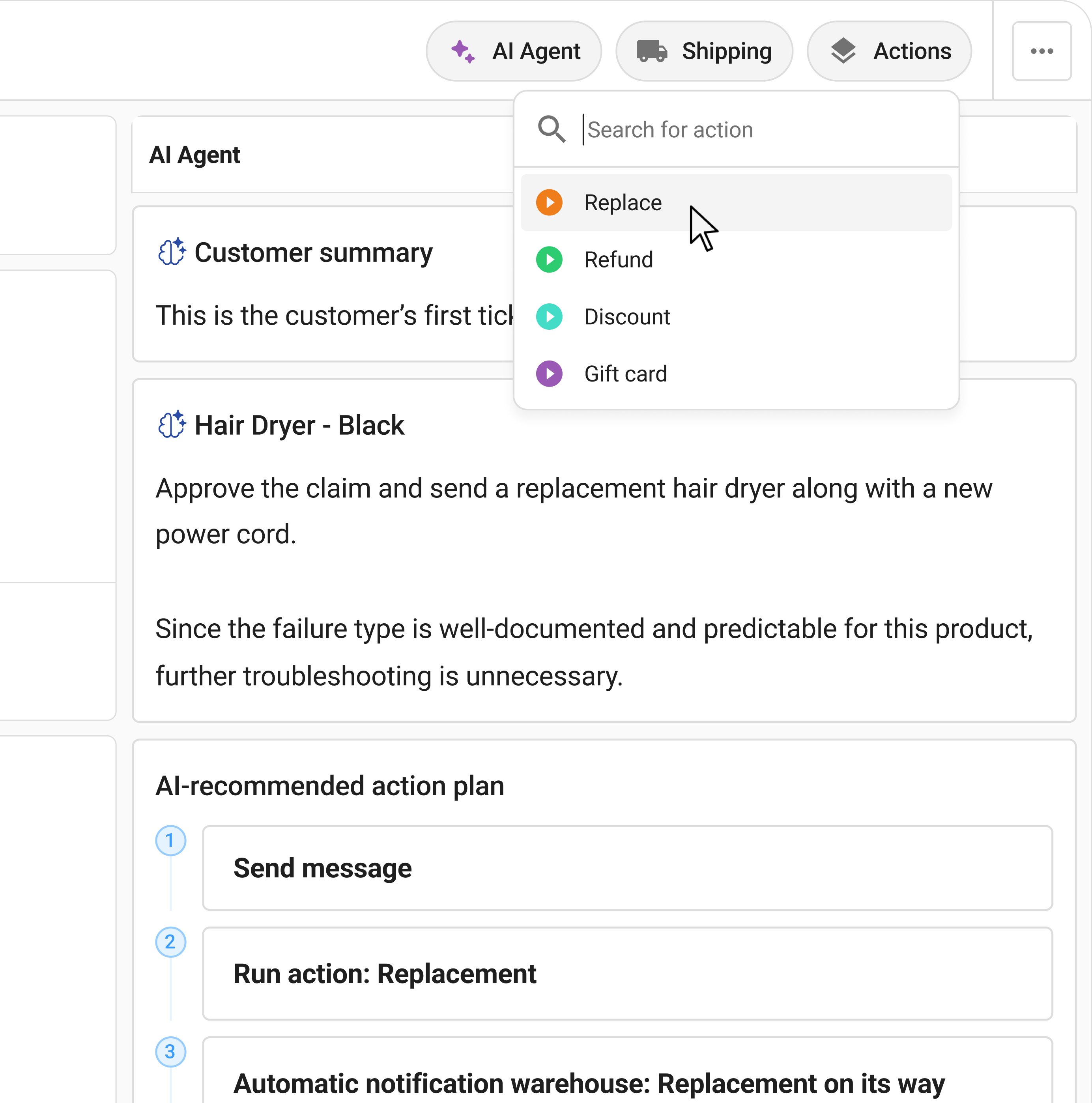
Claimlane's AI Agent, the first AI agent purpose-built for warranty claims and returns, reviews submitted images and video, applies warranty rules per product and supplier, and recommends or auto-approves resolutions. On the supplier side, the same review classifies the defect category, validates the evidence against supplier requirements, and pre-fills the supplier-facing claim form. The AI side of the platform cuts the evidence-review bottleneck without removing the option for a human to override.
MaxGaming, the largest gaming and e-sports ecommerce in Scandinavia with 30,000 SKUs across 200 brands, resolves complex RMA cases 77 percent faster using the AI Agent. The case study sits at /resources/case-studies/maxgaming.
<div class="cl-g2-badge" style="display:flex;align-items:center;gap:14px;background:#fafaff;border:1px solid #f0efff;border-radius:12px;padding:16px 20px;max-width:560px;margin:2rem 0"><div style="background:#4a3cff;color:#fff;font-weight:700;font-size:0.85rem;padding:6px 12px;border-radius:6px">G2</div><div style="font-size:1.6rem;font-weight:700;color:#4a3cff;line-height:1">4.8/5</div><div style="font-size:0.9rem;color:#333;line-height:1.4">Claimlane holds a 4.8 out of 5 rating on G2, with verified reviews from retailers using the platform to handle both customer-facing returns and supplier-facing claims.</div></div>
How Brands Are Fixing This in Practice
The pattern shows up across categories. Brands that move supplier claims out of email and into a structured system see resolution time drop and credit recovery climb.
Implementation Roadmap: 30, 60, 90 Days
The full transition out of email takes about three months for a retailer with 20 to 50 active suppliers. Here is the rough cadence.
Days 1 to 30: Baseline and Setup
Pull the last 12 months of supplier claims out of email. Sort into resolved, abandoned, and open. Tag by supplier. Count how many credits are still uncollected. That number becomes the case for the project.
Set up the claim record structure: supplier, product category, defect type, evidence required, SLA expected, owner. Onboard the top 5 suppliers by claim volume first. Configure their evidence requirements and SLA in the system.
Days 31 to 60: Migration and Supplier Onboarding
New claims open inside the platform instead of email. Existing email-based claims get triaged and either closed out or migrated. Suppliers get portal access with their own login, their own queue, and their own SLA clock.
Set up the SLA reminder rules: 24 hours before deadline, at deadline, 24 hours overdue, 7 days overdue auto-escalation. Reporting starts running per supplier.
Days 61 to 90: Analytics and Renegotiation Prep
Per-supplier performance dashboards become the management tool. Resolution time, rejection rate, recovery rate, credit value. Suppliers at the bottom of the leaderboard get scheduled into a quarterly review.
Use the data in renegotiation conversations. A supplier with an 18 percent rejection rate now has it in their performance scorecard, not as a complaint, as a number. The conversation changes.
How Claimlane Supports Supplier Claims
Claimlane is built around the assumption that customer claims and supplier claims are the same workflow with different parties on the other end. Every customer return and warranty claim creates a record that contains the evidence the supplier needs to make a decision. The handoff is a routing rule, not a manual re-creation.
The supplier portal gives each supplier direct visibility into open and overdue claims. SLA timers run on their side, not just the retailer's. Suppliers update their own evidence requirements, which removes the maintenance burden on the retailer team.
The analytics layer connects customer-side data (volume, defect category, SKU) to supplier-side performance (response time, rejection rate, credit recovery), so the full quality picture sits in one view. Defect patterns get spotted at the supplier level before they reach recall scale.
For brands using Claimlane, supplier claims sit inside the same operating system as customer returns and warranty. One database. One workflow engine. One source of analytics. The warranty management software overview covers how the customer-side and supplier-side flows connect.
Frequently Asked Questions
Where to Start
The cheapest first step is the audit. Pull the last six months of supplier claims out of email. Count how many got submitted, how many got credits, how long each took. The number that comes out of that exercise is the case for fixing the process.
From there, the order is: structure the data, onboard the top five suppliers by volume, run SLA timers on the new flow, then turn on the analytics. Most retailers see resolution time drop in the first 60 days and recovery rate climb in the first 90.
For brands ready to skip the audit and move straight to fixing it, the forward to supplier feature overview and the RMA workflow template guide cover the setup. The returns reason codes guide covers the data taxonomy that makes per-supplier analytics work.