.webp)
Introduction: the CFO and the CSO want the same returns programme
Sustainability and finance teams rarely sit in the same meeting on returns. They should. In 2026, the levers that cut transport emissions and landfill volume are the same levers that protect gross margin: returnless refunds on low-value defects, repair instead of replace on serialised products, supplier recovery on defect cost, and refurbishment routes for resalable stock.
This guide covers the finance-plus-sustainability double pitch, the carbon math behind each lever, EU regulatory pressure shaping the 2026 reality, and how a brand actually measures CO2 per disposition without buying a separate sustainability tool. The framing borrows from the broader read on the environmental impact of customer warranty claims and the operational logic in AI reverse logistics optimization.
- The four big levers on returns carbon (returnless refunds, repair, supplier recovery, refurbishment) are also the four big levers on returns P&L. They get budgeted together or not at all.
- EU EPR and Right to Repair frameworks have shifted from policy noise to operational pressure in 2026, especially for furniture, electronics and apparel.
- Repair beats replace on both cost and CO2 once you measure the embodied carbon of the replacement unit, not just the shipping leg.
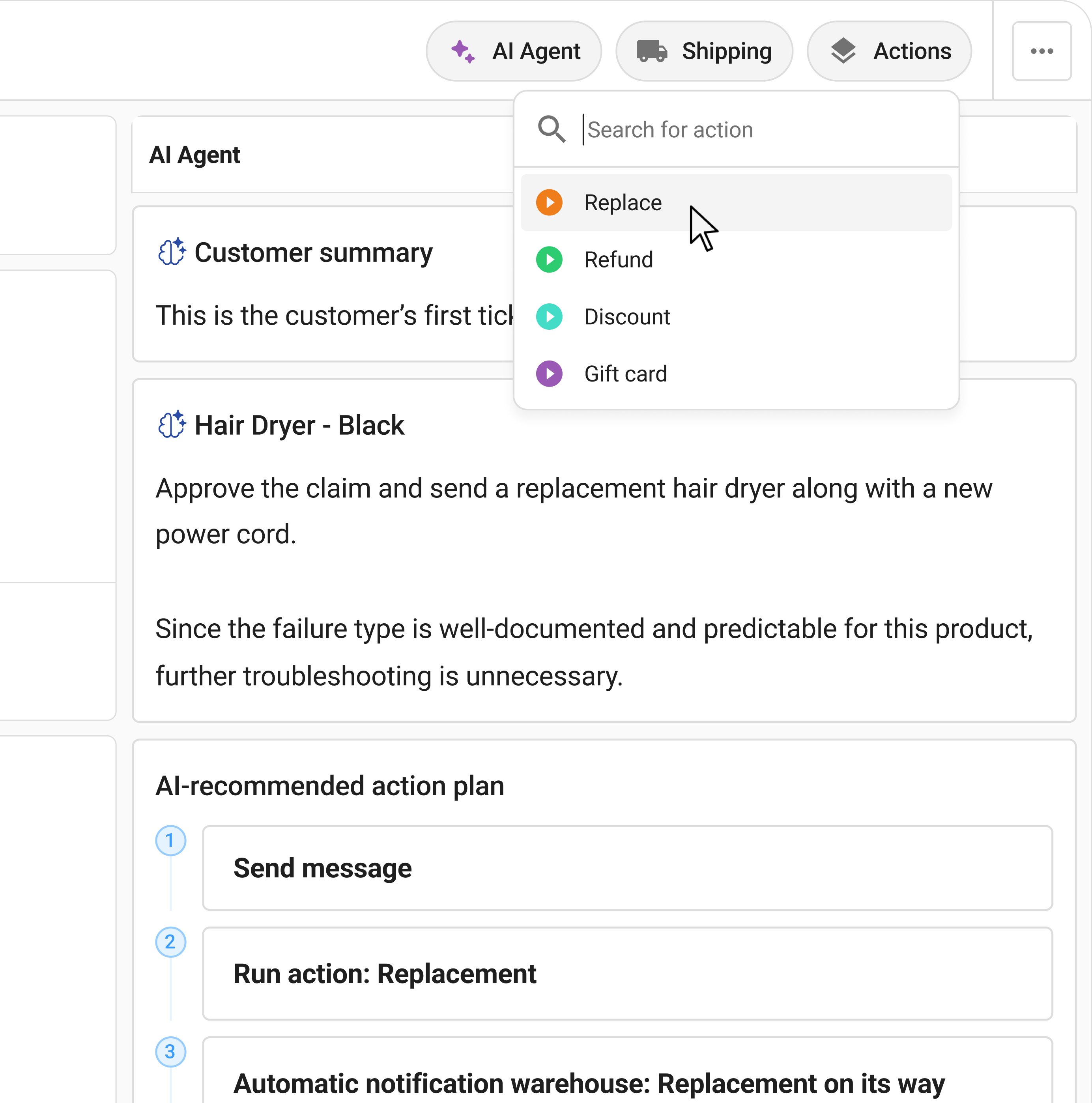
- Claimlane runs the disposition decisions (repair vs refurbish vs scrap vs returnless) as the engine inside the broader reverse logistics stack.
What "sustainable returns" actually means in 2026
Sustainable returns are reverse-logistics decisions that cut both the financial cost and the carbon cost of a returned product, by routing each item to its lowest-impact disposition (returnless, repair, refurbish, resale, recycle, scrap) instead of defaulting every return to replace.
A sustainable returns programme is not a recycling pledge or a returns fee. It is a disposition-routing problem. Every returned item has a set of possible end states, and each end state has a financial and a carbon cost. The job is to pick the right state per item, at scale, fast enough that the customer experience does not degrade. That logic shows up clearly in the 5 Rs of reverse logistics and the broader reverse logistics view.
The carbon-margin double pitch
The finance and sustainability cases line up cleanly when looked at side by side.
- Recovered supplier credits on defect
- Lower COGS per claim (repair vs replace)
- Fewer write-offs on resalable stock
- Smaller return reserve through better mix
- Less transport CO2 per item
- Lower landfill share
- Embodied-carbon savings from repair
- Cleaner Scope 3 reporting
The interesting line is the third one in each column. Repair-instead-of-replace saves both COGS and embodied carbon. Resale-instead-of-scrap saves both write-off and landfill. Once finance sees the carbon math on the same page as the margin math, the programme stops being a CSR slide and starts being a budget line. The pattern is consistent with the broader operational view in returns adjusted profitability.
The carbon math of a single return
A returned ecommerce item carries three carbon costs: the original outbound shipping (already spent), the inbound return leg, and the disposition tail. The disposition tail is where the variance is highest.
Return-to-warehouse, restock: low inbound CO2, near-zero disposition tail. Best case, available roughly half the time for soft goods.
Return-to-warehouse, scrap: low inbound CO2, large disposition tail. Worst case for low-defect items that should have been resold or refurbished. Documented in the 7 plagues of returns management.
Returnless refund on low-value defect: zero inbound CO2, near-zero disposition tail. Best case for items where the inbound transport carbon exceeds the recoverable value. Full pattern in returnless refunds.
Return-and-replace on high-value defect: the highest carbon path. The new unit carries the full embodied carbon of manufacturing and outbound shipping, plus the inbound return leg. This is the path that repair workflows replace.
NRF and Gartner returns data converge on roughly 4-6 kg CO2 per typical ecommerce return on the transport side alone. The embodied carbon of a replacement unit is often ten to twenty times that, depending on category. The bigger the unit, the bigger the multiplier.
EU EPR and Right to Repair pressure in 2026
Three regulatory threads matter for the 2026 plan. Brands selling into the EU should treat them as operational, not aspirational.
Extended Producer Responsibility (EPR) is now active across most product categories in major EU markets. Producers carry end-of-life cost. The cleanest way to lower that cost is to extend product life through repair and refurbishment instead of scrapping returned units. Reference: EU EPR framework.
The EU Right to Repair Directive (Directive 2024/1799) sets durable repair obligations for manufacturers of specified product categories, including a default repair preference during the legal guarantee period. Direct read in EU right to repair ecommerce and repair workflows EU compliance. Source: European Commission, Right to Repair.
GPSR (General Product Safety Regulation) tightens defect-tracking and recall obligations, raising the bar on serialised data and supplier traceability. Operational read in GPSR retailers EU law warranty claims.
Net effect: in 2026, repair, refurbishment and traceability are not differentiation. They are baseline.
Returnless refunds as a sustainability lever
The single biggest carbon saving on low-value defects is to skip the inbound shipping entirely. Returnless refund on items where the recoverable resale value is below the inbound transport cost (and inbound transport carbon) is a margin-positive AND carbon-positive decision. The customer keeps the item, refund happens fast, no truck moves.
The gotcha is policy abuse. Returnless refunds need rules: value thresholds, customer history, claim type, and serialised-product exclusions. The decision logic lives in the claims engine. Full operational pattern in ecommerce refund automation tools.
Repair workflows: the lowest-carbon, highest-margin path
Repair is the single most under-used disposition lever for serialised products and durable goods. The reason is process friction: brands route defect claims to replacement because the repair workflow is harder to operationalise. That changes when the repair flow is automated end to end: intake captures the fault code, the workflow routes to the in-network repair partner, parts get pulled from inventory, and the customer sees status updates throughout.
The finance read: repair COGS is typically 30-60% of replacement COGS for durables. The carbon read: repair avoids the embodied carbon of the replacement unit. Black Diamond's outdoor gear repair programme runs on this logic, with the case study covering the operational pattern at Black Diamond.
We measured CO2 per repair and per replace for two quarters. Repair pulled ahead on both margin and carbon by a wide enough margin to change our default policy.
Erik Holm, Sustainability Manager, Black Diamond
Repair tooling matters. Best repair management software walks the category. The decision logic of when to repair vs replace is covered in repair vs replace warranty claims. Spare-parts availability ties this together with spare parts and supplier-side scoring through AI predictive spare parts inventory.
Supplier recovery loops and the embodied carbon question
Claim cost that gets pushed back to the supplier as a credit memo is not the same as scrapped product carbon recovered. But the two correlate strongly. Defect-driven returns that go through supplier recovery surface the right defect data fast enough that the supplier can act on the root cause. Root-cause fixes lower defect volume, which lowers the carbon of the next batch.
The operational mechanics are in supplier chargebacks and supplier recovery. The data-quality piece, which decides whether the supplier accepts the claim, lives in supplier quality issue reporting guide. Claimlane's Forward to supplier routes evidence packets directly to the supplier portal.
Refurbishment, resale and recommerce
Used-stock dispositions are the third lever. Returned items in resalable condition should go through a refurbishment or resale channel rather than scrap or markdown. Recommerce as a category grew faster than core retail in 2025 and the 2026 trajectory continues, walked through in recommerce in 2026.
The gating factor is condition grading at intake. Photo and serial-number capture during the claim drives the grading decision. Items grade clean and get rerouted before they hit the scrap pile. AI image recognition warranty claims and the broader AI returns management view cover the automation layer.
The data layer: measuring CO2 per disposition
The number that lets finance and sustainability sit in the same meeting is CO2 per disposition. It is a simple calculation if the data is structured:
Inbound transport CO2 (from carrier API or a flat per-zone estimate) + disposition-tail CO2 (zero for restock and returnless, mid for refurbish, high for scrap, very high for replace including the embodied carbon of the new unit). Multiply by volume per disposition per category.
This lives naturally in the analytics layer that already aggregates claim and return data. Claimlane's Analytics module handles the disposition tagging and the rollup, similar to the events captured in returns analytics events.
Common mistakes in sustainable returns programmes
Three patterns kill momentum.
Measuring shipping carbon only. Inbound transport is the easy number, but it is rarely the biggest part of the footprint. Programmes that stop there underestimate the value of repair and refurbishment because they don't count the embodied carbon they avoid.
Treating returnless refunds as fraud bait without controls. The right framing is rules-based eligibility, with thresholds by value, category, customer history and claim type. Tools that handle this sit inside return fraud prevention.
Running repair as a customer-service exception. If repair lives outside the standard claim workflow, it stays small. Productising the repair path inside the claim engine moves it from exception to default, the pattern in warranty returns streamlined approach and thinking in workflows warranty resolution.
How AI lifts the disposition decision
AI handles three jobs in a sustainable returns programme.
Intake image grading. Photo and video review during the claim drives the condition grade. Items that grade clean get rerouted to resale. Items that grade for repair go to the repair queue. Items that grade for scrap go to recycle, not landfill. The full operational view is in AI returns personalization and AI image recognition warranty claims.
Returnless-refund decisioning. A claims-specialist agent applies the value, history and category rules in real time, not as a batch. Pattern documented in AI customer service automation.
Supplier defect routing. AI applies serialised defect codes to the right supplier scorecard and prepares the credit packet, picked up in AI warranty claims automation.
Claimlane runs these jobs through its AI Agent, the first AI agent purpose-built for warranty claims and returns, sitting alongside the general support AI in the brand's stack. Details at Claimlane AI Agent.
Tools that handle the sustainability + finance double view
Three categories overlap. Customer-facing returns (Shopify Returns, Loop, ReturnGO) handle the shopper experience. Reverse logistics platforms (reverse logistics software platforms) handle warehouse routing. Claims-and-warranty platforms (best claims management software, best warranty management software) handle the disposition decision and the supplier-recovery loop.
The orchestration matters more than the tool list. The disposition decision (returnless vs repair vs refurbish vs scrap vs replace) is the high-leverage decision. That decision lives in the claims engine.
Claimlane holds a 4.8/5 rating on G2 across returns, warranty and claims categories, with verified reviews from retailers running repair-first and recovery-first programmes.
Claimlane scores 4.8/5 on G2 across returns and warranty categories.
Where Claimlane fits in the stack
Claimlane runs the disposition decision and the supplier recovery loop as the engine inside a broader sustainability programme. The customer-facing returns layer (Shopify, Loop) handles the shopper experience. Carrier and 3PL partners handle the physical reverse logistics. Claimlane handles the call: returnless, repair, refurbish, recycle, scrap, replace.
The orchestration plays well with finance and sustainability tooling. Disposition tagging from Claimlane feeds Scope 3 reporting tools. Recovery memos from Forward to supplier feed AP and accruals. Workflows for repair and refurbishment route through Workflows. The claim trace ties back to serial numbers and supplier IDs for audit.
Claimlane runs this pattern for outdoor brands like Black Diamond on durable goods, and for cookware brands like OnyxCookware where repair routing protects warranty cost on cast-iron and steel products.
Quantify the repair-vs-replace upside in dollars and CO2. Book a 30-minute walkthrough.
FAQ
Conclusion: sustainability ships when finance signs the budget
Sustainable returns happen at the disposition level. The four levers (returnless on low-value defects, repair on durables, supplier recovery on defect cost, refurbishment on resalable stock) are the same levers finance cares about. The CFO read and the CSO read converge once embodied carbon is on the same page as COGS.
The practical move in 2026 is to tag every disposition, calculate CO2 per disposition alongside margin, and put repair-first and recovery-first as the defaults in the claim engine. The savings show up in the P&L first, then in Scope 3. Both matter.
See how Claimlane runs as the disposition engine inside a repair-first programme. Book a 30-minute walkthrough.