Warranty returns are one of the highest-stakes parts of post-sales customer service. A customer dealing with a faulty product is already frustrated. The way the team handles their claim either earns trust back or breaks the relationship for good.
Most warranty operations sit somewhere in the middle: not actively broken, but slow, manual, and expensive. Cases drag on for weeks. Customer service spends hours per case. Suppliers respond late or not at all. Recovery rates stay below 70%. The team accepts this as the cost of doing business.
It doesn't have to be that way. This guide covers what a working warranty returns process looks like in 2026, the four operational shifts that drive the biggest improvements, and how AI is changing what's possible.
Why warranty returns matter for post-sales success
The warranty return is the first real test of a brand's commitment to its products. Customers form lasting impressions in this moment, and those impressions shape repeat purchases, reviews, and word-of-mouth.
Impact 01
Customer trust
A clean returns process tells the customer the brand stands behind its products. A messy one tells them the opposite.
Impact 02
Repeat purchase rate
Customers who get a fast resolution after a problem buy again at higher rates than customers who never had a problem at all.
Impact 03
Operational cost
Manual warranty handling absorbs 10-45 minutes per case. At meaningful volume, that's a full headcount or more.
Impact 04
Supplier recovery
Brands with structured workflows recover 80%+ of supplier-responsible costs. Brands without recover 50-65%.
The financial side compounds. A brand processing 500 warranty cases a month at 25 minutes each is spending roughly 200 hours on warranty handling alone, before counting supplier recovery losses or the customer churn from delayed resolutions.
The common challenges in warranty returns
Most warranty operations hit the same set of problems regardless of category or company size.
The recurring problems
- Long forms and unclear guidelines. Customers abandon or submit incomplete claims, forcing email round-trips.
- Communication gaps between departments. Customer service, logistics, finance, and suppliers each see fragments. Nobody has the full picture.
- Manual data tracking. Spreadsheets and email threads make pattern analysis impossible. The same defects repeat without anyone noticing.
- No status visibility for customers. Customers email or call to check status, which adds support load on top of the claim itself.
A guide on why retailers struggle with warranty claims covers the operator side of these problems in more depth.
Do you need software to handle warranty returns?
Above a few hundred claims a month, yes. Here's why.
A trained agent typically handles 10-45 minutes per warranty case using email-based processes. That includes the customer conversation, brand policy lookup, photo verification, supplier handoff, and refund or replacement processing. Multiply that by claim volume, and the labour cost alone justifies dedicated software.
Brands running structured warranty platforms typically see significant reductions in handling time, week-over-week visibility into supplier performance, and recovery rates lifting toward the 80%+ range. Real customer outcomes vary by category, supplier mix, and product complexity. The Davidsen example below documents one brand's specific result.
Four operational shifts that drive the biggest improvements
1. Restructure customer intake
Most warranty processes break at the first step. Customers submit incomplete information through unstructured channels, support agents email back asking for photos, customers reply two days later, and the cycle continues.
The fix: structured self-service intake. A guided form that collects photos, order ID, defect description, and reason code in one submission. Required fields, not optional. Photo upload at submission, not on follow-up.
A self-service portal handles this end-to-end. Customers submit complete cases on their first visit. The team starts from full information instead of from a single-line email.
The results are practical. First-touch resolution rates rise. Email round-trips drop. Cases that previously took 30+ minutes resolve in 5-10.
2. Use a warranty management platform
Spreadsheets and shared inboxes hit operational limits between 200 and 500 monthly cases. Above that volume, the team can't track cases reliably, suppliers don't get held accountable, and the data going into reports is too inconsistent to be useful.
Key features that matter for a warranty platform:
01
Centralised case view
Every case visible in one place with full history. No more searching email threads.
02
Self-service customer intake
Branded portal with structured forms, photo upload, status tracking.
03
Supplier handoff workflows
Structured forwarding to suppliers with full evidence. Recovery rates improve.
04
Analytics on defect data
Defect trends by SKU, supplier, lifecycle stage. Spot patterns before they compound.
05
Native integrations
Shopify, Magento, Webshipper, Zendesk, Business Central, and others. Order data flows automatically.
A guide on warranty management software covers what to evaluate when comparing platforms.
3. Connect customer service, logistics, finance, and suppliers
Warranty cases touch four teams. Customer service handles the conversation. Logistics arranges return shipping. Finance issues credit notes. Suppliers approve chargebacks. When each team works from a different system or inbox, cases stall in handoffs.
The fix: one platform that all four teams can see and act on. Real-time status updates so each team knows what's happened and what's needed next. Customer-visible progress so customers don't email asking for updates.
Cross-functional alignment matters more than tooling alone. The platform makes alignment easier, but it doesn't replace the operational decisions about who owns which step.
4. Run B2B warranty flows separately from B2C
B2B warranty returns involve larger volumes, multiple stakeholders, and different policy frameworks per customer. Running them through the same flow as consumer returns creates friction on both sides.
B2B warranty flows specifically need:
- Bulk return submission for multi-line claims
- Per-partner policy rules (different terms for different B2B customers)
- Real-time visibility for the partner's procurement team
- Structured supplier handoffs with chargeback tracking
A dedicated B2B returns module handles these flows alongside B2C handling in the same platform.
How AI changes warranty operations in 2026
The biggest shift this year is AI handling parts of a case that previously needed a trained agent.
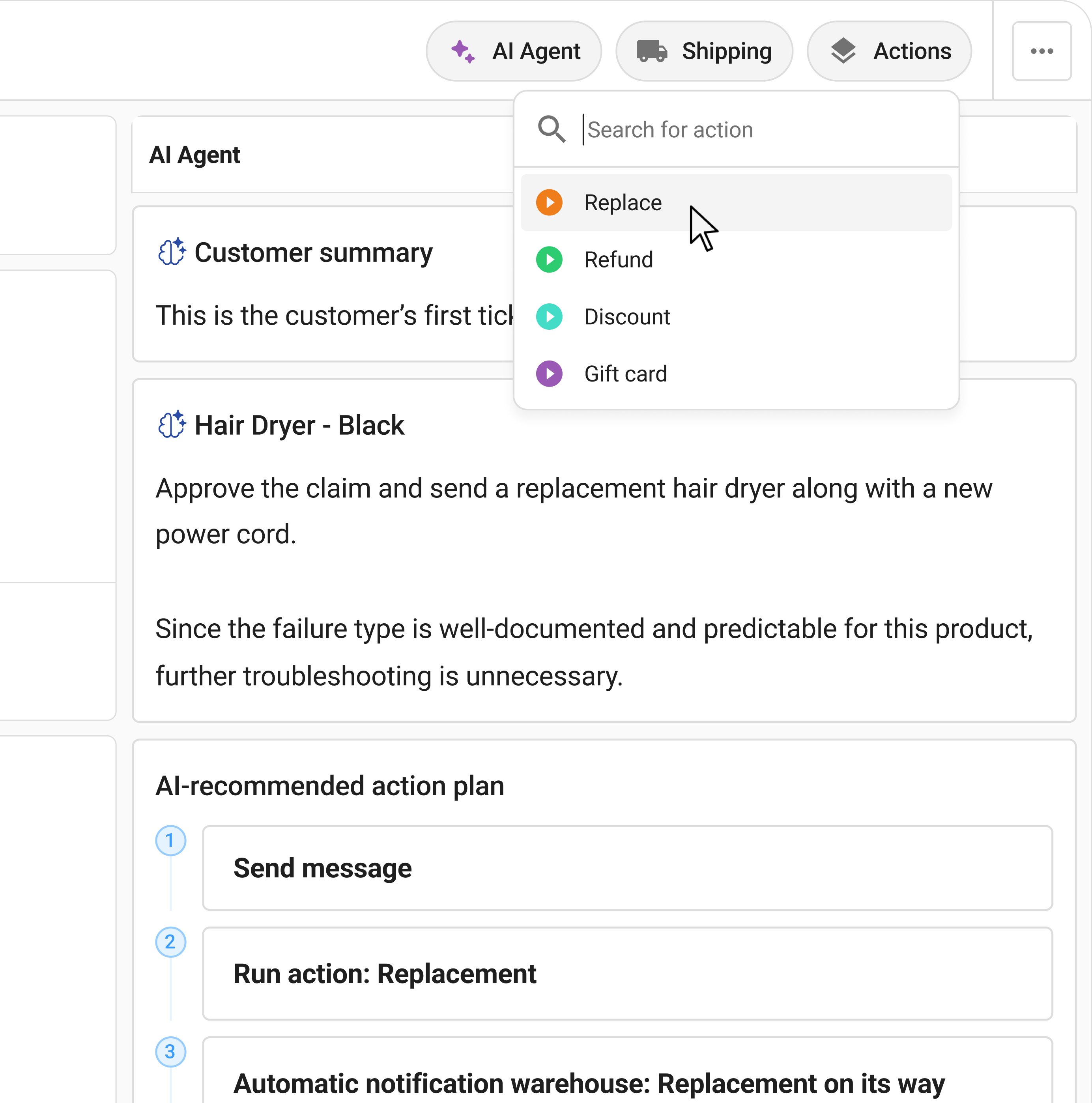
Claimlane's AI Agent, the first AI agent purpose-built for warranty claims and returns, reads photos and videos at intake, applies brand and supplier rules, classifies the defect, and recommends or auto-resolves the case. The 10-45 minute case becomes a 30-second decision the agent confirms with one click.
For brands running multiple suppliers with different policies, the AI handles the policy variance automatically. Customer service hires don't need months of brand-specific training because the AI handles the brand-policy layer.
77%
faster RMA resolution
AI Agent in practice · MaxGaming
MaxGaming runs 30,000+ SKUs across 200+ brands. After deploying the AI Agent, complex RMA cases resolve 77% faster. The support team handles complex warranty cases without months of product training because the AI handles the brand-policy layer.
What it looks like when this works
Three documented Claimlane customer outcomes show what a working warranty returns operation produces.
Davidsen · Efficiency
5 → 1-2
Agents needed for the same warranty case volume. Same operations, fewer people, faster turnaround.
Read the case study
Swoon · Recovery
60 → 85%
Supplier chargeback recovery rate after switching to structured, evidence-backed real-time submissions.
Read the case study
Onyx Cookware · ROI
9x
Year-one ROI on Claimlane investment. Agent time saved, faster supplier recovery, reduced lost margin.
Read the case study
The pattern across all three: warranty returns stop being a quarterly retrospective and become operational. Decisions happen weekly. Suppliers are held accountable monthly. Quality issues get caught in weeks instead of months.
Best practices for warranty returns
Five practices that consistently separate working warranty operations from struggling ones.
5 best practices
- Document the warranty policy clearly. What's covered, how to file, what evidence is needed. Visible on every product page, not buried in a footer.
- Offer structured self-service intake. Required photo upload, defect dropdown, order ID validation. Customers prefer it, the team gets cleaner data.
- Use warranty data to improve products. Track defect rate by SKU and supplier. The patterns surface real product or sourcing problems.
- Resolve with the customer first when in doubt. Recover from suppliers separately. Bad reviews cost more than the occasional unrecovered credit.
- Treat the warranty case as a retention moment. Customers who get a fast, fair resolution buy again at high rates. The warranty interaction is one of the most valuable retention events in ecommerce.
A deeper guide on warranty analytics for product quality covers the data side specifically.
Frequently asked questions
How long should a warranty return take?
For straightforward cases (clear defect, photos at intake, supplier policy on file), 1-3 days end-to-end is achievable. For complex cases requiring supplier approval or carrier investigation, 5-10 days is realistic. Anything beyond two weeks usually means the case is stalled in handoffs rather than waiting on legitimate inputs.
Do I need software to manage warranty returns?
Above a few hundred claims a month, yes. Below that, structured spreadsheets and a shared inbox can work, though even at low volume you lose visibility into supplier performance and defect patterns. The breaking point is usually somewhere between 200 and 500 monthly cases, depending on category complexity and how many suppliers the brand carries.
What's the biggest cause of slow warranty returns?
Incomplete documentation at intake. The customer submits a vague description, the agent emails for photos, the customer replies two days later, the cycle continues. Structured self-service intake with required photos eliminates most of this delay.
Should I resolve with the customer or the supplier first?
The customer first, when there's any ambiguity. Bad reviews and customer churn cost more than occasional unrecovered credit notes. Chase the supplier separately. Brands following this rule typically see CSAT improvements and supplier recovery rates that stay flat or improve because they have better evidence.
Can AI handle warranty returns?
Yes. Claimlane's AI Agent is the first AI agent purpose-built for warranty claims and returns. It reads photos and videos at intake, applies brand and supplier rules, and recommends or auto-resolves cases. MaxGaming reduced complex RMA resolution time by 77% after deploying it. The agent works inside every ticket and the support team confirms or overrides its decisions.
How do B2B warranty returns differ from B2C?
B2B warranty returns typically involve larger volumes per case (multi-line bulk returns), different policies per partner, and procurement-team visibility requirements. They also have higher financial stakes per case. Running them through a B2C-only flow creates friction on both sides. A dedicated B2B module handles these alongside B2C in the same platform.
What's a good supplier chargeback recovery rate?
Brands running structured workflows with photo evidence and clear supplier policies typically recover 80%+ of supplier-responsible costs. Brands working through email and ad-hoc requests typically recover 50-65%. The gap is meaningful: on $1M of supplier-responsible warranty costs, that's $150-300K of recovered margin.
How do I reduce warranty claim volume over time?
Track defect data by SKU and supplier, then act on the patterns. The top 10 SKUs by claim volume usually drive 60-80% of total claims. Fixing those (through supplier renegotiation, packaging changes, design updates, or product retirement) moves the needle far more than incremental process improvements.
Warranty returns are a structural part of post-sales operations. Done badly, they cost the brand money, time, and customer goodwill. Done well, they turn into one of the strongest retention moments in ecommerce. Claimlane handles structured intake, AI-assisted resolution, supplier accountability, and analytics in one platform. Book a demo to see what your warranty operation looks like with all four operating together.