At Claimlane we help retailers like GrejFreak, Luksusbaby, and Davidsen, among many others, with an easy way to handle product warranty claims with their customers and suppliers. It's no secret that 10 out of 10 retailers we talk to hate dealing with warranty claims.
After reading this, you'll understand why, and what we can do about it.
Why are warranty complaints so tricky?
A lot is in play when handling complaints on faulty products, and that's the core of the issue. Warranty claims are complex.
The flow on most webshops looks something like this:
Customer starts a long email dialogue with the retailer
Internal stakeholders research brand-specific claim guidelines
A return label is created in the carrier portal (if that's offered)
The retailer's warehouse handles and inspects the returned product
Retailer offers a refund, repair, or replacement
Claim data gets copied into a separate email or PDF template
The data is shared with the brand or supplier (long conversations follow)
The retailer closes the case once a credit note arrives from the supplier
That's eight steps, multiple stakeholders, several systems, and at least three external dependencies (the customer, the carrier, the brand). Each handoff is an opportunity for the case to stall.
The three main challenges we see every day

Stakeholders pull in different directions
Every brand has its own guidelines for handling claims. For a webshop like GrejFreak, with hundreds of brands, that's hundreds of policies to track. Meanwhile the customer needs a fast resolution. Webshops end up choosing between great customer service (quick resolutions) and supplier approval (waiting for the brand). Neither path is fully satisfying.
Customers don't document their claims correctly
Today's customers have little patience and high expectations. On most webshops, where to file a complaint isn't obvious. The result: customers submit incomplete documentation, customer service has to ask for more, and the conversation drags on. Everyone gets frustrated.
Manual workflows drain customer service
A single warranty claim takes 10 to 45 minutes to handle. Most teams run claims through email, which makes structured workflows nearly impossible. Every action means downloading and uploading files, filling out forms, and switching between the ERP, the ecommerce platform, and the carrier portal. Time evaporates.
Together, these three challenges turn what should be a structured process into an open loop. The case bounces between systems, between teams, and between the customer and the supplier. At small volume it's annoying. At scale it becomes the operational drag that defines the customer service team's quarter.
If you want to fix it systematically, the step-by-step guide on optimising the warranty claim process covers what to address first.
How this hits the business

The impact varies by industry and company size, but the pattern is consistent:
What broken warranty processes actually cost
- Customers repeat themselves and wait. Disappointed customers post Trustpilot reviews and tell their friends.
- Employee time evaporates. Lost productivity in man-hours adds up fast.
- Expert bottlenecks form. One or two people hold all the brand-specific knowledge. They go on holiday and the queue grows.
- Credit notes slip through the cracks. Supplier recovery falls because cases get closed without proper follow-through.
- Brand reputation erodes quietly. Each missed resolution is a small chip in customer trust that compounds over time.
Of those, the credit-note loss is the most measurable and the most fixable. A guide on supplier recovery and how to get credit notes faster covers the financial side directly.
Three things you can do today
You don't need a new platform to start improving. Three changes any retail or ecommerce team can make this week:
Make the claim path obvious
Stop hiding the warranty claim process in a footer link or a 12-step FAQ. Put it where customers look. The faster they find it, the less time the team spends explaining where it is.
Capture documentation up front
Use a structured intake form (a smart form, or [Claimlane's self-service portal](/product/self-service-portal)) so customers submit photos, order ID, and reason codes the first time. The number of email round-trips drops sharply.
When in doubt, resolve with the customer first
Don't make the customer wait while you negotiate with the supplier. A bad review hurts more in the long run than a one-time refund out of your own pocket. Resolve, then chase the credit note separately.
These three steps remove most of the immediate friction. The structural fix (one platform handling claims, suppliers, and analytics together) is what we built Claimlane for.
Where AI changes the math in 2026
Since we wrote the original version of this article, the biggest shift in warranty operations has been AI handling parts of a case that previously needed a trained agent.
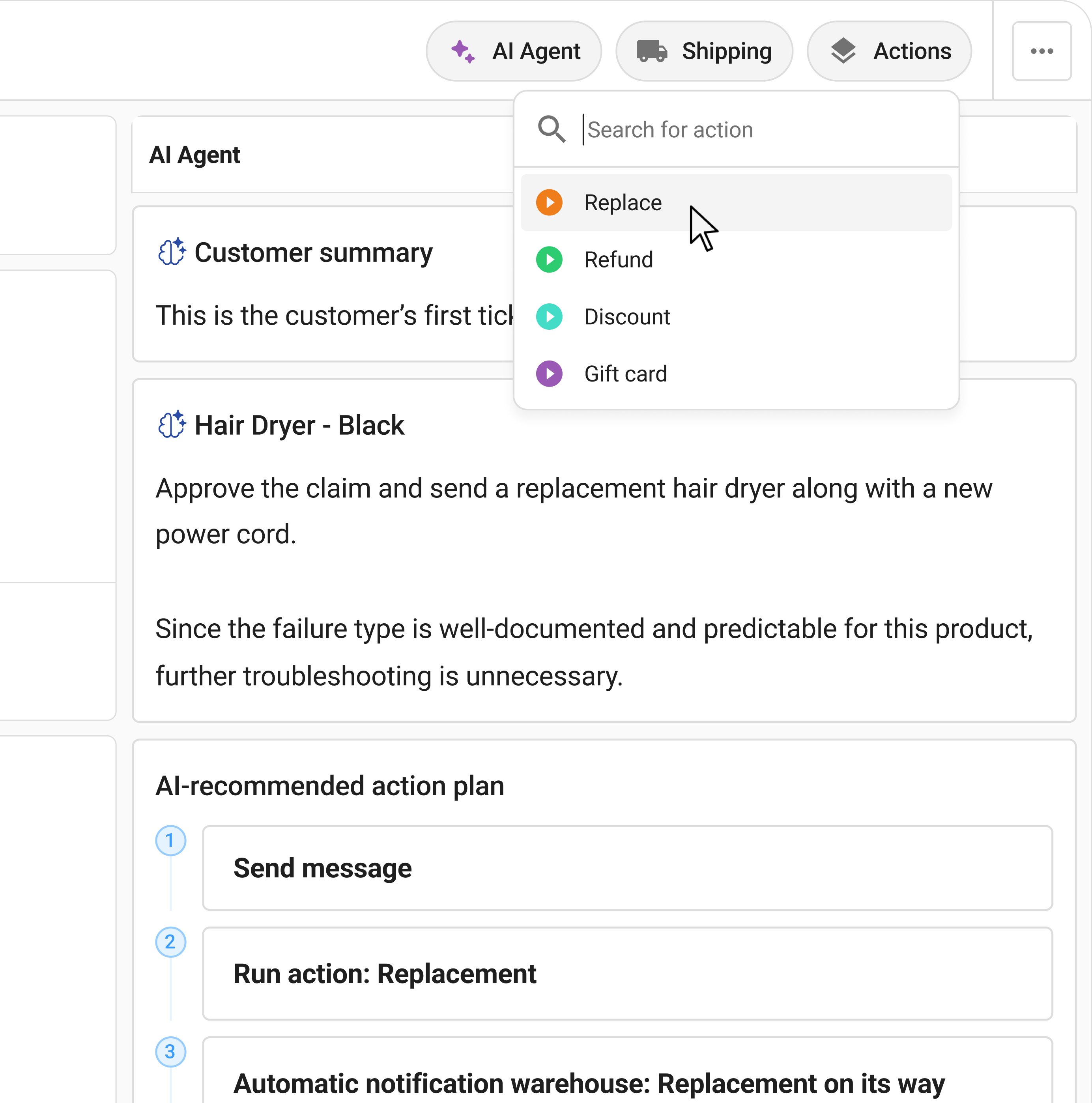
Claimlane's AI Agent, the first AI agent purpose-built for warranty claims and returns, reads customer-submitted photos and videos, applies brand and supplier rules, summarises the case, and recommends or auto-approves the resolution. The 10-45 minute case becomes a 30-second decision the agent confirms with one click.
For retailers handling hundreds of brands like GrejFreak, this is the difference between training every agent on every brand's policies versus letting the AI handle the policy layer.
77%
faster RMA resolution
Customer story · MaxGaming
MaxGaming runs 30,000+ SKUs across 200+ brands, exactly the GrejFreak-style complexity. Their support team handles complex RMA cases without months of product training because the AI handles the brand-policy layer.
How Claimlane fits
We built Claimlane specifically for the challenges this article describes. The platform handles the full warranty claim lifecycle from one place:
✅
Customer self-service portal
Customers submit complete claims with photos, order ID, and reason codes. Fewer touchpoints for the team.
📸
Structured documentation
Every claim arrives with photos, descriptions, and issue tags. No follow-up email rounds.
🔌
Native ecommerce integrations
Shopify, Magento, WooCommerce and others, with order data pulled in automatically.
📊
Full case overview
Every case visible in one place. Supplier handoffs structured, not scattered across inboxes.
The clearest measure of impact is from a real customer. Davidsen, named at the top of this article, went from five people handling warranty claims to one or two after switching to Claimlane.
5 → 1-2
agents handling claims
Customer story · Davidsen
Davidsen went from five people handling warranty claims to one or two after switching to Claimlane. Same case volume. Same supplier complexity. Fewer manual handoffs.
Frequently asked questions
Why are warranty claims so hard for retailers?
Three reasons. Different brands have different policies, so retailers carrying hundreds of brands track hundreds of policies. Customers submit incomplete documentation, forcing email round-trips. And manual workflows across multiple systems (ERP, ecommerce platform, carrier portal, supplier email) make every case slow.
How long does a warranty claim typically take to handle?
Between 10 and 45 minutes per case in most retail and ecommerce operations, depending on complexity, supplier, and how much information was submitted upfront. Cases with incomplete documentation push toward the 45-minute end because of follow-up emails. Cases with structured intake and clear supplier rules sit closer to 10.
What's the biggest cause of slow warranty claim resolution?
Incomplete documentation at intake. The customer submits a vague description, the agent emails for photos, the customer replies two days later, the cycle continues. Structured self-service intake fixes this by requiring the right information before submission.
Should I resolve with the customer or wait for the supplier first?
Resolve with the customer first when there's any ambiguity. Bad reviews and customer churn cost more than the occasional unrecovered credit note. Chase the supplier separately. Most retailers we work with adopt this rule and find their CSAT improves while supplier recovery rates stay flat or go up because they have better evidence.
How do I reduce warranty claim handling time?
Three changes have outsized impact. First, structured customer intake so cases arrive complete. Second, automated routing so cases reach the right team or supplier without manual triage. Third, AI handling the parts of a case that previously needed a trained agent (photo review, policy application, resolution recommendation). MaxGaming reduced complex RMA resolution time by 77% with Claimlane's AI Agent.
Can AI handle warranty claims?
Yes. Claimlane's AI Agent is the first AI agent purpose-built for warranty claims and returns. It reads customer-submitted photos and videos, applies brand-specific and supplier-specific rules, and recommends or auto-resolves cases. The agent decides whether to confirm or override. Cases that used to need 10-45 minutes of agent time become 30-second decisions.
How do retailers carrying hundreds of brands handle warranty policy variance?
Two ways that work. Either a structured rule engine where each brand's policies are encoded once and applied automatically (Claimlane's standard approach), or AI that reads each brand's policy documents and applies them per case. Both remove the need for agents to memorise brand-specific guidelines. GrejFreak runs hundreds of brands this way.
When should a retailer move off email-based warranty handling?
Most retailers hit the breaking point between 200 and 500 monthly claims, especially when they carry 15+ brands or sell complex products like furniture, electronics, or outdoor gear. The signs are agents asking each other how to handle specific brand-supplier combinations, recovery rates trending down, and customer complaints about resolution delays the team can't trace.
We built Claimlane to fix exactly the three challenges this article describes. If you're carrying hundreds of brand policies, drowning in email-based claims, or watching customer service burn time on manual workflows, book a demo and we'll show you what the same operation looks like with structured workflows, supplier handoffs, and an AI Agent doing the policy-layer work.
— Michael Kruse Sørensen, Co-founder