
An acquisition has a checklist, and it is a long one. Finance systems, contracts, headcount, brand, tax structure, the ERP, the sales channels, the warehouse. Every one of them gets a workstream and an owner in the integration plan.
Warranty claims rarely get either.
The reason is simple and expensive. In most companies, warranty claims are not a department and not a system. They are a shared inbox, a spreadsheet, and one person who knows what each supplier wants. None of those three things appear on an org chart, and none of them show up in a data room.
So the deal closes, and the warranty obligation on every product ever sold transfers with the business. The team and the process that handled those obligations may not.
Why claims never appear in due diligence
Diligence finds things that cost money in a visible way. Licences, contracts, headcount, leases, debt. It is very good at finding a system, because a system has an invoice.
A warranty claims process usually has no invoice. It has an inbox that comes free with the email system, a spreadsheet that comes free with the laptop, and a person whose job title says customer service.
So it does not surface. The buyer sees a customer service function with three people in it and assumes those three people answer questions about delivery. What they actually do is hold together a claims process across two hundred suppliers, each with their own documentation rules, none of which are written down anywhere.
The cost of that process is real. It is just distributed across salaries and margin rather than sitting on a line item, which makes it precisely the kind of thing an acquisition is structurally bad at seeing.
What actually breaks after the deal closes
1. The obligation stays, the capability leaves
Warranty is a promise attached to a product, not to an org chart. Every unit sold before the deal carries a promise that runs for two years, five years, sometimes ten.
Acquisitions routinely dissolve the function that was keeping that promise. The claims team was part of the seller's shared services and did not come across. Or the acquirer already has a customer service team and assumes it can absorb the work, without anyone checking whether that team has ever processed a warranty claim in their lives.
The result is a business that owns a liability it now has no process to service. The claims keep arriving regardless. They just arrive somewhere nobody is looking.
2. Every brand does it differently, and it compounds
One acquisition means reconciling two ways of working. A roll-up means reconciling one more each time a deal closes.
Brand A takes claims by email and approves them at the manager's discretion. Brand B has a form on the website that emails a shared inbox. Brand C runs everything through a module in an ERP nobody else uses. Brand D has a phone number printed on the product and no record of anything.
None of that is anyone's fault. Each approach was reasonable when it was built. The problem only appears when a group tries to answer a group-level question and finds there is no group-level data to answer it with.
Which products fail most across the portfolio. Which suppliers cost us the most in claims. What does a claim cost us to process, on average, across the brands we own. Those questions have no answer, and the longer the roll-up runs, the more expensive the answer becomes to build.
3. Supplier recovery stops before anyone notices
This is the one that quietly costs money.
When a product fails because it was faulty from the factory, the cost belongs to the supplier. Recovering it means submitting the claim exactly as that supplier requires, then tracking it until the credit note actually arrives.
That knowledge lives in one person's head, and in an acquisition, that person is often the one who takes the redundancy package.
What follows is not dramatic. Claims still get sent. Suppliers still say yes. The credit notes simply stop arriving, because nobody on either side is tracking whether they did. The loss shows up as margin that is slightly worse than the model said it would be, in the first year after a deal, when there are a hundred other things to blame that on.
4. Open cases fall into the gap
On the day the deal closes there are live cases. Repairs at a service centre. Claims awaiting supplier approval. Spare parts on order. Replacements promised to a customer by an agent who no longer works there.
Those cases sit in a system that may be switched off, held by a team that may be dissolved, on behalf of a legal entity that may no longer exist.
5. The customer does not know or care that a deal happened
Somebody bought a chair, a helmet, a power tool. It broke. They have a warranty, and they are going to make a claim.
They will not accept that the servicing department was dissolved in a transaction, because from where they are standing there was no transaction. There was a brand, and a promise, and now a broken product.
An acquisition is the worst possible moment to give that customer a bad experience, because it is exactly when the brand equity that was just paid for is most fragile.
Three shapes of the same problem
Not every deal breaks claims in the same way. It is worth knowing which one you are in, because the fix is different.
The transitional service agreement trap
Carve-outs deserve their own warning, because they come with a countdown that nobody starts.
When a brand is carved out of a larger group, the seller usually agrees to keep running certain functions for a transition period. Six months, twelve, sometimes eighteen. Claims often sit inside that arrangement without being named in it, because they were part of a shared customer service function rather than a separate service.
Two things then happen. The buyer treats the arrangement as the status quo and turns their attention to the things that are visibly on fire. And the seller, entirely reasonably, does the minimum required and no more, because it is no longer their brand.
Then the agreement ends, and the capability ends with it, on a date everyone knew about and nobody planned around.
The TSA end date is the most useful thing in the whole deal, because it is the only hard deadline the claims workstream will ever get. Use it.
Standardise the system, not the process
This is the mistake most groups make, and it is worth spelling out.
The instinct after a few acquisitions is to write one warranty policy and one process, and make every brand follow it. It feels like the responsible thing to do, and it fails within a quarter.
It fails because the differences between the brands are real. A furniture brand with a five year frame warranty and a spare parts catalogue genuinely does not run the same process as an electronics brand with serial numbers and a repair centre. Forcing them into one process means one of them ends up doing their real job in a spreadsheet again, off to the side, where it cannot be seen.
The version that works is to standardise the platform and let the rules differ inside it. Each brand keeps its own workflows, its own required information per SKU, its own supplier rules. The group gets one place where all of it lives, and therefore one set of numbers that can be compared.
That is the difference between a group that owns eight brands and a group that owns eight spreadsheets.
What a group-level claims process looks like
The shape that survives a roll-up keeps the differences and removes the fragmentation.
- One self-service portal per brand, each with its own branding, its own products and its own required information, all running on the same underlying system.
- Rules and workflows that differ per brand, per SKU, per supplier and per case type, so the electronics brand and the furniture brand each get the process they actually need.
- Supplier claims forwarded in the format each supplier requires, with the rules held in the system rather than in one person's memory.
- Analytics that work across the portfolio, so cost per claim, defect rate and supplier performance can finally be compared brand to brand.
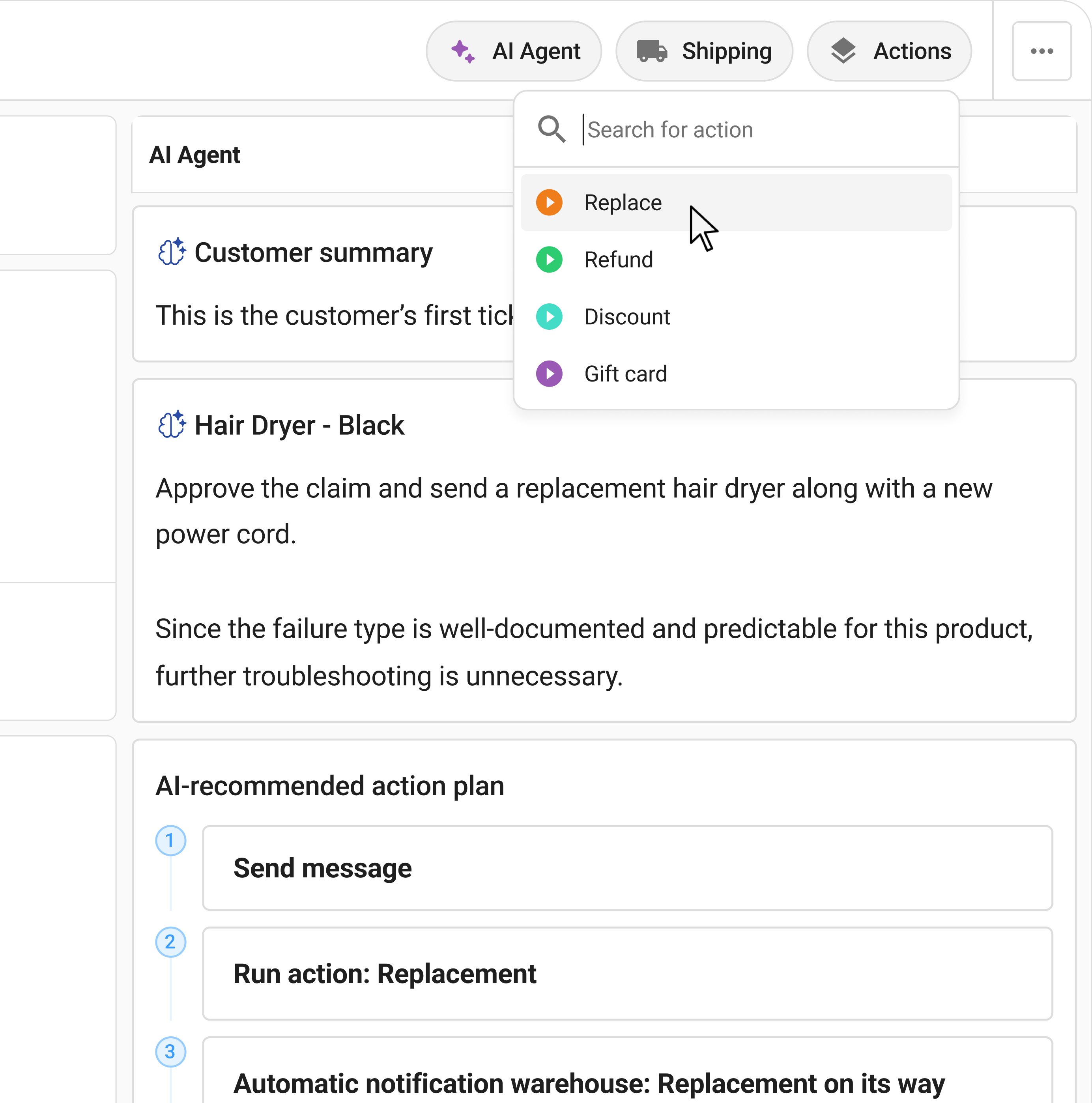
- Claimlane's AI Agent, the first AI agent purpose-built for warranty claims and returns. It reviews the images and video a customer submitted, applies the warranty rules for that product and supplier, and recommends the resolution, which matters most when a support team is suddenly handling products they have never seen before.
That last point is the one acquirers underestimate. A customer service team that has been absorbing a new brand does not know its products, its failure modes, or its supplier terms. Getting them to a correct decision without months of training is the whole problem of the first year.
Coolshop went from multiple systems to one centralized post-purchase platform. Davidsen went from five agents handling claims to one or two.
If the acquisition also brings a system change, and it usually does, the same argument applies to those projects. ERP migrations break the claims process in their own specific ways, and after a deal they tend to arrive together.
The question to ask in the first integration meeting
A customer bought a product from the acquired brand three years ago. It broke last week. They are filling in a form on a website that now belongs to you.
Who reads that claim, what rules do they apply, and who pays for the outcome.
If the room cannot answer that, the gap is open, and every day it stays open is a day of quiet cost and slow brand damage on an asset that was just paid for.
Book a meeting and we will map the claims workstream against your integration timeline.