
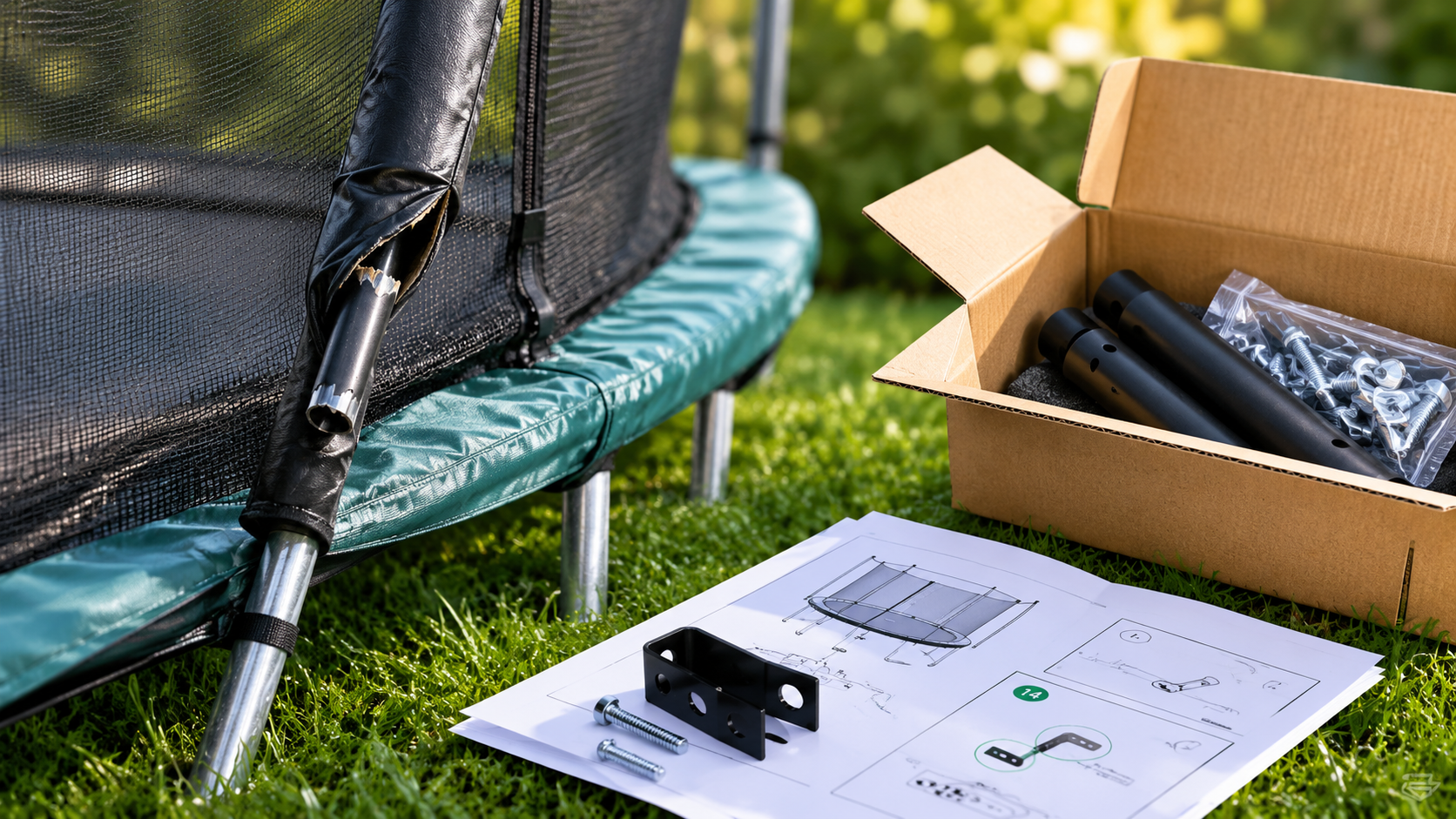
A return on a t-shirt and a warranty claim on a trampoline reach the same support team, on the same platform, under the same policy. That is where the trouble starts.
The t-shirt is easy. Wrong size, or wrong colour. The label is already in the package. The customer repacks the box, drops it at a parcel shop, and the job is done in about a minute. No agent ever sees it.
The trampoline is not easy. The customer is halfway through the build, one pole is bent, and one bracket is missing. The box is already flat in the recycling. Nothing is going back.
So the customer emails support. Support asks for the order number, then the serial number, then a photo, then a description of the missing part, then whether the damage looks like it happened in transit. Each question costs a day.
Most brands end this by shipping a new trampoline.
That looks like generous service. It is also the most expensive answer available, and brands reach for it because the cheaper answer was never built.
A spare parts flow, in plain terms
A spare parts flow lets a customer point at the exact component that is broken or missing, using the product's own assembly guide, at the moment they submit a claim. The part lands on the ticket as structured data rather than a paragraph of description, so an agent can ship a bracket instead of a trampoline.
The whole-unit habit is a margin decision nobody made
A whole-unit replacement on an assembled product carries three costs. The cost of the goods. Outbound shipping on something bulky. And the write-off on a returned unit that was almost entirely functional, because it rarely goes back on the shelf at full value.
The broken bracket costs a fraction of that, and it often ships in an envelope.
Nobody sat in a meeting and chose to pay the higher number. The higher number is what happens when identifying a single pole or screw takes more agent time than shipping a new product. Over-shipping is the rational move inside a system that has no cheaper option in it.
The gap between those two numbers, repeated across a season of trampolines or cots or garden furniture, is the whole case for spare parts. It sits on the P&L rather than in the support queue.
The five-part test
Not every category needs this. Plenty of brands would get nothing back. The categories that do benefit share five traits.
The product is assembled from components. A trampoline has poles, springs, brackets, a mat and a net. The clearest candidates are products with 20 to 30 or more separate parts, where a customer cannot reasonably describe what broke.
Failure is partial. One bracket snaps and the rest of the product still works.
The product cannot travel. Return shipping on a bulky item approaches the value of the part, and sometimes the value of the product.
The product is worth repairing. Long expected life, and a price that justifies keeping it alive.
The customer assembles it. Home assembly is where missing screws and bent poles get found, usually on a Saturday, usually halfway through.
A category that meets four or five of these has a spare parts problem whether or not it has a spare parts process. An unmanaged problem does not disappear. It shows up as long email threads and replaced products.
Six industries where a single broken part causes the whole unit to be shipped back, and why.
One broken part shouldn't scrap the whole unit
Across these categories the same thing happens: a single component fails, but the system treats it as a full-unit fault — so the whole thing gets shipped, refunded or scrapped.
Trampoline poles, tent poles, bike components, climbing hardware.
Assembled on site and far too bulky to send back.
Table legs, drawer runners, glass panels, fittings.
One damaged leg reads as a full-unit fault in most systems.
Cot fittings, stroller wheels, high chair straps.
Safety sensitive, and parents who need it working today.
Blades, batteries, motors, guards.
No parts catalogue, so a working machine gets scrapped.
Cables, fans, panels, mounts, controllers.
Many components, and customers able to swap one themselves.
Fittings, mounts, serialised components.
Compatibility depends on serial data nobody captured.
The four failures that compound
Brands without a parts process hit the same sequence, in the same order.
Customers cannot name the part. They describe it instead. The metal piece that holds the other piece. An agent then plays twenty questions over email, across time zones, asking for more photos at better angles. Support is guessing, and guessing is slow.
The parts have no SKUs. Many brands never built a parts catalogue, because the products were designed to be sold whole rather than maintained. Even once the agent knows which bracket failed, there is nothing in the system to order.
So the brand over-ships. A whole product, or a whole assembly, because identifying one screw costs more agent time than it saves. This is the expensive habit, and it is a symptom rather than a policy.
And none of it gets measured. Nobody learns which part fails most often, on which SKU, from which supplier, because the failure was never recorded as a part. It was recorded as a replacement.
That last failure is the one that costs the most over time. A brand that knows bracket 14 fails on three percent of units has a supplier conversation and a design fix. A brand that replaced 200 trampolines knows only that it replaced 200 trampolines.
The three levels of a parts setup
Spare parts is not one feature that a brand either has or does not have. It runs on a ladder, and most brands can start further down it than they assume.
Level one, free text. The assembly guide appears in the claim flow. The customer types in the part name or number and a quantity, reading it off the diagram. Part 003, two pieces. Front left chair leg. An agent can overwrite it later with a catalogue entry. This works for a brand with no structured parts data at all, which is most brands.
Level two, a global catalogue. The customer picks from a dropdown of every part the brand stocks, regardless of which product it belongs to. Cleaner data, and no mapping work required. The trade-off is that a customer can select a part that does not fit their product.
Level three, parts mapped to the parent product. The dropdown shows only the parts that are valid for the exact item the customer owns, linked by parent SKU or EAN. This is the level that makes precise reporting possible: warranty cost per part, per product, per customer, and supplier reimbursement based on what actually failed.
Level three is where the finance story lives. It is also the only level where the selection is clean enough to trigger an automatic replacement without a human checking it first.
The database does not have to exist on day one. At level one, customers build it. Each part a customer types in gets validated by an agent, who can attach a SKU, and the validated part then appears as a selectable option for the next customer with the same fault. The catalogue assembles itself out of real claims, which means it only ever contains parts that actually break.
Davidsen went from five agents handling claims to one or two after moving claims into a structured flow. The claims did not disappear. The guesswork did.
Davidsen, DIY and building materials
What it actually takes to set up
The blocker is rarely the software. It is that the assembly guides are scattered.
Most brands already have manuals. They sit in a Drive folder, on an internal share, in a supplier's email, or only in print. The work is mapping each product to its guide, either as an instructions URL on the product record in Shopify, or by uploading the guides into the product data library and pointing each product at the right one.
That is the whole prerequisite. A brand that can produce a list of its products and a link to each assembly guide can run a parts flow at level one within its existing claim process. No parts catalogue, no SKUs, no ERP project.
Getting the part out of the door is a separate step, and it can run through the store the brand already sells on. The Shopify Create Order integration in our December product update creates an order for a spare part, an accessory or a paid repair directly from the ticket.
There is a second benefit that brands rarely price in. The manuals stop being buried PDFs and become part of the customer experience. A customer looking at an exploded diagram of their own product, clicking the pole that snapped, is having a better time than a customer writing a paragraph and attaching four photos.
The rule changes on 31 July 2026
Repair has been an operational choice. From 31 July 2026 it becomes a legal one across the EU. Member states apply Directive (EU) 2024/1799 on common rules promoting the repair of goods from that date. It obliges producers to repair certain goods on request and pushes repair ahead of replacement as a remedy.
The operational consequence is straightforward. A brand that cannot identify a broken part today will struggle to supply one on request tomorrow. The parts catalogue that looked like a nice-to-have becomes the thing the obligation runs on.
Brands already running a parts flow are in a good position here, because the hard part of compliance is not willingness to repair. It is knowing, at claim time, exactly which component the customer needs.
Where a parts flow does not pay off
Worth stating plainly, because the wrong call here wastes real money.
Fashion, footwear, cosmetics, consumables and most single-component goods do not need a parts flow. The product works or it does not. Returns are simple, the label goes in the box, and adding a part-selection step to a one-minute job makes that job worse.
Plenty of retailers carry both. A retailer selling t-shirts and trampolines does not need one process. It needs two, running beside each other, with the right one triggered by the product. That is a routing question, and it is the part most brands get wrong when they try to force every claim down a single path.
The number that matters
Support efficiency is real, and it is not the strongest argument for spare parts. The strongest argument is margin, and it has three lines.
Fewer full-product replacements, which shows up directly in cost of goods and in freight on bulky items. Lower waste and lower transport emissions, which matters to any brand with a sustainability commitment it has to evidence. And accurate cost per claim at part level, which is what lets a brand charge a supplier for the component that keeps failing instead of absorbing it.
That third line is the one finance teams care about and the one most brands cannot produce, because the data was never captured. Structured parts data turns warranty from a cost that gets explained after the fact into a cost that can be attributed, recovered, and designed out.
Brands selling products made of parts are already paying for spare parts. Most of them pay in whole products, one replacement at a time, and never see the total.
More detail on how the pieces fit together sits in Claimlane's guide to spare parts.
Cult Furniture cut resolution time by 66% and reduced refund-related calls by 20% after moving claims into a structured flow. The question worth sitting with is a simpler one. If a customer called today holding a broken bracket, could the team name the part and ship it, or would they ship the whole thing again? Build the return and warranty portal customers actually use.