
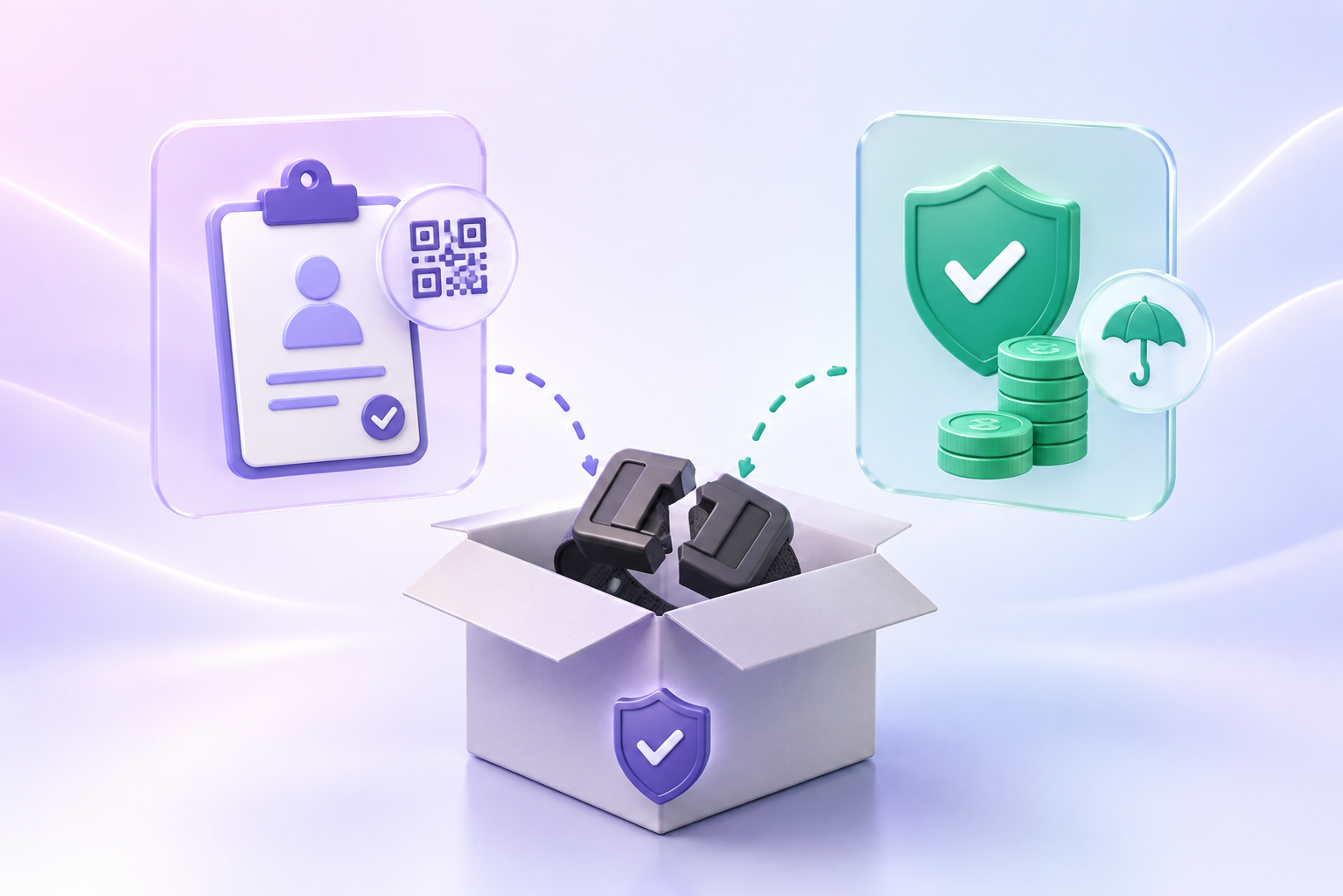
Search "Shopify warranty app" and the results look like one category. They are two, and the two make money in opposite directions.
The first type registers products. The brand pays for the app, the customer scans a QR code or fills a form after purchase, and the brand ends up with a database of owners it can email. The second type sells extended warranty plans at checkout. The customer pays a premium, an insurance underwriter carries the risk, and the brand takes a revenue share.
Both are legitimate. Neither of them handles a claim. The app collected the serial number, and then the customer emailed a photo of a snapped buckle, and the app had nothing to say.
This comparison covers what is actually in the Shopify warranty category in 2026, which business model each app belongs to, and what a warranty-heavy brand with repairs and spare parts needs that none of them provide.
The three-part definition
A warranty program has three parts. Registration, capturing who owns the product and from when. Adjudication, deciding whether a reported fault is covered. Resolution, repairing, replacing or refunding, then recovering the cost from whoever caused it. Shopify's warranty app category covers part one.
"Warranty app" on Shopify means two different things
The distinction matters because the two types answer different questions and a merchant comparing them side by side is comparing a CRM feature to an insurance product.
Registration apps answer: who owns this product, and can the brand reach them. Extended-warranty apps answer: can this brand earn margin on a protection plan. Claims answer neither, which is why claims quietly stay in the support inbox after either app goes live. Claimlane's guide to warranty registration and why brands need it covers the first honestly, including its limits.
Type one, registration apps
Registration apps put a form or a QR code in front of the buyer after purchase. Some tie the record to a serial number, some just to an email and an order.
The value is real. A registered product means the brand knows the purchase date without asking for a receipt, which removes the most tedious argument in warranty handling. Claimlane's pieces on product registration software, proof of purchase in warranty claims and when warranty registration makes sense to offer cover where it pays and where it does not.
The limit is also real. A registration record is a row in a table. It does not know the brand's warranty terms, cannot read a photo, and has no opinion on whether the buckle snapped because of a defect or because someone stood on it.
Type two, extended-warranty sellers
These apps add a protection plan to the cart. An underwriter carries the risk, the customer pays, the brand takes a cut, and claims against the plan are handled by the underwriter's own process rather than the brand's.
For a merchant selling high-ticket electronics, that revenue is worth having. It also has nothing to do with the statutory warranty the brand already owes. In the EU, the two-year legal guarantee applies regardless of whether the customer bought a plan, which means a brand can sell extended warranties all day and still have a claims process it has not built. Claimlane's guides to extended warranty platforms and extended warranty programs cover the model.
The Shopify warranty apps merchants shortlist in 2026
| App | Type | Built around | Adjudicates claims, routes repairs, recovers supplier cost? |
|---|---|---|---|
| Dyrect | Registration | Post-purchase warranty registration and owner data capture | No |
| NeuroWarranty | Registration | QR-code warranty registration and customer re-engagement | No |
| My Product Registration | Registration | Simple registration forms tied to orders | No |
| SeriaLogic | Registration | Serial number issuance and lookup | No |
| SureBright | Extended warranty | Protection plans sold at checkout, underwriter-handled claims | No, the underwriter does |
| Claimlane | Warranty and claims platform | Registration, adjudication, repairs, spare parts and supplier claims in one record | Yes |
Merchants who arrived here looking for the returns side rather than the warranty side should read Claimlane's best Shopify returns apps comparison instead, and its guide to a returns management system on Shopify. Brands weighing exchange-first returns tools like Loop are looking at a different category again.
What none of them do
Five things, and they are the expensive five.
They do not apply warranty terms per product, per supplier and per market. They do not read the photo or the video the customer uploaded. They do not decide repair versus replace. They do not identify the spare part or check whether it is in stock. And they do not send a claim to the supplier who made the faulty batch.
A warranty app that cannot say no is a marketing tool with a legal document attached.
Registration is the input, not the product
Registration data is genuinely useful, and Claimlane treats it as the first step rather than the whole job. Warranty registration captures the owner, the purchase date, the serial number and the channel, and then that record is what the claim gets judged against.
Without it, every claim starts with a receipt hunt. With it, coverage is a lookup. Claimlane's guide to serial number tracking covers why the serial is the join key that makes defect analysis possible at all.
Registration is the input. The claim is the product.
The claim is where the money is
A claim is a decision followed by a logistics operation. Is it covered. Repair or replace. Which part. Which bench. Who pays.
Each of those steps has a cost and a clock, and in most Shopify brands all of them run on email. Claimlane's articles on warranty claims processing, repair versus replace decisions and optimising the warranty claim process cover each step, and spare parts management software covers the part of the resolution that quietly ships the wrong SKU twice.
The finance number behind the warranty
A warranty is a liability. Brands that sell a two-year guarantee are carrying the expected cost of future repairs and replacements, and that cost has to be reserved for and reported.
The reserve is only as good as the claim data behind it. Cost per claim fully loaded, meaning labour, freight, part and replacement, is the number that feeds it, and supplier recovery is the offset that shrinks it. Claimlane's guides to cost per warranty claim and warranty reserve accounting cover both, and forwarding claims to suppliers is the mechanism behind the offset.
A registration app cannot tell a CFO any of that. It can tell them how many people scanned a QR code.
A readiness check
- 50 or more claims a month across returns and warranty
- Photos, video or serial numbers are needed before a claim can be judged
- Repairs, replacements or spare parts are part of the resolution
- Three or more suppliers drive meaningful defect volume
- Sales run through retail, dealers or marketplaces as well as Shopify
Claimlane's warranty management best practices guide expands each of those, and the platform view sits on warranty management software.
How Claimlane runs alongside Shopify
Claimlane runs as the post-purchase execution layer next to Shopify, not inside it. Orders, customers and products flow in. Resolutions flow back. The claim record holds the registration, the evidence, the warranty rule, the repair, the part and the supplier claim in one place, and it connects to NetSuite, SAP, Microsoft Dynamics and Business Central on the ERP side, plus Zendesk and Gorgias on the support side.
The list of places a Shopify order can come from keeps growing. Merchants can now sell inside ChatGPT, Gemini and Copilot through Shopify Agentic Storefronts, and a warranty claim on one of those orders has to land in the same record as a claim from the web store. Registration apps are tied to the storefront. The claim layer has to be tied to the order.
The two-tier version, stated plainly. Simple size-and-fit returns on a Shopify DTC store belong with a returns app. Branded post-purchase tracking belongs with a tracking-led tool. Complex faults, repairs, spare parts, supplier claims and mixed B2C and B2B flows are Claimlane's category, and Claimlane's warranty claim software guide sets out the requirement list.
Proof point. Black Diamond automated its warranty claim and repair workflows in Claimlane, which is the exact part of the process a registration app hands back to the support inbox.
Read the Black Diamond case study · Read the Skechers warranty claims case study
Brands in the categories where this bites hardest, outdoor gear, climbing hardware, sporting goods, can see the category view on the outdoor and sporting goods page.
Claimlane holds a 4.8 out of 5 rating on G2.
Frequently asked questions
Does Shopify have built-in warranty management?
What is the difference between a warranty registration app and a warranty platform?
Do extended warranty apps handle a brand's own warranty claims?
Is warranty registration worth it for a Shopify brand?
Build the return & warranty portal customers actually use. Black Diamond runs warranty claims and repair workflows as automated flows rather than inbox threads, and Davidsen went from five claims agents to one or two on the same volume. Both started from a registration record and built the claim on top of it. Book a demo to see that flow on live Shopify data.