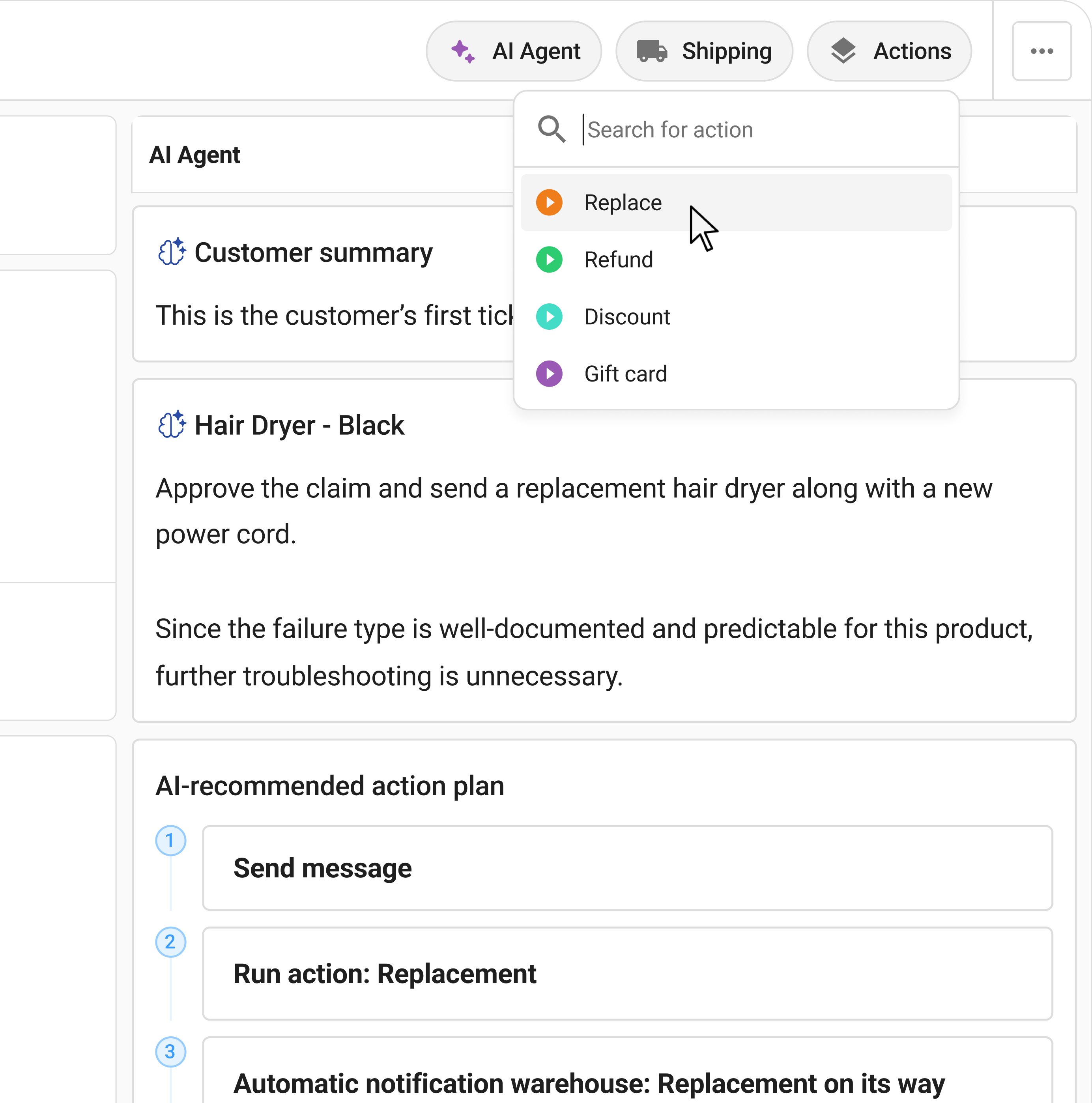
.webp)
Shopify handles checkout, shipping, and payments well. Returns? Not so much.
The platform's native returns tools cover the basics: mark an order as returned, issue a refund, restock inventory. But for brands processing more than a handful of returns per week, those basics create bottlenecks fast. Support agents end up managing returns through email threads, manually checking policies, and copying order data between tabs.
A dedicated returns management system fills the gaps. It plugs into Shopify, automates the repetitive parts, and gives both customers and support teams a better experience. But not all systems offer the same features, and not every feature matters equally.
This guide breaks down the specific features that separate a good Shopify returns management system from one that just adds another dashboard to check.
What Is a Returns Management System for Shopify?
A returns management system (RMS) is software that connects to a Shopify store and handles the entire post-purchase return, exchange, and warranty claim process. It replaces manual email-based workflows with structured, automated flows.
Instead of a customer emailing support and waiting for a response, the RMS provides a self-service portal where the customer initiates the return, uploads photos if needed, selects a reason, and gets an instant resolution or next steps.
For the merchant, the system automates approvals, generates shipping labels, syncs refunds back to Shopify, and collects data on why products come back.
The difference between a Shopify returns app and a full returns management system comes down to scope. A basic app handles return requests and label printing. A full RMS covers returns, exchanges, warranty claims, repair workflows, supplier coordination, and analytics, all from one platform.
Where Shopify's Built-In Returns Fall Short
Shopify added native return management features in recent years, but they're designed for simplicity, not scale. Here's where growing brands hit friction:
No customer-facing return portal
Shopify doesn't offer a branded self-service portal where customers can initiate returns on their own. Customers either email support or rely on a third-party app.
Limited automation
There's no rules engine for auto-approving returns based on order value, product category, return window, or customer history. Every return requires manual review.
No warranty or repair support
Shopify treats every return the same. It doesn't distinguish between a sizing exchange, a warranty defect claim, and a repair request. Brands with warranty registration or product guarantee programs need functionality Shopify simply doesn't have.
No return reason analytics
While Shopify tracks basic return volumes, it doesn't offer deep analytics on return reasons, product defect patterns, or cost-per-return breakdowns.
No supplier claim forwarding
Brands that sell third-party products can't forward warranty claims to suppliers through Shopify. That process stays manual.
Feature 1: Branded Self-Service Return Portal
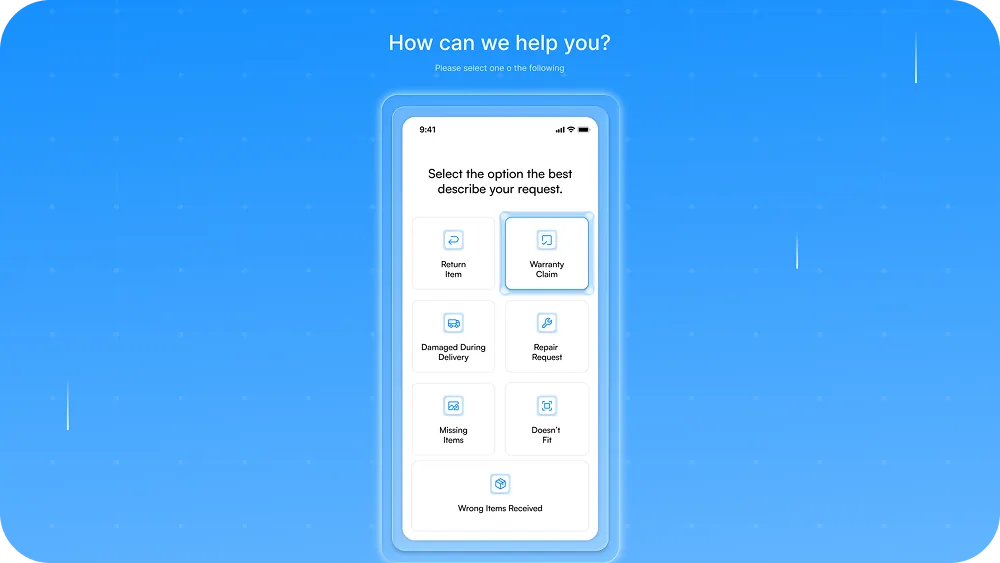
This is the feature that makes the biggest immediate difference. A self-service portal lets customers start a return, exchange, or warranty claim without emailing support.
The portal connects directly to Shopify, so when a customer enters an order number, the system pulls order details automatically. The customer selects which item to return, chooses a reason, uploads photos if required, and gets an instant response.
What to look for
- Branded design that matches the store's look and feel, not a generic third-party page
- No login required. Customers should be able to start a return with just an order number and email
- Photo and video upload for damage claims and warranty issues
- Mobile-optimized. Most Shopify customers shop on mobile. The return portal should work just as well on a phone
- Multiple claim types. The portal should handle returns, exchanges, warranty claims, and repair requests from one interface
Claimlane's self-service portal is built for exactly this. Customers submit claims with photos, videos, serial numbers, and order details. The portal adapts based on product type, so a warranty claim on a piece of furniture collects different information than a sizing return on apparel.
Feature 2: Automated Return Approval Rules
Manual review of every return request is what creates the bottleneck. A good RMS lets merchants build rules that auto-approve, auto-deny, or route returns based on conditions.
Common automation rules
- Auto-approve returns within the return window for orders under a certain value
- Auto-approve exchanges (no refund involved, lower financial risk)
- Require photo evidence for damage or defect claims above a value threshold
- Auto-deny returns on final-sale or personalized items
- Route high-value returns to a senior agent for review
- Apply different rules per product category, supplier, or customer segment
Claimlane's workflow automation lets brands build these rules without code. Different products, categories, and customer segments can each follow different return paths.
Why this matters for Shopify stores
Shopify stores with 200+ returns per month can save 40-60 hours of manual processing time per month by automating approvals. That's the equivalent of a part-time employee dedicated entirely to reading return emails and clicking buttons.
Feature 3: Exchange and Store Credit Workflows
Every return that becomes an exchange instead of a refund is retained revenue. The best returns management systems make exchanges the path of least resistance.
Exchange features that move the needle
- Instant exchanges that ship the replacement before the return arrives
- One-click size or color swaps for apparel and accessories
- Store credit with bonus (e.g., "Get 110% of your order value as store credit instead of a refund")
- Shop Now flows that let the customer browse the full catalog and pick a different product entirely
Brands using exchange-first workflows typically retain 20-40% of revenue that would otherwise be lost to refunds. For a Shopify store processing $50,000 in monthly returns, that's $10,000-$20,000 in saved revenue.

Feature 4: Return Label Generation and Shipping
A returns management system should generate return shipping labels automatically, either as printable PDFs or QR codes for printerless drop-off.
Key shipping features
- Carrier integration with major providers (UPS, FedEx, DHL, local carriers)
- QR code returns so customers don't need a printer
- Conditional label generation. Only issue labels after the return is approved and conditions are met
- Return routing. Send defective products to an inspection center, resalable items to the main warehouse, warranty claims to a repair facility
- Scan-based labels that only charge postage when the customer actually uses them
For Shopify brands selling internationally, the system should handle return labels across multiple countries with local carrier options.
Feature 5: Warranty and Repair Claim Management
This is where a full returns management system separates itself from a basic Shopify returns app. Returns are one workflow. Warranties are a completely different one.
Warranty claims involve product-specific rules, proof of purchase verification, damage assessment, and decisions about whether to repair, replace, or refund. Many also require coordination with the original manufacturer or supplier.
Warranty features to look for
- Product-specific warranty rules. Different products have different warranty periods and coverage terms
- Warranty registration collection so the brand knows who bought what and when
- Repair tracking. If a product goes out for repair, the system should track its status through the entire lifecycle
- Supplier forwarding. When the manufacturer is responsible, the claim should be forwarded to the supplier with all documentation attached
- Spare parts management. Some warranty resolutions involve sending a replacement part rather than replacing the whole product. The system should support spare parts workflows
Shopify's native tools have zero warranty support. Brands handling warranty claims without dedicated software end up managing them in spreadsheets or email threads, which breaks down fast as claim volume grows.
Feature 6: AI-Powered Claim Processing
AI is the newest and most impactful feature category in returns management. Instead of a human agent reviewing every claim, AI handles the repetitive assessment work.
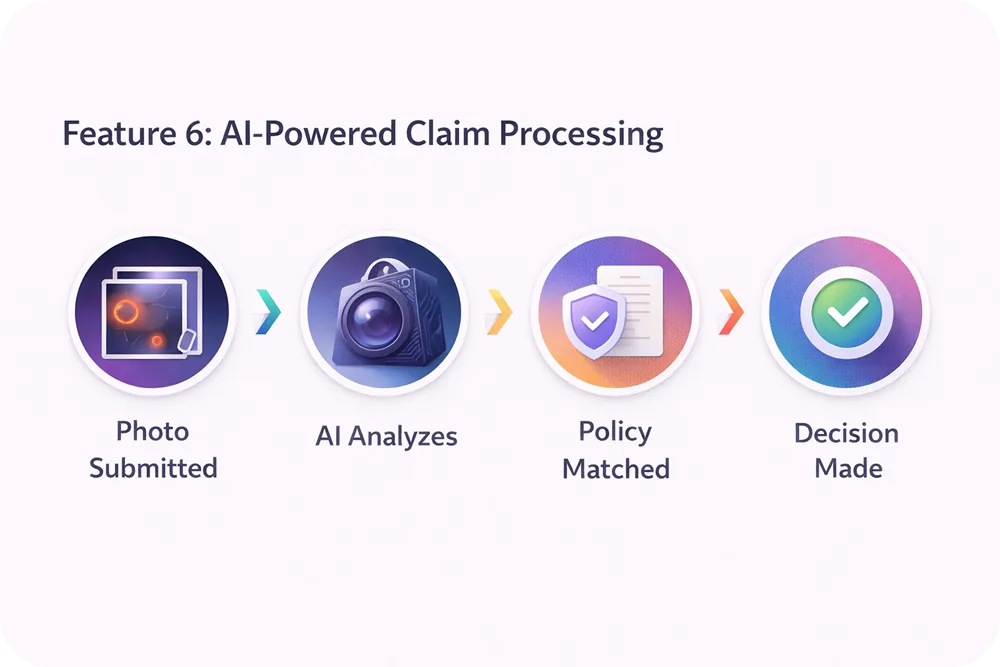
How AI claim processing works
- Customer submits a claim with photos and a description
- AI analyzes the images to identify the product, detect damage type, and assess severity
- AI cross-references the claim against the product's warranty policy and return rules
- AI either auto-approves, auto-denies, or escalates with a recommendation
Claimlane's AI Agent, the first AI agent purpose-built for warranty claims and returns, does exactly this. It reviews submitted images and videos, applies product-specific warranty rules per product and supplier, and recommends or auto-approves resolutions. Support agents no longer need months of product training to handle claims correctly. Learn more about Claimlane's AI.
MaxGaming, the largest gaming and e-sports ecommerce in Scandinavia with 30,000+ SKUs across 200+ brands, resolved complex RMA cases 77% faster using Claimlane's AI agents.
Why this matters for Shopify stores
Shopify stores with high SKU counts or diverse product catalogs benefit most from AI claim processing. Training human agents on warranty rules for hundreds or thousands of products isn't practical. AI scales where humans can't.
Feature 7: Return Reason Analytics and Reporting
Every return contains data about why a product didn't work. A good RMS captures this data and turns it into insights.
Analytics features that matter
- Return rate by SKU. Which products are returned most, and why?
- Return reason distribution. What percentage of returns are sizing issues vs. damage vs. change of mind?
- Cost per return. What does each return actually cost including shipping, processing, and lost revenue?
- **Product defect tracking.** Are specific batches or suppliers producing more defective products?
- Resolution tracking. How many claims are resolved as refunds vs. exchanges vs. repairs?
- Time to resolution. How long does it take from claim submission to final resolution?
Claimlane's analytics dashboard gives brands visibility into all of these metrics. The data helps identify problematic products, underperforming suppliers, and process bottlenecks.
Brands that act on return analytics typically reduce their return rate by 5-15% within the first year. On a Shopify store doing $5M in annual revenue with a 20% return rate, a 5-point reduction saves roughly $350,000 in annual return costs.
Feature 8: Integrations Beyond Shopify
A returns management system that only connects to Shopify creates data silos. The best systems integrate with the full tech stack.
Essential integrations
- Shopify and Shopify Plus (the foundation)
- ERP systems for inventory and financial sync
- Helpdesk tools (Zendesk, Freshdesk, Gorgias) so support agents see return status alongside tickets
- Shipping carriers for label generation and tracking
- 3PL providers for brands outsourcing fulfillment and returns processing
- WooCommerce or other platforms if the brand sells on multiple channels
- Accounting software for automated refund reconciliation
Claimlane supports 75+ integrations including Shopify, WooCommerce, ERP systems, Zendesk, and major shipping providers. The platform syncs order data, claim status, and refund information across all connected systems.
Feature 9: Fraud Detection and Prevention
Return fraud costs ecommerce brands billions annually. A returns management system should include tools to identify and prevent fraudulent return behavior.
Fraud detection features
- Serial returner flagging. Identify customers with abnormally high return rates
- Photo verification. AI checks whether submitted photos match the product, look for signs of tampering, and detect stock photos or AI-generated images
- Cross-claim analysis. Flag when the same product photo is submitted across multiple claims
- Metadata checking. Verify photo timestamps and location data match the claimed timeline
- Policy abuse detection. Catch customers who exploit return windows, wardrobing (wearing and returning), or free-shipping thresholds
For Shopify stores, fraud detection is especially important during peak seasons (Black Friday, holiday sales) when return volumes spike and fraudulent claims often hide in the volume.
Feature 10: Automated Customer Notifications
Customers who don't know the status of their return create support tickets. Automated status emails eliminate the "where's my refund?" problem.
Notification touchpoints
- Return request received and approved
- Return label generated
- Package in transit (carrier tracking integration)
- Return received at warehouse
- Inspection complete
- Refund, exchange, or store credit issued
Brands that implement automated return notifications see a 30-50% reduction in return-related support tickets. For a Shopify store handling 500 returns per month, that's 150-250 fewer tickets for the support team to handle.
Feature 11: Returnless Refund Logic
Sometimes it costs more to process a return than the product is worth. A returnless refund feature lets the merchant refund the customer without requiring the product back.
How it works
- Set a value threshold (e.g., products under $15)
- Define eligible return reasons (e.g., damaged items only, not change of mind)
- The system automatically applies returnless refund logic when conditions are met
- The customer keeps the product, the brand saves on shipping and processing costs
For Shopify stores with a mix of high and low-value products, this feature alone can save thousands per month in unnecessary reverse logistics costs.
Feature 12: Supplier Claim Forwarding
Shopify stores that sell products from multiple brands or suppliers often absorb warranty costs that should be the manufacturer's responsibility. A returns management system with supplier claim forwarding changes that.
How supplier forwarding works
- Customer submits a warranty claim through the self-service portal
- The system identifies the product's supplier from the order data
- The claim, including photos, description, and customer details, is automatically forwarded to the supplier
- The supplier reviews and responds within the system
- The brand tracks supplier response times and recovery rates
Brands like GrejFreak have used this feature to recover warranty costs from suppliers that they previously absorbed entirely.
How to Evaluate a Returns Management System for Shopify
Not every Shopify store needs every feature listed above. Here's how to prioritize based on store size and complexity.
For small Shopify stores (under 100 returns/month)
Prioritize: self-service portal, automated approvals, exchange workflows, basic analytics. These features remove the most manual work at the lowest complexity.
For mid-size Shopify stores (100-500 returns/month)
Add: return reason analytics, fraud detection, automated notifications, and return optimization strategies. At this volume, data-driven decisions start making a measurable financial impact.
For large Shopify Plus stores (500+ returns/month)
All features matter, but especially: AI claim processing, warranty management, supplier forwarding, and deep integrations. The ROI of automating returns at this scale is significant.
For brands with warranty obligations
Regardless of size, any brand offering product warranties needs: warranty claim management, repair tracking, supplier forwarding, and AI-powered damage assessment. Shopify has nothing for this. A dedicated platform like Claimlane fills the gap completely.
Small Shopify Stores
- Self-service portal
- Automated approvals
- Exchange workflows
- Basic analytics
Mid-Size Shopify Stores
- Return reason analytics
- Fraud detection
- Automated notifications
- Return optimization
Large Shopify Plus Stores
- AI claim processing
- Warranty management
- Supplier forwarding
- Deep integrations
Brands With Warranties
- Warranty claim handling
- Repair tracking
- Supplier forwarding
- AI damage assessment
The Financial Case for a Dedicated RMS
Here's a simplified cost comparison for a Shopify store processing 400 returns per month:
| Metric | Without RMS | With RMS |
|---|---|---|
| Avg. handling time per return | 15 min | 2 min |
| Monthly agent hours on returns | 100 hrs | 13 hrs |
| Returns auto-approved | 0% | 55% |
| Revenue retained via exchanges | 5% | 30% |
| Monthly support tickets from returns | 280 | 120 |
| Fraud caught | Low | High |
At an average support agent cost of $20/hour, the 87-hour monthly time savings alone equals $1,740. Add the revenue retained through exchanges and reduced fraud losses, and the ROI typically covers the cost of the system within the first month.
FAQ: Shopify Returns Management System Features
Shopify has basic return functionality for marking orders as returned and issuing refunds. It does not include a customer-facing portal, automated approvals, warranty claim handling, AI processing, or return analytics. Most growing Shopify stores need a dedicated platform.
The self-service return portal. It has the biggest impact on both customer experience and operational efficiency. Customers get instant responses instead of waiting for email replies, and support agents handle fewer routine requests.
Yes, but not all can. Basic Shopify returns apps focus on simple return and exchange flows. A full platform like Claimlane handles warranty claims with product-specific rules, damage assessment, repair tracking, and supplier coordination.
Pricing varies. Basic apps start free or at $20–30/month. Mid-tier platforms run $100–300/month. Enterprise solutions with AI, warranty management, and advanced integrations are custom-priced based on claim volume.
No. Returns management systems run separately from the Shopify storefront. The return portal is hosted on a subdomain or embedded as a page. It has no impact on page load speed or checkout performance.
Yes. Most platforms support both standard Shopify and Shopify Plus. Plus stores benefit more due to higher volumes, complex policies, and multi-market requirements.