
Most brands meet a new right-to-repair law the way they'd meet a lawsuit. Legal reads it, flags the risk, and the question becomes how little the brand can do and still comply.
That is the wrong reflex, because right to repair is not a legal problem. It is an operations problem wearing a legal costume. The laws do not ask a brand to sign something. They ask it to actually provide parts, tools, and documentation, and to stop using software to block repairs. That is a build, not a memo.
And the brands set up to do it have an edge most of them have not noticed. A brand that already runs a real repair and warranty operation is most of the way compliant and gets to market repairability as a feature. The holdouts are paying lawyers to lose slowly while their parts-pairing defenses fall state by state.
US right to repair, in plain terms
State right-to-repair laws require manufacturers of covered electronics and appliances to make repair parts, tools, and documentation available to owners and independent repair shops on fair terms. Several also ban parts pairing, the practice of using software to stop a genuine replacement part from working unless the maker authorises it.
In plain terms, the laws move repair out of the brand's exclusive control. The brand can still run the best repair experience. It just can no longer be the only one allowed to.
The state map as of 2026
The patchwork is the hard part, because a brand selling nationally now faces several different repair regimes at once.
Colorado and Oregon ban parts pairing outright. Minnesota's Digital Fair Repair Act has covered consumer electronics since mid-2024. The coverage lists differ, the dates differ, and the parts-pairing rules differ, which is why a brand needs one process that satisfies the strictest state rather than fifty improvised ones. This is the same multi-jurisdiction problem European brands hit with EU right to repair and right to repair for home appliances.
Parts pairing is the real fight, and brands are losing it
Parts pairing was the last lever brands held to keep repair in-house. Software checks the serial of a replacement part and refuses it unless the maker blessed it. It looked like quality control and worked like a moat.
The 2026 laws are closing it. Colorado and Oregon prohibit using software to block parts or to throw misleading warnings when a non-authorised part goes in. The brands still engineering new parts-pairing schemes are building features that are illegal in a growing list of states and unpopular everywhere else.
The contrarian read: losing parts pairing is a gift to brands that can run repairs well, because it forces a level field where service quality wins instead of lock-in. A brand that handles a repair claim faster and cleaner than an independent shop keeps the customer without needing software to trap them.
The repair operation the laws actually require
Stripped of the legal language, every right-to-repair law asks for the same operational backbone. A parts catalog with availability and pricing. Repair documentation. A way for owners and shops to request parts. And evidence that the brand is meeting the availability window.
A parts catalog is not a press release. It is a live inventory tied to products and serials, the kind of spare parts management that connects to an ERP like NetSuite or Microsoft Dynamics Business Central so availability is real, not aspirational. The request flow is a self-service portal that takes the model, serial, and fault, and the fulfilment is a workflow that routes parts, repairs, or replacements by rule.
This is also where predictive spare-parts inventory stops being a nice-to-have. A mandated availability window means stockouts are now a compliance failure, not just a service miss.
Repair vs replace, now that replace is not always allowed
Replace was the easy button. A unit comes back, ship a new one, scrap the old one, move on. In categories and states touched by these laws, the easy button is getting harder to reach, and the economics were never as good as they looked anyway.
| Old default: replace | New default: repair-ready |
|---|---|
| Swap the unit, scrap the original | Diagnose, repair, return the same unit |
| Parts pairing locks repair to the brand | Parts and docs available by law |
| Spare parts seen as a cost center | Spare parts are the compliance backbone |
| Repair data scattered or absent | Repair history tied to product and serial |
| Replacement cost absorbed each time | Recover defect cost from suppliers |
The finance case is plain. A repair usually costs a fraction of a replacement, and a brand that recovers part of the defect cost from the supplier through a structured supplier claim widens the gap further. Black Diamond automated its warranty claim and repair workflows with Claimlane, which is what turns a legal mandate to repair into a process that actually saves money instead of just satisfying a regulator.
Spare parts go from cost center to compliance backbone
For years spare parts sat in the awkward middle: necessary, unglamorous, and treated as working capital to minimise. Right to repair changes the category. Parts availability is now a legal obligation with a clock on it.
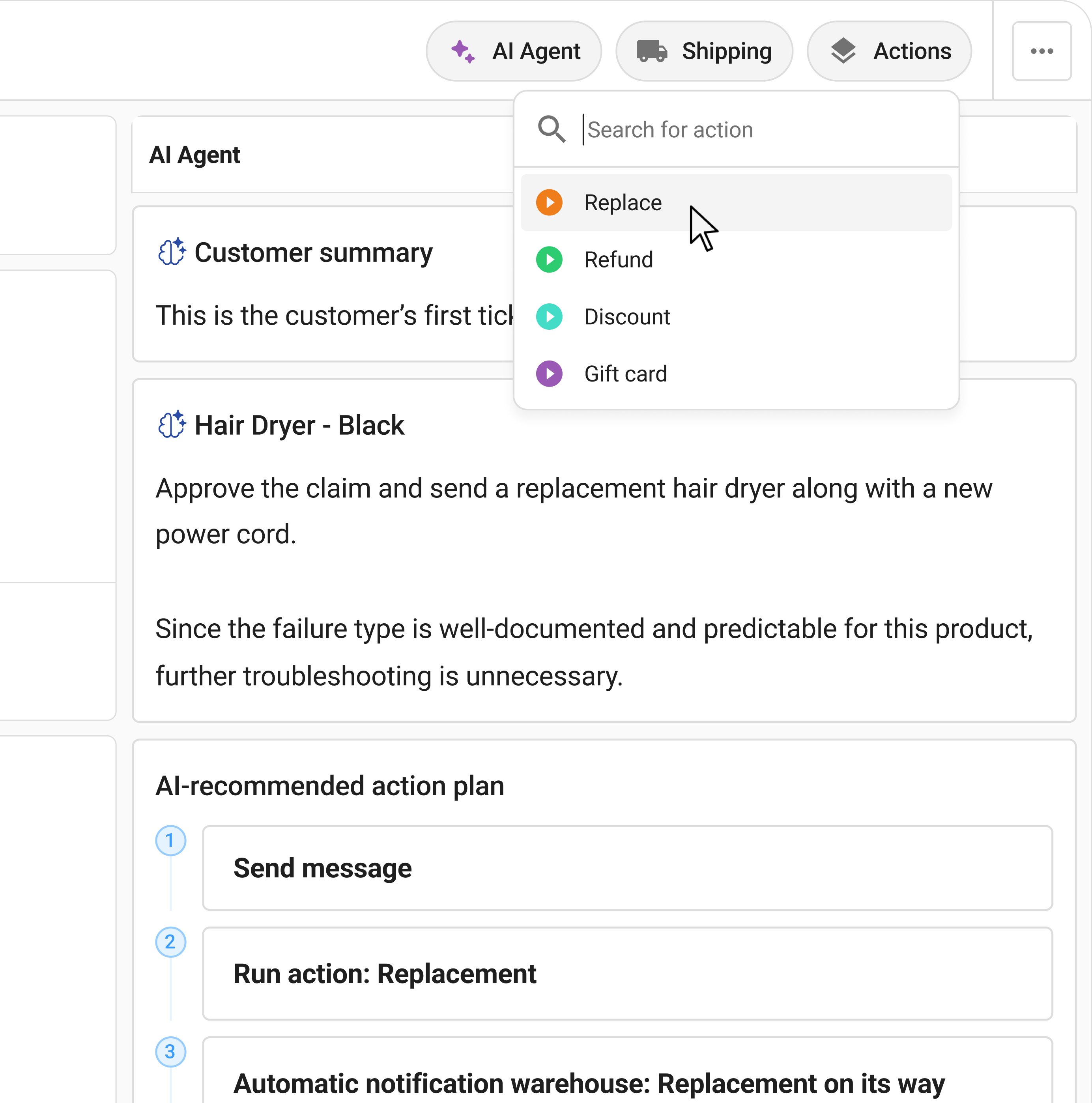
That reframes the investment. A brand with a real spare parts operation tied to serial number tracking can prove availability, fulfil requests, and use the same data to spot the recurring faults driving parts demand. Claimlane's AI Agent, the first AI agent purpose-built for warranty claims and returns, reviews fault photos and recommends whether a case needs a part, a repair, or a replacement, so the parts operation runs on signal instead of guesswork. The guardrails hold: humans stay in the loop on high-value cases, rules are configurable, and every decision is logged, which is the audit trail a compliance-grade repair process needs.
Generic returns app or claims platform: the two-tier reality
A returns app that issues refunds and prints labels does nothing for a repair mandate. It has no parts catalog, no repair workflow, no serial-level history, no availability evidence. For a size-and-fit return it is the right tool. For a regulated repair operation it is the wrong drawer.
The two-tier split is sharp here. Simple returns belong with the generic post-purchase apps. Complex warranty, repair, and spare-parts operations belong on a specialist platform that runs as the execution backbone alongside the rest of the stack. Brands sizing the field can read the best repair management software and the best warranty management software for 2026.
Are you ready to run mandated repairs at scale?
Right-to-repair readiness check
- Selling covered electronics or appliances across multiple US states
- 50+ repair or warranty claims a month
- A spare-parts catalog tied to products and serials
- Repair documentation owners and shops can actually get
- Any current reliance on parts pairing to control repair
- Supplier exposure where defect cost could be recovered
Three or more yes answers means repair should run as a managed operation, not a legal checkbox.
What to measure
Track repair rate versus replacement rate, because shifting cases toward repair is where the money and the compliance both sit. Track parts availability against the mandated window, the number that turns into a violation if it slips. Track supplier recovery on defective parts, the line that tells finance whether the repair mandate is a cost or a recovery channel.
Right to repair is sold to brands as a loss of control. For brands that can actually repair things, it is the opposite. The moat was always going to fall. So here is the question worth sitting with: when a customer in Colorado needs a part next January, will the brand be the easiest place to get it, or the one that made them go somewhere else? More context sits in manufacturer warranty for consumer electronics and warranty management best practices.
Claimlane scores 4.8 out of 5 on G2, built on the repair and spare-parts workflows these laws now make table stakes.
So, when the part is needed in a parts-pairing-free state, is the brand the easiest place to get it, or the reason the customer walks? Book a demo and pressure-test the repair process.
FAQ
Which US states have right-to-repair laws in 2026?
California, Colorado, Minnesota, New York, and Oregon have consumer-electronics repair laws on the books, with Colorado and Washington digital-electronics laws taking effect on 1 January 2026. Coverage, dates, and parts-pairing rules vary by state.
What is parts pairing and why is it being banned?
Parts pairing uses software to stop a genuine replacement part from working unless the manufacturer authorises it. Colorado and Oregon ban it because it blocks independent and owner repair, and several other states are following, so brands relying on it face a shrinking legal runway.
How long must brands keep spare parts available?
Windows vary by state and price tier. California requires parts and documentation for three years for products under fifty dollars and seven years for products over one hundred, for items sold after July 2021. A mandated window makes a parts stockout a compliance failure, not just a service miss.
Is right to repair a threat or an opportunity for brands?
For brands that already run a real repair and spare-parts operation it is an opportunity, because service quality replaces lock-in as the way to keep customers. For brands relying on parts pairing and replace-only policies it is a cost, because the controls they depend on are being removed.