.webp)
The right to repair movement has reached home appliances. EU regulations now require manufacturers of washing machines, dishwashers, refrigerators, and other household products to make spare parts available, provide repair information, and design products that can actually be fixed.
For home appliance brands, this is not a theoretical policy debate. It is an operational requirement that affects product design, supply chain management, customer service workflows, and warranty claim processing. Brands that built their after-sales model around "replace and forget" now need to build repair capabilities.
This guide covers what the right to repair means specifically for home appliances, what brands must do to comply, and how AI-powered repair workflows cut the cost of compliance while improving customer satisfaction.
- EU Right to Repair regulations specifically target home appliances with mandatory spare parts availability, repair information disclosure, and design-for-repairability requirements.
- Manufacturers must make spare parts available for 7-10 years after the last unit is placed on the market, depending on the product category.
- Compliance requires structured repair workflows with full documentation, parts traceability, and reasonable repair timeframes.
- Claimlane's AI Agent automates appliance warranty claim triage by analyzing defect photos, checking warranty terms, and recommending repair or replacement in seconds.
What the Right to Repair Means for Home Appliances
The EU Right to Repair directive, combined with the Ecodesign Regulation, creates specific obligations for home appliance manufacturers.
Spare parts availability
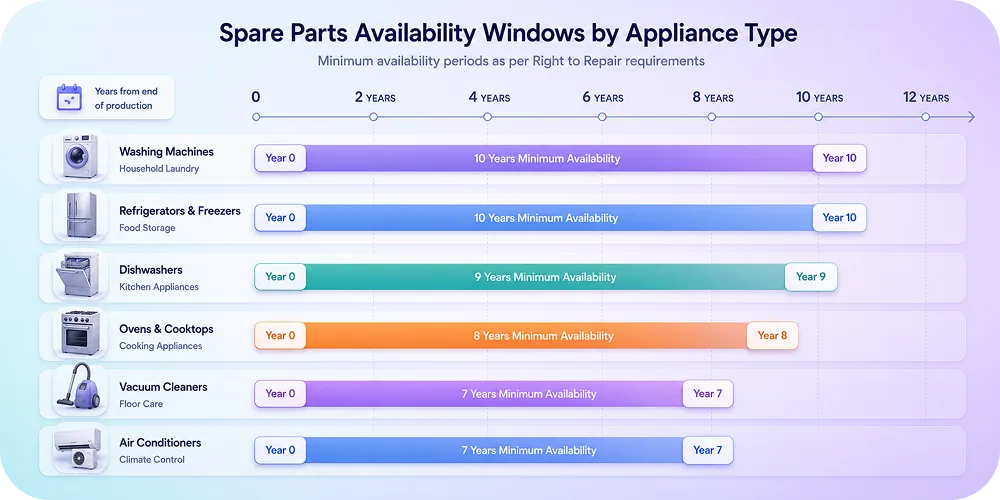
Manufacturers must make essential spare parts available for a minimum period after the last unit of a model is placed on the market:
- Washing machines and washer-dryers: 10 years for professional repairers, 10 years for consumers (for certain parts)
- Dishwashers: 10 years
- Refrigerators and freezers: 7-10 years depending on part type
- Electronic displays (TVs, monitors): 7-8 years
Parts must be delivered within 15 working days of order. Prices must be reasonable and published.
Repair information disclosure
Manufacturers must provide professional repairers and consumers with access to repair and maintenance information, including:
- Unambiguous appliance identification (model number, serial number)
- Disassembly maps and diagrams
- List of required repair tools
- Technical repair instructions
- Diagnostic fault and error codes with corresponding remedies
Design for repairability
Products must be designed so that spare parts can be replaced using commonly available tools. Fasteners must be reusable. Disassembly sequences must not damage the product.
This has a direct impact on product development. Engineering teams need to factor repairability into the design process, not bolt it on after launch.
The Operational Challenge for Appliance Brands
Home appliance brands face a unique set of challenges when implementing right to repair compliance.
Long product lifecycles
A washing machine sold today might generate a repair claim in 2033. Brands need systems that track warranty status, parts compatibility, and repair history across a decade or more.
Complex product architectures
Modern appliances contain electronic control boards, mechanical components, seals, pumps, and sensors. Diagnosing which component has failed from a customer's description requires specialized knowledge or AI-powered analysis.
High logistics costs
Shipping a 70kg washing machine for repair is expensive. In-home repair by a technician is the preferred model, but coordinating field service teams adds complexity. Spare parts need to be available locally or shipped fast enough to meet the 15-day delivery requirement.
Supplier coordination
Appliance brands often source components from dozens of suppliers. When a customer needs a replacement control board, the brand needs to know which supplier made that board, whether it is still in production, and how to get it to the customer or repair center quickly.
Claimlane's supplier forwarding automates this coordination, routing parts requests to the correct supplier with full claim documentation attached.
How AI Makes Appliance Repair Workflows Viable
Without AI, the economics of appliance repair at scale are difficult. Every claim requires diagnosis, every diagnosis requires product expertise, and product expertise is scarce and expensive.
AI-powered defect diagnosis
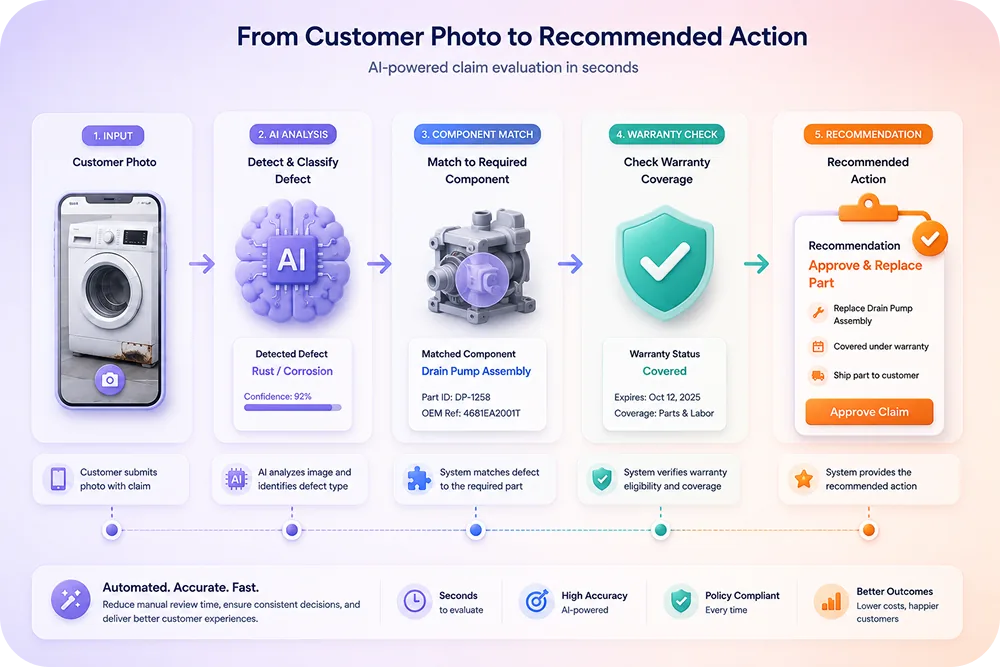
Claimlane's AI Agent, the first AI agent purpose-built for warranty claims and returns, changes this equation. When a customer submits a warranty claim with photos of a leaking dishwasher or a malfunctioning display panel, the AI Agent:
- Analyzes the images to identify the type and severity of the defect
- Cross-references the product model against known issues and technical service bulletins
- Checks warranty status and applicable regulations
- Recommends repair (with specific parts needed) or replacement
Automated repair-or-replace cost analysis
For expensive appliances, the repair vs. replace decision has major cost implications. AI models analyze:
- Estimated repair cost (parts + labor)
- Product age and remaining warranty
- Customer history and claim frequency
- Spare parts availability and lead times
- Regulatory requirements (is repair mandatory under Right to Repair?)
This analysis replaces gut-feel decisions with data-driven recommendations.
Proactive defect pattern detection
Warranty analytics powered by AI identify patterns across thousands of claims. If a specific washing machine model starts generating an unusual number of pump failure claims, the system flags it before it becomes a recall-level issue.
This proactive detection is valuable for GPSR compliance, which requires economic operators to monitor product safety and take corrective action when issues emerge.
Building a Right to Repair Strategy for Appliances
Compliance is the floor, not the ceiling. Brands that approach right to repair strategically gain competitive advantages.
Map every repairable component
Start by cataloging every component in every product that can be individually replaced. For each component, document: part number, compatible models, supplier, lead time, and expected failure rate.
Set up a warranty registration program
Warranty registration creates a direct link between a customer and their specific appliance. When a repair claim comes in, the system instantly knows the model, purchase date, and warranty status. This speeds up triage and ensures compliance.
Implement structured claim intake
Replace email-based claim handling with a self-service portal that collects structured data. For appliances, the portal should request:
- Model and serial number (can be scanned from the product label)
- Photos of the defect
- Description of symptoms (e.g., leaking, not heating, error code displayed)
- Preferred repair method (in-home, ship-in, local repairer)
Enable AI-powered triage
Connect Claimlane's AI Agent to handle the first pass on every claim. The AI determines whether the issue is repairable, identifies the likely component, and recommends next steps.
Build supplier parts agreements
Negotiate long-term spare parts agreements with component suppliers that guarantee availability for the required period (7-10 years). Use analytics to forecast demand and avoid overstocking.
Connect to ERP and logistics
Integrate the warranty and repair system with the ERP to automate credit memos, inventory updates, and shipping. When a repair is completed, the system should update all downstream records automatically.
Repair Economics: When Repair Beats Replacement
The economic case for repair depends on the product, the component, and the logistics involved.
The breakeven point
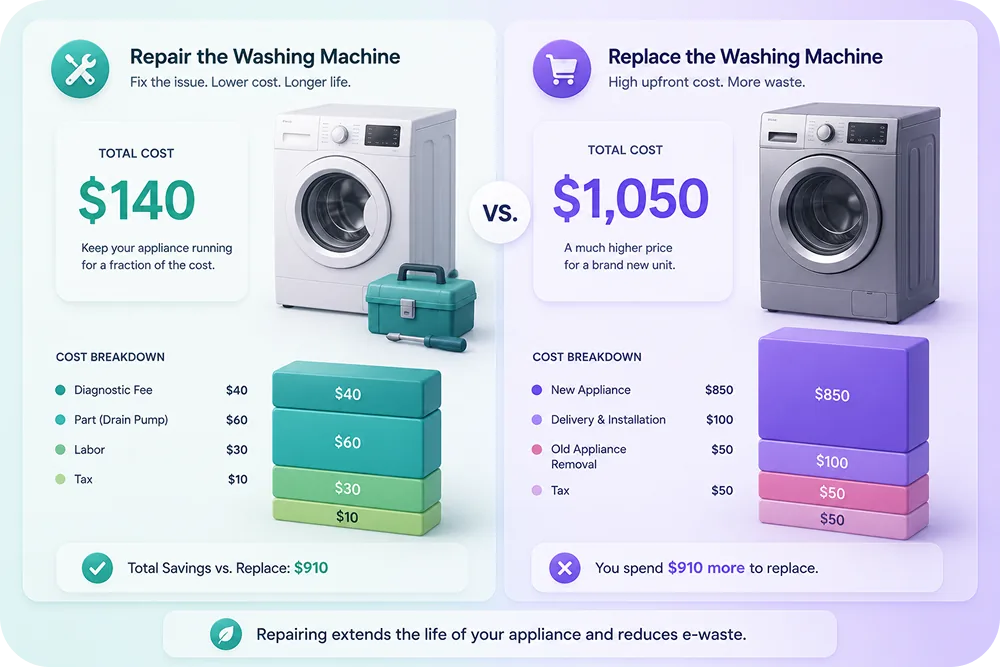
Repair is economically favorable when the cost of the spare part plus labor is less than the cost of a full replacement unit plus reverse logistics for the defective product.
For a $800 washing machine, a $60 pump replacement plus $80 for a technician visit ($140 total) is far cheaper than shipping a replacement unit ($800 + $150 shipping + $100 disposal of defective unit).
Where repair saves money
- High-value products: Refrigerators, ovens, washing machines. Repair savings are proportional to product cost.
- Common failure modes: If 70% of claims for a product involve the same component, stocking that part and training on that repair is highly efficient.
- In-warranty claims: During the warranty period, the brand bears the cost. Repair reduces that cost.
Where replacement may still win
- Low-value accessories: If the spare part costs nearly as much as the full product, replacement is simpler.
- End-of-life products: If the product is near the end of its spare parts availability window, replacement avoids the risk of future parts shortages.
What Happens If Appliance Brands Do Not Comply
Non-compliance carries real consequences.
Market access restrictions
Products that do not meet Ecodesign requirements (including repairability) cannot legally be sold in the EU. Market surveillance authorities can order products removed from sale.
Financial penalties
Member states set their own penalties for non-compliance, ranging from fines to product bans. The penalties vary but can be significant for large-volume appliance manufacturers.
Reputational damage
Consumer awareness of right to repair is growing. Brands that are seen as blocking repair or making it unnecessarily expensive face backlash. Conversely, brands that make repair easy gain trust and loyalty.
Case Studies: Appliance-Adjacent Repair Success
While the brands below are not appliance manufacturers specifically, their repair and warranty workflows demonstrate the principles that appliance brands need.
Black Diamond
Black Diamond manages warranty claims and repairs across a wide range of technical outdoor products. Claimlane handles the workflow from claim intake to repair resolution.
Davidsen
Davidsen, a DIY and hardware retailer, reduced warranty claim handling from a 5-person team to 1-2 agents using Claimlane's structured workflows.
Onyx Cookware
Onyx Cookware went from multi-day email-based warranty handling to same-morning resolution. Claims submitted at 8 AM are resolved by 10 AM.
The Right to Repair Roadmap for 2026 and Beyond
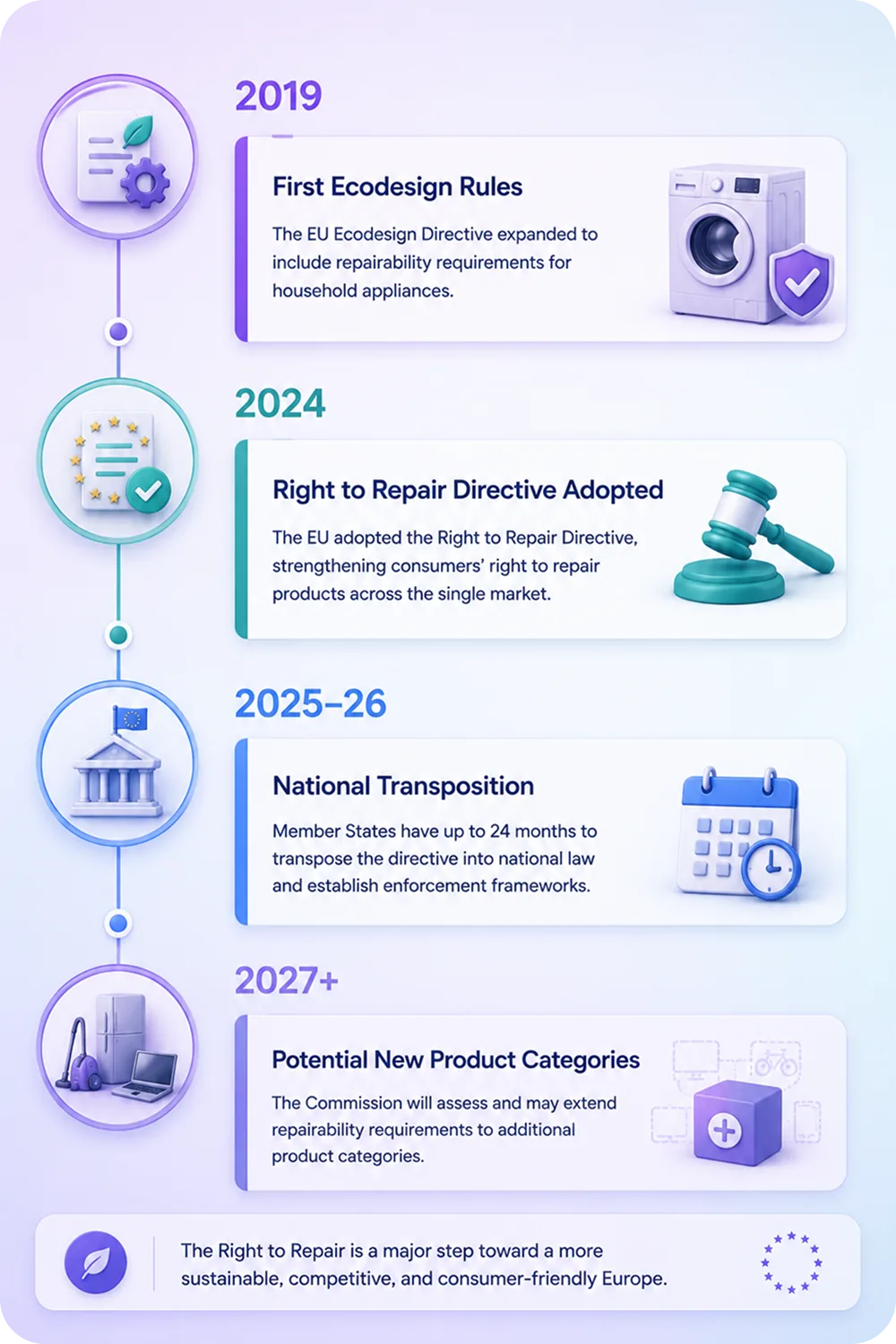
The regulatory landscape continues to evolve.
Expanding product categories
The European Commission is expected to extend Ecodesign requirements to more product categories, including textiles, furniture, and consumer electronics beyond displays. Appliance brands should watch these developments.
Repairability scoring
France already requires a repairability index score on certain products (smartphones, laptops, washing machines, TVs, lawnmowers). The EU is considering harmonizing this across all member states. Brands with strong repair workflows can score well, turning compliance into a marketing advantage.
Digital product passports
The EU Digital Product Passport initiative will require products to carry digital documentation of their composition, repairability, and environmental impact. Brands already using structured warranty registration and repair tracking are ahead of the curve.
Book a demo to see how Claimlane manages warranty and repair workflows for brands navigating right to repair compliance.