.webp)
Apparel and accessories have the highest return rates in ecommerce. Depending on the category, 30-50% of online clothing purchases get sent back. The number one reason: fit and appearance didn't match expectations.
Virtual try-on technology attacks this problem directly. Using augmented reality (AR), AI body mapping, and 3D rendering, customers can see how a product looks on them before placing an order. Glasses on their face. A jacket on their body. A watch on their wrist.
The brands deploying virtual try-on aren't doing it for novelty. They're doing it because it measurably reduces returns, increases conversion, and builds customer confidence in online purchases.
This article covers how virtual try-on works, which categories benefit most, implementation approaches, and how to measure the return-on-investment through reduced return rates.
- Fit and appearance mismatches drive 30-50% of apparel returns. Virtual try-on lets customers preview products on themselves before buying.
- AR face/body mapping, 3D garment rendering, and AI size prediction are the three core technologies.
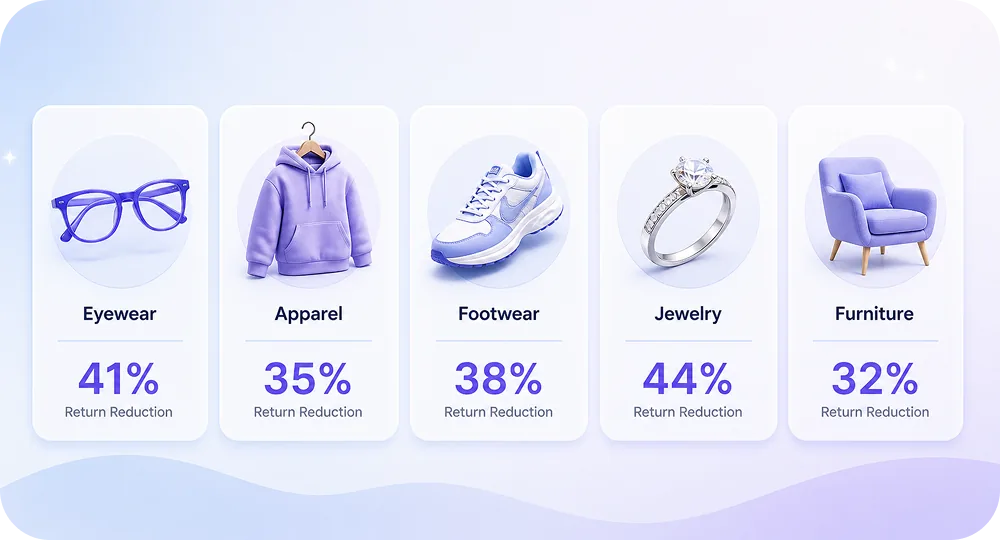
- Early adopters report 25-35% reductions in returns for try-on-enabled products.
- Claimlane's AI Agent captures structured return data to measure whether try-on tools actually reduce fit-related returns.
How Virtual Try-On Technology Works

Virtual try-on combines several technologies to create a realistic preview of how a product looks on a specific customer.
AR Face and Body Mapping
The smartphone camera captures the customer's face or body. AI models map facial landmarks (for eyewear, makeup, jewelry) or body proportions (for clothing, watches). The product is then rendered on top of the camera feed in real time, adjusting for angle, lighting, and movement.
Apple's ARKit and Google's ARCore provide the foundational AR capabilities. Specialized try-on platforms build product-specific rendering on top.
3D Garment Rendering
For clothing, the garment needs to look realistic on different body shapes. 3D garment simulation uses physics-based cloth modeling to show how fabric drapes, wrinkles, and moves on a specific body type. The inputs: a 3D garment model and the customer's approximate body measurements (from AI estimation or manual input).
AI Size Prediction
Virtual try-on often works alongside AI size recommendation. The customer inputs their height, weight, and fit preferences (or the AI estimates body measurements from a photo). The model predicts which size will fit best and shows the virtual try-on in that size.
This combination of visual try-on + size prediction addresses both "it looked different" and "it didn't fit" return reasons simultaneously.
Categories Where Virtual Try-On Reduces Returns Most
Eyewear
Eyewear was the first mainstream virtual try-on category. Warby Parker, Ray-Ban, and hundreds of DTC brands now offer AR try-on for glasses and sunglasses. The technology is mature: face mapping is accurate, frame rendering is realistic, and the experience works well on mobile.
Return reduction: Eyewear brands with virtual try-on report 25-30% lower return rates compared to products without try-on.
Apparel and Fashion
Clothing try-on is harder because garments need to drape realistically on different body types. But the technology is catching up. Brands like ASOS, Zara, and several DTC fashion labels are testing AI-powered virtual fitting rooms.
The biggest impact: reducing bracketing (customers ordering multiple sizes and returning the ones that don't fit). Virtual try-on with size prediction cuts this behavior significantly.
Footwear
Shoe try-on uses foot scanning (via smartphone camera) to map foot dimensions, then shows how a shoe looks on the customer's foot. Nike's and several other brands' foot scanning features have shown measurable reductions in size-related returns.
Jewelry and Watches
Small, high-value products like rings, necklaces, and watches benefit from AR try-on because customers want to see how the piece looks on their specific body. Wrist size for watches, finger size for rings, and neckline proportions for necklaces all affect the purchase decision.
Home Decor and Furniture
Furniture AR isn't body-based but room-based. Customers place virtual furniture in their actual room using their smartphone camera. IKEA Place was an early example. The technology reduces furniture returns driven by size mismatches and style incompatibility.
The Business Case for Virtual Try-On

Reduced Return Costs
Every returned item carries costs: shipping, processing, restocking, and potential markdowns. For apparel brands with 30%+ return rates, the true cost of returns can eat 20-30% of gross margin. Virtual try-on that reduces returns by 25-35% delivers direct bottom-line impact.
Higher Conversion Rates
Customers who try products virtually convert at higher rates because they buy with more confidence. They've already seen how the product looks on them. The hesitation of "will this look right on me?" is resolved before the add-to-cart click.
Lower Bracketing Behavior
Bracketing costs brands money even when the customer keeps one item. They still process and reship 2-3 returns per order. Virtual try-on with size prediction reduces the need to order multiple sizes.
Better Customer Data
Virtual try-on generates valuable data: which products customers try on, which sizes they consider, where they drop off. This feeds into predictive returns analytics and product development.
Measuring Try-On Impact With Returns Data
Virtual try-on only works if it actually reduces returns. To prove that, brands need structured return reason data that separates fit-related returns from other reasons.
What to Track
- Return rate by try-on usage: Compare return rates for customers who used try-on vs. those who didn't for the same products.
- Return reason breakdown: Are fit-related returns ("wrong size," "didn't look as expected") decreasing while quality returns remain stable?
- Bracketing rate: Are customers ordering fewer sizes per purchase?
- Product-level impact: Which products benefit most from try-on? Which show no improvement?
Using Claimlane for Returns Measurement
Claimlane's AI Agent, the first AI agent purpose-built for warranty claims and returns, captures structured return reason data that makes this measurement possible. Through the self-service portal, customers select specific return reasons and provide details. The AI classifies these consistently, creating clean data for analysis.
Claimlane's analytics can then break down return rates by product, reason, and time period, showing whether try-on-enabled products actually have lower fit-related return rates.
Claimlane is rated 4.8/5 on G2 and conn
Implementation Approaches

SDK Integration
Most virtual try-on providers offer SDKs that integrate into existing ecommerce apps or websites. The brand provides 3D product models (or the provider creates them from photos), and the SDK handles the AR rendering, body mapping, and UI.
Implementation timeline: 4-8 weeks for a basic integration. Longer for custom experiences.
Third-Party Plugins
For Shopify and WooCommerce stores, several try-on providers offer plug-and-play apps. These require less development effort but offer less customization.
3D Product Asset Creation
The biggest bottleneck isn't the AR technology. It's creating 3D product models for every SKU. Options include:
- Manual 3D modeling: Most accurate but expensive ($50-200 per SKU)
- AI-generated 3D from photos: Faster and cheaper, improving rapidly in quality
- 3D scanning rigs: Hardware that captures products in 3D automatically
For large catalogs, AI-generated 3D models are the practical choice. Quality is now sufficient for most try-on use cases.
Progressive Rollout
Start with the highest-return products. If 80% of fit-related returns come from 20% of SKUs, equip those SKUs with virtual try-on first. Measure the impact, then expand.
Challenges and Limitations
Accuracy Gaps
Virtual try-on isn't perfect. Color rendering on different screens varies. Fabric drape simulation doesn't capture every material accurately. Body mapping from a smartphone camera has margin of error.
These gaps mean virtual try-on reduces returns significantly but doesn't eliminate them. Brands still need a solid returns management system for the returns that do happen.
Customer Adoption
Not all customers use virtual try-on even when available. Adoption rates typically range from 10-25% of product page visitors. The challenge: making the feature discoverable and easy to use without disrupting the standard shopping flow.
Cost of 3D Asset Creation
Creating 3D models for thousands of SKUs is expensive. Brands need to prioritize high-return products and use AI-assisted 3D generation to keep costs manageable.
Privacy Concerns
Body scanning and face mapping raise privacy questions. Brands must be transparent about data handling, offer opt-in experiences, and comply with data protection regulations like GDPR.
The Future of Virtual Try-On
Generative AI Fitting Rooms
Generative AI can now create realistic images of a customer wearing a specific garment from a single selfie. Instead of AR overlays, the output is a photo-realistic image. This approach is faster, works on any device, and doesn't require AR capabilities.
Cross-Category Try-On
Future platforms will let customers try on complete outfits, not just individual items. A customer selects a shirt, pants, and shoes, and sees all three on their body simultaneously. This reduces returns from style mismatch when items are purchased separately.
Integration With Return Policies
Brands are experimenting with return policy adjustments for try-on users. Some offer extended return windows for customers who don't use try-on (as an incentive to try the feature) while maintaining standard policies for try-on users who still return.
Real-Time Fit Feedback
AI models are starting to provide real-time fit warnings: "This shirt may be tight across the shoulders based on your measurements" or "This jacket runs long in the sleeves for your arm length." These text-based alerts complement the visual try-on experience.
FAQ: Virtual Try-On Technology
Conclusion: Try Before They Buy, Return Less
Virtual try-on technology is moving from novelty to necessity for ecommerce brands with high return rates. The math is simple: if 30% of apparel purchases come back and virtual try-on cuts fit-related returns by 25-35%, the margin impact is massive.
But measuring that impact requires structured return data. Claimlane captures exactly the return reason granularity needed to prove whether try-on tools are working, and which products still need improvement.
Book a demo to see how Claimlane's return analytics can measure the impact of virtual try-on on return rates.