.webp)
Intercom is good at the conversation. It is less good at the work behind the conversation: pulling the order, checking the warranty, processing the refund, looping the supplier. The right integration stack makes that work happen in the background while the agent stays in Intercom.
This list covers 11 integrations ecommerce brands actually use in 2026, sorted by what they do for the customer journey. Returns and warranty come first because for physical-goods brands that is where most of the support hours live.
TL;DR
- The Intercom App Store has 250+ apps, but ecommerce brands really only need 8-12 to cover the full customer journey.
- Returns and warranty (Claimlane), commerce (Shopify), email (Klaviyo), and payments (Stripe) cover 70% of post-purchase support tickets.
- The rest depends on team size: Slack and Linear for routing, Aircall for voice, HubSpot or Salesforce for CRM.
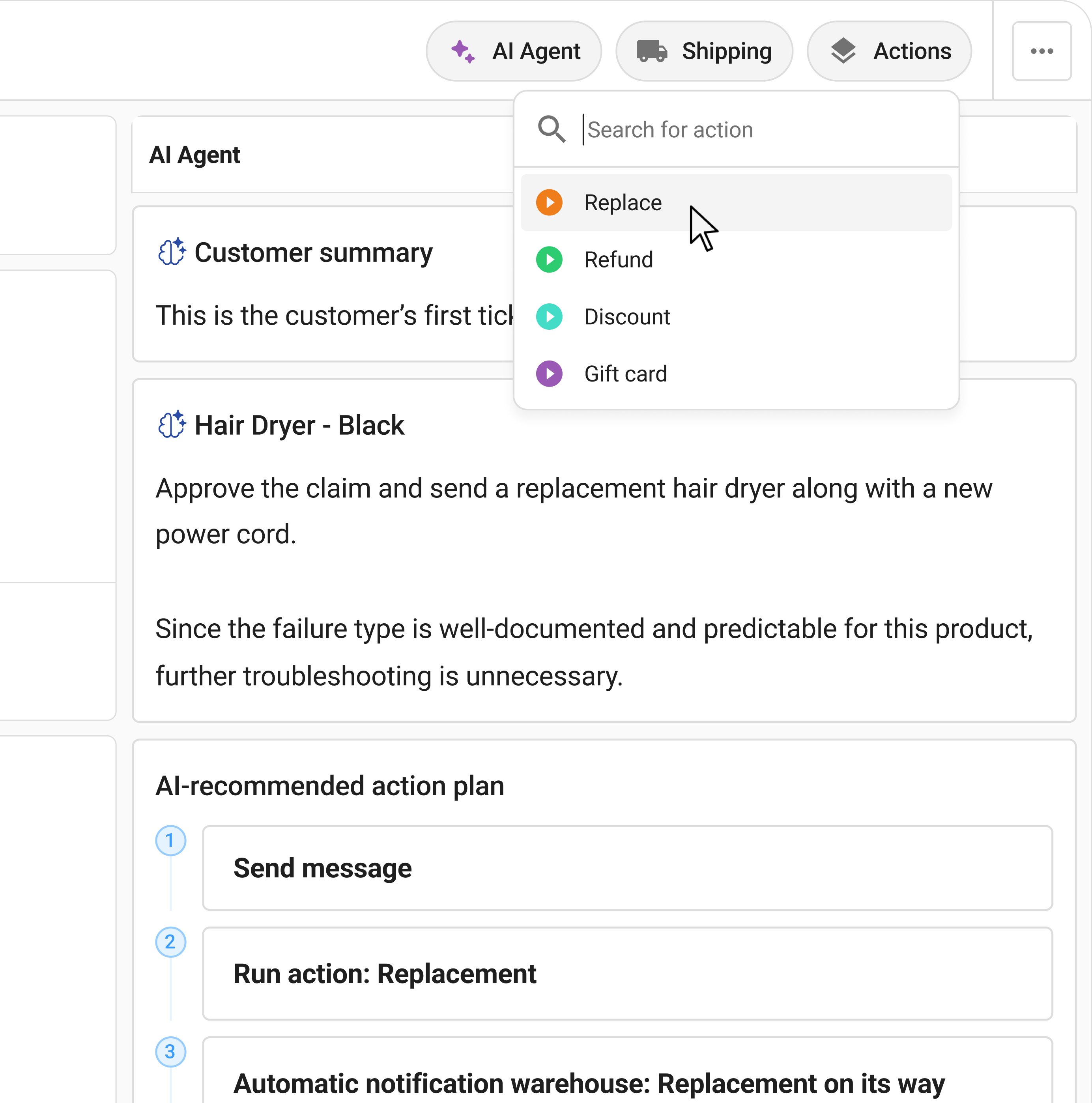
- Claimlane's AI Agent integrates with Intercom to resolve warranty and return claims without leaving the inbox.
Quick Comparison
| Integration | Category | Best Use | Pricing Tier |
|---|---|---|---|
| Claimlane | Returns + Warranty | Claim resolution in the inbox | Custom |
| Shopify | Commerce | Order lookup, refunds | Free |
| Klaviyo | Customer profile context | Klaviyo plan | |
| Stripe | Payments | Refund actions, charge lookup | Free |
| HubSpot | CRM | Contact sync, lifecycle stage | HubSpot plan |
| Salesforce | CRM | Enterprise account context | Salesforce plan |
| Aircall | Voice | Inbound calls in Intercom | Aircall plan |
| Slack | Team comms | Escalations, alerting | Free |
| Linear | Engineering | Bug routing from tickets | Linear plan |
| Calendly | Scheduling | B2B onboarding bookings | Free / paid |
| Yotpo | Reviews | Review prompts post-resolution | Yotpo plan |
For a wider view of customer service stacks, the best ecommerce customer service software guide and the customer service automation platforms roundup cover adjacent tools.
Why Trust This Comparison
This list comes from a team that builds returns and warranty software used by brands like Black Diamond, Luksusbaby, Konges Sløjd, and Babysam. Claimlane integrates with Intercom and a wider stack of 75+ tools. Reviews on G2 sit at 4.8/5.
"We finally have warranty and repair workflows automated, so agents in the inbox can resolve cases without context-switching."
1. Claimlane: Returns and Warranty in Intercom
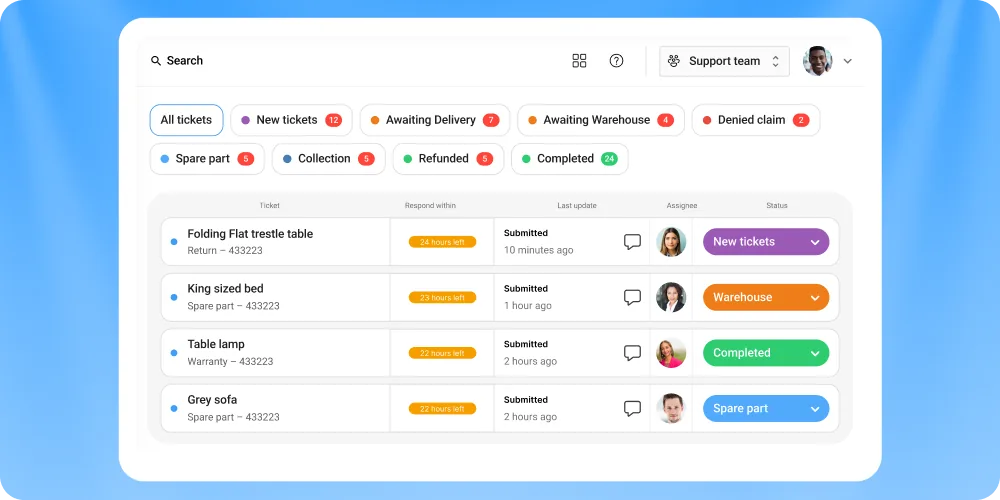
Claimlane is a returns and warranty management platform for brands and retailers. It handles claims, repairs, replacements, returns, and spare parts from one system. The Intercom integration sends claim context into the conversation so the agent does not have to flip between tabs.
Why people choose Claimlane for Intercom
Most Intercom-using ecommerce brands hit the same wall: the inbox is great for the conversation, terrible for the claim. Order details, warranty rules, supplier history, and proof images live elsewhere. The Claimlane integration brings all of that into the Intercom view, and Claimlane's AI Agent, the first AI agent purpose-built for warranty claims and returns, can adjudicate routine cases without an agent touching them.
Pros and cons
Pros
- Claim, warranty, and supplier context in the Intercom conversation
- AI claim review applied to image and video proof
- [Self-service portal](https://www.claimlane.com/product/self-service-portal) deflects routine cases before they reach Intercom
- Workflow engine handles repairs, replacements, refunds, spare parts
- 75+ tool integrations across the ecommerce stack
Cons
- Overkill for shops with low warranty volume
- Pricing is custom, no public starter tier
- Some advanced supplier flows need onboarding time
Core features
- AI Agent reviews claim photos and videos, applies warranty rules per supplier and SKU
- Self-service claim portal customers can open from Intercom or directly from the brand site
- Workflow engine for repairs, replacements, refunds
- Supplier claim handoff with proof packages
- Analytics on faulty products, see the analytics page
Pricing
Custom pricing based on volume and number of suppliers. Most brands land mid-market to enterprise.
Product in action
Screenshot suggestion: Intercom conversation pane with Claimlane claim card showing order, photos, warranty status, and AI recommendation.
A typical flow: customer messages Intercom about a damaged jacket. Agent clicks the Claimlane card. Order, warranty status, and AI claim review appear inline. Agent confirms the AI recommendation. The case closes in the same conversation.
Book a walkthrough at /book-demo.

2. Shopify
The Shopify app for Intercom is the foundation for any Shopify brand. It pulls order, customer, and product data into the conversation pane. Refunds can be issued from inside Intercom on simple cases.
Best for: every Shopify brand. The Shopify returns guide and the best Shopify tools cover the wider picture.
Limits: order context only. No warranty logic, no supplier handoff, no repair workflows.

3. Klaviyo
Klaviyo provides Intercom with email engagement context: which campaigns the customer opened, segments they sit in, lifecycle stage. Agents use it to tailor tone in high-value VIP conversations.
Best for: brands running mature email programs. See the best Klaviyo integrations for ecommerce for a wider list.
Limits: marketing data only. No transactional or warranty layer.

4. Stripe
The Stripe app for Intercom shows recent charges, subscription state, and lets agents process refunds without leaving the conversation. Useful for subscription brands and DTC brands using Stripe Checkout.
Best for: subscription and DTC brands.
Limits: payment context only. The payment reversals and chargebacks guide explains where it stops mattering and where claims start.

5. HubSpot
HubSpot in Intercom gives agents contact and deal context, lifecycle stage, and recent activity. Common in mid-market B2B brands or hybrid B2B/DTC.
Best for: brands using HubSpot as primary CRM. Wider stack tips in the best HubSpot integrations for ecommerce.
Limits: CRM-centric. Warranty and returns still need a dedicated tool.
6. Salesforce
For enterprise brands, Salesforce in Intercom pulls account, opportunity, and case data into the conversation. Common in B2B ecommerce or where the same brand sells through a B2B channel.
Best for: enterprise ecommerce, especially with a B2B side of the business.
Limits: heavy setup, weak fit for pure DTC. See Salesforce integrations for business.
7. Aircall
Aircall brings inbound voice into Intercom. Agents can take calls in the same window where they handle messaging. Call recordings attach to the conversation.
Best for: brands handling phone volume for high-ticket items (furniture, electronics, B2B).
Limits: voice infrastructure adds cost. Better for brands with real call volume, not as a checkbox feature.

8. Slack
Slack and Intercom is the default escalation route. Tickets above a threshold post to a dedicated channel. Internal experts join the thread without joining Intercom.
Best for: every team above 10 agents.
Limits: alerting only. No workflow, no resolution.
9. Linear
Linear in Intercom turns customer reports into engineering tickets. Bug reports route from the conversation to the right Linear project. Useful for digital-heavy ecommerce (subscriptions, mobile apps).
Best for: brands with significant product engineering work.
Limits: not relevant for purely physical-goods support.
10. Calendly
Calendly in Intercom lets agents drop a scheduling link into the conversation. Common in B2B onboarding or in furniture brands where a customer wants to schedule a callback or delivery.
Best for: B2B onboarding, white-glove DTC, furniture brands.
Limits: scheduling only.
11. Yotpo
Yotpo in Intercom triggers a review request after a positive resolution. The review is more likely to land 5 stars because the customer just had a good experience.
Best for: brands running reviews as a growth lever.
Limits: reviews only. The post-purchase experience piece covers why the moment after a resolution matters more than any other touchpoint.
How to Choose the Right Stack
The right stack depends on three things.
1. What share of tickets are post-purchase?
If 50%+ of Intercom tickets are returns, warranty, or repair, the highest-leverage integration is the one that owns those workflows. Claimlane fits there. The customer service workflows for returns piece covers what good looks like.
2. What is the team size?
Under 5 agents: Shopify, Stripe, Klaviyo, Claimlane, Slack. That is the minimum stack.
5-20 agents: add HubSpot or Salesforce for CRM context, Aircall if voice is real.
20+ agents: add Linear for engineering routing, Calendly for B2B touchpoints, Yotpo for the review loop.
3. What is the platform of record?
If Shopify is the source of truth, the Shopify app is mandatory. If the brand runs a custom build, Claimlane integrates with 75+ tools and connects to the core stack. The best ecommerce integrations roundup maps the wider field.
Hidden Costs of Intercom Integrations
Intercom integrations look great in the demo. They start to crack around 5,000 monthly tickets. Three failure modes recur across mid-market and enterprise brands.
Sync drift between Intercom and the system of record. Customer attributes change in Shopify, the Intercom cache is two hours behind, and the agent gives the wrong refund window. The fix is bi-directional webhooks on the fields that matter (order status, warranty status, return eligibility), not just nightly batch syncs. Most off-the-shelf integrations are built on batch, and most teams find out the hard way after a few high-value cases go sideways.
Identity mismatch on multi-channel customers. A customer messages from a logged-in mobile session, then again from email, then again from a guest checkout. Intercom sees three different users. The brand sees one frustrated person. The fix is to stitch identity through Intercom's user merge logic and an external customer-ID source. Brands that skip this end up with personalisation that breaks at the worst possible moment, the high-emotion claim conversation.
Agent fatigue from over-notification. Every integration wants to post into Intercom. Shopify posts order updates. Klaviyo posts engagement events. Slack posts escalations. Yotpo posts review requests. After two months, agents tune out the side panel because it is too noisy. The fix is a strict notification ranking: only the events that change the next action belong in the conversation pane. Everything else goes to an analytics view nobody opens during a live ticket.
These are the issues that turn a "best integration stack" article into a real implementation. The customer service workflows for returns piece covers the workflow side, and the post-sales ticketing system piece covers the routing side. The contact center automation piece covers the broader scaling pattern.
Industry Notes
For baby and nursery brands, the Claimlane integration handles the warranty volume that an Intercom-only setup cannot. Luksusbaby and Babysam both run this combination. For outdoor and sporting goods brands, the repair workflow matters more than the refund flow, which is why Black Diamond's setup is a useful reference.
A related read is the Aftership alternatives guide for brands looking at the tracking side, and the AI customer success playbook for teams designing retention flows on top of Intercom.
"Data quality on retailer claims jumped the moment we automated the intake. Intercom feels lighter now."
FAQ
Does Intercom have a native warranty integration? +
Is the Shopify Intercom integration free? +
Can agents process refunds from Intercom? +
Which Intercom integration is best for B2B ecommerce? +
How does Claimlane compare to Zendesk RMA? +
Conclusion
Intercom is the inbox. The integrations decide whether the inbox is a place where work actually gets resolved or just a place where it gets logged. For ecommerce brands, the top of the stack is returns and warranty, because that is where the support hours actually live.
Claimlane brings claim context, AI review, and supplier handoff into the Intercom conversation. Book a walkthrough at /book-demo to see it on a sample claim.