.webp)
Most write-ups of the EU Battery Regulation read like a filing checklist. Re-register by January, relabel by August, join a producer responsibility organisation, done.
That framing misses where the money moves. A registration is a one-time admin cost. The takeback obligation is a recurring operational cost, and it lands on the one process most brands have not wired for it: returns.
When a customer sends back a cordless drill, an e-bike battery, or a pair of powered headphones, that return now carries a regulated component with takeback, reporting, and safe-handling duties attached. The compliance guides that rank for this term, EcoComply, Lufapak, the law firms, describe the rule from the regulator's seat. None of them describe what the returned battery does once it hits a brand's claim queue. That gap is the whole article.
EU Battery Regulation, in plain terms
Regulation (EU) 2023/1542 replaces the old Batteries Directive and makes producers responsible for batteries across their full life, including collection and end-of-life takeback. It covers portable, LMT (light means of transport), industrial, EV, and starter batteries, and it ties registration, labelling, and extended producer responsibility into one framework.
For a brand selling battery-powered products into the EU, the practical translation is simple. Every battery placed on the market has to be accounted for, and a route has to exist for it to come back.
The 2026 dates that change the work
The calendar is what makes this a 2026 problem rather than a someday problem. Three dates do most of the damage to a brand's operating plan, and each one touches a different part of the warranty and returns process.
Distributors also pick up a free-of-charge takeback duty at or near the point of sale for waste EV and LMT batteries. For an omnichannel brand with a dealer network, that duty does not stay at head office. It spreads across every channel that sold the product.
Takeback is a returns problem, not a filing problem
Here is the part the legal summaries leave out. A takeback obligation only means something when a battery physically comes back, and the moment a battery comes back, it is a return.
That return needs an intake step that records the battery category and chemistry, a safe-handling flag because a swollen lithium cell is a hazard, a disposition decision (repair, refurbish, recycle, or route to a PRO), and a data trail that proves the brand did the right thing. A brand already running a structured returns management system has most of that scaffolding. A brand running returns over email has none of it.
The overlap with safe shipping is direct, since a returned battery is also a dangerous-goods shipment the second it leaves the customer. The regulation and the carrier rules are pulling on the same return.
The data the regulation wants is claim data
The Battery Regulation does not just want batteries back. It wants numbers. Quantities placed on the market, categories, chemistries, and end-of-life volumes, reported in the digital format the April 2026 implementing rules define.
That is the same structured data a good claim record captures anyway. When a returned battery is logged against a product, a serial, and a reason code, the reporting stops being a separate annual scramble and becomes a query. Brands that already run serialized product defect tracking and serial number tracking software are most of the way there, because the unit is identified the moment it returns.
The brands that struggle are the ones whose battery returns live in a spreadsheet, a 3PL inbox, and a help desk, none of which can answer "how many LMT batteries came back last quarter, and what happened to each one."
Where the cost actually shows up
Nobody files a P&L line under "battery chemistry." The cost hides inside support time, scrap, and lost supplier recovery.
A battery return that is handled by hand costs more than a normal return because it needs an evidence step, a safety check, and a disposition decision a generic refund flow never asks for. At even a modest volume, that delta is real money.
| What the compliance guides cover | What the returns operation actually needs |
|---|---|
| Register and re-register producers | A route for every battery to physically come back |
| Join a producer responsibility organisation | Disposition logic: repair, refurbish, recycle, PRO |
| Apply expanded labelling | Safe-handling flag and evidence at intake |
| Report quantities annually | Claim-level data that makes reporting a query |
| Treat it as legal compliance | Treat it as a returns and recovery workflow |
The finance angle that the guides miss: brands that route faulty battery products through a structured supplier claim instead of scrapping them recover a share of the defect cost. Recovering even 30% of defect cost from suppliers, the kind of result supplier chargeback recovery is built for, turns a compliance cost center into a partial offset. Davidsen went from 5 claims agents to 1 to 2 after moving its warranty and returns onto one platform, which is the FTE math a CFO reads quickly.
Building battery takeback into the claims workflow
The operational answer is to treat a battery return as a claim type with its own rules, not a special case someone handles by memory.
That means a self-service portal that asks for the model, serial, and condition photos at submission, workflow automation that routes a swollen or damaged cell to safe handling and a healthy one to refurbishment, and forward-to-supplier logic so the defect cost goes back up the chain. The reporting then falls out of analytics instead of a year-end panic.
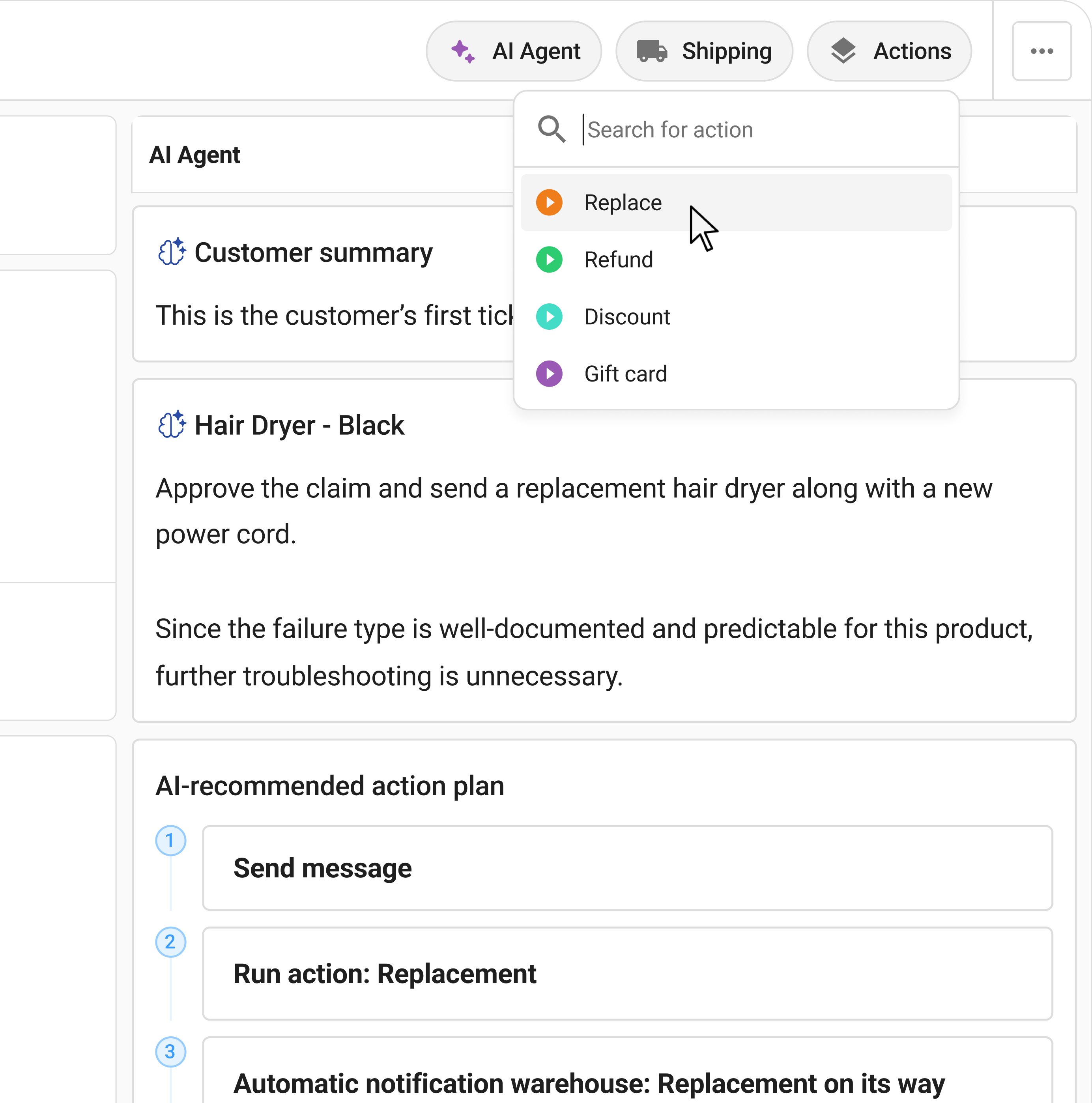
Image review helps at volume. Claimlane's AI Agent, the first AI agent purpose-built for warranty claims and returns, reviews the condition photos on a returned battery product, applies the brand's rules per product and supplier, and recommends a disposition. The guardrails matter here because safety does: high-risk cases stay human-in-the-loop, the rules are configurable rather than a black box, and every decision leaves an audit trail, which is exactly what a regulator-facing process needs. The same image-review approach powers AI image recognition for warranty claims.
Generic returns app or claims platform: the two-tier reality
This is where the platform choice gets decided. A size-and-fit returns app built for Shopify fashion can issue a refund and print a label. It was never built to record battery chemistry, flag a hazard, drive a disposition decision, and feed regulated reporting.
That is the two-tier split. Simple size and fit returns belong with the generic post-purchase apps. Complex, regulated, evidence-heavy returns, faulty batteries among them, belong on a specialist platform that runs alongside them as the execution layer. Brands weighing the broader market often start with the best reverse logistics software and the best returns management software, then split simple from complex.
Are you ready for battery takeback at scale?
Battery takeback readiness check
- 50+ battery-product returns or claims a month
- Multi-supplier battery exposure (3+ suppliers driving volume)
- Multi-channel sales (D2C, retail, dealer, marketplace)
- Photo-required intake for condition and safety
- Significant FTE time on battery return handling
- Supplier chargeback opportunity on defective cells
Three or more yes answers means battery takeback should run as a claim type, not a manual exception.
The brands that should worry are the warranty-heavy ones with repairs and spare parts, because they already see the volume. A brand handling a handful of battery returns a year can manage by hand. A brand handling fifty a month cannot, and the regulation only pushes that number up as collection targets rise.
What to measure
Track battery return volume by category, because the regulation reports on it and so should the brand. Track disposition mix, the share that gets repaired or refurbished versus recycled, since that ratio is both a cost lever and a sustainability story. Track supplier recovery rate on defective batteries, the number that tells finance whether the takeback duty is a pure cost or a partial offset.
The regulation is not going to get simpler. The brands that wire battery takeback into the returns flow now will report by query and recover by default. The ones that treat it as a filing exercise will find the cost waiting in the returns queue, where it was always going to land. Related reading sits in the environmental impact of warranty claims and repair workflows under EU compliance.
Claimlane scores 4.8 out of 5 on G2, and the reason that matters for battery takeback is support: a regulated return process fails quietly when no one answers the operator's questions.
Ready to handle battery returns as a workflow instead of an exception? Book a demo.
FAQ
Does the EU Battery Regulation apply to ecommerce brands selling from outside the EU?
Yes. Producer obligations follow the act of placing a battery on the EU market, including online sales to EU customers, so non-EU brands carry registration, takeback, and reporting duties through an authorised representative.
What is the difference between battery registration and battery takeback?
Registration is a one-time administrative step that records a producer and its battery categories. Takeback is the ongoing duty to provide a route for waste batteries to come back and be properly handled, which is where the recurring returns cost sits.
How do brands handle returned batteries safely?
By capturing condition photos at intake, flagging swollen or damaged cells for dangerous-goods handling, and routing each unit to a disposition: repair, refurbishment, recycling, or a producer responsibility organisation. A structured claim record keeps the evidence and the decision together.
Can battery takeback data feed regulatory reporting automatically?
When battery returns are logged against products, serials, and reason codes, the quantities and categories the regulation asks for become a query rather than a manual collection exercise. Analytics built on claim data produces the reporting as a by-product.