.webp)
A contractor's impact driver dies at 8 a.m. on a job that has to ship Friday. The standard warranty path asks him to box it up, send it in, wait for inspection, and wait again for a repair or replacement. That is a week of a tool he needs today, and a week of a customer deciding whether to buy this brand again.
An advance replacement program flips that order. The brand ships a working unit first, the customer keeps working, and the faulty one comes back after. For downtime-sensitive products, that single change decides retention.
The catch is that shipping first is easy to promise and hard to run. It only holds together with warranty rules, stock visibility, and a reliable way to chase the return. That is workflow, and it is exactly what a return management system built for warranty is meant to handle.
A drill dies mid-job: the case for shipping first
Picture the same scenario across categories. A studio's audio interface fails before a session. A cyclist's bike computer bricks two days before a race. A clinic's handheld scanner stops reading. In each case the product itself is replaceable, but the time without it is the real cost.
Standard warranty handling optimises for the brand's risk. Advance replacement optimises for the customer's uptime. The brands that win in these categories have decided uptime is worth more than the small risk of shipping before inspection. It is the same logic behind exchange-first resolutions that retain revenue: keep the customer in the product instead of handing back cash.
What an advance replacement program is
At its core, advance replacement is a warranty resolution type. Instead of repair, refund, or return-then-replace, the sequence is replace-then-return. It sits alongside the other resolution paths a brand offers, and the decision of which path to use is a rules question, not a one-off judgment call.
That places it in the same family as a standard return merchandise authorization, with one difference that changes everything downstream: the replacement moves first. Everything about stock, accounting, and return-chasing has to account for that ordering.
Advance replacement vs repair-first vs standard RMA
Brands often treat these as interchangeable. They are not. The right choice depends on product value, downtime sensitivity, and how repairable the item is. The repair versus replace decision is the backbone here, and advance replacement is the fastest-resolution branch of it.
For a dead-on-arrival unit, advance replacement is almost always the right call, since making a customer wait on a product that never worked is the fastest way to lose them. That overlap with dead on arrival claims is where many brands start before widening the program.
The economics of cross-shipping
Advance replacement carries two real costs: a pool of swap stock tied up to ship on demand, and the exposure on units that never come back. Both are manageable, and both are smaller than they look once weighed against retention.
A practical way to frame it for finance: model the program as a swap-stock holding cost plus a small expected loss on unreturned units, set against the refunds avoided and the repeat-purchase value of customers kept in the product. In downtime-sensitive categories, the retained customer value tends to clear that cost comfortably. Mapping it against claims and returns analytics turns the program from a gut call into a number a CFO can sign off.
When to offer advance replacement, and when not
Advance replacement is not a default for every SKU. It earns its place where downtime hurts and the warranty status is clear. Offering it on a low-value, easily abused item invites loss with little retention upside.
For lower-value or high-abuse items, a standard RMA or a returnless decision is usually the better economic call. The point is to make the path a rule tied to product, value, and customer, not a case-by-case argument every time.
Controlling the risk of shipping before you inspect
The honest objection to advance replacement is the unreturned unit. Ship first, and some customers never send the original back. The fix is process, not hope.
Three controls do most of the work. Verify the claim with structured evidence before the replacement ships, so the AI review and warranty rules confirm coverage up front. Set a clear return window with automated reminders. And hold an authorization or invoice trigger that activates only if the original is not returned in time. Together these keep losses to a thin, predictable line. Capturing the evidence cleanly is the same discipline behind good serialized product defect tracking.
Running advance replacement without manual chaos
Done by hand, advance replacement is a mess of spreadsheets: who got a replacement, which originals are outstanding, which warranties were valid, which suppliers owe credit. At any volume that breaks.
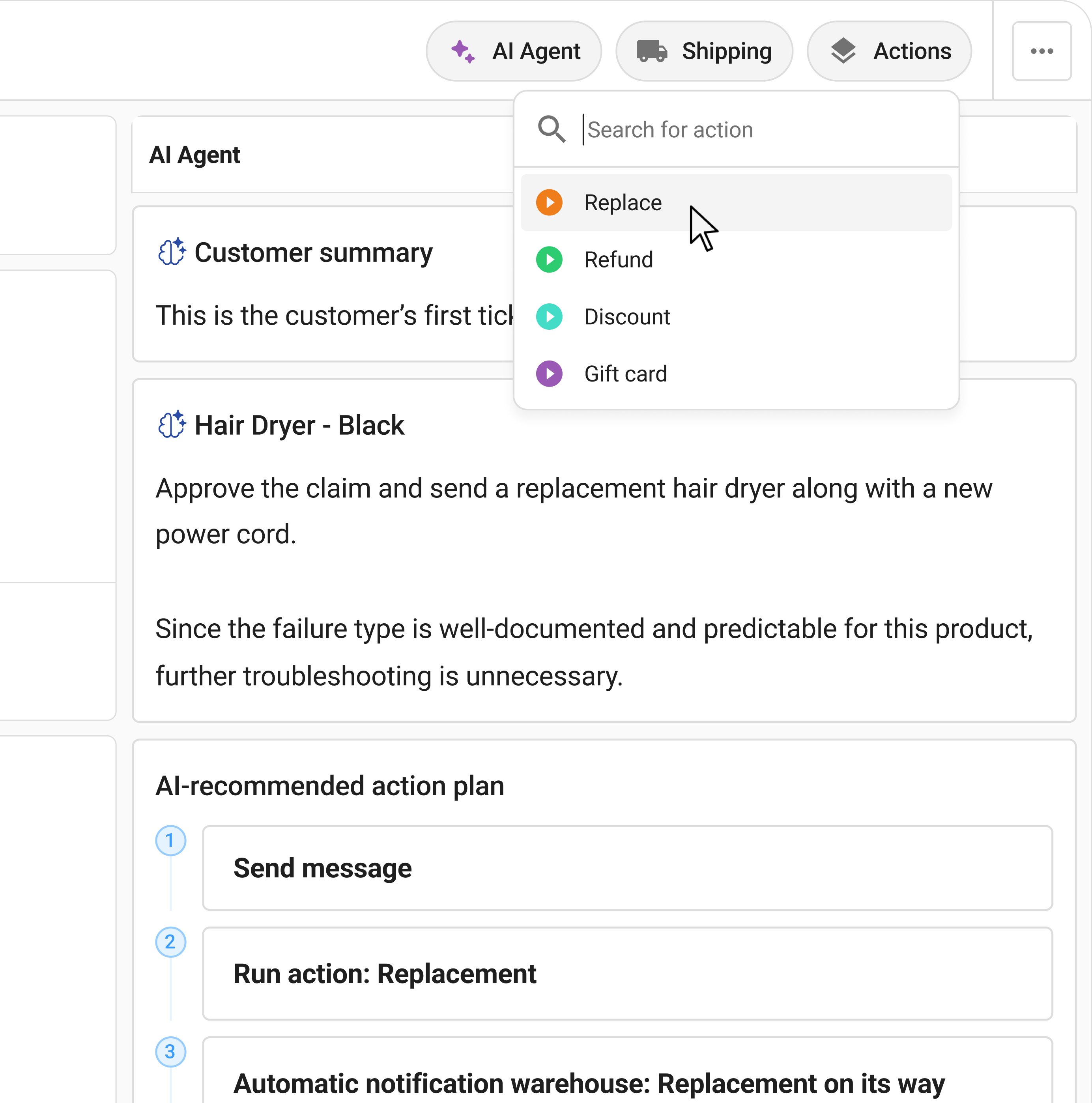
Claimlane runs the program as a workflow. Claimlane's AI Agent, the first AI agent purpose-built for warranty claims and returns, reviews the submitted photos, video, and serial number, applies the warranty rules for that product and supplier, and confirms eligibility before a replacement is authorised. From there the claim and repair workflows track the outstanding return, fire reminders, and flag any unit that misses its window.
The customer side runs through a self-service portal where they submit the claim and get the replacement moving without a support queue. And because Claimlane connects to commerce and ERP systems like NetSuite, Business Central, and Shopify through its integrations, swap stock and credits stay reconciled instead of drifting. This is where Claimlane sits versus a general size-and-fit returns app such as Loop Returns: simple exchanges to those tools, complex warranty resolutions like cross-ship to Claimlane.
Advance replacement for dealer networks and B2B
Cross-ship gets more valuable, and more complicated, the moment a dealer or distributor sits between the brand and the end user. A dealer cannot afford a customer waiting, and the brand cannot afford losing track of which units sit where across the network.
This is the omnichannel-with-dealer-network case, and it is where manual handling fails first. Hybrid flows that mix B2C and B2B need one system that knows the warranty terms, the dealer agreement, and the stock position at once. Claimlane is built for that hybrid, the same way it handles B2B warranty claims and the practical work of how to simplify B2B returns. For brands carrying their own service operation, it also ties back to spare parts and field support so a replacement and a repair are not two disconnected processes.