.webp)
Every return is a decision point. The customer has already decided the original product is not working out. The question is what happens next: does the money leave the business entirely (refund), or does it stay in the ecosystem (exchange or store credit)?
For most ecommerce brands, the default is a refund. The customer returns the product, gets their money back, and the transaction is closed. But that default costs brands billions in lost revenue every year. According to the National Retail Federation, US retail returns exceeded $740 billion in 2023, and only a fraction of those were converted to exchanges.
An exchange-first strategy flips the default. Instead of making refunds the easiest option, it makes exchanges and store credit the path of least resistance. The goal is not to trap customers or make refunds difficult. It is to present better alternatives that serve both the customer and the brand.
This article covers how exchange-first strategies work, why they matter financially, and how to implement them without damaging customer trust.
- Exchange-first strategies make product exchanges and store credit the default return option, retaining revenue that would otherwise leave through refunds.
- Instant exchanges (shipping the new product before receiving the return) reduce friction and increase exchange conversion rates.
- Store credit with a bonus (e.g., 10% extra value) incentivizes customers to keep money in the brand ecosystem.
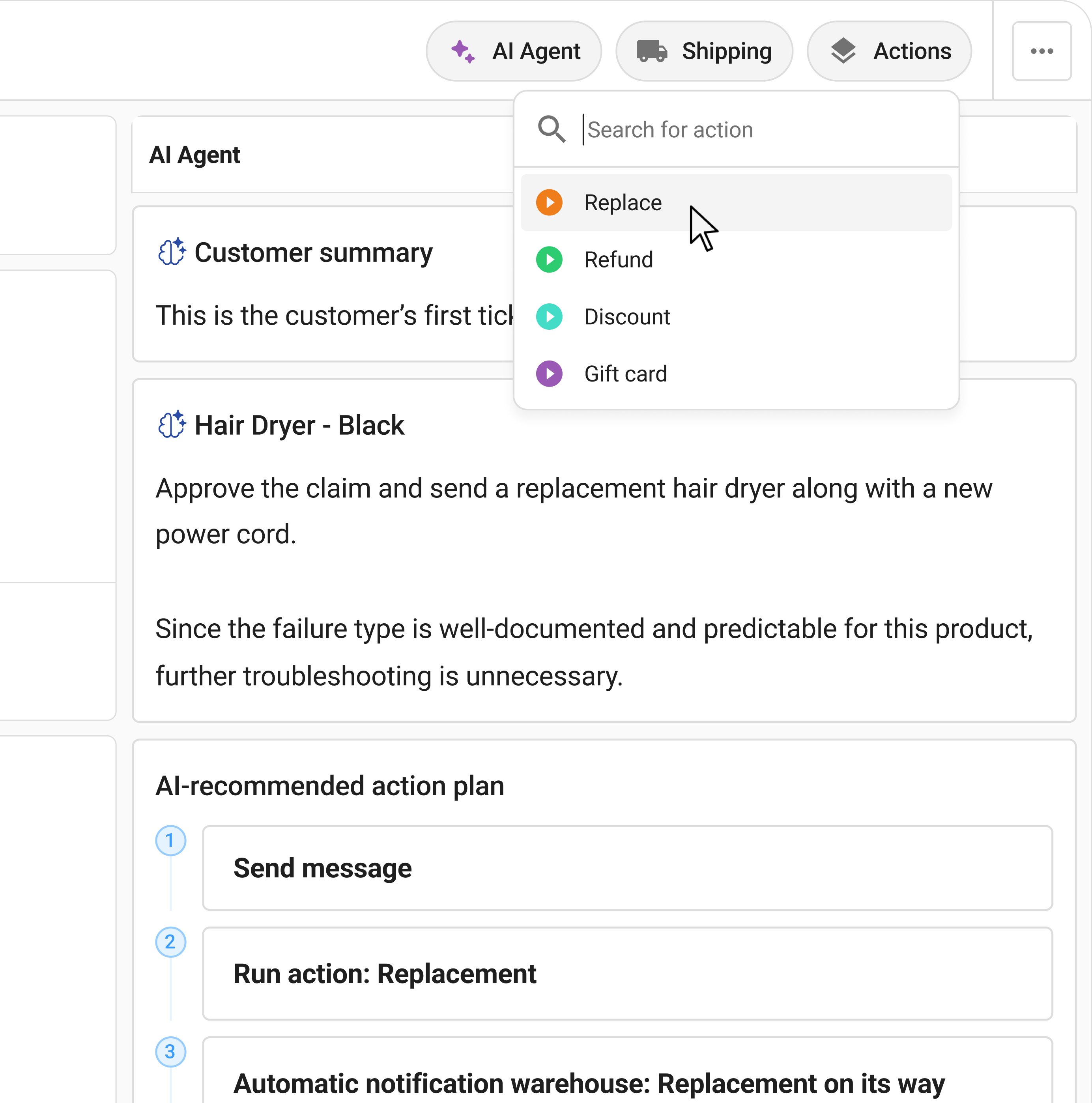
- Claimlane's workflow engine supports exchange-first flows with configurable resolution options, AI-powered claim assessment, and integration with ecommerce platforms for seamless order creation.
The Economics of Exchanges vs. Refunds
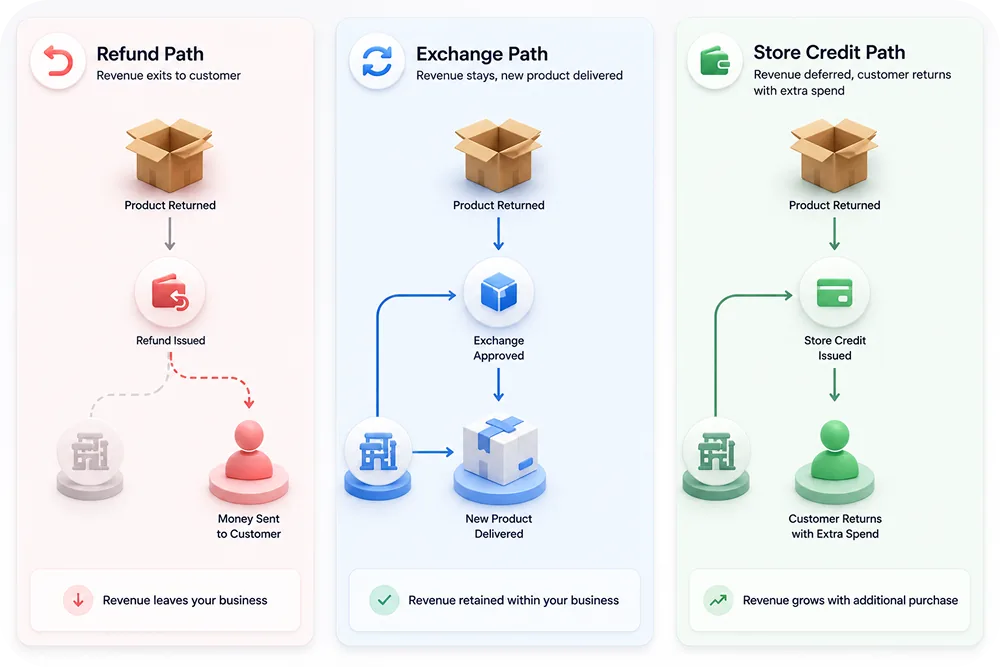
The financial difference between an exchange and a refund is straightforward but often underestimated.
Refund: revenue lost
When a customer gets a refund, the brand loses the sale entirely. The product comes back (incurring reverse logistics costs), the money goes back to the customer, and the brand needs to resell the returned item (often at a discount). Net impact: negative.
Exchange: revenue retained
When a customer exchanges for a different product, the revenue stays with the brand. The original product still comes back, but a new sale is created simultaneously. If the exchange is for a higher-value item, the brand gains additional revenue. Net impact: neutral to positive.
Store credit: revenue deferred
When a customer accepts store credit instead of a refund, the revenue stays in the brand's ecosystem. The customer will return to make another purchase, and store credit recipients often spend more than the credit value (adding new revenue on top of the retained amount).
A brand processing 10,000 returns per month at an average order value of $80 loses $800,000 in revenue if every return is a refund. Converting just 30% to exchanges retains $240,000 per month. That is $2.88 million per year in retained revenue from a single operational change.
How Instant Exchanges Work
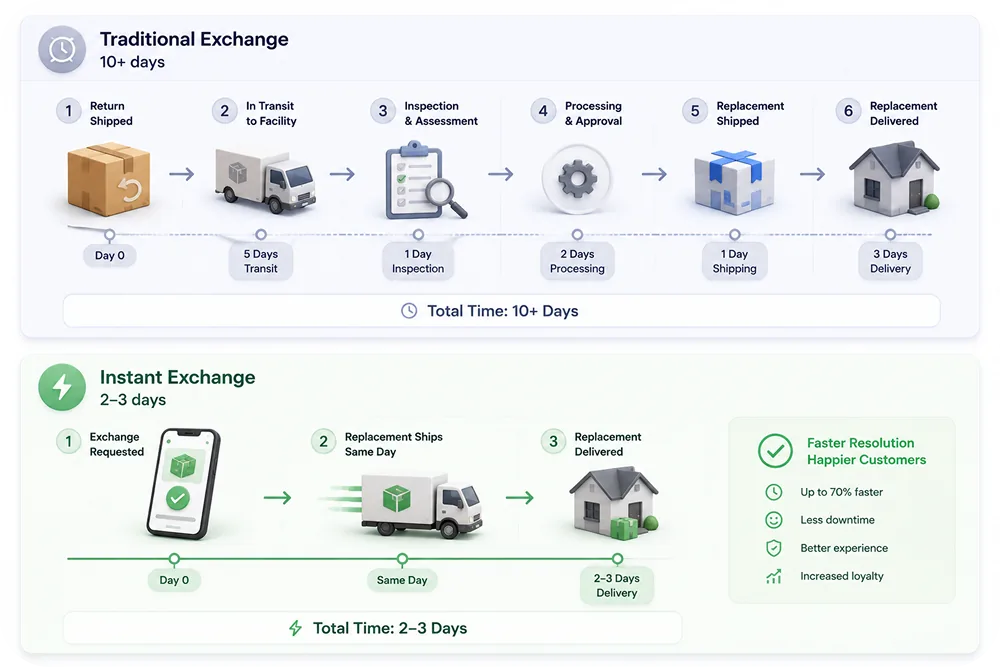
Traditional exchanges require the customer to return the original product, wait for it to be received and inspected, and then receive the replacement. That process can take 1-2 weeks. Most customers would rather just get a refund and buy elsewhere.
Instant exchanges flip the sequence. The replacement ships before the original return arrives. Here is how the process works:
- Customer initiates a return through the self-service portal and selects "exchange" as the preferred resolution.
- The system creates a new order for the replacement product immediately. If it is a different size, color, or variant, the customer selects it during the return process.
- The replacement ships from the nearest warehouse with available stock. The customer receives it in the same timeframe as a normal order.
- The original return ships back using a prepaid label. The brand processes it when it arrives.
- If the original is not returned within the specified window, the brand charges the customer for the replacement.
This approach removes the biggest barrier to exchanges: the wait time. When the replacement arrives as fast as a new order, customers have no reason to prefer a refund.
Store Credit as a Revenue Retention Tool
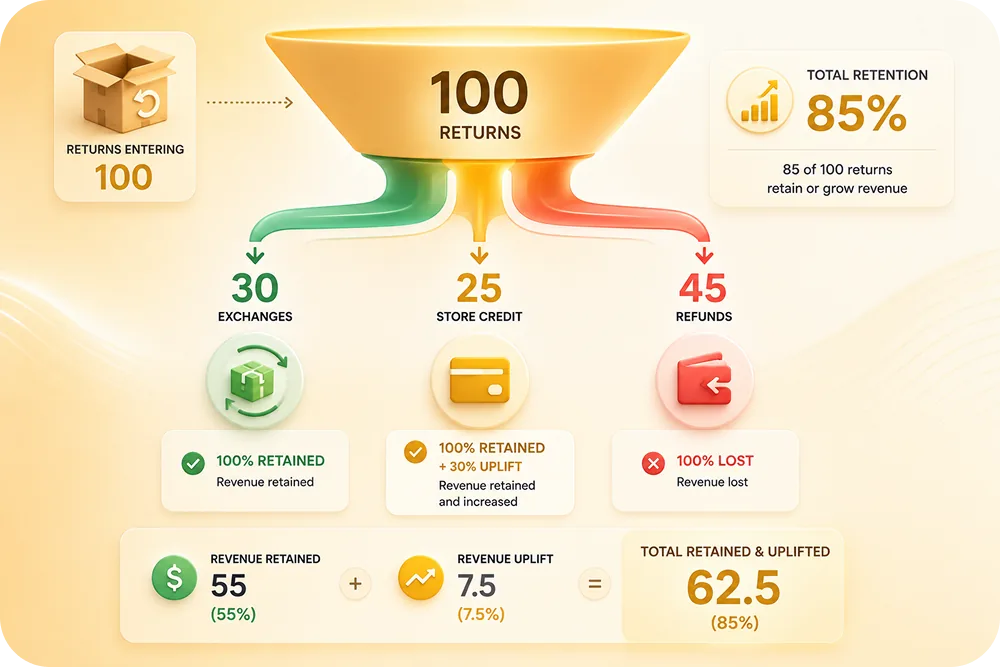
Store credit is a powerful middle ground between exchanges and refunds. The customer does not have to choose a replacement immediately, but the revenue stays with the brand.
The bonus incentive
The most effective store credit strategy adds a bonus. Instead of receiving $80 in store credit for an $80 return, the customer gets $88 (a 10% bonus). This small investment creates a strong incentive to choose store credit over a refund.
The math works because store credit recipients typically spend more than the credit value. A customer with $88 in store credit who buys a $120 product adds $32 in new revenue.
Expiration and urgency
Store credit with a reasonable expiration window (6-12 months) creates urgency without feeling punitive. It encourages the customer to return and shop while the brand is still relevant to them.
Integration with the returns flow
The returns portal should present store credit as an option alongside exchange and refund, with the bonus clearly displayed. Claimlane's workflow engine can configure which resolution options appear based on return reason, product category, and customer segment.
Warranty Claims and Exchange-First Strategies
Exchange-first is not just for buyer's remorse returns. It applies to warranty claims too.
When a product fails under warranty, the customer wants a working product, not necessarily their money back. An exchange-first warranty workflow sends a replacement immediately while the defective product is returned for inspection.
Claimlane's AI Agent adds intelligence to this process. By analyzing the submitted photos and claim details, the AI can verify the defect and approve the exchange before a human reviews it. For clear-cut warranty cases (visible damage, known defect patterns), the replacement can ship within hours of the claim submission.
This speed matters for customer retention. A customer who receives a fast, hassle-free warranty replacement is more loyal than one who never had an issue in the first place.
"We handle thousands of claims per year, and Claimlane helps us resolve them faster while keeping our customers happy. The structured process means we can offer exchanges and replacements with confidence."
Building an Exchange-First Return Flow
Step 1: Redesign the returns portal
The return initiation page should present resolution options in order of preference: exchange first, store credit second, refund third. The exchange option should show available alternatives (different size, color, or similar product). The store credit option should display the bonus value.
Step 2: Enable instant exchanges
Connect the returns system to inventory and order management. When a customer selects an exchange, the system should check stock availability, create a new order, and trigger fulfillment automatically. Claimlane's integrations with Shopify, WooCommerce, and other platforms make this connection possible.
Step 3: Configure exchange rules
Not every return qualifies for an instant exchange. Define rules based on:
- Product value: High-value items may require the return before shipping the replacement.
- Customer history: Repeat returners may have different exchange eligibility than loyal customers.
- Return reason: Size/color exchanges are lower risk than defect claims.
- Stock availability: Cannot exchange if the desired variant is out of stock.
Step 4: Set up store credit with bonus
Configure the store credit system with bonus tiers. For example: 10% bonus for credits over $50, 15% bonus for credits over $100. Display the bonus prominently during the return flow.
Step 5: Track and optimize
Measure exchange conversion rate, store credit redemption rate, and revenue retention per return. Use analytics to identify which products, return reasons, and customer segments convert best to exchanges.
When Refunds Are the Right Choice
An exchange-first strategy does not mean eliminating refunds. Some situations call for a refund:
Product discontinued
If the product has no suitable replacement and the customer does not want store credit, a refund is the right resolution.
Repeated defects
If a customer has already received an exchange that also turned out defective, a refund with an apology is better than a third attempt. This is where defect tracking helps identify systemic issues.
Legal requirements
Consumer protection laws in many jurisdictions give customers the right to a refund under certain conditions. The exchange-first approach must comply with local return policy regulations.
Customer insistence
If a customer explicitly wants a refund and the brand has no legal basis to deny it, process the refund promptly. Forcing exchanges on unwilling customers damages trust and generates negative reviews.
The key is making exchanges the easiest option, not the only option.
Measuring Exchange-First Performance
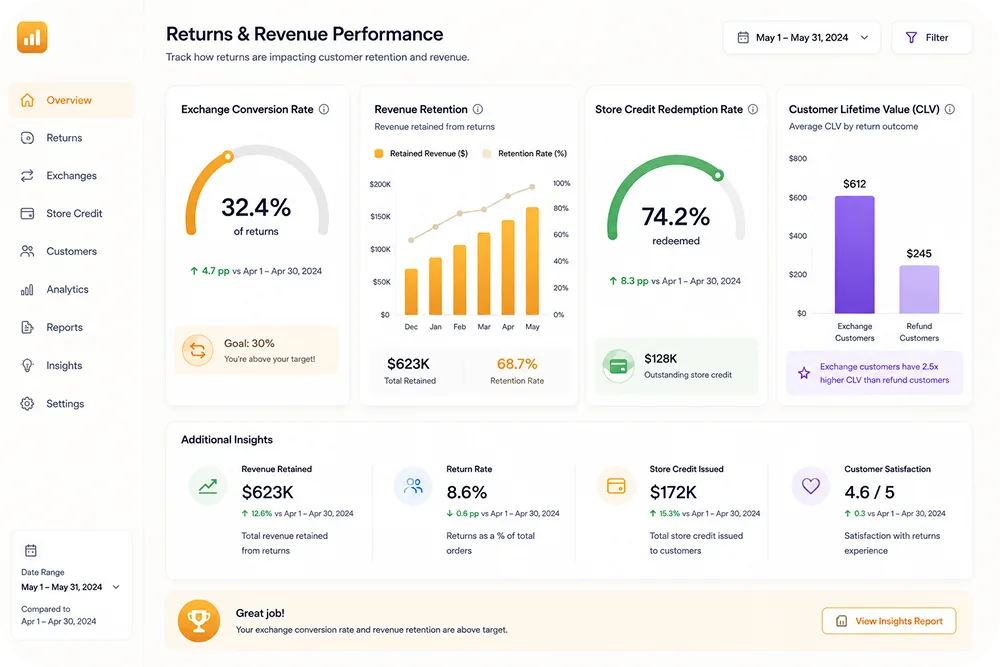
Exchange conversion rate
What percentage of returns result in an exchange rather than a refund? Track this as the primary KPI for exchange-first initiatives.
Revenue retention rate
Of total return volume (in dollars), how much stays with the brand through exchanges and store credit? Calculate: (exchange value + store credit issued) / total return value.
Store credit redemption rate
What percentage of issued store credit gets used? Low redemption rates indicate the credit may be too restrictive or the product catalog does not have enough alternatives.
Customer lifetime value post-return
Compare the CLV of customers who exchanged vs. customers who got refunds. Exchange customers typically have higher lifetime value because they maintained their relationship with the brand.
Net Promoter Score by resolution type
Measure customer satisfaction separately for exchanges, store credit, and refunds. This shows whether the exchange experience is positive enough to justify the strategy.
How Claimlane Supports Exchange-First Strategies
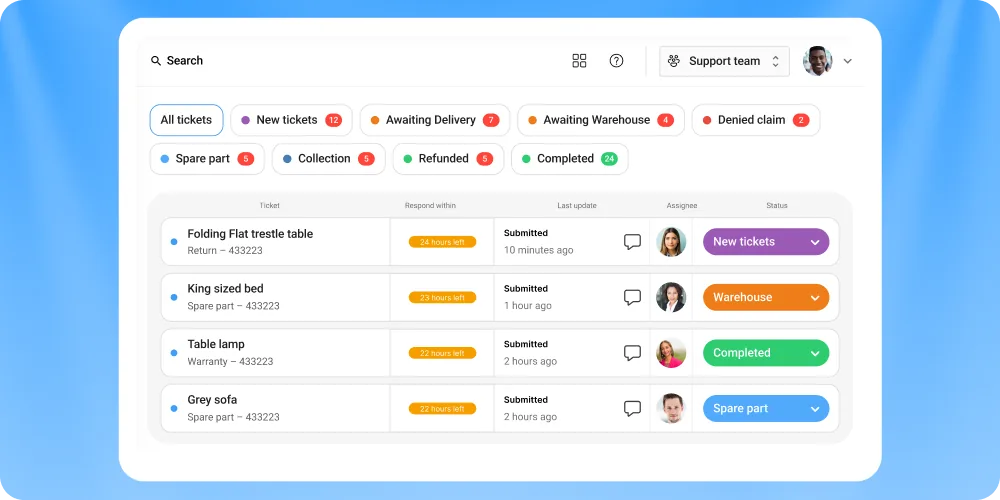
Claimlane provides the claims and returns infrastructure that makes exchange-first flows operationally feasible.
Configurable resolution workflows
The workflow engine lets brands define resolution hierarchies: which options appear first, which require approval, and which can be automated. Exchange and store credit can be prioritized over refunds based on configurable rules.
AI-powered claim assessment
For warranty claims, Claimlane's AI Agent verifies the defect and can auto-approve exchanges for clear-cut cases. This eliminates the delay between claim submission and replacement shipment.
Ecommerce integration
Claimlane's 75+ integrations include Shopify, WooCommerce, and other platforms. When an exchange is approved, the system can automatically create the replacement order in the ecommerce platform.
Revenue retention analytics
The analytics dashboard tracks exchange rates, store credit usage, and revenue retention across all return channels. Brands can see which products, reasons, and customer segments convert best to exchanges.
"We needed a system that could handle warranty claims at scale and give our customers the best possible experience. Claimlane delivered exactly that, with clear workflows and fast resolution times."
Common Exchange-First Mistakes
Making refunds difficult to find
The exchange-first approach should present exchanges prominently, not hide refunds. Customers who feel trapped will leave negative reviews and file chargebacks. Always offer a clear path to a refund.
Not checking stock before offering exchanges
Offering an exchange for a product that is out of stock creates a worse experience than a refund. Always check real-time inventory before presenting exchange options.
Ignoring the return reason
A customer who returns because the product is defective has different needs than one returning because of a sizing issue. Workflow rules should offer different resolution options based on return reason.
Not tracking exchange abuse
A small percentage of customers may abuse exchange policies (exchanging repeatedly, keeping both products). Monitor exchange patterns and set limits for high-risk accounts using returns analytics.
Forgetting about cross-border complications
International exchanges involve customs, duties, and longer shipping times. For cross-border returns, store credit may be a better option than an exchange that takes weeks to arrive.
FAQ
Conclusion
Every return that becomes a refund is lost revenue. Every return that becomes an exchange or store credit keeps the customer in the brand's ecosystem. The difference between these outcomes is operational: how the return flow is designed, what options are presented, and how fast exchanges are processed.
An exchange-first strategy is not about preventing refunds. It is about making exchanges so easy and attractive that customers choose them willingly. Claimlane provides the workflow engine, AI assessment, and ecommerce integrations to make exchange-first operations work at scale.
Book a demo to see how Claimlane supports exchange-first revenue retention.