
Watch what happens when a gaming laptop, an e-bike battery, or a cordless drill comes back. The customer emails support, support sends a prepaid label, the customer boxes the item with the battery inside and drops it at a parcel shop.
Somewhere in that chain, a Class 9 dangerous-goods shipment just moved with no discharge, no declaration, and no trained shipper. The customer is now an untrained dangerous-goods shipper, and nobody told them. The brand created that exposure the moment it sent a plain return label for a battery product.
The shipping guides that rank for this topic are written for outbound freight handled by trained staff. They cover state of charge, packaging, and labelling for people whose job is dangerous goods. The reverse flow is the blind spot, because the shipper there is a customer following the brand's instructions, and the failure point is the brand's returns intake, not the carrier's dock.
Lithium battery returns, in plain terms
Lithium-ion and lithium-metal batteries are Class 9 dangerous goods. Shipping them, including back to a brand as a return, is regulated by mode: air follows the IATA Dangerous Goods Regulations, with parallel rules for ocean and ground.
In plain terms, a returned battery is not an ordinary parcel. It carries condition, charge, and documentation requirements that a normal return label does not satisfy, and the rules tightened in 2026.
What changed on 1 January 2026
The 2026 edition removed the grey area, which is exactly what makes the reverse flow riskier than it was.
The state-of-charge limit moved from recommended to mandatory. For a return, that means a product with a lithium battery should be discharged to 30% before it ships back, a step that does not exist in a normal returns flow and that an untrained customer cannot reliably perform. Undeclared hazmat is the worst case: large fines and a permanent ban from a shipping network, which for an ecommerce brand is an existential supply-chain problem, not a fine. This is the same risk surface as damaged-in-transit claims, turned around.
The violation starts at your return instructions
The carrier guides assume the shipper knows the rules. In returns, the shipper is the customer, and the customer knows nothing about state of charge or Class 9 labelling. The label was the easy part and the wrong part.
So the compliance decision is really made upstream, in how the brand sets up the return. A brand that routes battery products through the same generic return flow as a t-shirt has built a violation generator. A brand that recognises a battery product at intake and triggers a different path has built a control. That recognition is a returns workflow decision tied to the product record, the same way serial number tracking identifies the unit.
The intake step the carrier guides assume already happened
Behind the curtain, a compliant battery return needs steps a normal return never includes. The product has to be identified as containing a lithium battery. The condition has to be checked, because a swollen or damaged cell cannot ship by normal means at all and a swollen cell does not care about your SLA. The charge state has to be addressed. The right packaging and declaration have to be specified. And the whole thing has to be documented.
For many battery returns, the safe answer is not a customer-shipped parcel at all. It is a different route: a designated drop-off, a specialised carrier, or a hold-and-inspect step. That decision needs data at intake, which is what a self-service portal collects when it asks for the model, condition photos, and fault before a label is ever issued. The wider context is reverse logistics built for regulated goods rather than convenience.
Compliant battery returns, costed
The honest comparison is not compliant versus free. It is the per-return cost of doing it right versus the cost of one undeclared-hazmat incident.
| Generic return flow | Hazmat-aware return flow |
|---|---|
| Same label as any parcel | Battery product flagged at intake |
| No condition or charge check | Condition photo and charge step before label |
| Customer ships blind | Routed to compliant carrier or drop-off |
| No declaration or record | Class 9 declaration and per-item documentation |
| One incident risks a network ban | Auditable trail across every battery return |
The finance number that lands: a compliant battery return costs more per case than a t-shirt return, but a single undeclared-hazmat penalty runs from five to fifty thousand dollars and up, and a network ban prices out at the brand's entire shipping operation. MaxGaming resolves complex RMA cases 77% faster with Claimlane's AI Agent across 30,000+ SKUs and 200+ brands, and that speed matters here because a battery sitting in an unidentified return queue is both a cost and a hazard the longer it waits. Routing the defect back to the supplier through a structured supplier claim recovers part of the cost the compliance step adds.
Building hazmat logic into the returns workflow
The fix is to make the returns system treat a battery product as its own claim type with its own rules, decided before a label exists.
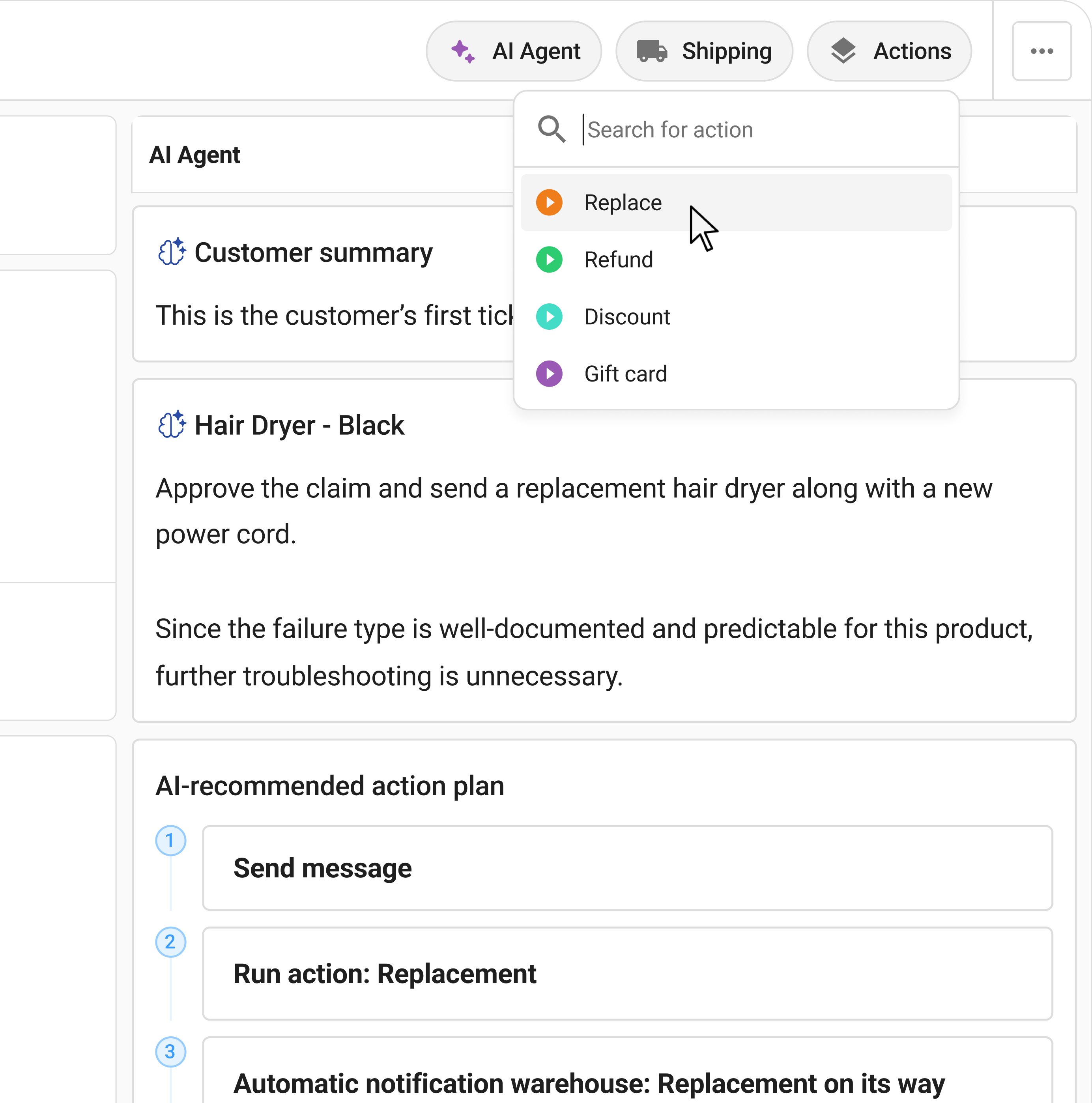
That means workflow rules that recognise battery SKUs and branch the path, a portal that captures condition and charge state at submission, and analytics that keeps the documentation trail every Class 9 movement needs. Claimlane's AI Agent, the first AI agent purpose-built for warranty claims and returns, reviews the intake photos and flags a swollen or damaged cell before anyone ships it, recommending a safe route instead of a default label. The guardrails are not optional when safety is involved: humans stay in the loop on flagged hazards, the rules are configurable per product and carrier, and every decision is logged, which is the audit trail a dangerous-goods process is required to keep. This builds on AI RMA automation.
Generic returns app or claims platform: the two-tier reality
A standard returns app generates a label and a refund, which is correct for a non-hazardous item. It has no concept of dangerous goods, no condition gate, no carrier branching, no Class 9 documentation. For a battery return, that is not a small gap, it is the gap that creates the violation.
The two-tier line is clear. Simple, non-hazardous returns belong with the generic post-purchase apps. Regulated, condition-dependent, dangerous-goods returns belong on a specialist platform that runs as the execution backbone alongside the rest of the stack. Brands sizing the field can read the best reverse logistics software for 2026 and reverse logistics software platforms.
Are you ready to ship returned batteries legally?
Lithium battery returns readiness check
- Selling products with lithium batteries (e-bikes, tools, gaming, wearables)
- 50+ battery-product returns or warranty cases a month
- Battery returns currently shipped on a standard return label
- No condition or charge-state check before a label is issued
- No per-item Class 9 documentation trail
- Multiple carriers or markets with different DG rules
Three or more yes answers means battery returns need a hazmat-aware workflow, not a generic label.
What to measure
Track the share of battery returns routed through a compliant path versus a standard label, the number that quantifies live exposure. Track flagged-hazard catches at intake, the swollen or damaged cells stopped before shipment. Track supplier recovery on defective batteries, the offset against the cost of doing returns the safe way.
The label was always the easy part. The hard part is the decision made before the label, and that decision lives in the returns operation, not the carrier's dock. Brands that recognise a battery at intake and route it deliberately keep their network access and their record clean. Brands that keep emailing plain labels are running an undeclared-hazmat program by accident. For the next step, read how brands handle electronics returns and warranty claims and dead-on-arrival claims on regulated products.
Claimlane scores 4.8 out of 5 on G2, on the kind of condition-gated returns workflow a dangerous-goods process depends on.
The decision that keeps a brand compliant happens before the label. See how that decision works in practice in the guide to electronics returns and warranty claims.
FAQ
Can customers ship lithium batteries back on a normal return label?
Usually not safely. Lithium batteries are Class 9 dangerous goods with condition, charge, and documentation requirements a standard return label does not meet. The compliant path is decided at returns intake, where the brand can route the item to a suitable carrier or drop-off.
What is the 30% state-of-charge rule for 2026?
From 1 January 2026, lithium-ion batteries packed with equipment must be offered for air transport at no more than 30% of rated capacity. The limit moved from recommended to mandatory, which is hard to guarantee when an untrained customer is the one shipping a return.
What are the penalties for shipping lithium battery returns wrong?
Per-violation fines run from roughly five to fifty thousand dollars, and undeclared hazmat can bring fines above fifty thousand plus a permanent ban from a shipping network. For an ecommerce brand, losing carrier access is a larger problem than the fine itself.
How do brands handle a swollen or damaged battery return?
A swollen or damaged cell cannot ship by normal means and needs to be flagged before any label is issued, then routed to a specialised path. Capturing condition photos at intake, with AI review to catch hazards, is what stops a dangerous unit from entering the parcel network.