.webp)
How to Optimize Your Returns Process (With Elon Musk’s 5-Step Framework)
What if Elon Musk helped you optimize your e-commerce returns process? Using his 5-step algorithm, you can eliminate delays, automate claims, and drastically improve customer satisfaction.”
Check out the 2 minute video where Elon Musk outlines his 5 step “Algorithm” for optimization that he has used at SpaceX and Tesla.
Then come back. The rest of this article applies his thinking to returns.
Here’s the algorithm, quoted in full from Walter Isaacson’s biography on Elon Musk.
While we don’t know exactly what Elon would do to optimize your process we can do the second best thing and apply his 5-step algorithm.
Let’s jump in:
1. Question every requirement:
Step 1 · Elon Musk
"Question every requirement. Each should come with the name of the person who made it. You should never accept that a requirement came from a department, such as from 'the legal department' or 'the safety department.' You need to know the name of the real person who made that requirement. Then you should question it, no matter how smart that person is. Requirements from smart people are the most dangerous, because people are less likely to question them. Always do so, even if the requirement came from me. Then make the requirements less dumb."
According to Musk a classic mistake is “to optimize something which should not exist in the first place” (by the way, we know the feeling). So before we start to optimize we should first question all the steps and requirements in our current process. Probably we do things today which are unnecessary.
A useful starting point is to map exactly how returns are handled today, before changing anything. Spend time on the floor with the returns team, observe the current process, and ask questions until the end-to-end flow is clear. The result is a process map covering different return types from start to finish. Basically, map your As-Is returns process.
In short, the idea is to spend time on the floor with your returns team, observing the current process and asking questions to map exactly how you handle returns today. The result is a process map of how you handle different types of returns from end to end.
Now, look at the process map and for each step in the process we ask ourselves and our team: Why do we do what we do? Is this step necessary at all? What would happen if we didn’t do this?
Beware these responses
- "Because we have always done it like this"
- "Because [department] says we should"
- "That's just how it works"
- "It was added a few years ago, I don't remember why"
Beware if the response is: “Because we have always done it like this” or “Because X says we should”.
One typical example is for documentation. E.g. the returns team may spend a lot of time documenting their work for another department that anyway does not use the information. That’s where a cleanup can be useful.
So, map your process and all the current requirements. Question every step.
Benchmark your warranty process in 3 minutes
14 questions. Instant score. Actionable recommendations to reduce claim handling time.
2. Delete any part or process you can
Step 2 · Elon Musk
"Delete any part or process you can. You may have to add them back later. In fact, if you do not end up adding back at least 10% of them, then you didn't delete enough."
Once you have mapped your process and questioned each of the requirement and step you can now delete any part of the process which is not strictly necessary.
“We can’t remove this” is a typical response. And it’s understandable. Probably we have been doing this for a long time. It can be hard to imagine how a process might work if one of the steps were removed. And there is an urge to keep things are they are.
So before we conclude that we can’t remove anything let’s first understand that it is actually very likely that we have too many steps in the process today.
Two ways to help us realize we may have too many steps in our current process:
Two reasons most processes have too many steps
- The "just in case" effect: steps get added because someone might need them later. Like packing for a holiday. You bring an extra pair of jeans just in case, end up dragging extra luggage, and return with half your clothes unused.
- The 80/20 rule: roughly 20% of the steps deliver 80% of the result. Most of the actions in a process can be removed without changing the customer outcome.
1) Realize that a step was added in the first place because “we might need it”. Like packing for a holiday. “I’ll bring an extra pair of jeans, just in case”. You end up dragging a heavy and paying for extra luggage and anyway return with half of your clothes unused.
2) Realize that probably 20% of the steps we do deliver 80% of the result. In other words, the Pareto Principle or 80/20 rule is helpful here. In other words there’s probably room for removing many of the actions we take today without drastically altering the result for the customer.
Musk’s advice here is that as a rule of thumb you should rather take away too many steps rather than too few. The benefits will be greater and you can always put back steps later.
So look at all the actions you take, question each of them: Question every step: can we remove this? What would happen if we removed this? Would the outcome still be the same? What would be the impact on our KPIs (e.g. customer satisfaction, handling time, and profits)?
3. Simplify and optimize
Step 3 · Elon Musk
"Simplify and optimize. This should come after step two. Common mistake is to simplify and optimize a part or a process that should not exist."
Now we have a shorter list of actions in our process map. Since we have removed the unnecessary steps we now only have the critical steps remaining to process the returns.
We now examine the rest of the steps one by one and look at how we can simplify and optimize each step.
Here we ask questions for each remaining step such as:
- “How could we do this better / faster?”
- “What would the 5 star experience look like?”
- “What would make your (the team’s) life a lot easier?”.
One powerful example for optimization in the returns process is to collect the right information from customers up front. A guide on structured customer intake for returns covers the specifics.
You may look at your current process and notice that your team often asks customers for more information to document their return. Maybe the customer did not append pictures on the first email. This delays the entire process and creates additional steps.
This step could be avoided had we received the right information up front. So how can we make sure we receive the right information up front from customers?
Well, we can make sure to prompt the customer for the right information as they submit their return dependent on what return type they submit.
This creates additional benefits:
The customer is asked a few questions in the submission form to identify the type of return they want to file. Perhaps it’s simply an unwanted product. Or maybe it’s a claim for a broken product. Each type prompts the customer to provide different information. Submitting a claim requires the customer to provide picture documentation.
This implementation means we get the right information up front, always. This reduces the risk of a followup. Now our team does not need to categorize the return as the customer has already done so. And the customer has a simple and clear experience.
We have built this into Claimlane via our B2C and B2B returns portals that make is easy for brands and retailers to set these flows up.
So for step 3, go through each remaining step and consider how it can be simplified and optimized.
4. Accelerate cycle time
Step 4 · Elon Musk
"Accelerate cycle time. Every process can be speeded up. But only do this after you have followed the first three steps. In the Tesla factory, I mistakenly spent a lot of time accelerating processes that I later realized should have been deleted."
Now how can we do this faster?
Why do things take the time it takes today. Is that necessary? Could we do it faster? What would it take to do it twice as fast? 10x as fast?
What would be the outcome if we could do this process 2x faster? How valuable would that be? For customers? For us?
Maybe your goal is to create a better experience for your customer by reducing the Resolution Time, i.e. the total time it takes from a customer first submits the return until it is resolved. To improve the resolution time, look for where the big delays happen. Every time you follow up with a customer by email e.g. asking for more information, there’s a risk that the customer may only respond the next day. Maybe your team is busy for the rest of the day and can’t continue the resolution. The result is a process that may take only 20 minutes to handle but it’s spread over multiple days. This is not great for the customer plus it’s inefficient for your team that needs to come back to the same case multiple times.
Also, we can return to the 80/20 rule to see how else we might speed up the process. In many situations 20% of the mistakes will take 80% of the time to handle. So how can we improve our handling of those difficult 20%? When talking returns, it might be that most returns are unwanted products that are simple to handle and can largely be automated. However, the difficult claims take most of the time. This might be where you need to optimize your cycle times.
Maybe you need to empower your team to make faster decisions. Maybe you notice that your team is confused about how to handle a certain situation or often waits for your approval of how to handle a certain situation. Maybe you need clearer guidelines that let your team decide how to a handle edge cases. Perhaps the cost of making the wrong decision once in a while does not matter compared to the big benefit of your team being able to make quick decisions without waiting for your approval.
5. Automate
Step 5 · Elon Musk
"Automate. That comes last. The big mistake in Nevada and at Fremont was that I began by trying to automate every step. We should have waited until all the requirements had been questioned, parts and processes deleted, and the bugs were shaken out."
Now we look for places to automate. Again, go through the list of actions, can we automate each of the steps?
Automation is powerful, but it also takes great effort to set up. Therefore, as Elon Musk warns, you should only focus on automation as the 5th step after making sure the step cannot be deleted and your process is otherwise simplified and optimized.
Automation is great because we save time. But the hidden benefit is often that things actually get done. Because we are human, if things take just a little bit of time there’s a risk it won’t get done. We know this from our own lives and our to do lists. It’s painful to admit, but many of these small things actually don’t get done. We push them ahead of us because they are not as important and the other bigger things we are doing. Automation can help us get those small things done quickly and right away and help us create magical moments for the customer.
One rule of thumb for automation is “If you know you need to do the same thing more than twice, you should automate it”. E.g. sending the same message. You should automate it.
Send automatic email followups or set up Macros or templates for common responses.
Or integrate your order system with your helpdesk so the returns or support team always have customer and order information right at hand when communicating with your customer.
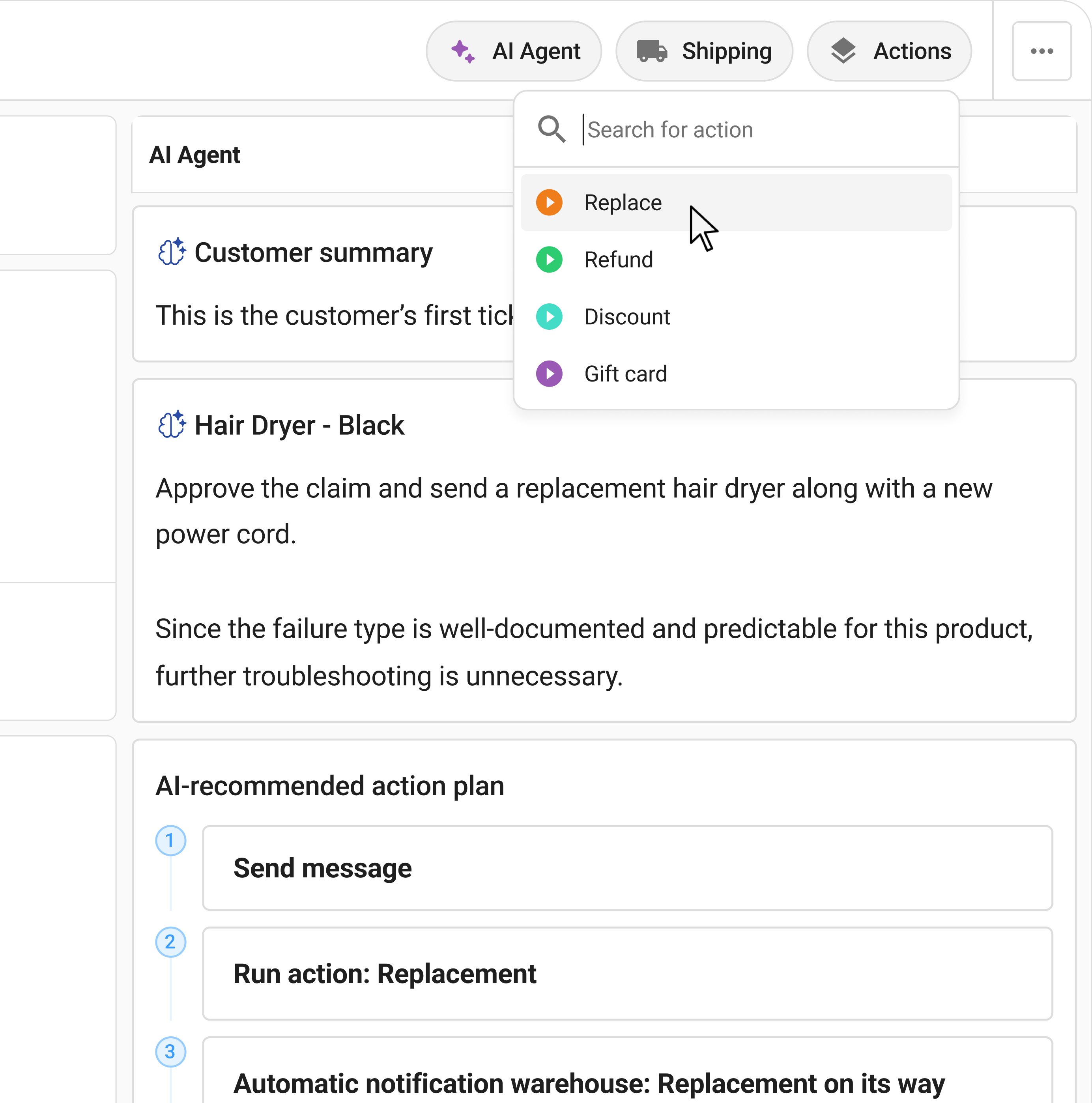
We have powerful inbuilt automations in Claimlane. On top of automatically collecting the right information up front and automating customer followups, you can automate entire Outcomes. Such as automatically sending a credit note, generating a shipping label, or sending a new product.
The biggest 2026 shift in step 5 is AI handling the parts of a case that previously needed a trained agent. Claimlane's AI Agent, the first AI agent purpose-built for warranty claims and returns, reads customer-submitted photos and videos, applies brand and supplier rules, and either auto-resolves cases or assembles them for human review. Cases that used to need 15 minutes of agent time collapse to seconds. MaxGaming, running 30,000+ SKUs, cut complex RMA resolution time by 77% after deploying it.
Data processing is also automatic with Claimlane. Which means you can now easily do analyses of your returns data.
5 → 1-2
agents handling claims
What this looks like in practice · Davidsen
After applying these steps to their warranty operation, Davidsen went from five people handling claims to one or two. Same case volume. The difference came from removing manual steps and automating the rest. Read the full case study.
How can you use Elon Musks algorithm to boost your post-purchase processes?
Warranty Returns:
For warranty returns, question every step - are all the procedures and forms truly necessary? Eliminate unnecessary actions that only slow down the process, such as duplicate checks or excessive paperwork. Streamline the process by automating initial claim validation and offering quick replacements. Speed up cycle times by implementing automated approval systems. Finally, automate notifications and updates to keep customers informed throughout the warranty process, improving efficiency and satisfaction.
Ecommerce Returns:
In ecommerce returns, start by evaluating each step - are lengthy forms or approval chains really needed? Remove redundant steps that add complexity, like unnecessary data collection. Simplify the return flow by pre-filling customer details to reduce friction. Shorten cycle times by minimizing delays and speeding up the approval process. Automate key actions such as issuing return labels, processing refunds, and notifying customers, creating a smooth and quick return experience. A return management system might also be a good place to optimize your return processes.
Ecommerce Warranty:
Optimize ecommerce warranty processes by reassessing every step - is manual documentation required at every stage? Remove unnecessary tasks, like shipping items to service centers when it can be done remotely. Optimize workflows by collecting essential details (like serial numbers) upfront, reducing processing time. Accelerate warranty claims by automating approvals and replacements. Finally, automate customer notifications to ensure transparency and quick resolutions, improving customer satisfaction.
Post-Purchase Experience:
To improve the post-purchase experience, review every communication step - can you eliminate repetitive emails or redundant follow-ups? Remove unnecessary touchpoints and focus on value-added interactions, like personalized recommendations. Streamline the process by offering easy returns and clear instructions. Accelerate the customer journey by reducing response times, and automate loyalty program invitations, follow-ups, and feedback requests to create a seamless and efficient post-purchase experience. Are you looking to optimize your ecommerce post-purchase experience? Then look no further.
Reverse Logistics:
In reverse logistics, evaluate each action - can you eliminate unnecessary inspections or redundant steps in the process? Streamline your operations by reducing handoffs and simplifying workflows. Optimize logistics by centralizing returns and improving inventory management systems. Speed up returns processing by automating inventory updates and shipment tracking. Automate workflows to reduce manual work, allowing for quicker handling of returns and restocking.
Product Recall:
When handling product recalls, question every step - are all the verification processes necessary? Remove unnecessary steps that delay action, such as long approval chains. Optimize your recall process by creating a centralized system for affected customers to easily access information and initiate returns. Reduce cycle times by automating communication and approval processes. Finally, automate recall notifications and claim submissions to ensure swift action and minimize customer frustration.
Give Elon Musks algorithm a try
Once all five steps have been applied, the returns process will be measurably leaner. Less time, less cost, and a cleaner experience for both customers and the team. If you try this and want to compare notes, book a demo and the Claimlane team will help you map it against your specific operation.
If you do try this out give us a shout, we would love to hear how it goes. Or if you need help you know where you can find us.
Frequently asked questions
What is Elon Musk's 5-step algorithm?
Elon Musk's 5-step algorithm is a process improvement framework he applied at SpaceX and Tesla. The five steps are: question every requirement, delete any part you can, simplify and optimise, accelerate cycle time, and automate. The order matters. Musk's repeated mistake was automating before deleting and simplifying.
Why does the order of the 5 steps matter?
Because automating or accelerating a step that should not exist is wasted effort. Musk specifically warned about this: "common mistake is to simplify and optimise a part or a process that should not exist." Going in order forces every step to justify its existence before getting attention.
How do you apply Musk's algorithm to ecommerce returns?
Map the current returns process step by step. Question every step (why is it there, who decided it). Delete the steps that are not strictly required. Simplify the remaining steps with structured intake and clear policies. Speed up cycle time by removing email follow-ups and unclear ownership. Then automate the routine work like routing, status updates, and refund processing.
What are the most common steps to delete in a returns process?
Approvals that almost never reject anything, duplicate inspections done by different teams, data fields collected but never used, internal email chains that exist because nobody owns the case, and reports that get generated but never read. These add up to a meaningful share of agent time across most returns operations.
When should you automate parts of the returns process?
Last. After requirements have been questioned, unnecessary steps have been deleted, the remaining steps have been simplified, and cycle time has been improved. Automating a broken or unnecessary process amplifies the problem rather than solving it.
Can AI handle parts of the returns process?
Yes, in 2026 AI handles the parts of a case that previously needed a trained agent: reading photos, applying brand and supplier rules, classifying defects, and recommending or auto-approving resolutions. Claimlane's AI Agent cut MaxGaming's complex RMA resolution time by 77% after deployment.