.webp)
Search this term and the entire first page talks to the consumer: how to cancel, what your rights are, where to complain. The merchant who has to refund within a statutory deadline, decide who pays return freight, and keep the legal clock separate from the goodwill policy gets nothing.
That's the gap this guide fills. For omnichannel retailers selling cross-border into the EU, the cooling-off period isn't trivia, it's an operational regime with deadlines and penalties, sitting right next to the voluntary refund policy and the warranty obligations, and frequently confused with both. Claimlane's interest is practical: these three flows end up in the same queue unless somebody designs them apart.
The definition first, then the three regimes, then the operations.
What a cooling-off period is
Definition
A cooling-off period is a legally mandated window in which a consumer can cancel a purchase without giving a reason and without penalty. It exists by statute, not by the seller's choice, which is what separates it from a voluntary return policy.
The legal logic: certain sales formats, distance selling and doorstep selling above all, deny the buyer the chance to inspect goods or resist pressure, so the law builds in a regret window. In ecommerce returns terms, a slice of every EU brand's return volume isn't policy generosity at all. It's law wearing the policy's clothes.
The three regimes: EU, UK, US
Cross-border brands operate under at least three different rulebooks, and the differences are large enough to break a one-policy setup.
| Regime | Window | Covers ecommerce? | Key mechanics |
|---|---|---|---|
| EU (Consumer Rights Directive) | 14 days from delivery | Yes, core purpose | No reason needed; refund within 14 days; extends to 12 months if the right isn't disclosed |
| UK (Consumer Contracts Regulations 2013) | 14 days from delivery | Yes | Mirrors the EU model post-Brexit, with its own statutory text |
| US (FTC Cooling-Off Rule) | 3 business days | No | Door-to-door and off-premises sales over $25; online sales are not covered federally |
The US row surprises people on both sides of the counter. There is no federal cooling-off right for online purchases; US ecommerce returns run on the seller's voluntary policy plus state-level rules. The primary sources are the EU Consumer Rights Directive, the UK Consumer Contracts Regulations, and Cornell's summary of the FTC Cooling-Off Rule. A brand's return policy template has to encode whichever regimes its markets trigger.
What the EU right obliges a brand to do, operationally
The directive reads as consumer rights. Flip it, and it's a merchant checklist with four clocks.
Disclose before purchase. The right, the 14-day window, the model withdrawal form, and who pays return shipping must be stated pre-contract. Miss the disclosure and the window stretches to 12 months, the single most expensive footnote in EU ecommerce.
Accept the withdrawal without a reason. No defect required, no interrogation allowed. The customer has 14 more days to send goods back after declaring withdrawal.
Refund within 14 days of being informed, covering the standard outbound shipping too. The brand may withhold the refund until the goods return or proof of sending arrives, and the refund mechanics run through the same rails as any payment reversal, so finance needs the trigger date logged, not guessed.
Charge return freight only if disclosed. Silence means the brand pays. At scale, processing statutory withdrawals against these clocks is exactly the job a return management system exists to do, because deadline breaches here aren't service failures, they're compliance events.
The exemptions sellers get wrong
The 14-day right has carve-outs, and brands lose money in both directions: honoring withdrawals the law exempts, and denying ones it doesn't.
Common EU exemptions, seller's reading
- Personalized and made-to-order goods: exempt, state it on the product page, not just the policy
- Sealed hygiene goods, once unsealed: exempt only after unsealing, so intake should ask about the seal
- Sealed audio, video, software, once unsealed: exempt after unsealing, the classic electronics case
- Digital content: the right lapses once download or streaming starts with express consent and acknowledgment
- Perishables and goods inseparably mixed after delivery: exempt by nature
Two operational notes. The exemption must be communicated at the right moment, or it may not hold. And "unsealed" disputes are evidence disputes, which is why photo-at-intake matters for electronics categories in particular: the seal's state decides the case.
Cooling-off right vs return policy vs warranty
Three different promises share one returns portal, and conflating them produces wrong answers daily.
The cooling-off right is statutory regret: any reason, narrow window, full refund. The voluntary return policy is marketing: the brand chooses 30 or 60 or 100 days and its own conditions, as long as it never undercuts the statutory floor. The warranty, and beneath it the EU's two-year legal guarantee of conformity, covers defects, which is a different fact pattern entirely, closer to warranty vs guarantee territory and to the conformity rules sitting alongside EU right-to-repair obligations.
The practical test at intake: does the customer regret the purchase, or is something wrong with the product? Regret inside 14 days is law. Regret inside the policy window is goodwill. A defect is never a cooling-off case, whatever day it is, and routing it as one quietly waives rights the brand has against its supplier.
Keeping withdrawals out of the claims queue
The queue design failure looks like this: statutory withdrawals, goodwill returns, and warranty claims all arrive as "I want to send this back," land in one inbox, and get handled by whoever opens them, against whichever deadline that agent remembers.
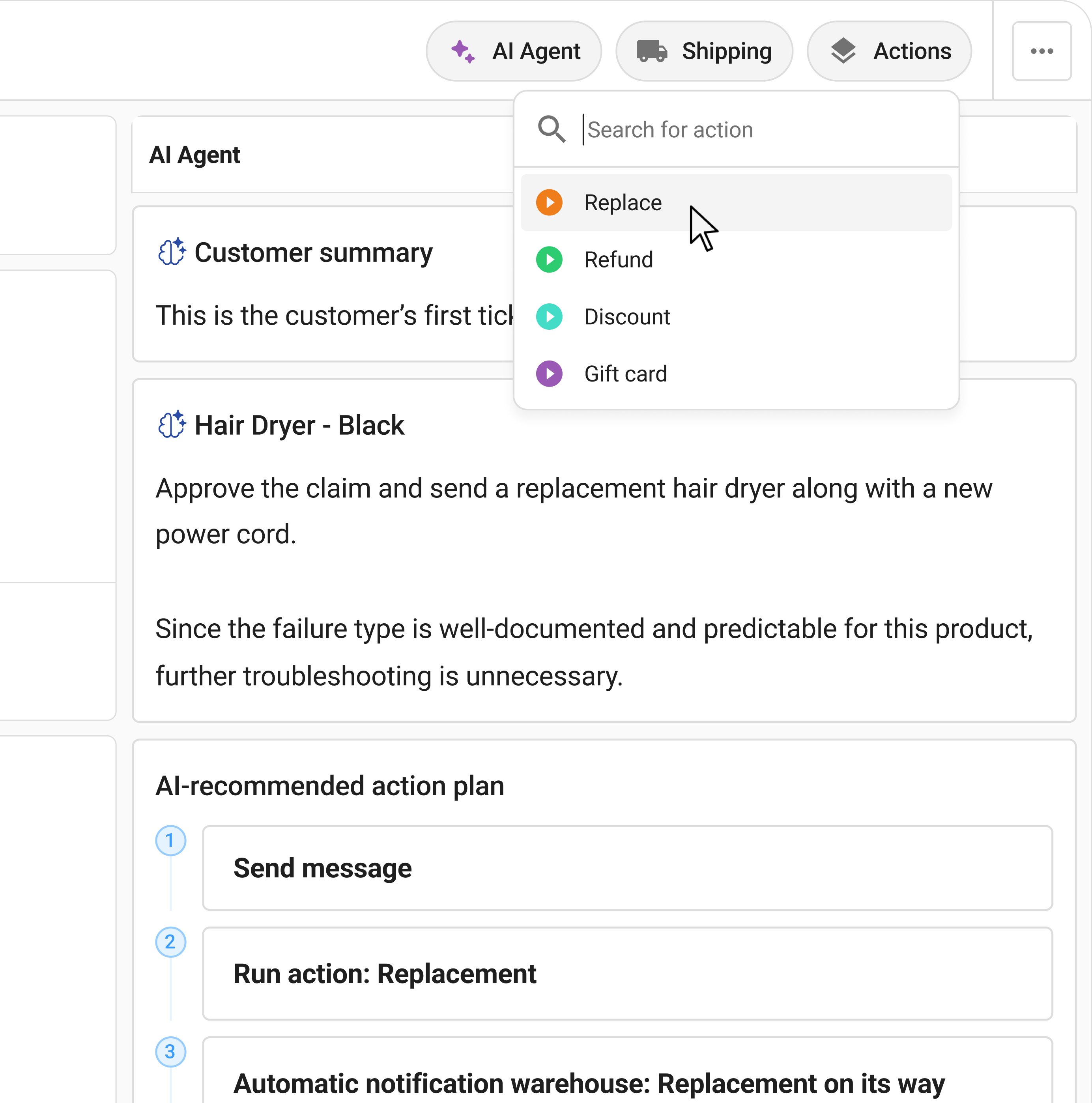
Separation at intake fixes it. A self-service portal that asks the routing question first, regret or defect, then the date and market, sorts the three flows before any human touches them: withdrawals onto the 14-day refund clock, policy returns onto the standard flow, defects into evidence collection. Each flow carries its own deadlines through purpose-built workflows for service teams, so the compliance clock never depends on agent memory.
The payoff is also financial reporting nobody has to assemble: statutory withdrawal volume becomes its own line, distinct from the controllable returns the ops team is paid to reduce.
Cross-border setup: one policy or per market
Brands selling into the EU, UK, and US face a design choice: one global policy at the strictest standard, or per-market policies at each legal floor.
One global policy is simpler to communicate and more generous than US law requires, which costs margin on US returns but buys uniform operations. Per-market policies protect margin and multiply complexity: localized policy pages, localized portal logic, and agents who know which rulebook applies, the same per-market discipline that cross-border ecommerce logistics already demands on the freight side.
The wrong answer is the accidental hybrid: a US-drafted 30-day policy pasted onto an EU storefront with no withdrawal-right disclosure. That setup doesn't reduce the EU obligation, it extends the window to 12 months and adds a compliance exposure on top. Operator patterns for both setups live in the case study library.
The abuse edge: regret rights and serial returners
A no-reason return right invites no-reason abuse, and EU brands carry it as a cost of doing business. The wear-and-return pattern, documented in wardrobing fraud, sits awkwardly here: the statutory right covers inspecting goods as one would in a shop, not using them for a weekend.
The directive's own lever is the diminished-value rule: a brand may deduct for handling beyond what inspection requires. Enforcing it takes condition evidence at receipt, photos against the outbound record, which is an intake-design question rather than a legal one. Angling Direct's process rebuild, covered in their warranty process story, shows the general pattern: structured evidence turns judgment calls into checkable ones.
Deduct carefully and document always. The right itself can't be waived, and a brand that fights regret returns case by case loses more in handling cost than it recovers in deductions.
Claimlane is rated 4.8/5 on G2 and holds G2 badges across returns and warranty management categories.
FAQ
What is a cooling-off period?
Does the 14-day cooling-off period apply to online purchases?
Is there a cooling-off period for online purchases in the US?
Who pays return shipping during the cooling-off period?
What products are exempt from the EU cooling-off right?
A twenty-minute audit closes most of the exposure: does every EU storefront disclose the right, the form, and the freight rule, and does the intake separate regret from defect? Where the answer is no, fix the disclosure first, then build the return & warranty portal customers actually use so the three clocks run themselves.
.webp)