
.webp)
As ecommerce brands scale, customer service volume scales with them. More orders mean more questions about shipping, more return requests, and more warranty claims. At some point, every growing brand faces the same question: build an in-house support team or outsource it?
Neither answer is automatic. Outsourcing customer service offers speed, cost savings, and scalability. But it comes with trade-offs around quality control, brand consistency, and customer experience. And in 2026, a third option has emerged: AI-powered automation that handles routine support without humans on either side.
This guide covers the pros and cons of outsourcing, when it makes sense, what to look for in a partner, and how AI is changing the equation.
TL;DR
- Outsourcing ecommerce support can cut costs 40–70% but comes with trade-offs in quality control, brand voice consistency, and customer insight visibility.
- AI-powered automation is the third option. It handles 60–70% of routine tickets (order tracking, simple returns, warranty checks) without human involvement.
- The best 2026 model is a three-layer hybrid: AI for high-volume tasks, outsourced agents for moderate complexity, and in-house specialists for complex claims.
- Claimlane's AI Agent resolves warranty and return claims autonomously, reducing the need for outsourced product expertise. MaxGaming resolved RMA cases 77% faster.
What Is Ecommerce Customer Service Outsourcing?
Outsourcing ecommerce customer service means hiring a third-party company (often called a BPO, or business process outsourcer) to handle customer interactions on behalf of the brand. These interactions include:
- Email and chat support
- Phone support
- Social media responses
- Return and exchange processing
- Order tracking and WISMO ("where is my order?") inquiries
- Warranty claims and product complaints
The outsourced team operates as an extension of the brand, using the brand's tools, following its policies, and communicating in its voice.
Pros of Outsourcing Customer Service
Cost Savings
The most cited benefit. Outsourcing to regions with lower labor costs (Philippines, Eastern Europe, Latin America) can reduce support costs by 40% to 70% compared to hiring in-house in Western markets. A full-time in-house agent in the U.S. costs $35,000 to $55,000 annually. An outsourced agent in the Philippines costs $8,000 to $15,000.
Scalability
Peak seasons (Black Friday, holiday period, post-holiday returns) create massive spikes in support volume. Outsourcing partners can ramp up staffing quickly without the brand managing hiring, training, and offboarding cycles.
Extended Hours
Global outsourcing enables 24/7 support coverage. A team in Southeast Asia can handle overnight tickets for a European brand, ensuring customers get responses within hours rather than waiting until the next business day.
Access to Specialized Tools
Established BPOs invest in support technology (helpdesks, CRM systems, workforce management tools) that might be too expensive for a small brand to license independently.
Focus on Core Business
Outsourcing frees internal teams to focus on product development, marketing, and growth rather than managing a support operation.
Cons of Outsourcing Customer Service
Quality Control Challenges
Outsourced agents don't know the brand the way internal employees do. They may lack product knowledge, miss nuances in customer communication, or follow scripts too rigidly. This is especially problematic for brands selling complex products like electronics or technical equipment.
Brand Voice Inconsistency
Maintaining a consistent brand voice across an outsourced team is difficult. Customer interactions that feel generic or off-brand erode trust. The difference between "I'm sorry for the inconvenience" and a response that genuinely reflects the brand's personality is noticeable.
Communication Barriers
Language proficiency varies. Even fluent non-native speakers may miss cultural context, idioms, or regional expectations. This can lead to misunderstandings, especially in sensitive situations like warranty disputes or return fraud investigations.
Loss of Customer Insights
When support conversations happen outside the organization, valuable customer feedback can get lost. Complaints about product quality, recurring sizing issues, or shipping damage patterns are intelligence that should flow back to product and operations teams.
Data Security Risks
Sharing customer data with third parties introduces security and compliance considerations. GDPR, CCPA, and other regulations require careful data handling regardless of where support agents are located.
Hidden Costs
The headline per-agent cost doesn't capture the full picture. Add management overhead, quality assurance, training materials, tool licenses, and the cost of fixing mistakes, and the savings may be smaller than expected.
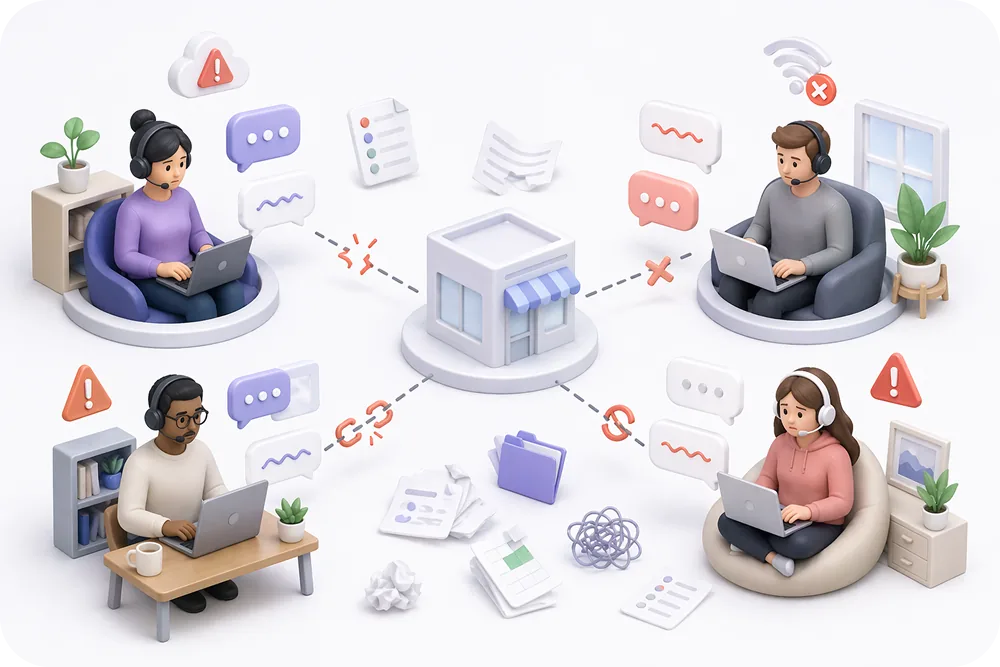
When Outsourcing Makes Sense
Outsourcing isn't right for every brand at every stage. It tends to work best in specific situations.
High-Volume, Low-Complexity Support
If most tickets are order tracking, shipping updates, and simple return requests, outsourcing handles them efficiently. These are process-driven tasks that follow clear rules.
Seasonal Spikes
Brands that see 3x to 5x volume increases during holidays benefit from outsourcing's flexibility. Hiring temporary in-house staff for four weeks of peak is rarely practical.
Rapid Growth
Startups scaling from 100 to 1,000 orders per day need support capacity fast. Outsourcing bridges the gap while the brand builds long-term operational capabilities.
Multi-Language Requirements
Brands selling across Europe or globally need support in multiple languages. A single BPO with multilingual capabilities is often more practical than hiring native speakers for each market.
When to Keep Support In-House
Complex or Technical Products
Products that require deep expertise (specialized electronics, custom furniture, or medical devices) are hard to support through outsourced teams without extensive training.
Premium or Luxury Brands
High-end brands where the customer experience is a core differentiator need support that matches the product quality. Generic outsourced support clashes with luxury positioning.
High-Value Claims and Disputes
Complex warranty claims, supplier chargebacks, and return fraud investigations need experienced staff with authority to make decisions.
When Customer Feedback Drives Product
Brands that use support conversations to inform product development need those insights flowing directly to internal teams.
The Third Option: AI-Powered Customer Service
The outsourcing vs. in-house debate increasingly has a third answer: automate routine support with AI and reserve human agents (in-house or outsourced) for complex cases.
What AI Can Handle Today
- WISMO queries (order tracking, delivery status)
- Simple return and exchange initiation
- Return policy questions
- Product information lookups
- Warranty eligibility checks
- Photo-based damage assessment
Claimlane's AI Agent, for example, analyzes product images and videos, applies warranty rules per product and supplier, and recommends resolutions. It handles returns and warranty claims without requiring human intervention for straightforward cases.
MaxGaming, with over 30,000 SKUs, resolved complex RMA cases 77% faster using AI agents. New support staff no longer need months of product training because the AI handles the product expertise layer.
The Hybrid Model
The most effective approach in 2026 combines three layers:
- AI automation for high-volume, rules-based interactions (60% to 70% of tickets)
- Outsourced agents for moderate-complexity tasks requiring human judgment (20% to 30%)
- In-house specialists for complex claims, VIP customers, and cases requiring brand authority (5% to 10%)
This model gives brands the cost efficiency of outsourcing, the scalability of AI, and the quality control of in-house expertise.
Cost Comparison
We achieved our ROI almost immediately by implementing Claimlane.
Jesper Nielsen, Head of Customer Service — GrejFreak
How to Choose an Outsourcing Partner
If outsourcing is the right move, here's what to evaluate.
Industry Experience
Look for BPOs with ecommerce experience specifically. Generic call centers won't understand return flows, order management systems, or ecommerce logistics.
Technology Stack
The partner should work with your existing tools (Shopify, Zendesk, Gorgias, Claimlane). Check for integrations compatibility before signing.
Quality Assurance Process
Ask about QA methodology: ticket audits, CSAT monitoring, agent coaching, and escalation procedures.
Data Security and Compliance
Verify GDPR compliance, SOC 2 certification, and data handling protocols.
Pricing Model
Common models include per-agent (monthly fee per agent), per-ticket (fee per resolved interaction), and per-hour. Per-ticket pricing aligns incentives around efficiency but can encourage rushed resolutions.
Trial Period
Start with a pilot (30 to 60 days) focused on a specific channel or ticket type before expanding.
Setting Up Outsourced Support for Returns
Returns and warranty claims are among the most common reasons brands outsource support. Here's how to set it up effectively.
Create Clear Playbooks
Document every return scenario: standard returns, exchange requests, defective products, missing items, and damaged-in-transit claims. Include decision trees, escalation triggers, and example responses.
Use a Self-Service Portal
Reduce ticket volume by letting customers initiate returns through a self-service claims portal. When customers can submit photos, select return reasons, and get instant approvals for simple cases, outsourced agents only handle exceptions.
Centralize Returns Data
Use a returns management platform that gives outsourced agents the same data visibility as in-house staff. Claimlane's workflow tools ensure consistent handling regardless of who processes the claim. Rated 4.8/5 on G2 (read reviews), Claimlane is trusted by brands across industries for returns and warranty automation.
Monitor Returns-Specific KPIs
Track first-response time for return requests, resolution time, customer satisfaction on return interactions, and cost per return.