.webp)
The Best Customer Success Software for Ecommerce in 2026
Customer success software helps teams track account health, manage engagement, run playbooks, and reduce churn. For ecommerce brands, the category has a specific problem: most CS platforms were built for SaaS companies managing subscription contracts, not retailers managing product experience and post-purchase relationships.
This guide compares the five leading customer success platforms (Gainsight, ChurnZero, Totango, Custify, and Vitally) across features, ecommerce fit, and pricing. It also covers a part of the CS stack that most buyer's guides skip: what happens to retention when your CS platform can't see claim and warranty data.
TL;DR
- Gainsight is the enterprise standard: deepest automation and analytics, highest cost, steepest learning curve.
- ChurnZero suits mid-market SaaS teams needing churn prediction and playbook automation without a long implementation.
- Totango offers a modular architecture and a meaningful free tier, making it accessible for teams at different maturity levels.
- Custify and Vitally are strong alternatives for mid-market teams that want faster time-to-value and a cleaner interface.
- None of these platforms track claims, warranty outcomes, or supplier-recovery data, but Claimlane feeds that data into your CS health scores as the claims execution layer in your stack.
What Is Customer Success Software?
Customer success software gives CS teams the data and workflows to manage post-sale customer health at scale. It aggregates product usage, engagement, support history, and financial data into health scores, then triggers playbooks and alerts when accounts need attention.
For ecommerce, the relevant inputs differ from SaaS. Instead of product usage logs and login frequency, retention signals come from repeat purchase rate, return patterns, warranty claim outcomes, and post-purchase satisfaction.
The best CS platform for an ecommerce brand is the one that can ingest these signals, surface at-risk accounts before they churn, and give CS teams enough context to act. Whether any of the leading platforms does this natively is one of the main evaluation questions this guide answers.
Key Features to Evaluate
When comparing customer success platforms for ecommerce, the features that determine practical value:
Health scoring, how the platform defines, weights, and surfaces account health. Can you configure it around post-purchase signals like claim rate, resolution time, and return frequency?
Playbook automation, how the platform triggers and executes retention workflows. Does it support ecommerce-specific triggers (post-claim check-in, post-return re-engagement)?
Integration depth, which data sources the platform connects to. Ecommerce relevance: Shopify, Klaviyo, Zendesk, Gorgias, ERP, and after-sales platforms.
Reporting and analytics, how the platform surfaces trends and segments. Can you identify cohorts by post-purchase experience quality, not just NPS or renewal status?
Ease of implementation, how long it takes to go live and how much admin overhead it requires. Relevant for ecommerce teams without dedicated RevOps support.
The 5 Best Customer Success Platforms for Ecommerce
| Platform | Best for | Ecommerce fit | Pricing (est.) |
|---|---|---|---|
| Gainsight | Enterprise SaaS with 10+ CSMs | Moderate, needs customisation | From ~$30k/year |
| ChurnZero | Mid-market SaaS, churn-focused | Limited, SaaS-native logic | $1,500-$3,000/mo |
| Totango | Freemium + enterprise models | Moderate, modular architecture | Free tier; ~$50k/year at scale |
| Custify | Mid-market, clean UI | Good, flexible health scoring | From ~$499/mo |
| Vitally | Mid-market, fast implementation | Good, strong Shopify connector | From ~$750/mo |
1. Gainsight
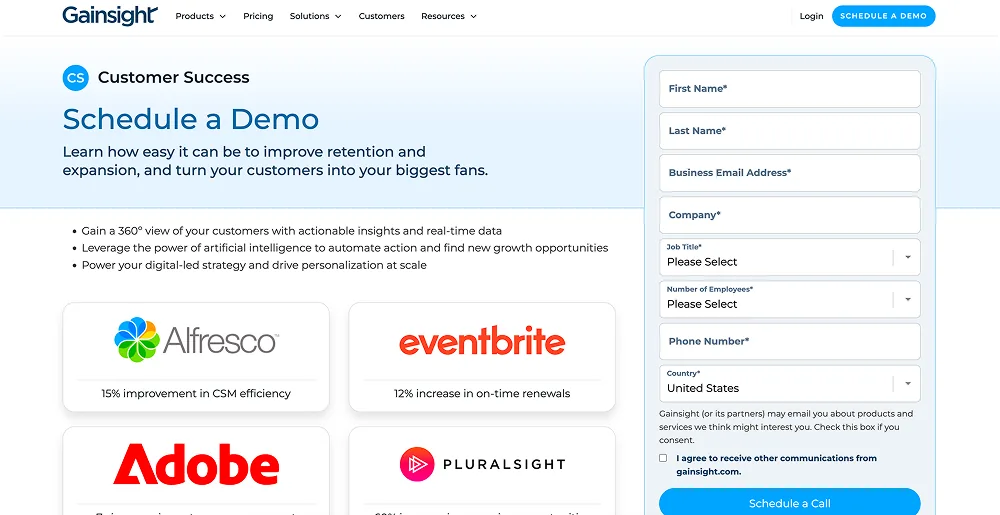
Gainsight is the enterprise standard in customer success. It offers the deepest set of automation capabilities, the most sophisticated health-scoring models, and the broadest integration library of any platform in this category.
For ecommerce brands with a large B2B wholesale or retail partner network, Gainsight handles the complexity: account hierarchies, multi-segment health scoring, and enterprise playbooks that trigger across the full partner lifecycle.
The challenges are cost and complexity. At $30,000/year and up, and with a steep learning curve that typically requires a dedicated admin, Gainsight is sized for enterprise operations with multiple full-time CS staff. Smaller ecommerce teams often find the overhead higher than the value justifies.
Best fit: Enterprise ecommerce brands managing 50+ high-value B2B accounts with a dedicated CS team.

2. ChurnZero
ChurnZero is built specifically for SaaS businesses managing subscription churn. Its command centre gives CS managers a daily view of which accounts need attention, which playbooks are running, and which health scores have shifted.
The platform's churn-prediction logic is strong for subscription models. For ecommerce teams selling physical products through a replenishment or loyalty model, the SaaS assumptions baked into ChurnZero's default metrics (login frequency, feature adoption, contract renewal date) require significant re-mapping to work.
Pricing at $1,500 to $3,000 per month makes it accessible for mid-market teams. The trade-off is implementation effort when the use case doesn't fit the SaaS mould directly.
Best fit: Mid-market brands with a subscription or membership component who need strong churn-prediction playbooks.

3. Totango
Totango's modular SuccessBLOCS architecture lets teams enable specific capabilities as they grow. It offers a meaningful free tier, making it one of the few platforms where a CS team can start building health scoring and playbooks without an upfront commitment.
At scale, Totango handles high data volumes and supports both tech-touch and high-touch CS motions within the same platform. For ecommerce brands managing a mix of SMB retail partners and enterprise accounts, the segmentation flexibility is useful.
The annual cost at $50,000 and a 20% setup fee for new customers makes it a serious investment. Teams get the most value when the platform's modular architecture matches a genuine need for different engagement models across account segments.
Best fit: Ecommerce brands with varied account tiers who need to run different CS motions from one platform.
4. Custify
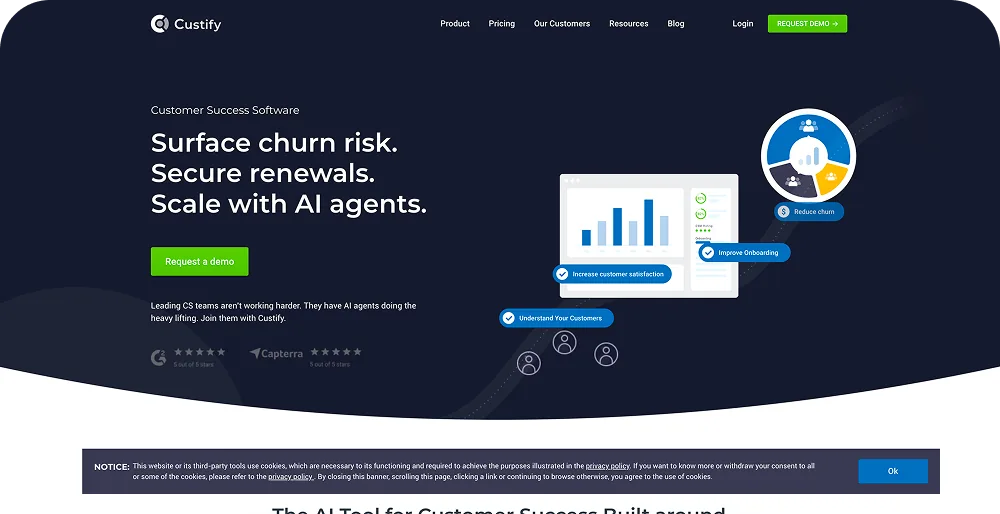
Custify is designed for mid-market SaaS teams and offers one of the cleaner interfaces in the category. Health scoring is flexible and configurable; the playbook builder covers the standard use cases without requiring engineering resources.
For ecommerce teams, Custify's flexibility on health score inputs is its strongest point. You can configure it around signals that matter to retail CS: repeat order frequency, support ticket volume, post-purchase NPS, and return or claim outcomes (via API or CSV import).
At approximately $499 per month, it's accessible for smaller CS teams. The integration depth is narrower than Gainsight or Totango, so teams with complex data pipelines should verify connector availability before committing.
Best fit: Mid-market ecommerce teams with a dedicated CS function who want flexibility without enterprise complexity.
5. Vitally
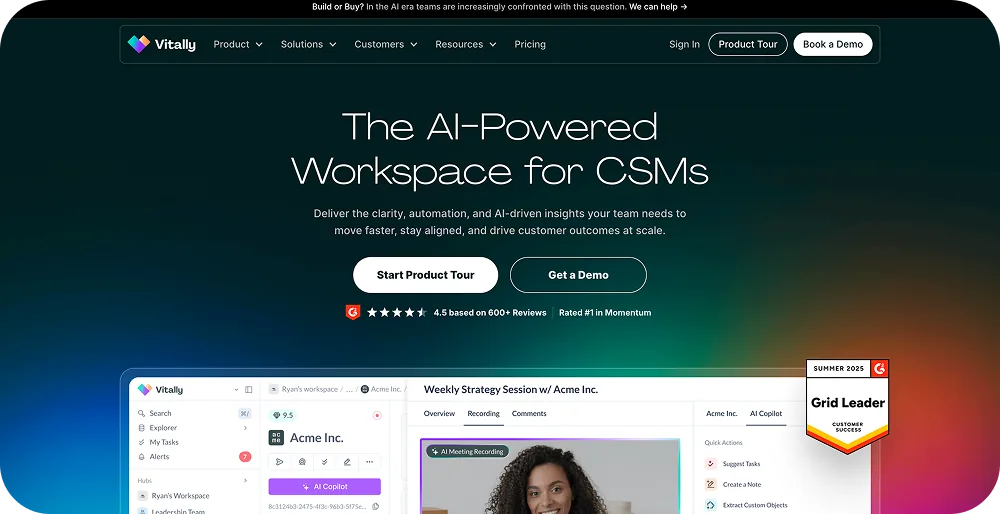
Vitally is one of the fastest-growing platforms in the mid-market CS space. Its Shopify connector is one of the few native ecommerce integrations in the category, making it a practical starting point for brands who want CS health scoring built around actual transaction and retention data.
Implementation is faster than most alternatives, and the interface is designed for CS teams rather than RevOps engineers. Health scoring, playbooks, and customer portals are all configurable without deep technical overhead.
For ecommerce brands new to formal CS tooling, Vitally's combination of fast deployment and ecommerce-relevant data connectors makes it worth evaluating first.
Best fit: Growth-stage ecommerce brands building a CS function for the first time and wanting quick time-to-value.
How to Choose Customer Success Software for Ecommerce
Three questions to narrow the field:
1. What is your account model? B2C direct-to-consumer brands need health scoring built around purchase behavior and post-purchase experience. B2B brands managing retailer networks need account hierarchy support and partner-level health scoring. Most CS platforms do one well, not both.
2. What data inputs matter for your health score? Return rate, claim resolution time, product defect rate, and warranty outcomes are meaningful churn signals for ecommerce brands. Check whether the platform can ingest these via API or native integration before building a health score model that misses them.
3. What is the team size and CS maturity? Gainsight requires dedicated admin resources. ChurnZero and Totango need implementation effort. Custify and Vitally offer faster deployment with lower admin overhead. The right choice depends on how much the CS team can invest in tooling vs. customer interaction.
The customer retention after returns guide covers the specific retention signals that matter most when physical product experience drives churn. The customer lifetime value returns article shows how return and claims data connects to LTV calculations.
Where Claimlane Fits in Your Customer Success Stack
The CS + Claims Stack Pattern
Your CS platform tracks retention health. Claimlane generates the claims data that tells you whether the post-purchase experience is helping or hurting that health.
- CS platform: health scores, playbooks, churn alerts, renewal motions
- Claimlane: claim resolution time, warranty outcomes, defect rate by SKU, supplier recovery data
- Connection: Claimlane data feeds into the CS health score via API, giving CS teams visibility into the post-purchase experience that drives or prevents churn
Claimlane is not a customer success platform. It doesn't manage health scores, run playbooks, or track renewal dates. But it generates the post-purchase data that CS platforms are often missing.
A CS team using Gainsight or Vitally sees purchase frequency, NPS, and support ticket volume. Without claims data, they can't see that a segment of high-LTV accounts had three warranty claims rejected in the last 90 days, or that a specific product line has a 14% defect return rate. Those signals are churn risk. CS teams that can't see them can't act on them.
Konges Sløjd, a Danish baby and nursery brand managing claims from over 1,000 retail partners worldwide, uses Claimlane to structure and automate retailer claim data. Clean, structured claim data at that scale feeds accurate signals into any downstream analytics or CS workflow. The Konges Sløjd case study covers how they built this.
The Coolshop case study shows a similar pattern for a high-volume multi-category retailer: Claimlane integrates with their ERP and ticketing system to create a connected post-purchase data layer.
For CS teams who want to understand how claims analytics connect to retention strategy, the warranty analytics product quality article covers the data layer in detail. The best after-sales service platforms guide covers the broader after-sales stack that CS tooling sits alongside.
G2 Rating
Claimlane holds a G2 rating of 4.8 out of 5. The Cult case study and Coolshop case study give a practical picture of what claims data quality looks like in live ecommerce operations.
FAQ
Conclusion
See how Claimlane feeds claim data into your CS health scores
See how Claimlane runs as the claims P&L engine inside your existing CS and ecommerce stack.
Book a 30-min walkthroughThe five platforms in this guide (Gainsight, ChurnZero, Totango, Custify, and Vitally) cover the retention motion well. Where most of them fall short for ecommerce is claims visibility. A CS team tracking account health without claim resolution data, defect rates, and warranty outcome signals is working with an incomplete picture.
Claimlane doesn't replace any of these platforms. It gives them the post-purchase operations data they need to make retention health scores accurate for brands where physical product quality and claims experience determine whether customers come back.
For more on how the after-sales stack connects to broader ecommerce operations, the ecommerce customer experience guide and the post-purchase experience customer loyalty article are relevant next reads. The returns and warranty KPIs guide covers the measurement framework that connects operations data to CS health scores.