Warranty claims start simple. An email here, a spreadsheet there. The first 20 cases a month are manageable. The first 100 are still doable. By 200, the team is buried in repetitive admin work, customers are waiting days for responses, and suppliers are sending follow-up emails about claims nobody can find.
Most brands respond to this by hiring more support agents. The problem is that the volume keeps growing, the new agents face the same broken process, and the cost per claim doesn't actually drop. Adding people to a broken workflow gets you a bigger broken workflow.
There's a better path. Brands like Davidsen reduced their claims team from 5 agents to 1-2 without growing volume. MaxGaming resolves complex RMA cases 77% faster across 30,000+ SKUs. Sebra moved aftersales from cost centre to retention lever. The pattern across all of them isn't more headcount. It's a different process.
This guide covers the four operational changes that make the biggest difference, with the proof points to back them up.
Why warranty claims get painful as brands scale
Three structural gaps drive the workload up faster than headcount can keep pace:
Gap 1
Information gaps
Missing photos, unclear product details, wrong order numbers. Every incomplete claim turns into 2-4 back-and-forth emails before the team can do anything useful.
Gap 2
Process gaps
No centralised way to track claims. Cases live in email threads, spreadsheets, helpdesk tickets, and shared drives. Nobody has the full picture, and claims get stuck.
Gap 3
Supplier gaps
Slow manual forwarding of cases. Suppliers receive incomplete information, ask for more details, and the cycle repeats. Credit recovery suffers.
These gaps compound at scale. A 100-claim month with 30 minutes of avoidable admin per claim is 50 hours of lost time. At 500 claims, that's a full-time job. (For more on identifying these bottlenecks, see the 3 reasons retailers hate warranty claims.)
Before making changes, it helps to evaluate where the biggest bottlenecks actually sit. (Here are 10 practical questions every operations leader should ask to identify the right starting point.)
The 4 changes that cut warranty claim workload
01
Collect complete information upfront
Make it easy for customers to submit photos, receipts, descriptions, and order details in one structured intake step. Removes the back-and-forth and speeds up first response by days.
02
Forward claims to suppliers instantly
Send ready-to-process claims with one click. No chasing for missing info, no email threads, no formatting work. Suppliers approve faster and credit recovery rates improve.
03
Automate repetitive tasks
Label creation, status updates, customer and supplier notifications all happen automatically. Agent time goes to complex cases, not admin work.
04
Track every claim from start to finish
Full visibility on open vs closed cases, supplier performance, recurring product issues. No claims get lost. Patterns become visible. Decisions get easier.
Each change is small individually. Together they typically cut warranty claim handling time by 60-80%. Here's how each one works in practice.
1. Collect complete information upfront
The biggest source of wasted time in warranty operations is incomplete claims. A customer emails support saying "my product is broken." The agent replies asking for the order number, photos, and a description of the issue. Two days later the customer responds with the order number but no photos. The agent asks again. By the time the case is actionable, four days have passed and three messages have moved between two people.
A structured intake fixes this at the start. The customer goes to a self-service portal that walks them through every required field: order details (auto-pulled from email), photos with prompts for what to photograph, defect description, contact information. The case can't be submitted until it's complete. The agent receives a fully formed claim with everything they need to make a decision.
This single change removes 80-90% of back-and-forth communication on warranty cases.
In practice
Brands using Claimlane's self-service portal see complete claim intake from day one. The validation layer ensures cases arrive with photos, order data, and structured defect codes already attached. No email tag, no missing context.
2. Forward claims to suppliers instantly
Most warranty claims involve suppliers. Either the supplier covers the warranty cost, the supplier needs to repair the product, or the supplier owes credit on a defect. Either way, the claim has to move from the brand to the supplier and back.
In manual workflows, this looks like: agent receives the claim, drafts an email to the supplier with relevant details, attaches photos, sends. Supplier replies asking for additional info. Agent replies with the info. Supplier approves or denies. Agent updates customer.
The cycle takes days even when nothing goes wrong. When the supplier asks for info the brand doesn't have, it takes weeks.
Structured supplier forwarding eliminates the manual coordination. The brand's case data, photos, and defect details forward to the supplier in one click. The supplier sees a structured view, applies their rules, and responds inside the same workflow. Status updates flow back automatically.
In practice
Claimlane's supplier forwarding workflow reduces the typical supplier coordination cycle from days to hours. Most brands see supplier credit recovery rates improve 20-40% in the first quarter alongside the time savings, because cleaner data means cleaner approvals.
3. Automate repetitive tasks
Inside every warranty case there's a long list of repetitive admin work that doesn't need a human. Generating return shipping labels. Sending status update emails to the customer. Notifying the supplier when a case opens. Creating credit notes. Updating inventory after the resolution.
Each of these tasks takes 1-3 minutes. They feel small individually. At 100 claims a month, they add up to 5-10 hours of admin work. At 500 claims, it's a full week.
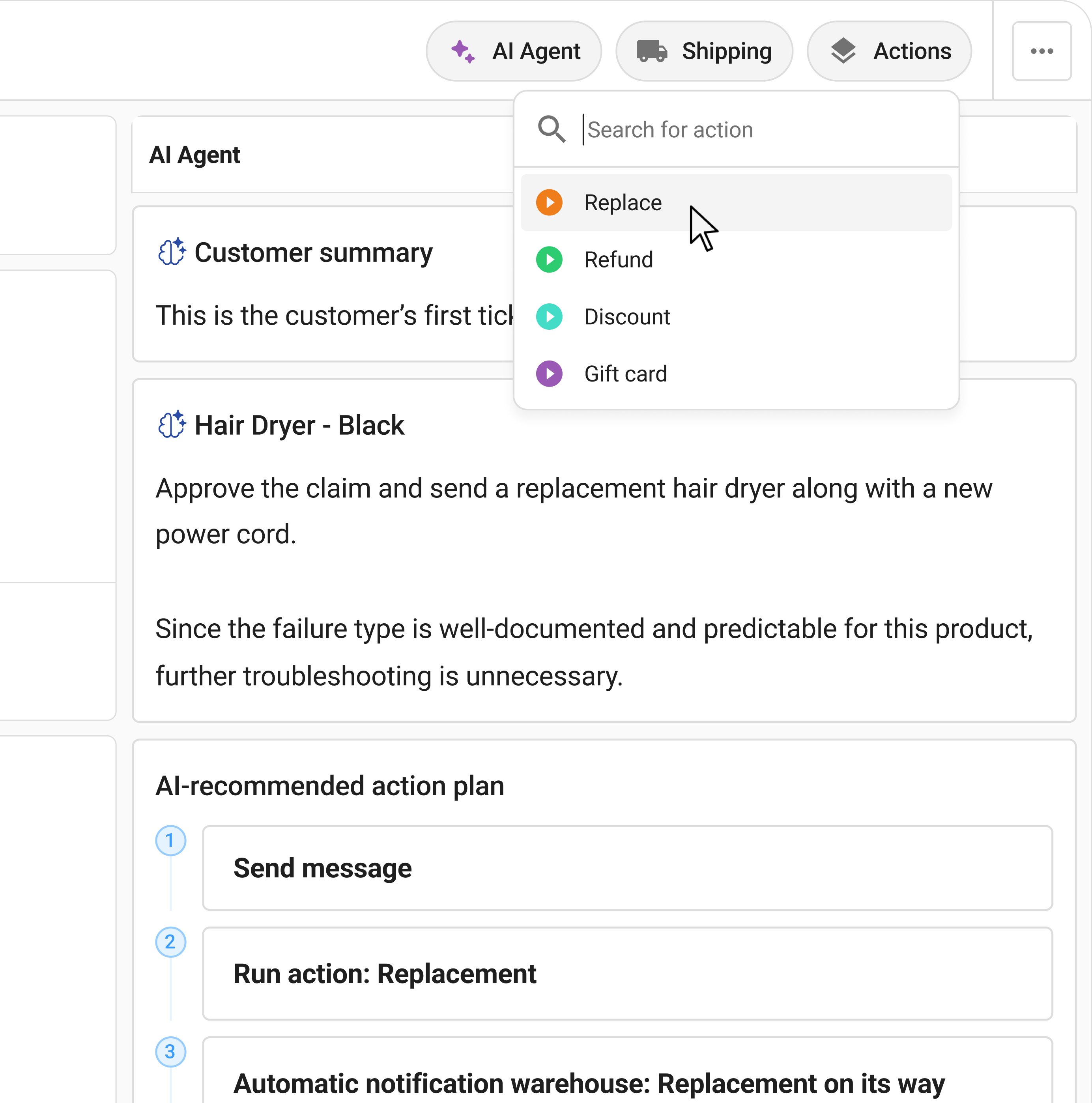
Automation handles all of it. Status updates trigger automatically when the case moves through the workflow. Labels generate based on rules. Suppliers and customers get notified at the right milestones without anyone touching the case. The agent's time goes to the 10% of cases that actually need human judgement.
(For the broader operational picture, see how to automate returns and warranty claims and the deep dive on warranty claims automation with AI.)
4. Track every claim from start to finish
The fourth change isn't about speed. It's about visibility.
Most brands running manual warranty workflows can't answer basic operational questions: How many claims are open right now? Which products are generating the most claims? Which suppliers are approving fast and which are slow? What's the average resolution time?
The data exists somewhere — across email threads, spreadsheets, helpdesk tickets, and shared drives — but it's not aggregated. So decisions get made on instinct rather than evidence.
A structured platform aggregates this automatically. Every case is tracked with structured data. Reports show open vs closed counts, supplier performance, defect patterns at the SKU level, and resolution time trends. The data stops being invisible.
In practice
Claimlane's analytics layer surfaces the patterns most brands miss. Recurring defects on a specific SKU. Suppliers that consistently underperform on credit notes. Categories with rising claim rates that signal a quality issue upstream. The data turns warranty operations from reactive to predictive.
What the impact looks like in practice
These four changes aren't theoretical. Brands across categories see consistent results.
5 → 1-2
Davidsen cut their claims team from 5 agents to 1-2
77% faster
MaxGaming RMA resolution across 30,000+ SKUs
9x ROI
Onyx Cookware's return on Claimlane investment
Cost → Lever
Sebra moved aftersales from cost centre to retention lever
The pattern across these brands isn't industry-specific. Davidsen sells building materials. MaxGaming sells gaming peripherals. Sebra sells children's furniture. What they have in common is the operational shift: from manual workflows that scale linearly with volume, to structured workflows that scale much more efficiently.
(For more proof, see how Black Diamond automated warranty workflows and how GrejFreak handles warranty claims at scale.)
What it means for the team
The shift isn't just operational. It changes what the team actually does.
| Before structured workflow |
After structured workflow |
| 10-15 minutes per case on admin |
2-3 minutes per case on admin |
| Email threads to gather missing info |
Cases arrive complete from intake |
| Manual supplier forwarding |
One-click structured handoffs |
| Spreadsheets across multiple tools |
Single dashboard with status visibility |
| Senior agents on admin tasks |
Senior agents on complex cases only |
The shift turns warranty handling from a cost centre that scales with headcount into an operation that scales with technology. (For more on the shift in mindset, see the workflow approach to warranty resolution.)
The self-audit
If any of these signals apply, the warranty workflow is past the point where manual processes pay off:
Are you still chasing customers for missing info?
Information gap. Structured intake fixes this.
Are you manually forwarding claims to suppliers?
Process gap. Structured supplier workflow fixes this.
Are you tracking claims in spreadsheets?
Visibility gap. Centralised tracking fixes this.
Is the team spending more time on admin than judgement?
Automation gap. Repetitive tasks should run themselves.
Three or more "yes" answers means the brand is past the threshold where structured warranty management earns back its cost.
The bottom line
Scaling a brand without scaling warranty admin work is possible. It just requires changing the system, not adding people to a broken one.
The four changes (complete intake, instant supplier forwarding, automation of repetitive tasks, end-to-end tracking) are the operational pattern that brands like Davidsen, MaxGaming, Sebra, and 8000+ others use to handle high warranty volumes without proportional headcount growth.
For brands ready to make the shift, book a Claimlane demo to see the workflow in action and discuss whether it fits the operation.
FAQ
How can ecommerce brands reduce warranty claim workload? +
Four operational changes drive the biggest reduction. First, collect complete information upfront through structured intake so cases arrive with photos, order data, and defect details already attached. Second, forward claims to suppliers instantly with one-click structured handoffs. Third, automate repetitive tasks (label generation, status updates, notifications). Fourth, track every claim end-to-end for visibility on supplier performance and defect patterns. Together these typically cut handling time by 60-80%.
When should brands move from manual to automated warranty workflows? +
Most brands hit the breaking point around 50-100 warranty claims per month. Below that, generic helpdesk tools and spreadsheets are workable. Above that, the inconsistency in decisions, lost supplier credits, and slow resolution times compound fast. Brands selling durable goods (electronics, furniture, outdoor gear, baby products) often need structured workflow earlier because each claim is more complex.
How much time does structured warranty intake save per claim? +
Manual workflows typically take 10-15 minutes of admin time per claim, mostly on email back-and-forth, data entry, supplier coordination, and customer notifications. Structured workflows reduce this to 2-3 minutes per claim because intake captures everything upfront and most actions happen automatically. At 200 claims per month, that's 25-40 hours of agent time recovered.
How does structured warranty workflow improve supplier credit recovery? +
Most brands lose 20-40% of recoverable supplier credit because the workflow doesn't capture the data needed to file claims cleanly. Structured workflow captures defect details, photos, and SKU data automatically at intake, then forwards complete cases to suppliers in one click. Cleaner data plus faster forwarding means higher approval rates and faster credit notes.
What's the difference between automation and AI in warranty workflows? +
Automation handles rule-based repetitive tasks: label generation, status updates, scheduled notifications. AI adds reasoning to complex cases: assessing photos to flag damage patterns, suggesting resolutions based on customer history and product knowledge, detecting fraud signals across cases. Most modern warranty platforms combine both, with automation handling the high-volume routine work and AI assisting on cases that need judgement.
Can a brand reduce warranty workload without buying new software? +
To a degree. A clear claim submission form, standardised supplier email templates, a shared spreadsheet for tracking, and clear policies on resolution decisions all help. These take some pressure off at low volumes (under 50 claims per month). Above that volume, the manual coordination overhead grows faster than process improvements can keep up. Software pays off at the point where the cost of admin time exceeds the cost of the platform.
How does Claimlane reduce warranty workload? +
Claimlane handles all four operational levers in one platform. The self-service portal collects complete claim information at intake. Supplier forwarding workflows send cases to suppliers in one click with all data attached. Automation rules handle label generation, status updates, and notifications. Analytics surface defect patterns and supplier performance. Brands like Davidsen reduced their claims team from 5 agents to 1-2, MaxGaming resolves complex RMA cases 77% faster, and Sebra moved aftersales from cost centre to retention lever using this exact pattern.
What signals indicate it's time to upgrade warranty workflows? +
Five common signals. Volume above 50-100 claims per month. Team chasing customers for missing photos and order info. Manual supplier forwarding via email. Spreadsheets as the primary tracking system. Senior agents spending more time on admin than complex cases. Three or more of these means the operation is past the threshold where structured warranty workflows earn back their cost.

.webp)