
.webp)
Every online purchase follows a pattern. The customer sees a product, evaluates it against alternatives, decides to buy (or not), and then lives with that decision. Sometimes they keep the product. Sometimes they return it. Understanding what happens at each stage is what separates brands that grow from brands that churn through customers.
Consumer buying behavior in ecommerce is shaped by psychology, product presentation, social proof, pricing, and increasingly, the post-purchase experience. A generous return policy can increase conversion rates. A frustrating returns process can kill repeat purchases.
This guide covers the stages of the buying decision process, the psychological factors that influence ecommerce purchases, and how smart brands use returns data to understand and improve buying behavior.
TL;DR
- Every online purchase follows five stages: problem recognition, information search, evaluation of alternatives, purchase decision, and post-purchase behavior.
- 92% of consumers check the return policy before buying. A lenient policy increases purchase probability by 18–25% because it reduces perceived risk.
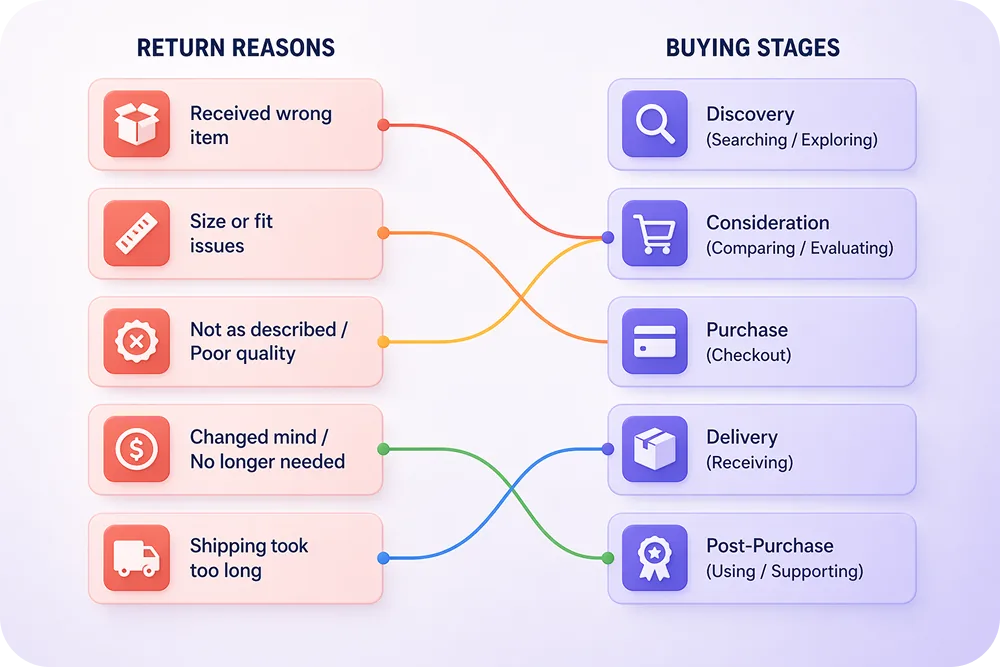
- Returns data is the most underused feedback loop in ecommerce. Every return reason maps directly to a buying stage that failed.
- Claimlane's analytics dashboard tracks return reasons by product, category, and customer segment, showing exactly where the buying experience breaks down and what to fix.
The Five Stages of the Consumer Buying Decision Process
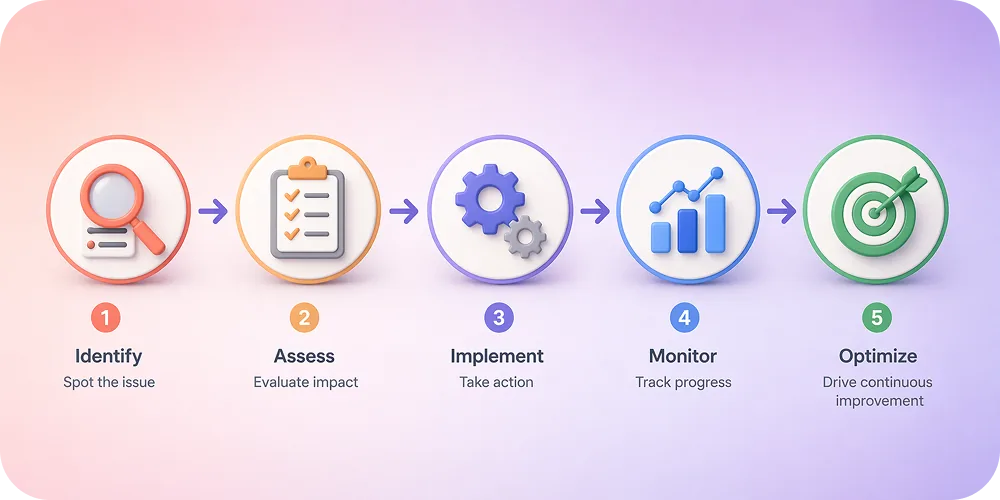
1. Problem Recognition
The buying process starts when a consumer recognizes a need or want. In ecommerce, this trigger comes from:
- External stimuli: An Instagram ad, a friend's recommendation, a blog post, a Google search result
- Internal stimuli: Running out of a product, a seasonal need (winter coat, sunscreen), dissatisfaction with a current product
- Life events: Moving to a new home, starting a new job, having a baby
For ecommerce brands, this stage is about visibility. Being present when the customer first becomes aware of the need is the entire point of SEO, paid ads, and content marketing.
2. Information Search
Once the need is recognized, consumers start researching options. The depth of research depends on the purchase type:
- Low-involvement purchases (under $30, routine items): Minimal research. The customer might compare 2-3 options on Amazon and pick based on price, reviews, and Prime delivery.
- Medium-involvement purchases ($30 to $200): Moderate research. The customer reads reviews, checks comparison articles, and might visit 3-5 brand websites.
- High-involvement purchases ($200+): Extensive research. The customer reads expert reviews, watches video reviews, compares specs in detail, and may take days or weeks to decide.
Brands that provide thorough product information, honest reviews, and comparison content capture customers during this stage. Brands that don't lose them to competitors who do.
3. Evaluation of Alternatives
Consumers compare options based on:
- Price: Still the top factor for 60% to 70% of online shoppers
- Reviews and ratings: Products with 4+ stars and 50+ reviews convert significantly better
- Product images and descriptions: Can the customer accurately assess the product online?
- Return policy: A clear, generous return policy reduces perceived risk. Brands offering free returns or easy exchanges see higher conversion rates.
- Shipping speed and cost: Free, fast shipping has become an expectation, not a differentiator.
- Brand trust: Established brands convert better for high-involvement purchases.
4. Purchase Decision
The customer commits to buying. But even at this stage, drop-off happens:
- Cart abandonment averages 70% across ecommerce. Major causes: unexpected shipping costs, complicated checkout, required account creation.
- Payment friction: Limited payment options, declined cards, or security concerns kill conversions.
- Last-minute price comparison: The customer checks if the same product is cheaper elsewhere.
5. Post-Purchase Behavior
This is where most brands drop the ball. The post-purchase experience determines whether a customer becomes a repeat buyer or a one-time visitor who leaves a negative review.
Post-purchase outcomes:
- Satisfaction: The product meets or exceeds expectations. The customer keeps it, maybe leaves a review, and is likely to buy again.
- Cognitive dissonance: Buyer's remorse. The customer questions whether they made the right choice. Clear order confirmations, shipping updates, and reassuring messaging help.
- Dissatisfaction: The product doesn't match expectations. The customer initiates a return. How the brand handles the return process determines whether the customer ever comes back.
Recognition
Search
Alternatives
Decision
Behavior
Psychological Factors That Influence Ecommerce Buying Behavior
Social Proof
People look to others when making decisions. In ecommerce, social proof takes several forms:
- Customer reviews and ratings: The most powerful form of social proof online. Products with reviews convert 270% better than those without (Spiegel Research Center).
- User-generated content: Photos and videos from real customers showing the product in use.
- "X people bought this today" notifications: Creates urgency and validates the purchase.
- Influencer endorsements: Particularly effective for discovery-phase purchases in fashion, beauty, and lifestyle.
Scarcity and Urgency
Limited availability triggers faster decisions. "Only 3 left in stock," "Sale ends in 2 hours," and "Limited edition" all tap into the fear of missing out (FOMO). However, if customers feel manipulated by fake scarcity, trust erodes quickly.
Anchoring
The first price a customer sees becomes the reference point. Showing the original price crossed out next to the sale price makes the discount feel more significant. The "compare at" price anchors the perceived value higher than the actual purchase price.
Loss Aversion
People feel losses more strongly than equivalent gains. In ecommerce, loss aversion works through:
- Return policies: The risk of losing money on a bad purchase stops customers from buying. A clear return policy removes that risk.
- Store credit vs refund framing: Offering store credit as the default return option frames the customer's "loss" differently than a cash refund.
- Free shipping thresholds: "Spend $15 more for free shipping" makes the customer feel they'd lose the shipping value by not adding to the cart.
The Paradox of Choice
Too many options paralyze decision-making. Brands with 500 SKUs in a category often convert worse than brands with 50 curated options. Product recommendations, "best seller" tags, and filtered search help narrow choices.
How Returns Data Reveals Buying Behavior Problems
Returns Are Feedback
Every return tells a story about where the buying experience failed. When customers return products, the reasons map directly back to gaps in the buying decision process:
| Return Reason | Buying Stage That Failed | Fix |
|---|---|---|
| "Not as described" | Information Search | Better descriptions, photos, videos |
| "Wrong size/fit" | Evaluation | Size guides, fit tools, UGC photos |
| "Found cheaper" | Evaluation / Post-Purchase | Price matching, value messaging |
| "Changed my mind" | Post-Purchase (remorse) | Better matching, onboarding emails |
| "Defective/damaged" | Product quality | QC, supplier accountability |
| "Arrived too late" | Purchase Decision | Accurate delivery estimates |
Brands using returns analytics can map these reasons to specific products, categories, and customer segments. Instead of guessing why customers leave, the data shows exactly where the buying experience breaks down.
Whether customers are shopping in-store or online, their expectations are, quite rightly, increasing every day. We, therefore, decided the time was right to invest in our vital online aftercare service, something which many retailers often overlook, despite its power to make or break a retailer's reputation if they do not get it spot-on.
Elisa Schjødt Frank, Head of Customer Success — Matas
The Expectation Gap
Most returns happen because of a gap between what the customer expected and what they received. This gap forms during the buying process:
- Product photos that are too polished set unrealistic expectations
- Missing key details (material feel, exact color, weight) leave the customer guessing
- Sizing that varies between brands makes fit unpredictable for apparel
- Review manipulation (only showing 5-star reviews) creates inflated expectations
Claimlane's analytics dashboard helps brands identify which products have the highest expectation gaps by tracking return reasons, claim types, and product-specific feedback. Rated 4.8/5 on G2 (read reviews), Claimlane turns returns data into actionable buying experience improvements.
How the Return Policy Influences Buying Behavior
Return Policies as Conversion Tools
A return policy isn't just a post-purchase safety net. It actively influences the purchase decision. Research consistently shows:
- 92% of consumers check the return policy before buying (Narvar)
- 67% of shoppers check the returns page before adding to cart
- Lenient return policies increase purchase probability by 18% to 25%
- Free return shipping reduces cart abandonment by up to 40%
This makes intuitive sense. The return policy is a risk-reduction tool. If the customer knows they can return the product easily, the perceived risk of buying drops. The buying decision becomes easier.
The Return Policy Paradox
Lenient return policies increase purchases AND increase returns. The question is whether the net effect is positive. For most brands, it is:
- A 30-day return window increases conversions more than the incremental return costs
- Customers who return items are often more valuable long-term than customers who never buy at all
- The data from returns (reasons, product feedback) helps improve the product and the buying experience
The key is managing the cost of returns efficiently. Brands using a returns management system can offer generous policies while keeping processing costs low through automation.
Generational Differences in Buying Behavior
How Different Generations Shop Online
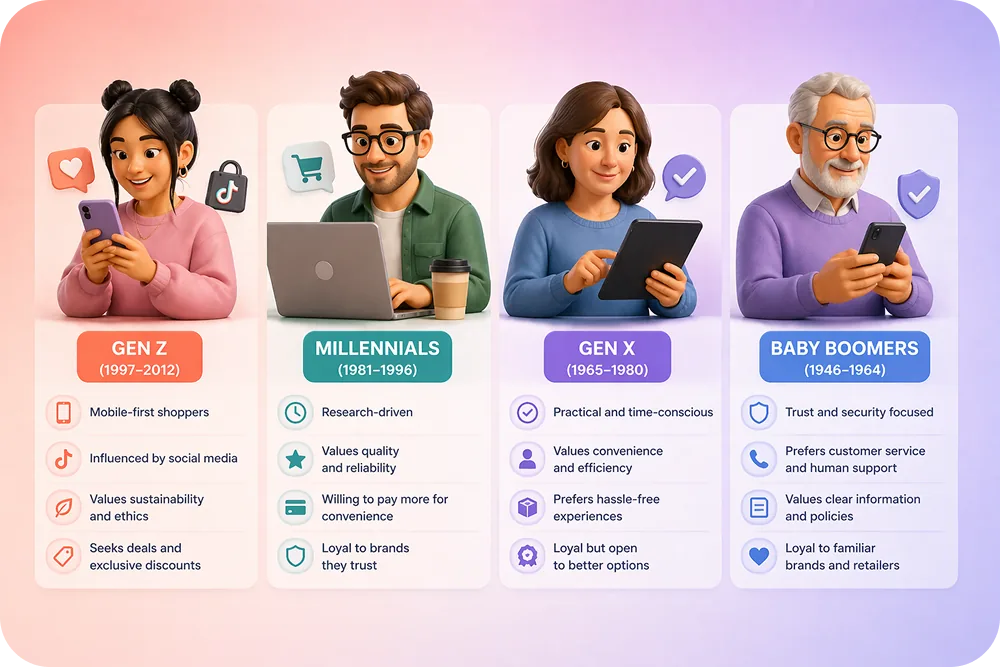
Buying behavior varies significantly by generation:
Understanding these differences helps brands tailor:
- Marketing channels: Where each generation discovers products
- Product page design: How much information to present and in what format
- Return experience: Self-service portals for younger shoppers, phone/email options for older ones
- Communication style: Casual and visual for Gen Z, detailed and professional for Boomers
Mobile vs Desktop Buying Behavior
The Mobile-First Shift
Mobile commerce accounts for over 60% of ecommerce traffic and roughly 40% of revenue in 2026. The gap between traffic and revenue reveals a key behavioral difference: customers browse on mobile but often complete purchases on desktop.
Mobile buying behavior is characterized by:
- Shorter sessions (2-3 minutes average vs 5-7 minutes on desktop)
- Higher bounce rates (50%+ vs 35% on desktop)
- More impulse purchases (especially from social media links)
- Lower conversion rates (1.5% to 2% vs 3% to 4% on desktop)
- Higher cart abandonment (85% vs 70% on desktop)
For returns, mobile matters too. Customers expect to initiate returns from their phone. A self-service portal that works seamlessly on mobile reduces friction and keeps the post-purchase experience consistent with how the customer originally shopped.
Using Buying Behavior Data to Reduce Returns
Close the Expectation Gap
The most effective way to reduce returns is to make the buying experience more accurate:
- Better product photography. Show products from multiple angles, in context, on different body types (for apparel). Include close-ups of material, texture, and details.
- Detailed size and fit information. Go beyond standard size charts. Include model measurements, fit notes ("runs small," "true to size"), and if possible, AI-powered size recommendation tools.
- Video content. A 30-second video showing the product in use gives customers more realistic expectations than 10 static photos.
- Honest reviews. Don't filter negative reviews. A product with a 4.2 rating and genuine reviews converts better long-term than a product with a suspicious 5.0 rating.
- Comparison tools. Help customers choose between similar products instead of buying multiple and returning the ones they don't want ("bracketing").
Segment by Return Behavior
Not all customers behave the same way. Segmenting customers by their return behavior reveals actionable patterns:
- Never-returners (60% to 70% of customers): These customers buy carefully and rarely return. Reward their loyalty.
- Occasional returners (20% to 25%): These customers return when something genuinely doesn't work. Focus on closing the expectation gap for their purchases.
- Serial returners (5% to 10%):** These customers buy with the intention of returning most items. They bracket (buy multiple sizes/colors), wardrobing (wear and return), or abuse return policies. Set boundaries while keeping the experience positive.
Claimlane helps brands identify these segments by tracking return patterns per customer, product, and category. The AI agent can flag unusual patterns and recommend actions.
The Role of Customer Service in Buying Behavior
Pre-Purchase Support
Customer service isn't just for problems. Pre-purchase support directly influences buying behavior:
- Live chat on product pages can increase conversion by 20% (Forrester)
- Quick responses to product questions reduce the information search stage
- Proactive outreach ("Still deciding? Here's a comparison guide") moves customers through the funnel
Brands that outsource customer service need to ensure their partners understand the products well enough to answer pre-purchase questions accurately. A wrong answer during the information search stage leads directly to a return later.
Post-Purchase Support
How a brand handles post-purchase issues shapes the customer's overall buying behavior:
- Fast, easy returns keep the customer in the brand's ecosystem (they get store credit and buy something else)
- Proactive shipping updates reduce WISMO queries and buyer's remorse
- Personalized recommendations based on return data help the customer find better-matching products next time
With Claimlane, we've transformed our returns process into a streamlined, automated system. We can now efficiently track the status of all returns and claims, and our teams collaborate more effectively than ever before. In short, the solution helps us streamline communication and share information both internally and externally, which has been key to our success.
Simone Andersen, Customer Care Manager — Coolshop
Behavioral Trends Shaping Ecommerce in 2026
Conscious Consumption
Consumers increasingly consider sustainability in purchase decisions. Buying behavior trends include:
- Preference for brands with transparent sustainability practices
- Willingness to pay 10% to 15% more for sustainably produced goods
- Negative reaction to excessive packaging and wasteful return processes
- Growing acceptance of refurbished and recommerce options
AI-Influenced Shopping
AI is changing how consumers discover and evaluate products:
- AI shopping assistants (ChatGPT, Google's AI Overview) are becoming starting points for product research
- Visual search lets customers find products by uploading photos
- Personalized recommendations based on browsing and purchase history drive 35% of Amazon's revenue
- AI-powered try-on tools reduce the expectation gap for fashion and beauty
Subscription and Loyalty Model Growth
Subscription models change the buying decision from a one-time event to an ongoing relationship. The initial purchase decision is heavier (committing to recurring charges), but subsequent purchases are nearly effortless. Brands with strong after-sales service retain subscribers better.