
.webp)
Outvio handles ecommerce returns logistics well. Branded portals, carrier integrations, post-purchase tracking, delivery automation. For DTC brands focused on the shipping experience, the platform works.
The gaps show up the moment a brand needs warranty validation, repair routing, or supplier-side claim recovery. Returns stop being a shipping problem and start being an aftersales problem. That is where teams start shopping for an alternative.
This guide covers the 7 alternatives that come up most often when brands outgrow Outvio. Each one fits a different shape of operation. The right pick depends less on the feature list and more on what kind of cases you are trying to resolve.
- Claimlane — best for warranties, repairs, and supplier-side claims alongside returns.
- Loop Returns — best for Shopify DTC brands that want exchange-first retention.
- Happy Returns — best for US brands that need physical drop-off infrastructure.
- AfterShip Returns — best for cost-accessible global returns automation.
- ReBOUND — best for cross-border returns logistics in the EU.
- Newmine — best for analytics-led returns reduction.
- ServiceNow — best for large enterprises with existing service management.
Claimlane ✨ – Best for structured returns, warranties, and repair automation
Loop Returns – Best for Shopify-native DTC brands
Happy Returns – Best for US drop-off network infrastructure
AfterShip Returns – Best for affordable global returns automation
ReBOUND – Best for international logistics-heavy brands
Newmine – Best for returns reduction and analytics
ServiceNow – Best for enterprise warranty and service workflows
Why Teams Look for Outvio Alternatives
Outvio is a strong fit for one shape of operation. Brands that ship a lot of fashion, handle return reasons that are mostly size or preference, and want a clean post-purchase experience get value from it. The platform starts to feel narrow the moment the cases get more complicated.
The brand starts handling warranties
Outvio is built around returns and delivery. It is not built around warranty claims. The day a brand has to validate entitlement, capture a serial number, route a defective unit to a supplier, and send a credit note back through the chain, the platform runs out of room.
This shows up most for electronics, outdoor equipment, appliances, and DIY tools. The customer files what looks like a return. The case is actually a warranty claim, with photo evidence, a serial number, and a supplier on the other end. A returns-only platform sees one half of that workflow.
The team needs repair routing
A returned unit is not always resaleable. A meaningful share goes to repair, refurbishment, or recommerce. Brands handling repairs need a tool that tracks the unit through inspection, parts, technician time, and return-to-customer, not a tool that closes the case the moment the refund is paid.
This is where Outvio runs thin. Repair workflows are a separate operational track, and most returns platforms either skip them or graft on a basic ticket flow.
Supplier claims start eating margin
For brands that recover costs from suppliers when a product fails, the bottleneck is documentation. Photos, serials, claim numbers, dates, repair logs. Returns platforms do not assemble that package. The team ends up running supplier claims out of a shared inbox, which is exactly where credit notes go to die. See the supplier recovery guide for the full pattern.
Multi-market complexity
Outvio supports international brands, but the platform was built around a specific operational pattern. As brands scale into multi-warehouse, cross-border, and localised portals, the requirements shift. Some teams stay on Outvio and add tools around it. Others switch.
How we picked these alternatives
This list ranks platforms by how often they come up in real evaluation cycles. Each one solves a different problem. No platform on this list is bad. They just fit different operations.
The team behind this guide works with brands running aftersales operations at every scale, from 200 cases a month to 20,000. Claimlane is rated 4.8/5 on G2, and the picks below are weighed against what actually wins evaluations against Outvio in the field.
The Best Outvio Alternatives in 2026
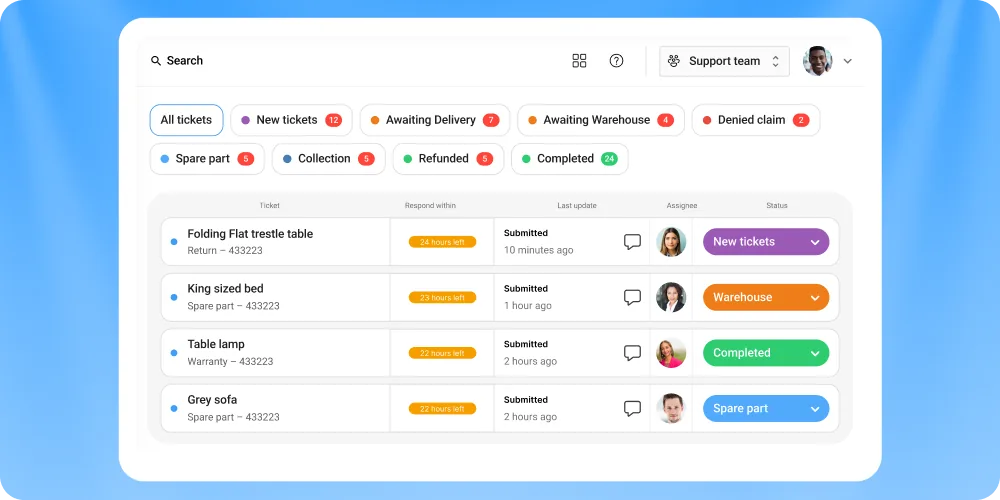
1. Claimlane
Claimlane is built around the full aftersales lifecycle. Returns, warranties, repairs, replacements, spare parts, and supplier claims all sit in one system rather than four. The product was designed for brands where the case rarely ends at a refund.
The unit of work is the case, not the return label. A customer files through a branded self-service portal with photos, videos, order details, and a serial number. The case enters a structured flow with entitlement rules, supplier mapping, and an audit trail. By the time a person looks at it, the data is already there.
Claimlane's AI Agent, the first AI agent purpose-built for warranty claims and returns, reviews the evidence, applies warranty rules per product and supplier, and recommends or auto-approves a resolution. MaxGaming, the largest gaming and e-sports e-commerce in Scandinavia, uses the AI Agent to close complex RMA cases 77 percent faster.
Best for: brands with warranty exposure, supplier claims, repair workflows, or multi-warehouse operations.
Strengths:
- Configurable workflows for returns, warranty, repair, and replacement.
- Native supplier handoff with credit-note tracking.
- AI-assisted triage and disposition.
- 75+ integrations to Shopify, WooCommerce, ERP, Zendesk, and shipping providers.
- Built for B2B and B2C in the same instance.
Limitations:
- Not aimed at brands with fewer than 100 cases a month.
- Setup is API-led, not drag-and-drop.
Pricing: SaaS pricing, custom by volume. Most brands reach value inside a staged 90-day rollout. GrejFreak reports ROI inside the first month.
Vs Outvio: Outvio is built around the return label and the post-purchase experience. Claimlane is built around the case, the rules, and the supplier on the other end. For brands handling only refunds and exchanges, Outvio is enough. For brands handling warranties, repairs, or supplier recovery, Claimlane closes the gap.
"Before Claimlane, our entire customer service team of 5 agents was involved in claims handling. Today, we have 1-2 agents who can solve everything in Claimlane."— Andreas Bang Nielsen, Marketing & Ecommerce Director, Davidsen
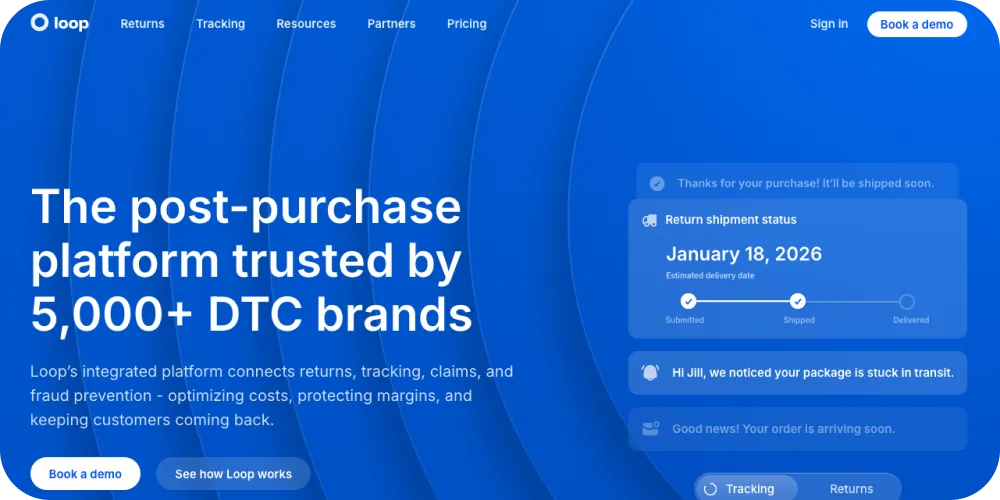
2. Loop Returns
Loop Returns is a Shopify-native returns platform designed for direct-to-consumer ecommerce brands.
Loop is the Shopify-native returns platform that built the "exchange-first" category. The pitch is retention: when a customer files a return, the portal nudges them toward an exchange before a refund, which keeps revenue inside the brand. For fashion DTC running on Shopify, it works.
The platform is built around the consumer flow. Branded portals, exchange logic, instant store credit, fraud rules, and integrations into Shopify's order and inventory data. Loop knows Shopify deeply and the integration shows.
Best for: Shopify DTC brands, especially fashion and apparel, that want exchange-led retention.
Strengths:
- Strong consumer-facing return experience.
- Exchange-first model lifts repeat purchase metrics.
- Tight Shopify integration with order and customer data.
- Customisable workflows for fashion-style returns.
Limitations:
- Built for Shopify; less useful for other platforms.
- Warranty and repair are not first-class concepts.
- Supplier claim recovery is not in scope.
Pricing: tiered by order volume, with custom enterprise pricing for higher tiers.
Vs Outvio: both platforms compete on the post-purchase experience. Loop is more retention-focused and Shopify-specific. Outvio carries broader logistics features and works across more commerce stacks.
3. Happy Returns
Happy Returns is the platform that ties returns to a physical drop-off network. Customers bring the return to a partner location, get instant refund confirmation, and walk away. The brand consolidates inbound shipping and avoids the label-printing step. For US brands with high return volume, the drop-off network is genuinely useful.
Best for: US-focused ecommerce brands with high return rates, especially apparel and accessories.
Strengths:
- Box-free, label-free drop-off through partner retail locations.
- Instant in-store refund confirmation reduces support tickets.
- Consolidated reverse logistics lowers per-return shipping cost.
- Strong consumer NPS on the return moment itself.
Limitations:
- US-only network. Not useful for EU or APAC operations.
- Software side is thinner than dedicated returns platforms.
- Warranty, repair, and supplier claims are not in the product.
Pricing: custom by return volume.
Vs Outvio: different problems. Happy Returns is about the physical return moment in the US. Outvio is about the software automation around the return process across markets.
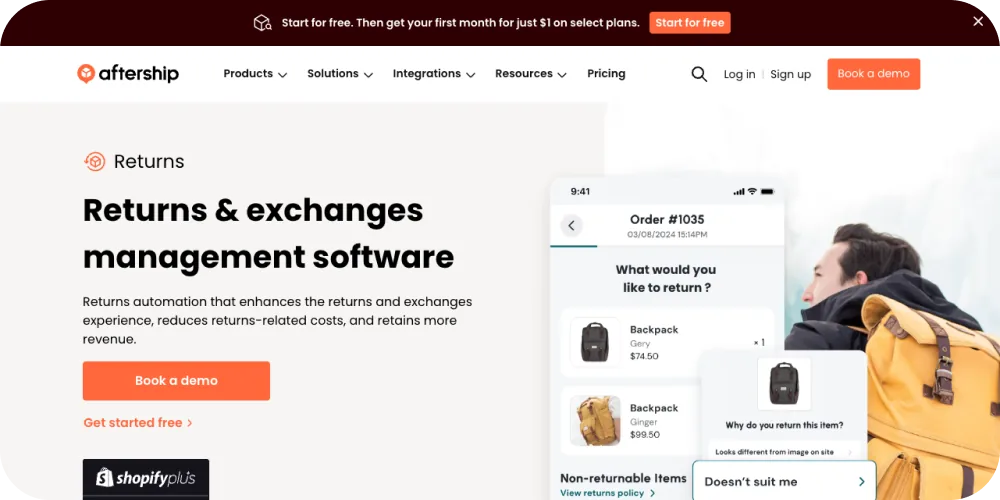
4. AfterShip Returns
AfterShip Returns is the returns automation layer inside the broader AfterShip post-purchase suite. The pitch is end-to-end visibility from order tracking through return resolution, with carrier integrations across most regions. The platform is approachable on pricing and works well for mid-market ecommerce that does not need warranty or repair flows.
Best for: mid-market ecommerce brands that want global returns automation at a moderate price point.
Strengths:
- Wide carrier coverage across regions.
- Reasonable entry-level pricing.
- Sits inside the same suite as order tracking, which simplifies the stack.
- Returns fraud rules included on higher tiers.
Limitations:
- Less depth on warranty validation.
- Repair workflows not a focus.
- Tighter feature set than dedicated platforms at the same tier.
Pricing: tiered SaaS, with a free entry plan that scales by volume.
Vs Outvio: AfterShip Returns is generally more cost-accessible and broader on carrier coverage. Outvio has more depth on the post-purchase experience and delivery automation side.

5. ReBOUND
ReBOUND specializes in cross-border ecommerce returns logistics.
ReBOUND specialises in cross-border returns logistics. The platform routes international returns through a network of local hubs, which lowers shipping costs and shortens the loop for the customer. For brands running heavy cross-border volume, especially in the EU, the network advantage is real.
Best for: ecommerce brands with cross-border returns volume, especially across the EU.
Strengths:
- Local hub network reduces international return cost.
- Localised return portals per market.
- Carrier partnerships across regions.
- Resale and disposition options post-return.
Limitations:
- Software layer is thinner than software-first platforms.
- Less coverage on warranty or repair flows.
- Custom enterprise pricing, less suited to smaller brands.
Pricing: custom enterprise pricing.
Vs Outvio: ReBOUND leads on physical cross-border infrastructure. Outvio leads on software automation and the post-purchase experience.

6. Newmine
Newmine takes a different angle. The platform is built around reducing returns rather than processing them. Returns analytics, root-cause analysis, product feedback intelligence, and recommendations on what to change at the catalogue level. The product appeals to teams that have read the hidden costs of returns and claims report and want to act on the data.
Best for: retailers and brands with high return rates that want to act on the data, not just process it.
Strengths:
- Strong analytics and root-cause reporting.
- Product-level insights tied to return reasons.
- Recommendations for catalogue and content fixes.
- Useful as a complement to a returns processing tool.
Limitations:
- Not a returns processing platform on its own.
- Implementation can be heavy.
- Less useful if return rate is already low.
Pricing: enterprise pricing.
Vs Outvio: these platforms answer different questions. Newmine asks why returns happen. Outvio asks how to process them better. Brands often run both.

7. ServiceNow
ServiceNow is the enterprise service management platform, not a returns tool. Large manufacturers use it for warranty and after-sales service workflows, SLA automation, and ERP integration at scale. The fit is for organisations that already standardise on ServiceNow and want to extend it into customer service and warranty rather than buy a separate tool.
Best for: large enterprises with existing ServiceNow estates and complex service management requirements.
Strengths:
- Mature service management framework.
- SLA automation and audit at enterprise scale.
- Tight ERP and IT integrations.
- Modules across the broader service portfolio.
Limitations:
- Heavy implementation, long time to value.
- Not built specifically for ecommerce returns.
- High cost of ownership for the consumer-facing use case.
- Overkill for most DTC brands.
Pricing: enterprise licensing.
Vs Outvio: different scope. ServiceNow is the enterprise service management spine. Outvio is the ecommerce-specific returns and post-purchase tool. A brand picks one or the other based on what already runs internally.
Feature Comparison
| Platform | Returns automation | Warranty support | Repair workflows | Global drop-off network |
|---|---|---|---|---|
| Claimlane Workflow-first |
92%
|
✓ | ✓ | ~ |
| Loop Returns Shopify-native |
78%
|
~ | – | – |
| Happy Returns Network-first |
62%
|
– | – | ✓ |
| AfterShip Returns Software-first |
74%
|
~ | – | ~ |
| ReBOUND Logistics-heavy |
66%
|
~ | ~ | ✓ |
| Newmine Analytics-first |
55%
|
– | – | – |
| ServiceNow Enterprise |
58%
|
✓ | ✓ | – |
How to Choose the Right Outvio Alternative
The wrong way to pick a platform is to count features. The right way is to start from the kind of case you handle most.
If most cases end in a refund or exchange. Loop Returns, AfterShip Returns, or Outvio are likely the right shape. The differences come down to commerce stack, regional fit, and price.
If a meaningful share of cases involves a warranty. A returns-only platform leaves money on the table. Claimlane handles the full lifecycle and connects to suppliers for cost recovery. See the warranty management software breakdown for the buyer view.
If repairs are a real part of the operation. Repair workflows are their own discipline. Claimlane treats repair as a first-class case type. Most returns platforms do not.
If US physical drop-off matters. Happy Returns is the network play.
If cross-border returns are heavy. ReBOUND is built for it.
If the goal is reducing returns, not just processing them. Newmine answers a different question and often runs alongside a processing tool.
If the brand is already deep in ServiceNow. Extending the existing service management estate is usually cheaper than buying a new tool.
The pattern most aftersales teams hit by 2026: returns are no longer just a shipping problem. They are a case management problem with a refund, a warranty claim, a repair, or a supplier credit on the other end. The right platform fits the shape of the case, not just the shape of the return label.
If you're looking beyond returns-only platforms and want something that covers aftersales logistics too, here are the best Metapack alternatives for aftersales operations.
For brands focused on shipping and delivery experience, Sorted is another common name. Here are the best Sorted alternatives in 2026 to compare.
Rebound is another player in the aftersales space. Check out the top Rebound alternatives if you're evaluating your options.
Final take
Outvio fits one shape of operation. Branded portals, carrier automation, post-purchase tracking for ecommerce brands where the cases end in refunds, exchanges, and delivery exceptions. For that shape, the platform works.
The 7 alternatives on this list each fit a different shape. Shopify-native retention. US physical drop-off. Global software automation. Cross-border logistics. Returns reduction. Enterprise service management. Full aftersales lifecycle.
The shape that comes up most in 2026 is the last one. Brands are running out of room with returns-only tools the moment warranties, repairs, and supplier claims enter the picture. That shift is what drives most Outvio evaluations toward a platform like Claimlane.
To see how Claimlane handles returns, warranties, repairs, and supplier claims in one system, book a demo or explore the interactive demo.