.webp)
Returns are no longer a side concern in ecommerce. For most Shopify brands selling physical products, they're now one of the largest operational cost centres after fulfilment, often eating 5-15% of revenue depending on the category.
The brands handling returns well treat them like any other business operation: structured workflows, automation where it makes sense, real data, and the right tools. The brands handling them badly run them through email and Shopify's basic admin panel, then watch resolution times stretch and customer churn quietly climb.
This guide covers how Shopify returns management actually works in 2026, where native tools fit and where they break, which apps are worth evaluating, and what to look at before picking a system.
What is Shopify returns management?
Shopify returns management is the workflow a brand follows to handle product returns, exchanges, refunds, and warranty claims for orders placed through Shopify. It spans the customer-facing return request, the internal approval and routing, the warehouse processing, and the financial resolution.
Shopify includes built-in returns tools in every plan. They cover the basics: initiate a return from the admin, generate a return label, issue a refund, restock inventory. For low-volume stores, that's enough.
Above 50-100 returns per month, native Shopify breaks down. Brands at that volume typically move to a dedicated returns app or platform that adds self-service portals, automated approval rules, exchange-first workflows, multi-carrier label generation, and proper analytics.
How returns work in Shopify natively
Out of the box, the Shopify returns process looks like this:
Through Shopify's self-serve returns page in the customer account, or by emailing support. Native Shopify supports basic self-serve, but customisation is limited.
An agent reviews the request in the Shopify admin, approves or declines, and adds notes. Each return is approved manually, one at a time.
Shopify Shipping generates a label through built-in carriers. For carrier flexibility or international returns, brands often need a separate shipping app.
The return arrives at the warehouse, staff inspect it, decide if it's resellable. Inspection results are logged manually, often in spreadsheets outside Shopify.
An agent issues the refund or exchange from the Shopify order. Inventory is restocked manually if needed.
Shopify sends an automatic notification when the refund completes. Status updates between approval and resolution typically don't happen unless someone sends a manual email.
This works for stores at low volume. Above 50-100 returns per month, the friction shows up.
Where native Shopify falls short
The gaps in Shopify's built-in returns are predictable. Most brands hit them in the same order:
Native self-serve returns exist but are minimal. No conditional logic, no policy enforcement at intake, no warranty claim flow.
Every return needs an agent to click approve. At 200+ returns a month, that's hours of repetitive work that should be automated by policy rules.
Native exchange handling is functional but not exchange-first. No automatic upsell on exchange, no different-product swaps, no bonus credit incentives.
Shopify treats warranty claims like returns. They're not. Warranty needs photo evidence, defect categorisation, and supplier coordination that native Shopify doesn't support.
Shopify Shipping is fine for domestic. International returns, multi-carrier strategies, or complex routing all need a dedicated shipping or returns app.
Shopify shows return volume but not return rate by SKU, defect patterns, supplier accountability, or refund cost trends. The data exists. The dashboard doesn't.
The cost of running returns on email and Shopify admin
For brands hitting volume, the cost of staying on native tools shows up in four places:
Agent time per return on native Shopify + email
Average resolution time on manual workflows
Of support tickets are "where's my refund?" status checks
Of customers won't buy again after a bad return experience
For a brand processing 500 returns a month, that's roughly 125-200 agent hours and a meaningful chunk of customer LTV walking out the door.
What to look for in a Shopify returns app
The right Shopify returns app extends what Shopify does natively. The features that matter for brands at scale:
Self-service portal that adapts. The customer should be able to start a return, select the right products, upload photos, and pick a resolution (refund, exchange, repair, warranty claim) without ever emailing support. The intake form adapts based on what they're returning.
Policy automation. Returns that fall inside the policy auto-approve. Returns outside the policy get flagged or routed to manual review. No agent should be approving every standard return manually.
Exchange-first flows. When a customer wants a different size or colour, the system offers exchange before refund. Done well, this retains 30-50% of the revenue that would otherwise leave the brand.
Warranty and claims handling. Shopify is built for fashion-style returns. For brands selling durable goods (electronics, outdoor gear, furniture, baby products, appliances), warranty claims need their own workflow with photo evidence, defect categorisation, and supplier integration.
Multi-carrier label generation. International returns, regional carriers, return-to-store options. The app should support more than what Shopify Shipping offers natively.
Analytics that drive decisions. Return rate by SKU, defect patterns, supplier accountability, time-to-resolution trends. Data the team can act on, not just count.
Integration with the rest of the stack. ERP for refunds and credit notes, helpdesk (Zendesk, Gorgias, Intercom) for support context, warehouse system for inventory. Native Shopify only ties to Shopify.
Best Shopify returns apps in 2026
Different apps solve different problems. The right one depends on the brand's product mix, return volume, and whether warranty claims are a meaningful part of the workflow.
This list isn't exhaustive. The Shopify App Store has dozens of returns apps. The above are the ones that come up most often in real evaluation conversations.
How to choose the right Shopify returns setup
Five questions to answer before evaluating any app:
Under 50/month: native Shopify is fine. 50-200/month: a basic returns app pays for itself. 200+/month: a dedicated platform is essential.
Brands selling durable goods (electronics, outdoor, furniture, appliances, baby products) need warranty workflows that most fashion-focused returns apps don't handle. This is where dedicated claims platforms like Claimlane fit.
High-exchange categories (apparel, footwear) benefit from apps with strong exchange-first flows. Low-exchange categories (electronics, home goods) gain less from those features and more from claims handling.
ERP (Business Central, NetSuite, SAP), helpdesk (Zendesk, Gorgias, Intercom), shipping (nShift, Shipmondo, Webshipper). The returns app should connect to what's already there, not replace any of it.
Brands recovering credits from suppliers for defective products need supplier claim workflows. Most fashion-focused apps don't have these. Brands like MaxGaming and Davidsen use Claimlane specifically for this reason.
The metrics that actually matter
Forecasting and safety-stock formulas matter for inventory. For returns, different metrics drive decisions:
The single highest-leverage metric. Find the SKUs returning at 2-3x the average rate. Fix or discontinue them.
From request to refund/replacement. Best-in-class: under 3 days. Manual processes: 7-14 days.
% of returns converted to exchanges. Direct measure of revenue retention. Target: 30-50% in apparel.
Includes shipping, agent time, restocking, refurbishment, write-offs. Most brands underestimate this by 2-3x.
% of returns resolved without agent involvement. Mature brands hit 60-80% with proper policy automation.
For warranty-heavy brands, % of defect cost recovered from suppliers. Without structured tracking, most brands recover under 20%.
Implementation: how to roll out a Shopify returns app properly
Same operational discipline applies whether the brand chooses Loop, Claimlane, AfterShip, or anything else. A structured rollout prevents a year of manual cleanup later.
Document every step from request to resolution. Who touches the return, what system they're in, where the friction sits. Most automation gaps become obvious on paper.
What's auto-approved, what needs review, what's denied. Time windows, condition rules, restocking fees, exchange rules. The policy becomes the configuration of the returns app.
Connect Shopify, the helpdesk, the ERP, and the shipping provider before going live. The returns app on its own without integrations creates another silo.
Don't migrate all returns on day one. Start with one category or one channel, validate the workflow, fix what breaks, then expand.
Time per return, resolution time, exchange ratio, customer satisfaction. Without baseline data, the team can't prove the app paid back. Track for 60 days before and 60 days after.
What changes when it's done right
The brands handling Shopify returns well share a few outcomes. Davidsen moved from 5 agents handling claims through scattered systems to 1 to 2 agents using Claimlane with full Shopify, ERP, and warehouse integration. Same volume, fraction of the work.
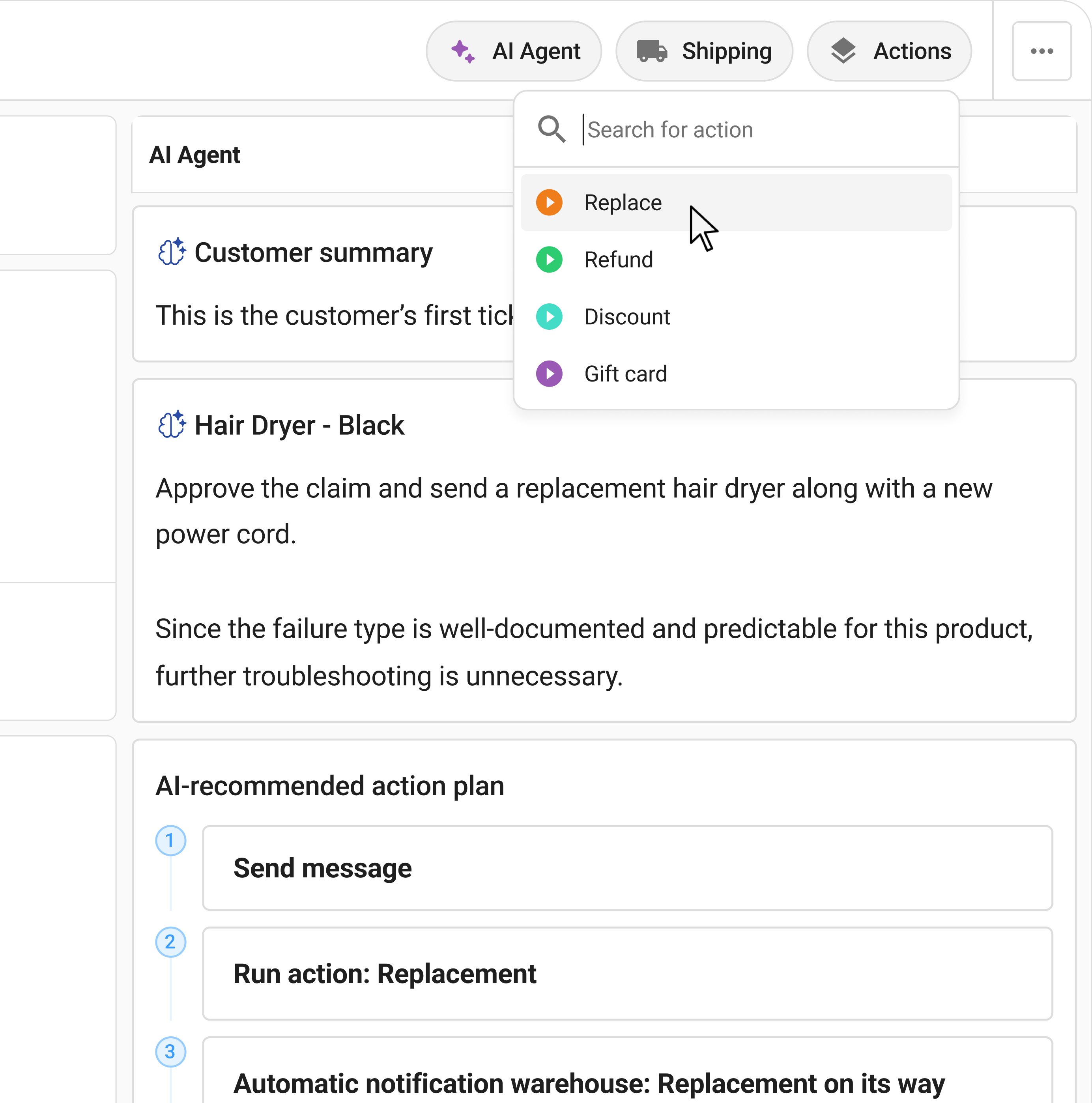
MaxGaming, an outdoor and gaming retailer with 30,000+ SKUs, resolves complex RMA cases 77% faster using Claimlane's AI Agent, the first AI agent purpose-built for warranty claims and returns, which analyses photos, applies warranty rules per supplier, and routes resolutions automatically.
Sebra, a baby and nursery brand, reframed claim handling from a cost centre to a retention lever. Customers who file claims now retain at the same rate as customers who never had a problem.
The pattern across these brands: returns aren't treated as an afterthought. They're treated as a discipline.
The bottom line
Shopify's built-in returns work for low-volume stores. Above 50-100 returns per month, a dedicated returns app stops being a nice-to-have. Above 200, it's table stakes.
The right app depends on the brand's product mix, return volume, and whether warranty and supplier claims are part of the workflow. Fashion DTC brands with high exchange volume should look at Loop. Brands handling durable goods, warranty claims, and supplier coordination should look at Claimlane. Brands operating internationally at scale might need ReBound's logistics network. Each fits a different operational profile.
What matters more than the tool: treating returns as a real operation. Map the process, define the policy, integrate the systems, measure the outcomes. Brands doing that consistently outperform competitors on margin, customer retention, and operational scale.
For Shopify brands handling returns, warranty claims, and supplier credit recovery in one workflow, book a Claimlane demo to see how it integrates with your existing stack.