
Return labels are one of those operational details that most ecommerce brands don't think about until something goes wrong. A customer can't print the label. The postage was charged but the package never shipped. The label expired before the customer got around to returning the item.
These small failures add up. They create customer service tickets, delay refunds, and leave customers frustrated. For brands processing hundreds or thousands of returns per month, the return label strategy directly affects both costs and customer satisfaction.
This guide covers how return labels work, the different types available, what each one costs, and how to choose the right approach for your business.
What Is a Return Shipping Label?
A return shipping label, sometimes just called a return label, is a pre-formatted shipping label that a customer uses to send a product back to the seller or a designated return facility. Return labels are different from return address labels. A return shipping label is a complete shipping label for the reverse journey, with postage, tracking, and routing built in.\
- The return address (seller's warehouse, 3PL, or returns center)
- The customer's address as the sender
- A tracking barcode
- Postage (either prepaid or charged upon scan)
- A routing barcode or RMA number that helps the warehouse process the return
Return labels are different from return address labels. A return address label is the small label on outgoing mail that tells the postal service where to return the package if delivery fails. A return shipping label is a complete shipping label for the reverse journey.
How Return Labels Differ from Outbound Labels
Return labels reverse the shipping flow and use different payment structures than outbound labels. They also have different expiration rules, carrier requirements, and cost implications. The biggest distinction is in how and when the postage is charged.
Types of Return Labels
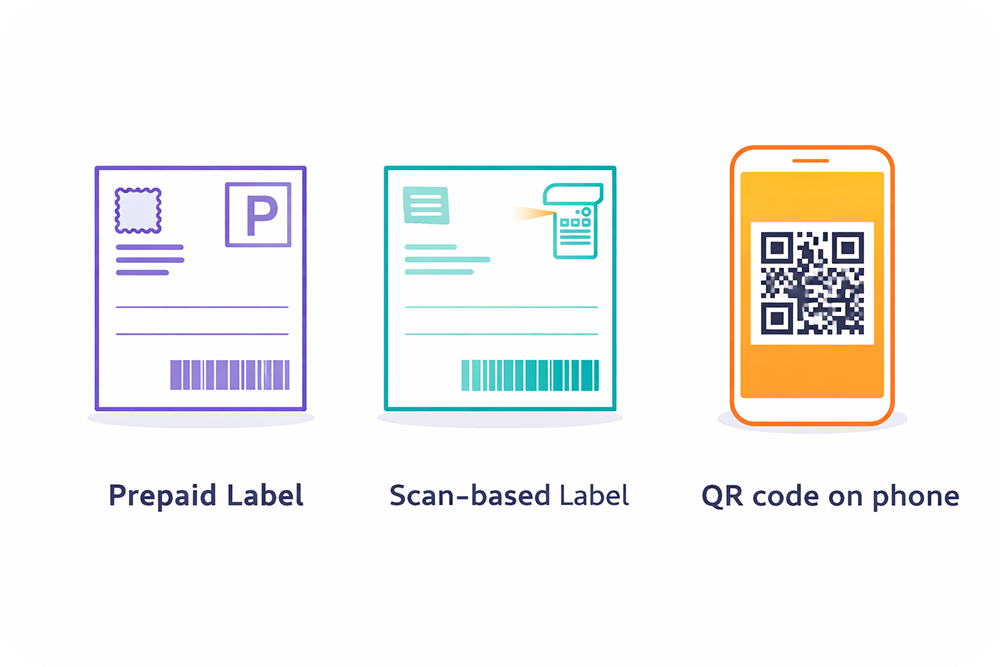
There are three main types of return labels, each with different cost structures, advantages, and limitations.
Postage paid at label creation. You pay for every label, even unused ones.
Postage charged only when the customer drops off the package and the carrier scans the label.
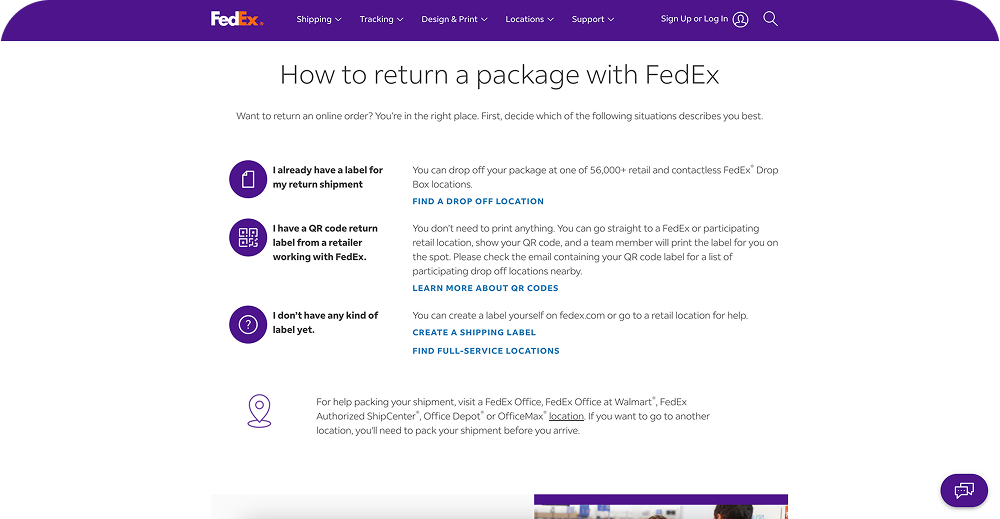
Customer brings a QR code to a drop-off location. No printing needed. Label is generated on-site.
Prepaid Return Labels
Prepaid return labels are exactly what they sound like: the postage is paid when the label is created, regardless of whether it's ever used. The merchant pays for the label upfront, and the customer receives it either in the original shipment or via email.
How they work:
- The merchant purchases a return label from the carrier
- The label is included in the box or sent digitally
- The customer attaches the label and drops off the package
- The merchant is charged at the time of label creation
Pros:
- Simple and familiar for customers
- Work with all major carriers
- Can be included in the original shipment for maximum convenience
Cons:
- You pay for every label, even unused ones. If your return rate is 20%, you're paying for labels on the 80% of orders that are never returned
- Rates are locked at the time of creation
- Can be wasteful if included in every box
Scan-Based Return Labels
Scan-based return labels are the preferred option for most ecommerce businesses. The key difference: you only pay when the customer actually uses the label. The charge is triggered when the carrier scans the barcode at the drop-off point.
How they work:
- The merchant generates a return label
- The label is included in the box or sent digitally
- Only when the customer drops off the package and the carrier scans it does the charge appear
- Unused labels cost nothing
Pros:
- No cost for unused labels
- Can be included in every shipment without financial risk
- Better cash flow management since you only pay for actual returns
Cons:
- Shipping rates may be higher than prepaid labels
- Charges can be unpredictable (you don't know the final cost until the label is scanned)
- Not all carriers offer scan-based options for all service levels
- Potential for surcharges that appear only at scan time
Prepaid Labels
Charged at creation. Simple but costly if unused.
Scan-Based Labels
Charged only when scanned. Pay-per-use model.
QR Code Returns
No printer needed. Label printed at drop-off.
QR Code Returns (Printerless)
QR code returns are the newest option and growing fast. Instead of sending a traditional shipping label, the merchant sends a QR code via email or through a returns portal. The customer brings the package to a participating drop-off location, where staff scan the code and print the label on-site.
67% of shoppers now prefer package-free, label-free returns, making QR codes increasingly important for customer satisfaction.
How they work:
- The customer initiates a return through the brand's portal
- A QR code is generated and sent to the customer
- The customer brings the item (sometimes without even needing a box) to a partner location
- Staff scan the QR code, print the label, and handle the packaging
Pros:
- No printer required for the customer
- Package-free options reduce waste
- Growing network of drop-off locations (UPS Stores, FedEx locations, USPS, Happy Returns, etc.)
- Customers love the convenience
Cons:
- Requires access to a participating drop-off point
- Not all carriers or locations support all merchants
- Less control over packaging quality
How to Create a Return Label
There are three ways ecommerce brands typically create return labels for customers:
Log into your carrier account (USPS, UPS, FedEx) and create a return label manually. Best for low volume. Doesn't scale past 50 returns a month.
Tools like ShipStation, Shippo, EasyPost, and Pirate Ship generate return labels in bulk. Connect your carrier account, set your return address, and labels can be created from the order in 1-2 clicks.
Customers initiate the return through a portal, label is generated automatically based on the rules you've set. Most automated, best for high-volume brands.
How customers receive and print the label:
- Email: PDF or PNG attachment. Customer prints at home or at work.
- Portal: Customer logs into the returns page, downloads the label themselves.
- In-box: Label included in the original shipment. Highest convenience, but pre-paid model means you pay for unused labels.
- QR code: No printing needed. Customer brings the QR code to a drop-off point and the label is printed there.
The right option depends on return volume, return rate, and how much friction you want in the process.
Carrier-Specific Return Label Details
Each major carrier handles return labels differently. Here's what ecommerce brands need to know.
Do Return Labels Expire?
Yes, most return labels expire, but the validity window varies dramatically by carrier. USPS scan-based labels last up to 365 days. UPS labels generally don't expire (though they can be voided within 90 days if unused). FedEx is the strictest, with printed labels valid for roughly two weeks. The expiry rules matter because they affect how you communicate with customers and how often you'll need to regenerate labels.
USPS
- Scan-based return labels are valid for 365 days (longest among major carriers)
- Offers Merchandise Return Service for high-volume returners
- Package Intercept available for rerouting returns
- Generally the most affordable option for lightweight packages
UPS
- Return labels generally don't expire
- Labels can be voided within 90 days if unused
- UPS offers Electronic Return Labels and Print Return Labels
- QR code returns available through UPS Store locations
FedEx
- Printed labels are valid for approximately two weeks
- Offers FedEx Ground and FedEx Express return options
- QR code returns available at FedEx Office locations
- Email return label service available for sending labels directly to customers
| Feature | USPS | UPS | FedEx |
|---|---|---|---|
| Scan-based labels | Yes (365-day validity) | Yes (no expiry) | Yes (~2-week validity) |
| QR code returns | Limited | Yes (UPS Store) | Yes (FedEx Office) |
| Best for | Lightweight, low-cost | Mid-weight, reliability | Speed, express returns |
| Voiding window | Varies | 90 days | ~14 days |
The True Cost of Return Labels
Return label costs go beyond just postage. Here's the full picture.
Direct Costs
- Postage: The shipping rate for the return journey, typically similar to outbound shipping costs
- Label generation fees: Some platforms charge per label generated
- Surcharges: Oversize, overweight, residential pickup, and fuel surcharges can all apply
Hidden Costs
- Unused prepaid labels: If you include prepaid labels in every shipment, you're paying for labels on orders that never get returned
- Customer service time: When labels don't work, expire, or can't be printed, customers contact support
- Processing delays: Unclear or damaged labels slow down warehouse intake
Who Pays for the Return Label?
This is a strategic decision, not just a cost decision.
- Merchant pays (free returns): Higher return rates, but higher conversion rates and customer loyalty. 97% of shoppers say a positive return experience makes them more likely to shop again.
- Customer pays: Lower return rates, but potentially lower conversion rates and negative reviews.
- Conditional free returns: Free returns for exchanges or defective products; customer pays for "changed my mind" returns. This is increasingly common as a balanced approach.
Who Should Pay for the Return Label?
How to Set Up Return Labels for Your Ecommerce Store
The setup process depends on your platform, shipping volume, and preferred carrier. Here's a step-by-step overview.
Step 1: Choose Your Label Type
For most ecommerce brands, scan-based return shipping labels are the best default choice. You avoid paying for unused labels, and the per-label cost difference is manageable at scale. If your return rate is below 10%, prepaid labels included in-box may be simpler and cheaper than setting up a scan-based system.
Step 2: Set Up Your Returns Portal
A returns portal is where customers initiate returns and receive their labels. This can be:
- A returns portal is where customers initiate returns and receive their labels. The right setup depends on what kind of returns you handle:
- For simple "changed my mind" returns: A dedicated page on your website or a third-party returns platform (Loop, Returnly, AfterShip) handles label generation.
- For warranty claims and defective products: A claims platform like Claimlane collects product details, photos, and return reasons upfront. The platform decides whether to generate a return label, send a replacement part, or trigger a warranty workflow, depending on the issue.
The advantage of collecting information before generating the label: you can make smarter decisions. If the item is low-value, offer a returnless refund instead of paying for a return label. If the issue is a defect, route the claim through a warranty process instead.
Step 3: Connect to Your Carrier
Most ecommerce platforms and shipping software (ShipStation, Shippo, EasyPost, Pirate Ship) offer return label generation. Connect your carrier account, set your return address, and configure your label preferences.
Step 4: Define Your Return Label Policy
Decide and clearly communicate:
- Who pays for return shipping
- How customers receive the label (email, portal, in-box)
- How long the label is valid
- What happens if the label expires or doesn't work
Include this information in your return policy so customers know what to expect before they buy.
Step 5: Track and Analyze
Monitor key metrics around return labels:
- Label utilization rate: What percentage of generated labels are actually used?
- Time to return: How long between label generation and carrier scan?
- Cost per return: Total return shipping costs divided by number of returns
- Label-related support tickets: How often do customers contact support about label issues?
Common Return Label Problems and How to Fix Them
Return labels cause more customer service headaches than most brands realize. Here are the most common issues and their solutions.
"I can't print the label"
This is the most common complaint. Not everyone has a printer at home. Solutions:
- Offer QR code returns as an alternative
- Partner with drop-off locations that can print labels on-site
- Provide labels in multiple formats (PDF, PNG, mobile-friendly)
"The label expired"
This happens most often with FedEx labels (two-week validity). Solutions:
- Use carriers with longer validity periods (USPS: 365 days, UPS: no expiry)
- Set up automatic re-generation for expired labels
- Alert customers before labels expire
"I was charged for a label I didn't use"
This only happens with prepaid labels. The fix: switch to scan-based labels where possible. If you must use prepaid labels, void unused ones within the carrier's void window.
"The tracking doesn't work"
Return label tracking can lag behind outbound tracking. The carrier may not update tracking until the package reaches a sorting facility. Set customer expectations that tracking updates may take 24-48 hours after drop-off.
International Return Labels
International returns add complexity that domestic returns don't have.
Customs Documentation
International return shipments may need customs forms, commercial invoices, and country-of-origin declarations. Some carriers provide simplified customs processes for returns, but it varies.
Cost Considerations
International return shipping is significantly more expensive than domestic. Many brands with international customers set up regional return centers to reduce costs. For example, a US brand selling in Europe might have a returns facility in the Netherlands rather than shipping everything back to the US.
Duties and Taxes
Returned goods may be subject to duties on the return journey, depending on the country and the reason for return.
FAQ: Return Labels
What is a return shipping label?
A pre-formatted label customers use to send products back, with return address, tracking, and postage included.
Prepaid vs. scan-based?
Prepaid charges at creation; scan-based charges only when used. Scan-based is more cost-effective for most brands.
Do I need to offer free return labels?
No, but free labels boost conversions. A conditional approach (free for defects, paid for preference) is increasingly common.
What is a QR code return?
A printerless option where customers bring a QR code to a drop-off point. 67% of shoppers now prefer this method.