.webp)
The warranty claim process is one of the most underrated parts of the customer journey. Customers only engage with it when something's already gone wrong, which means every friction point gets amplified. Get it right, and you build trust that outlasts the broken product. Get it wrong, and the customer remembers that, not the five great purchases before it.
If you're still handling warranty claims over email, the odds are against you.
What email actually costs your warranty team
Email feels free. It isn't. The cost just shows up in places that are hard to track unless you measure them.
Here's what a typical warranty inbox looks like in numbers:
- 40 to 60% of incoming messages are status checks. "Where's my claim?" "Any update?" "Did you get my photos?" Every one of these is an agent's time, not solving a claim, just confirming it exists.
- Average resolution time stretches to 2+ weeks. Most of that isn't actual work. It's waiting on missing information, chasing photos, or hunting through threads for the original order number.
- 20 to 30% of claims need rework. Wrong product, missing serial number, no proof of purchase. The customer gets asked the same questions twice, sometimes three times.
- One agent can handle 20 to 30 claims per day on email. With a structured platform, that number doubles or triples. Davidsen went from 5 agents handling claims to 1 to 2 after switching to Claimlane.
The hidden tax is that email scales linearly. Twice the claim volume means twice the agents. There's no way out of that without changing the system.
Three ways email fails your claims process
If you're trying to figure out how to manage email overload in a customer service team, the warranty claim inbox is usually the worst offender. Three things break every time you try to force email into a structured workflow.
Email wasn't designed to handle the specifics of a warranty claim: structured evidence, multiple stakeholders, status tracking, and clear next steps for the customer. When you try to force it into that job, three things break every time.
1. Information arrives incomplete
A customer emails to say their product is broken. They forget to attach photos. Or include photos but no order number. Or send the order number but skip the serial. Now you're four emails deep before the claim can even be reviewed. Multiply that by hundreds of claims a month.
2. Status tracking is invisible
The customer has no idea where their claim stands. Neither does the supplier you forwarded it to. Neither does the agent picking up the thread three days later. Everyone is guessing, and everyone is asking the same person for updates.
3. Data goes nowhere
Every email thread is a one-off. There's no way to see that 30% of your claims are about the same product, or that one supplier accounts for 60% of your replacements. The data exists, just scattered across thousands of inboxes where it can't be analysed.
The real cost of incomplete data
The messy, inconsistent data you get from email-based claim handling has knock-on effects that go far beyond the inbox. Incomplete information prolongs your communication with customers and drives longer resolution times, which means unhappier customers and more tickets piling up behind the ones you're already trying to close.
It also means you lose the ability to see patterns. When claim data is scattered across email threads, you can't easily spot that a specific product has a recurring defect, or that a specific supplier is responsible for a disproportionate share of issues. Without that visibility, you can't fix the root cause, so the same problems keep coming back.
The messy, inconsistent data you get from email-based claim handling has knock-on effects that go far beyond the inbox. Incomplete information prolongs your communication with customers and drives longer resolution times, which means unhappier customers and more tickets piling up behind the ones you're already trying to close.
It also means you lose the ability to see patterns. When claim data is scattered across email threads, you can't easily spot that a specific product has a recurring defect, or that a specific supplier is responsible for a disproportionate share of issues. Without that visibility, you can't fix the root cause, so the same problems keep coming back.
Email vs. shared inbox vs. claims platform
The middle ground most teams try is a shared inbox. It helps a bit. It still isn't built for this.
Shared inboxes solve the visibility problem inside the team. They don't solve any of the actual claim-handling problems.
What good looks like
The fix isn't to make email work harder. It's to use a purpose-built claims management platform designed for this specific job.
A proper platform does three things email can't:
1. Structured intake from the customer. Before anything reaches your team, the customer has answered the questions that matter: order number, product, serial, issue category, photos, video. The claim arrives complete or it doesn't arrive at all.
2. One source of truth. Customer, agent, supplier, and warehouse all see the same case in the same status. No one is forwarding threads or asking for updates. The platform shows it.
3. Automatic customer communication. The customer gets status updates without anyone typing them. Confirmation, in-review, approved, shipped. All triggered by status changes inside the platform.
On top of that, you get a single source of data you can actually act on: patterns, supplier performance, product defect rates, and resolution time trends. That's what closes the loop on root-cause issues, instead of patching the same problems claim by claim.
How brands actually use this
A few examples of what changes when warranty claims move out of email:
- Davidsen went from 5 agents handling claims to 1 to 2 using Claimlane.
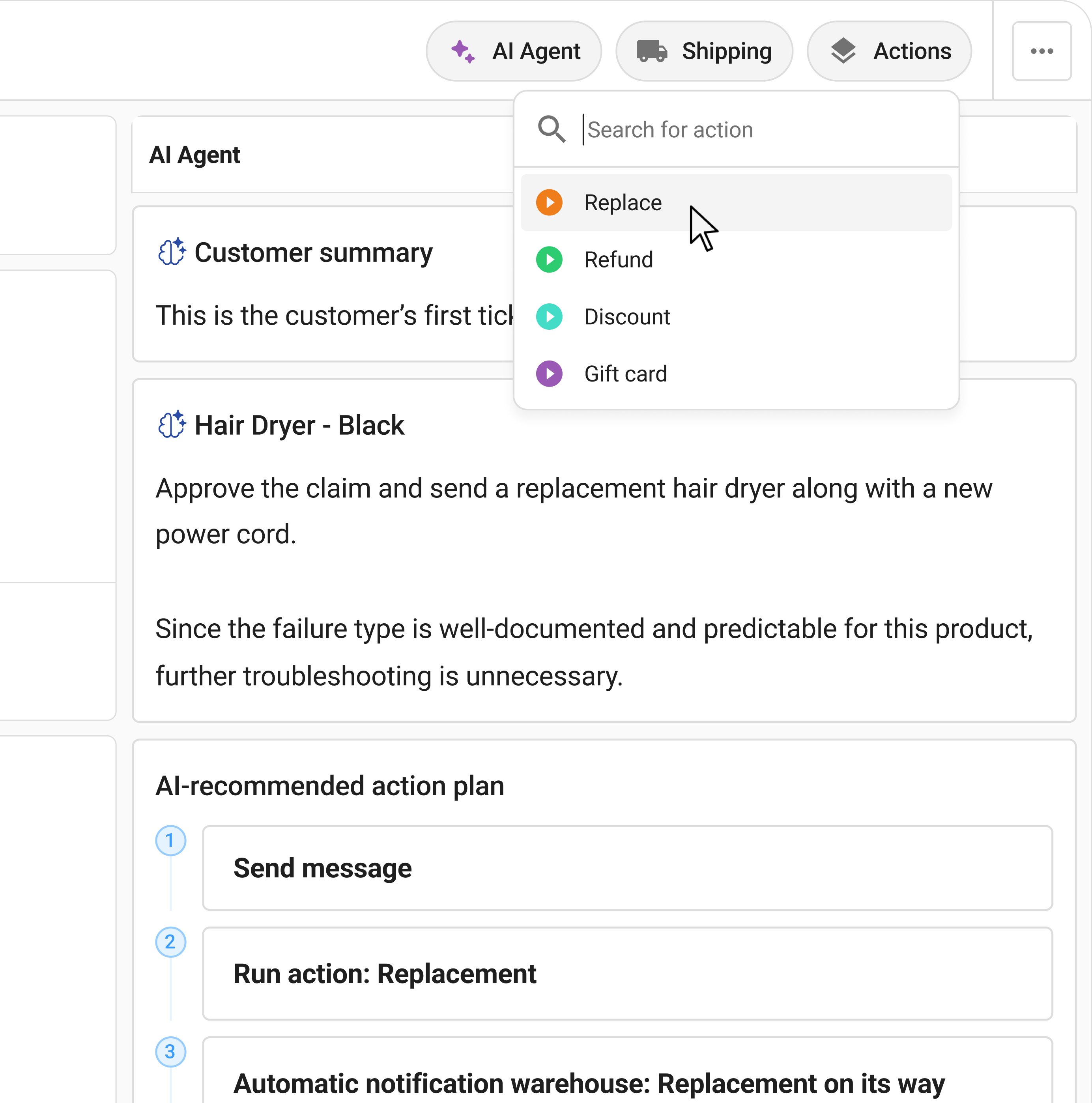
- MaxGaming resolves complex RMA cases 77% faster using Claimlane's AI Agent. With 30,000+ SKUs across 200+ brands, manual claim review wasn't possible. The AI Agent reviews images, checks business rules, and recommends actions so support agents don't need months of product training.
- Black Diamond automated their warranty claim and repair workflows entirely.
- GrejFreak saw ROI almost immediately after switching.
These aren't edge cases. They're what happens when the right tool fits the job.
What to use instead
The fix isn't to make email work harder. It's to use a purpose-built claims management platform that's designed for this specific job. A proper platform does three things email can't: it captures structured information from the customer up front, it gives every stakeholder the same view of every case, and it keeps the customer informed automatically as things progress.
On top of that, you get a single source of data you can actually act on: patterns, supplier performance, product defect rates, and resolution time trends. You also automate the repetitive status updates that currently eat up your team's day.
The takeaway
Email handles a lot of jobs well. Warranty claims isn't one of them. Knowing how to effectively manage emails means knowing when to stop using them. For warranty claims, that line is clear.
Email handles a lot of jobs well. Warranty claims isn't one of them. If you're still running that process through a shared inbox or individual email threads, you're paying for the gap every single day: in longer resolution times, unhappy customers, burned-out agents, and data you can't use.
Knowing how to manage email overload in a support team often comes down to knowing what doesn't belong in the inbox in the first place. For warranty claims, the line is clear.
Quit emails. Beat the odds.