.webp)
Selling globally means fulfilling from multiple locations. But when products come back, the logistics get complicated fast.
A customer in Germany returns a product that shipped from a warehouse in the Netherlands. A US customer returns an item that was fulfilled by a 3PL in California, but the brand's main distribution center is in Texas. A wholesale partner in the UK sends back a batch of defective units, and nobody is sure which warehouse should receive them.
Multi-warehouse returns logistics is the process of routing returned products to the right location, at the right time, for the right outcome. Get it wrong and returned inventory sits in the wrong place, refunds get delayed, and restocking costs eat into margins.
This article covers how to build a returns infrastructure that works across multiple warehouses, fulfillment centers, and international locations.
- Multi-warehouse returns require routing rules that consider product type, warehouse capacity, geographic proximity, and item condition.
- The biggest cost driver is shipping returns to the wrong location, where they sit as dead stock or require a second shipment.
- Real-time inventory visibility across all locations is essential to avoid overselling and stock misallocation.
- Claimlane connects to warehouse and ERP systems to automate claim-based routing decisions, with AI-powered assessment that determines the best resolution before a product ships back.
Why Multi-Warehouse Returns Are Hard
Forward logistics is complex enough with multiple warehouses. Returns multiply the complexity because the destination is not predetermined.
When a brand ships an order, the routing decision is straightforward: pick the fulfillment center closest to the customer with available stock. But when that customer returns the product, the decision tree is entirely different.
The routing problem
Should the return go back to the warehouse it shipped from? The nearest warehouse? A centralized returns processing center? A 3PL facility that handles inspection and grading? The answer depends on product type, condition, warehouse capacity, and what the brand plans to do with the returned item.
The visibility problem
Returned products in transit are invisible inventory. If a warehouse is expecting 200 returned units but the returns system does not communicate this, the warehouse cannot plan labor or storage. If returned inventory is not reflected in the central system, other channels may oversell products that are actually in return transit.
The cost problem
Every unnecessary shipment leg costs money. A return that goes to the wrong warehouse and then has to be reshipped to the right one doubles the logistics cost. According to NetSuite, reverse logistics costs represent 7-10% of the cost of goods for most businesses.
Return Routing Strategies for Multiple Warehouses
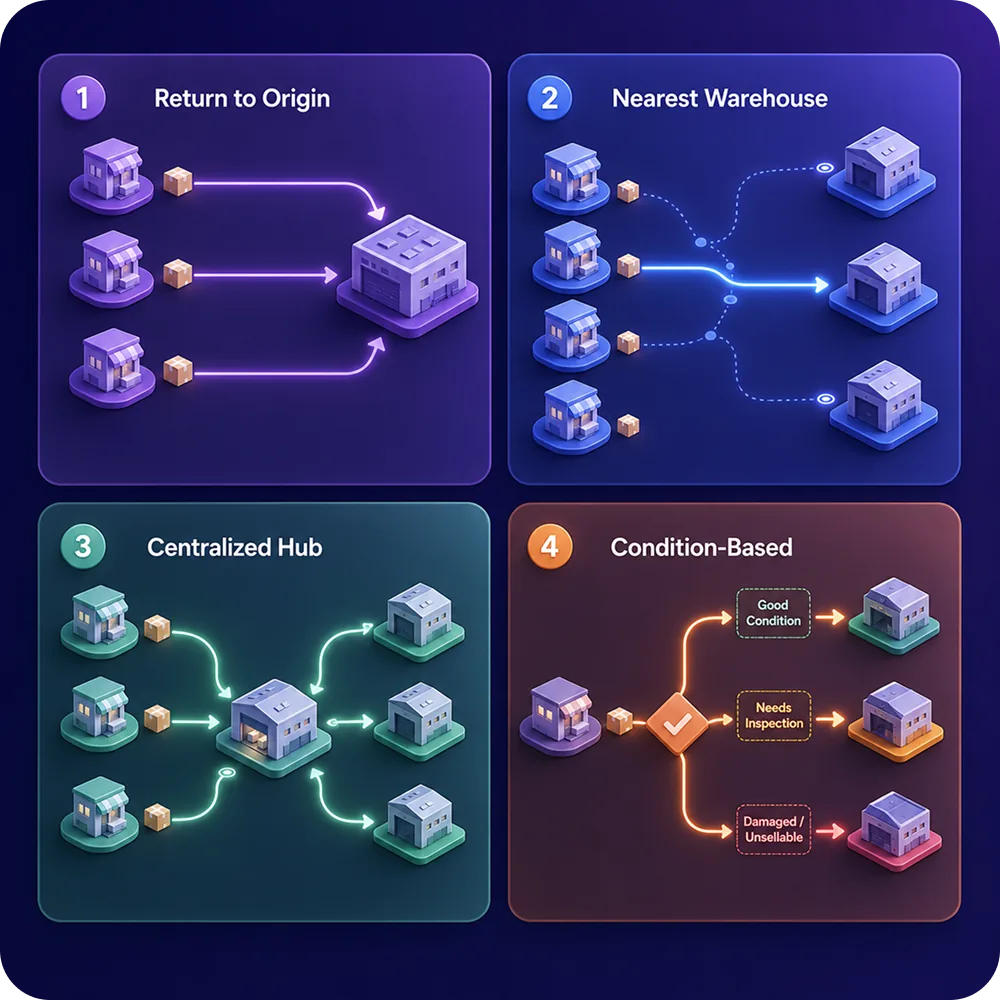
There are several approaches to routing returns when a brand operates from multiple locations. The right strategy depends on the brand's warehouse network, product categories, and return volumes.
Strategy 1: Return to origin
The simplest approach: send the return back to the warehouse it shipped from. This works well when each warehouse manages its own inventory independently and the brand wants to maintain location-specific stock levels.
Pros: Simple to implement. Each warehouse manages its own returns. Inventory stays balanced.
Cons: May not be the cheapest shipping option. The origin warehouse may not have the capacity or capability to process returns.
Strategy 2: Nearest warehouse routing
Route returns to the warehouse closest to the customer's location. This minimizes shipping costs and transit time, getting products back into sellable stock faster.
Pros: Lower shipping costs. Faster restocking.
Cons: Can create inventory imbalances. The nearest warehouse may not normally stock the returned product. Requires dynamic routing logic and real-time warehouse capacity data.
Strategy 3: Centralized returns hub
All returns go to a single, dedicated returns processing center. This center handles inspection, grading, refurbishment, and redistribution to the appropriate warehouse or secondary channel.
Pros: Specialized returns processing. Consistent quality grading. Simplified logistics rules.
Cons: Higher shipping costs (not always the nearest location). Creates a single point of failure. May not work for international returns where customs adds friction.
Strategy 4: Condition-based routing
Route returns based on what will happen to them. Products in sellable condition go to the nearest warehouse for immediate resale. Defective products go to a repair center. Unsellable items go to a liquidation partner or recycling facility.
This is where claims assessment before shipping matters. If Claimlane's AI Agent can determine that a product is defective based on submitted photos, the brand can route it directly to a repair center instead of sending it to a warehouse that will only forward it again.
Pros: Most efficient use of logistics resources. Each item goes where it needs to end up.
Cons: Requires pre-return assessment capability. More complex routing rules.
International Returns: Cross-Border Challenges
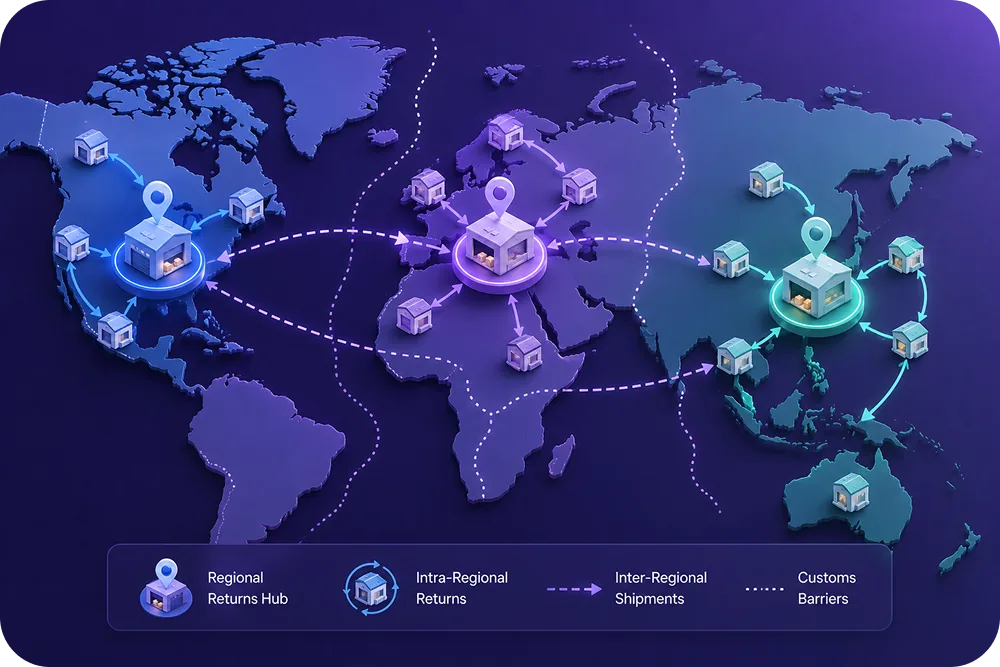
Multi-warehouse logistics gets significantly more complex when warehouses are in different countries.
Customs and duties
Returning a product across an international border often means dealing with customs paperwork, duties, and import taxes. Brands need to decide whether to absorb these costs, pass them to the customer, or set up regional returns hubs that keep returns within the same customs zone.
The EU is one customs zone, so returns between EU member states avoid customs friction. But returns from the UK to the EU (post-Brexit) or from the US to Europe add cost and complexity. This is where understanding Section 321 and duty drawback becomes important.
Regional returns hubs
Many global brands set up regional returns centers: one for North America, one for Europe, one for APAC. Returns within each region stay local, avoiding cross-border shipping. Only products that need to go to a central location (for example, a specialized repair facility) cross borders.
Carrier and logistics partner coordination
Each region may use different carriers, different label formats, and different tracking systems. A returns platform needs to support multiple carrier integrations and generate the right prepaid return labels for each region.
Currency and refund handling
International returns involve refunds in different currencies. The returns system needs to process refunds in the customer's original payment currency while accounting for exchange rate fluctuations. Cross-border returns platforms should handle this automatically.
Inventory Visibility Across Locations
The most underrated challenge in multi-warehouse returns is inventory accuracy.
In-transit inventory
Returned products spend days or weeks in transit. During that time, they are neither at the customer nor at a warehouse. A good returns system tracks in-transit returns and makes that data available to inventory planning. Without this, brands either oversell (counting inventory they do not have) or undersell (failing to account for returns in transit).
Returned inventory grading
Not all returned items are the same. Some are in perfect condition and can be immediately restocked. Others need cleaning, repackaging, or minor repair. Some are defective and need to go to the supplier. The grading process determines whether returned inventory enters sellable stock, goes to a secondary channel, or gets written off.
Claimlane's analytics dashboard tracks return reasons and product conditions across all locations. Brands can see which products are coming back sellable versus defective and adjust procurement accordingly.
Real-time sync between systems
Warehouse management systems (WMS), ERP systems, ecommerce platforms, and the returns management platform all need to share inventory data in real time. Claimlane's integrations connect to these systems so claim data, return status, and inventory updates flow without manual intervention.
"Claimlane helps us capture every customer issue, resolve it for the customer, and feed that back to the supply chain to drive continuous improvement."
The Role of AI in Multi-Warehouse Return Routing
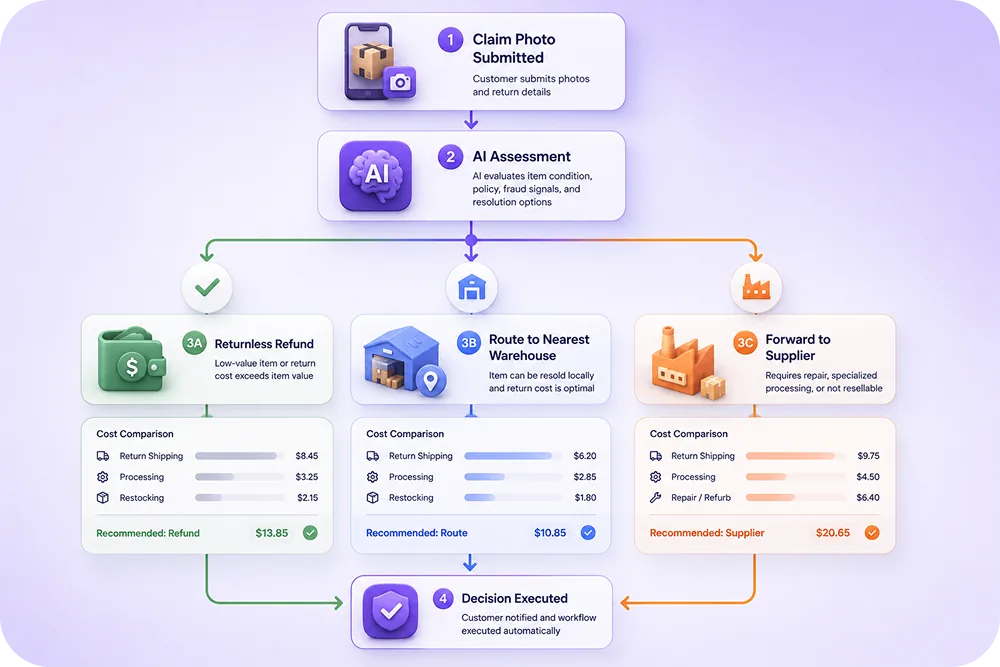
Traditional return routing relies on static rules: all returns go to location X, or returns from zip code range Y go to warehouse Z. AI-powered routing makes smarter decisions.
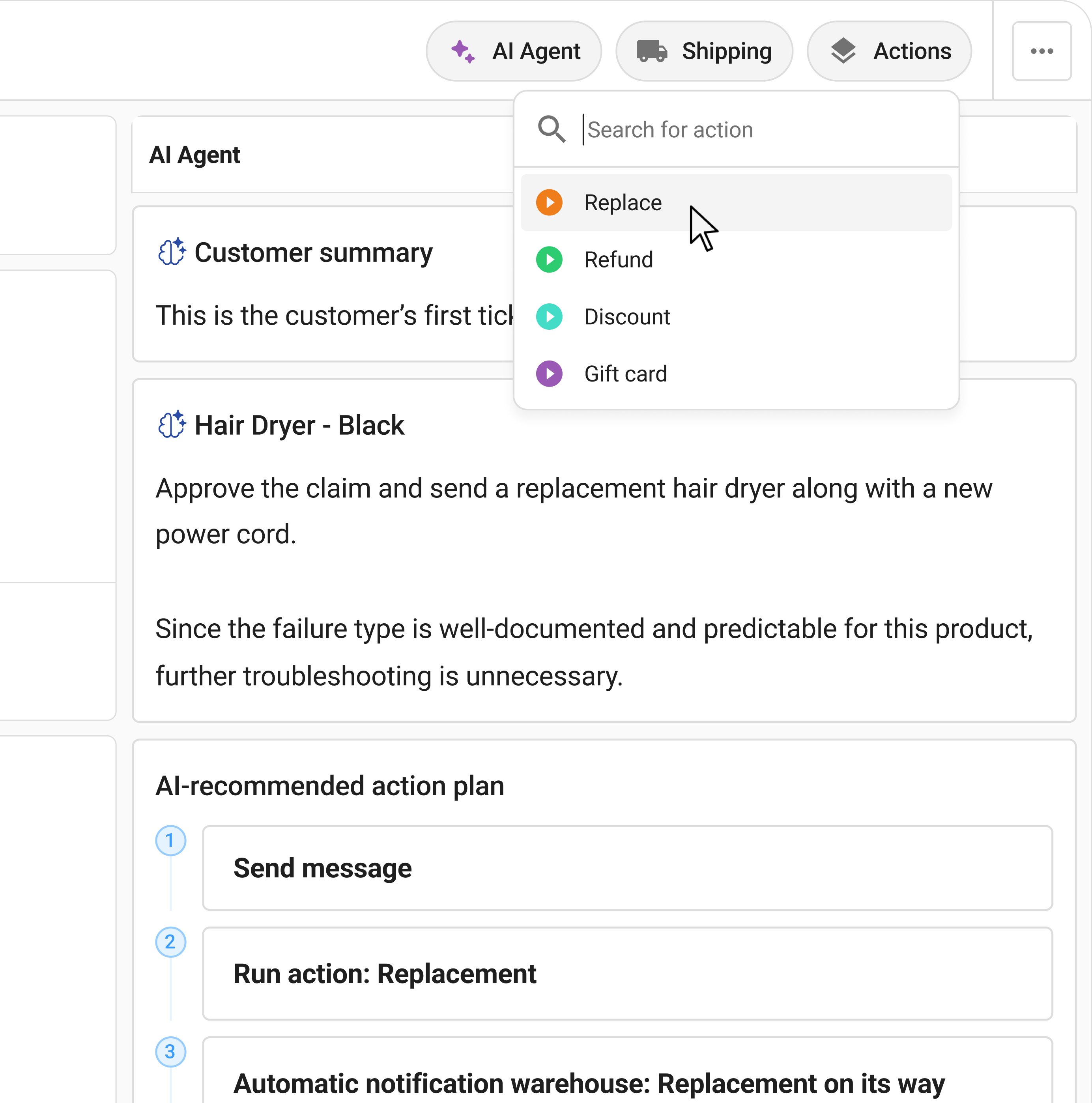
Claimlane's AI Agent, the first AI agent purpose-built for warranty claims and returns, can assess a return before it ships. By analyzing submitted photos and claim details, the AI determines:
- Product condition: Is the item sellable, repairable, or unsalvageable?
- Defect type: Is this a manufacturing defect that should go to the supplier, or cosmetic damage that can be refurbished?
- Resolution path: Should the brand even request the product back, or is a returnless refund more cost-effective?
This pre-return assessment prevents unnecessary shipments. If the AI determines a product is not worth returning (the shipping cost exceeds the product value or the item is clearly unsalvageable), the customer gets an instant refund without the return shipment. That saves money for both the brand and the customer.
For items that do need to come back, the AI's condition assessment feeds into the routing decision. Sellable items route to the nearest warehouse. Defective items route to the repair center or get forwarded to the supplier.
Building a Multi-Warehouse Returns Infrastructure
Step 1: Map the warehouse network
Document every warehouse, fulfillment center, 3PL facility, and repair center in the network. For each location, define: what product categories it handles, its returns processing capability, its geographic coverage, and its current capacity.
Step 2: Define routing rules
Build decision trees for return routing based on: originating warehouse, customer location, product category, product condition (if known pre-return), and warehouse capacity. Start simple and add complexity as the system matures.
Step 3: Connect claims to routing
The claims/returns platform should feed directly into the routing decision. When a customer submits a claim through the self-service portal, the system should automatically determine the return destination and generate the appropriate shipping label.
Step 4: Implement real-time inventory sync
Connect the WMS at each location to the central inventory system. Use Claimlane's ERP integrations to keep financial records aligned. Ensure returned-in-transit inventory is visible to all systems.
Step 5: Set up monitoring and optimization
Track return routing accuracy, restocking time, cost per return by destination, and inventory accuracy across locations. Use returns analytics to spot patterns and optimize routing rules.
Reducing Returns Logistics Costs
Multi-warehouse returns logistics is expensive. Here are the most effective cost reduction strategies:
Returnless refunds for low-value items
If the shipping cost exceeds the product value, do not ask for the product back. Returnless refunds save on shipping, handling, and warehouse processing. Claimlane's AI can automate this decision based on product value and claim assessment.
Consolidation points
Instead of routing individual returns to various warehouses, set up regional consolidation points where returns are aggregated and then shipped in bulk to the appropriate destination. This converts expensive individual parcel shipments into cheaper freight movements.
Carrier negotiation based on return volume
Multi-warehouse brands generate significant return shipping volume. Use that volume to negotiate better rates with carriers. Provide carriers with accurate return volume forecasts (based on historical return rate data) to secure competitive pricing.
Pre-return assessment to avoid unnecessary shipments
Every return that does not need to happen is money saved. Claimlane's AI Agent assesses claims before approving a return shipment, preventing unnecessary logistics costs.
How Claimlane Fits Into Multi-Warehouse Returns
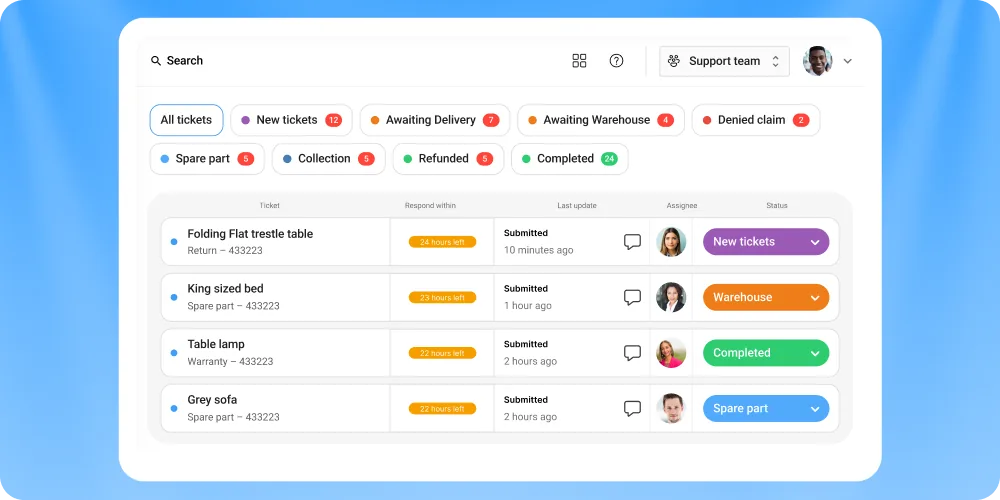
Claimlane is not a warehouse management system. It is the claims and returns intelligence layer that makes routing decisions smarter.
Pre-return claim assessment
Claimlane's AI Agent evaluates every claim before a return label is generated. Based on product photos, claim details, and business rules, it determines: should the product come back? If yes, where should it go? If not, what resolution (returnless refund, replacement from nearest warehouse) is most cost-effective?
Integration with warehouse systems
Claimlane's 75+ integrations include connections to ERP systems (Business Central, SAP), ecommerce platforms (Shopify, WooCommerce), and shipping providers. Return data flows from Claimlane into the WMS and ERP so warehouse teams know what is coming.
Supplier forwarding for defective products
When the AI identifies a manufacturing defect, the claim can be forwarded directly to the supplier with all documentation. This avoids routing defective products through the brand's warehouse network entirely.
Cross-location analytics
The analytics dashboard shows return patterns across all locations: which warehouses have the highest return volumes, which products generate the most returns by region, and where routing inefficiencies exist.
Claimlane is rated 4.8/5 on G2.
"Before Claimlane, our entire customer service team of 5 agents was involved in claims handling, with additional seasonal help from other departments. Today, we have 1-2 agents who can solve everything in Claimlane."
Common Multi-Warehouse Returns Mistakes
No condition assessment before shipping
Accepting every return without pre-assessment means products arrive at warehouses with no information about their condition. This delays processing and leads to routing errors.
Manual routing decisions
Having warehouse managers or support agents manually decide where each return goes does not scale. Automate routing based on rules, and use AI to handle edge cases.
Ignoring returned inventory in demand planning
Returned inventory should feed into demand forecasting. If a product has a 15% return rate, procurement should account for that when ordering new stock. Multi-warehouse brands need this data aggregated across locations.
Not tracking return cost per location
Each warehouse has a different cost structure for processing returns. Without location-level cost tracking, brands cannot optimize routing for cost efficiency.
Inconsistent processing standards
When multiple warehouses process returns, each may have different quality standards for grading and restocking. Define company-wide standards and enforce them through the returns management system.
Measuring Multi-Warehouse Returns Performance
Return-to-restock time
How long does it take for a returned product to become sellable inventory again? Track this per location and per routing strategy.
Routing accuracy
What percentage of returns arrive at the intended destination? Misrouted returns indicate problems with label generation, carrier performance, or customer confusion.
Cost per return by location
Compare the total cost of processing a return (shipping, handling, inspection, restocking) across locations. Use this data to optimize routing rules.
Cross-ship rate
How often does a returned product need to be re-shipped from the receiving warehouse to another location? A high cross-ship rate indicates routing rule problems.
Inventory accuracy post-return
Compare system inventory with physical counts after returns are processed. Discrepancies indicate sync issues between the returns platform, WMS, and ERP.
FAQ
Conclusion
Multi-warehouse returns logistics is one of the most complex operational challenges in ecommerce. The combination of routing decisions, inventory visibility, cross-border regulations, and cost optimization requires both smart technology and clear operational processes.
The brands that get this right use pre-return assessment to minimize unnecessary shipments, condition-based routing to send products where they actually need to go, and real-time inventory sync to keep all systems aligned. Claimlane provides the claims intelligence layer that makes these decisions smarter.
Book a demo to see how Claimlane supports multi-warehouse returns operations.