
.webp)
An ecommerce technology stack is the collection of software tools, platforms, and services that power an online store. From the storefront customers see to the warehouse systems that ship orders, every piece of the stack needs to work together. Get it right and operations scale smoothly. Get it wrong and brands end up with disconnected tools, manual workarounds, and data that doesn't flow where it needs to.
The challenge isn't finding tools. There are thousands of ecommerce software options available in 2026. The challenge is building a stack where every layer integrates cleanly, data flows automatically between systems, and the whole thing scales without requiring a rebuild every time the business grows.
This guide breaks down every layer of a modern ecommerce tech stack, explains what each layer does, lists the leading options, and shows how the pieces fit together.
TL;DR
- A modern ecommerce tech stack has seven core layers: storefront, payments, order management, shipping, returns/after-sales, marketing/CRM, and analytics.
- Integration between layers matters more than individual tool capability. Data needs to flow automatically between systems.
- Returns and after-sales is the most neglected layer yet affects 15–30% of orders. A dedicated returns platform fills gaps built-in tools can't cover.
- Stack complexity should match brand stage: startups need 5–10 tools, growth brands 15–25, enterprise 30–50+.
The Layers of an Ecommerce Tech Stack
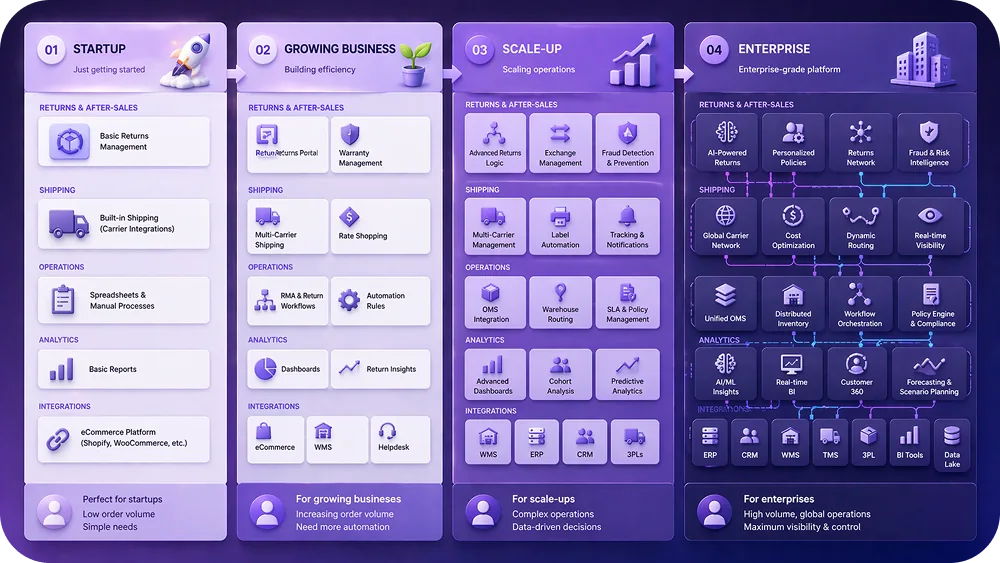
A complete ecommerce technology stack has seven core layers. Each layer handles a distinct function, and the layers connect through APIs and integrations.
Layer 1: Ecommerce Platform (Storefront)
The ecommerce platform is the foundation. It powers the online store, manages the product catalog, handles the shopping cart, and provides the checkout experience.
Leading Platforms
Shopify is the dominant platform for small to mid-market brands. It handles hosting, security, payments, and basic inventory out of the box. Shopify Plus serves enterprise brands. The ecosystem of apps and integrations is the largest in ecommerce.
WooCommerce is the open-source option built on WordPress. It offers more customization but requires more technical management. Best for brands with development resources who want full control.
BigCommerce sits between Shopify and WooCommerce. Strong multi-channel capabilities and B2B features. Less reliant on apps for core functionality than Shopify.
Magento/Adobe Commerce is the enterprise option. Highly customizable but expensive to implement and maintain. Best for large brands with complex catalog and pricing needs.
Headless platforms (commercetools, Medusa, Saleor) separate the frontend from the backend, allowing brands to build custom storefronts while using a commerce engine for catalog, cart, and checkout. Growing rapidly among tech-forward brands.
What to Look For
- Scalability: Can it handle traffic spikes during sales events?
- App ecosystem: Are the tools you need available as integrations?
- Total cost of ownership: Platform fees + app fees + development costs
- Multichannel support: Can it power sales on the website, marketplace, social, and in-store?
- API quality: How easy is it to connect other tools in the stack?
Layer 2: Payments
Payment processing is the most sensitive layer. It needs to be fast, secure, and support the payment methods customers expect in each market.
Leading Payment Solutions
- Stripe: The developer-friendly option. Excellent API, broad payment method support, and strong fraud detection. Works well for D2C brands of all sizes.
- Adyen: Enterprise-grade payment processing with strong international support. Popular among large European brands.
- Klarna/Afterpay: Buy-now-pay-later options that increase conversion by letting customers split payments. Particularly popular in Nordic and European markets.
- PayPal: Still relevant as a checkout option. Trusted by consumers, especially for cross-border purchases.
- Apple Pay/Google Pay: Mobile wallet options that reduce checkout friction.
Payment Stack Considerations
- Multi-currency support: Critical for cross-border sales
- Refund handling: How quickly and easily can refunds be processed when returns happen?
- Fraud prevention: Built-in or requires a separate tool?
- Payment method coverage: Different markets prefer different methods (iDEAL in Netherlands, Swish in Sweden, etc.)
Layer 3: Order Management System (OMS)
The OMS tracks every order from placement to delivery. It manages inventory across channels, handles order routing (which warehouse or fulfillment center ships each order), and provides visibility into the order lifecycle.
What an OMS Handles
- Inventory management: Real-time stock levels across all channels and locations
- Order routing: Sending orders to the optimal fulfillment location based on proximity, stock availability, and shipping cost
- Multi-channel sync: Ensuring inventory counts are consistent across the website, marketplaces, and physical stores
- Backorder management: Handling orders for out-of-stock items
- Reporting: Order status, fulfillment performance, and inventory health
Leading OMS Options
- Shopify OMS (built-in for Shopify stores)
- Brightpearl (mid-market, strong multichannel)
- NetSuite (enterprise ERP with OMS capabilities)
- Linnworks (marketplace-focused)
- Custom-built (large enterprises with unique requirements)
Layer 4: Shipping and Logistics
Shipping is where the digital meets the physical. The logistics layer handles carrier selection, label generation, shipment tracking, and delivery.
Key Components
- Carrier management: Connecting to multiple carriers (DHL, UPS, FedEx, local carriers) and selecting the best option per shipment
- Label generation: Creating shipping labels automatically based on order data
- Tracking: Providing real-time shipment tracking to customers and the operations team
- Warehouse management (WMS): For brands with their own warehouses, the WMS manages receiving, picking, packing, and shipping
- 3PL integration: For brands using third-party logistics, integration with the 3PL's systems
Leading Solutions
- ShipStation/Shippo: Multi-carrier shipping for small to mid-market brands
- Sendcloud: Popular in Europe, strong carrier network
- ShipBob: 3PL with built-in technology for DTC brands
- Narvar/AfterShip: Post-purchase tracking and communication platforms
It has never been easier to handle claims. We save both time and money by not having to call back faulty products from our retailers, which is also better for the environment. Now, we can judge a claim just from a picture.
Victoria Klitvad, Sales Support — Mads Nørgaard
Layer 5: Returns and After-Sales
Returns are the most neglected layer in most ecommerce tech stacks, and one of the most expensive to get wrong. A dedicated returns management system handles the entire post-purchase lifecycle.
What the Returns Layer Handles
- Self-service returns portal: Lets customers initiate returns without contacting support. Claimlane's self-service portal reduces support contacts by 40% to 60%.
- Claims management: Tracking and processing warranty claims, damage claims, and defect reports
- Return shipping logistics: Generating prepaid return labels, tracking return shipments, managing returnless refunds
- Workflow automation: Routing claims based on type, value, product category, and customer history
- Supplier forwarding: Routing defective product claims to the responsible supplier
- AI-powered processing: Image analysis, fraud detection, automated claim resolution
- Analytics: Return rates, return reasons, cost per return, and trend analysis
Why a Dedicated Returns Tool Matters
Most ecommerce platforms have basic returns functionality built in, but it's not enough for brands processing significant volume. The built-in tools typically lack:
- Warranty and claims management
- Photo-based damage assessment
- Supplier collaboration on defective products
- Advanced workflow routing
- AI automation for claim decisions
A dedicated returns platform like Claimlane, rated 4.8/5 on G2 (read reviews), fills these gaps and integrates with the rest of the stack.
Layer 6: Marketing and CRM
The marketing layer drives customer acquisition and retention. The CRM tracks customer relationships and enables personalized communication.
Key Marketing Stack Components
- Email/SMS marketing: Klaviyo (dominant in ecommerce), Mailchimp, Omnisend
- Customer data platform (CDP): Segment, mParticle, or built into the CRM
- Social media management: Hootsuite, Sprout Social, or native platform tools
- SEO and content: Ahrefs, Semrush, Surfer SEO, WordPress/Webflow for content
- Advertising: Google Ads, Meta Ads, TikTok Ads, with attribution tools like Triple Whale
- Loyalty programs: Smile.io, LoyaltyLion, Yotpo
- Reviews and UGC: Trustpilot, Yotpo, Judge.me
CRM Integration with Returns
The returns layer should feed data back to the CRM. Why:
- Customers who return frequently may need different marketing treatment than loyal non-returners
- Return reasons can inform product recommendations (e.g., if a customer returns for sizing, recommend the correct size next time)
- Post-return communication ("We're sorry that didn't work out. Here are some alternatives...") can retain customers who might otherwise churn
Layer 7: Analytics and Business Intelligence
The analytics layer turns data from every other layer into insights and decisions.
Essential Ecommerce Analytics
| Category | Key Metrics | Tools |
|---|---|---|
| Web | Traffic, CVR, bounce, AOV | GA4, Mixpanel |
| Sales | Revenue, orders, LTV | Platform, Looker |
| Marketing | CAC, ROAS, attribution | Triple Whale |
| Inventory | Stock, turnover, sell-through | OMS, NetSuite |
| Returns | Return rate, reasons, cost | Claimlane |
| Customer | Retention, NPS, CSAT | CRM, surveys |
Building Your Stack: Strategy and Integration
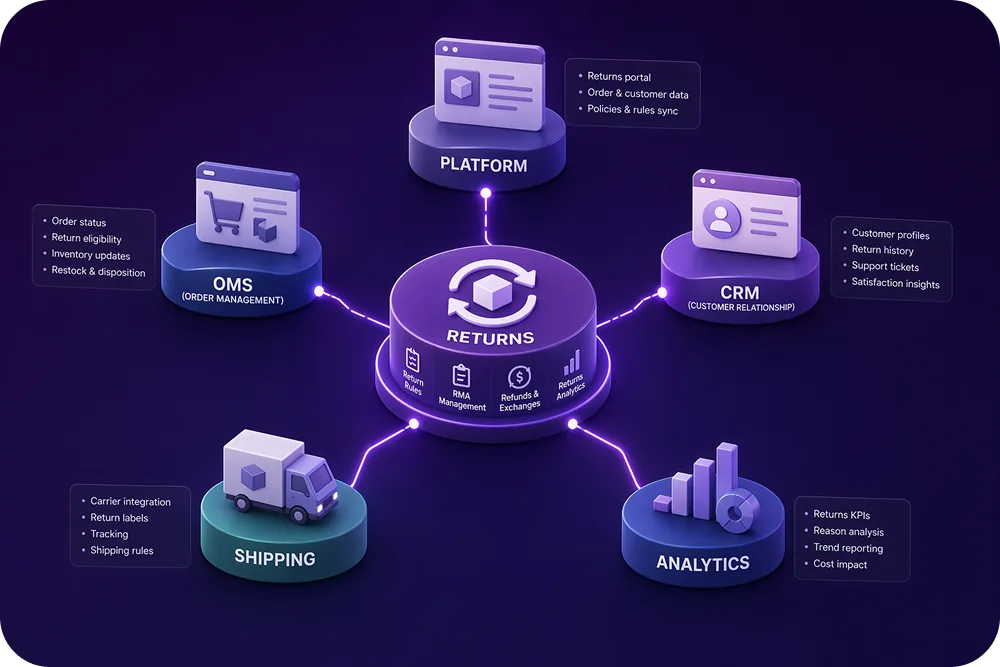
The Integration Imperative
The most common tech stack mistake is buying best-in-class tools that don't talk to each other. A great analytics tool is worthless if it can't access returns data. A powerful CRM can't personalize if it doesn't know which customers are serial returners.
Every tool in the stack should connect to its adjacent layers through APIs or native integrations. Key integration points:
- Platform to OMS: Order data flows automatically
- OMS to shipping: Orders route to the right carrier and warehouse
- Platform to returns: Order data available for return validation
- Returns to CRM: Customer return behavior feeds into segmentation
- All layers to analytics: Data from every system flows into a central analytics layer
Stack Sizing by Brand Stage
Startup (under $1M revenue)
Keep it simple. Shopify + Stripe + basic email marketing + a returns tool is enough. Don't over-engineer.
Growth ($1M to $10M)
Add a dedicated OMS if selling multichannel. Upgrade email to Klaviyo. Implement a proper returns platform like Claimlane. Add analytics beyond the platform dashboard.
Scale ($10M to $50M)
ERP/OMS integration becomes critical. Consider headless commerce if the storefront is a bottleneck. Advanced analytics and BI tools. International shipping and returns capabilities.
Enterprise ($50M+)
Custom integrations, enterprise ERP (NetSuite, SAP), dedicated data warehouse, advanced AI across the stack, multiple fulfillment and returns locations.
The AI Layer: Cutting Across the Stack
AI isn't a single layer. It's a capability that enhances every layer:
- Storefront: Personalized product recommendations, dynamic pricing, visual search
- Payments: Fraud detection and prevention
- Order management: Demand forecasting, inventory optimization
- Shipping: Route optimization, delivery time prediction
- Returns: AI claims processing, fraud detection, automated routing
- Marketing: Predictive customer segmentation, content generation, ad optimization
- Analytics: Anomaly detection, predictive analytics, natural language querying
The brands getting the most value from AI are those with clean data flowing between layers. AI needs data to learn, and that data needs to come from across the stack.
A dissatisfied mom will also take 10 of her closest friends with her if she leaves your business because of a negative experience.
Kenneth Nørgaard, CEO — BabySam
Common Tech Stack Mistakes
Buying Too Many Tools Too Early
Every new tool adds complexity: another login, another integration to maintain, another vendor relationship, another data silo to manage. Start with the minimum viable stack and add tools as specific needs emerge.
Ignoring Total Cost of Ownership
A $50/month app seems cheap until the brand has 40 of them. Total cost includes subscription fees, implementation costs, training time, and the ongoing maintenance of integrations between tools.
Choosing Tools Without Integration in Mind
The best tool in isolation might be the worst choice for the stack if it doesn't integrate with adjacent layers. Always check API quality, native integrations, and data export capabilities before committing.
Neglecting the Returns Layer
Brands invest heavily in the acquisition side of the stack (marketing, storefront, checkout) and under-invest in the post-purchase side (returns, customer service, after-sales). Returns affect 15% to 30% of online orders. Ignoring this layer has a direct impact on profitability and customer retention.