.webp)
Most ecommerce brands know their return rate. Few know why customers return products, which suppliers cause the most warranty claims, or how return patterns change by season, product line, or marketing channel.
Returns analytics software closes that gap. It turns raw return data into structured insights that help brands reduce return rates, catch product quality issues early, and make smarter decisions about suppliers, inventory, and product descriptions.
This guide reviews the best returns analytics software for ecommerce brands in 2026, what features to look for, and how to choose the right platform for your business.
Why Returns Analytics Matters More Than Ever
Return rates in ecommerce hover between 20-30% for most categories, and even higher for apparel and footwear. At those volumes, even small improvements in return prevention translate to significant revenue savings.
But you cannot reduce what you do not measure. And most ecommerce brands are still tracking returns with spreadsheets, basic Shopify reports, or fragmented data across multiple systems.
Returns analytics software gives brands visibility into:
- Return reasons by product, category, and SKU so you know which products have problems and why
- Defect and quality patterns that signal manufacturing issues before they scale
- Supplier performance so you can hold vendors accountable for quality
- Customer behavior patterns that reveal who returns frequently and why
- Financial impact of returns on margin by product, category, and channel
- Trend analysis showing whether return rates are improving or worsening over time
| Platform | Best For | Return Reason Tracking | Supplier Analytics | AI Features | Pricing |
|---|---|---|---|---|---|
| Claimlane | Warranty + returns analytics with supplier tracking | Advanced (AI + structured forms) | Yes (full supplier claim tracking) | AI image analysis, auto-triage, predictive | Custom pricing |
| Loop Returns | Shopify brands focused on exchanges | Good (customizable reasons) | Limited | Basic automation rules | From $155/mo |
| Narvar | Enterprise post-purchase experience | Good (integrated with tracking) | Limited | Predictive analytics | Custom pricing |
| ReturnGO | Shopify brands wanting automation | Good (rule-based) | Basic | AI return reason analysis | From $23/mo |
| Returnly (Affirm) | Instant credit and exchange-first flows | Moderate | No | Limited | Custom pricing |
| Happy Returns (PayPal) | In-person return drop-offs | Basic | No | Limited | Custom pricing |
What to Look for in Returns Analytics Software
Not all analytics platforms handle returns well. Here are the features that matter most:
Return reason tracking and categorization
The foundation of any returns analytics platform is structured return reason data. Look for software that:
- Captures return reasons at submission (not just a dropdown with 5 generic options)
- Allows custom reason categories that match your business
- Uses AI or NLP to categorize free-text feedback from customers
- Separates product defects from preference returns from sizing issues
Product-level analytics
Brand-level return rates hide the real story. The best platforms drill down to:
- Return rate per SKU, variant, and size
- Most common defect types per product
- Photo evidence linked to return reasons
- Comparison across product lines and categories
Supplier and warranty analytics
For brands that resell products from multiple suppliers, warranty analytics is essential:
- Claim rate per supplier
- Average warranty cost per vendor
- Defect type distribution by supplier
- Supplier response time and credit note tracking
- Warranty claim volume trends over time
Financial reporting
Returns cost money. Good analytics quantify exactly how much:
- Cost per return (processing, shipping, restocking)
- Revenue lost to returns by product and category
- Refund vs. exchange vs. credit breakdown
- Return cost as a percentage of revenue
Dashboards and visualization
Data is only useful if people actually look at it. The best tools offer:
- Real-time dashboards with key returns KPIs
- Customizable views for different teams (operations, product, finance)
- Automated reports on a daily, weekly, or monthly schedule
- Export capabilities for deeper analysis
Best Returns Analytics Software: Comparison
Here is a detailed comparison of the top returns analytics platforms for ecommerce brands in 2026.
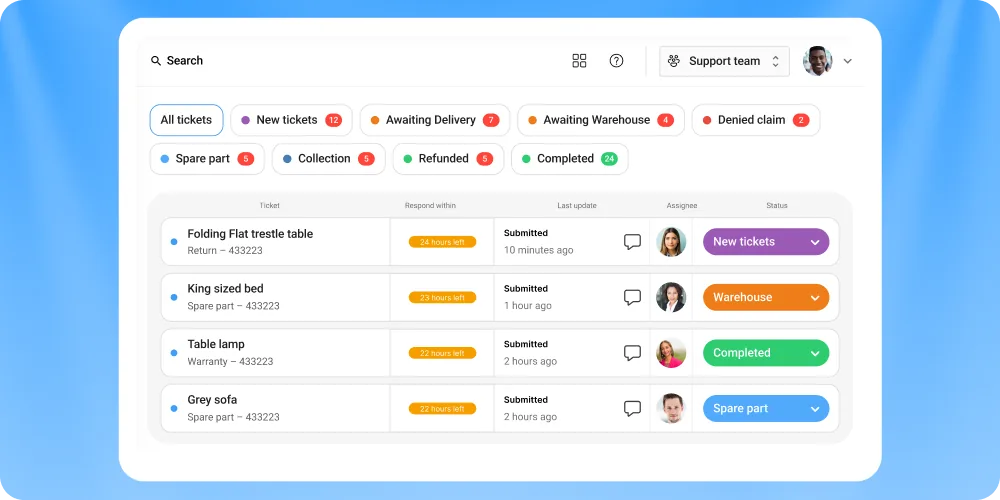
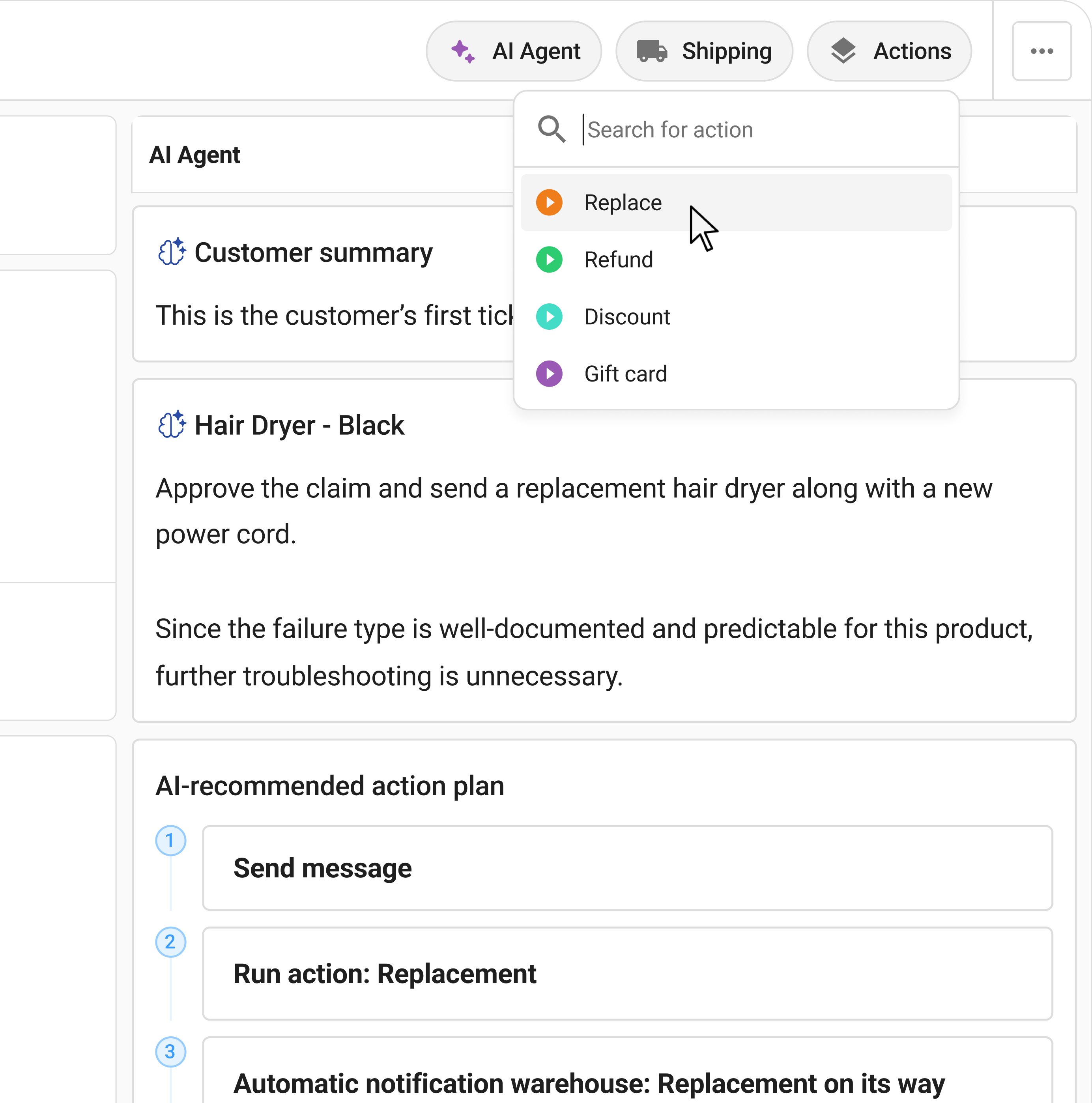
1. Claimlane: Best for Warranty and Returns Analytics With Supplier Tracking
Claimlane stands out as the strongest option for brands that need deep analytics on both returns and warranty claims, especially those working with multiple suppliers.
What makes it different
Most returns platforms treat analytics as an add-on. Claimlane builds analytics into the core of its claims processing workflow. Every return, warranty claim, and supplier interaction generates structured data that feeds into real-time dashboards.
Analytics capabilities
- Product quality analytics: Return and defect rates per product, SKU, and variant with photo evidence attached to each data point
- Supplier performance dashboards: Claim volume, defect types, response times, and credit note status per supplier
- Return reason analysis: AI-categorized return reasons with drill-down by product, category, and time period
- Financial reporting: Cost per claim, supplier recovery rates, and margin impact by product line
- Trend analysis: Historical views showing how return patterns change over time, by season, and by product launch
Warranty-specific analytics
Claimlane's analytics dashboard is particularly strong for warranty claims:
- Warranty claim rate by product and supplier
- Average claim cost and resolution type breakdown (repair vs. replace vs. refund)
- Supplier SLA compliance tracking
- Defect pattern detection across product batches
Who it is best for
Brands that sell physical products from multiple suppliers and need to track warranty claims, product quality, and supplier performance alongside standard returns. Particularly strong for retailers, distributors, and DTC brands with complex product catalogs.
MaxGaming, the largest gaming and esports ecommerce company in Scandinavia, uses Claimlane to track returns and warranty claims across 200+ brands and 30,000+ SKUs, resolving RMA cases 77% faster.
Integrations
Shopify, WooCommerce, and other ecommerce platforms via native integrations. Also connects with ERP systems and shipping providers.
Pricing: Custom pricing based on claim volume and features.
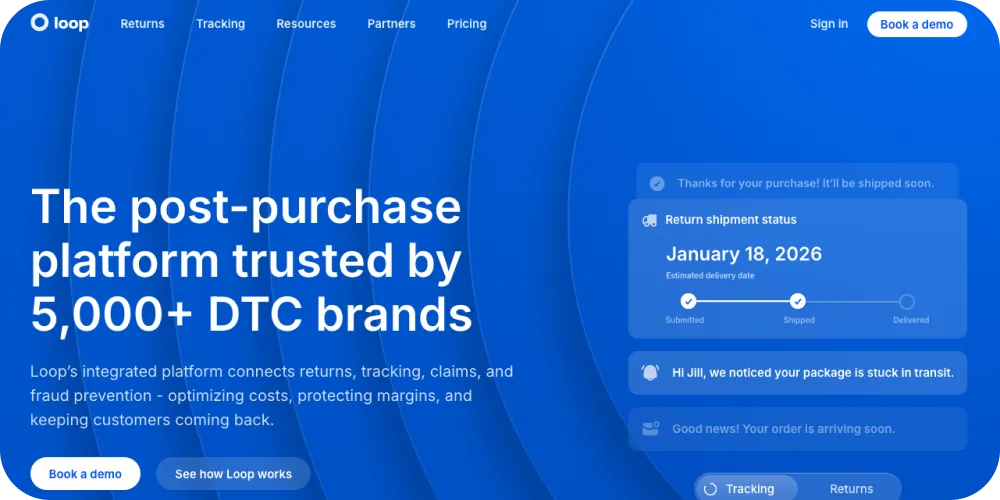
2. Loop Returns: Best for Shopify Exchange Optimization
Loop Returns is one of the most popular returns platforms for Shopify brands, with a focus on converting returns into exchanges.
Analytics capabilities
- Return rate tracking by product and reason
- Exchange vs. refund conversion reporting
- Revenue retained through exchanges
- Customer return frequency analysis
- Basic return reason categorization
Strengths
- Deep Shopify integration with one-click setup
- Strong exchange-first workflows that reduce refund rates
- Clean dashboard UI with real-time data
- Good return reason customization
Limitations
- Limited supplier and warranty analytics
- Analytics focused on return flow optimization, not product quality
- Best suited for DTC Shopify brands, not multi-supplier retailers
- No AI image analysis for defect detection
Who it is best for
Shopify-native DTC brands that want to reduce refund rates by pushing exchanges, with basic return reason analytics.
Pricing: Starts at $155/month. Enterprise plans with advanced analytics available.

3. Narvar: Best for Enterprise Post-Purchase Analytics
Narvar is an enterprise-grade post-purchase platform that covers shipping, tracking, returns, and customer communication.
Analytics capabilities
- Post-purchase experience scoring and benchmarking
- Return reason tracking integrated with delivery and tracking data
- Customer satisfaction metrics across the post-purchase journey
- Predictive analytics for return likelihood
- Benchmark data comparing performance to industry averages
Strengths
- Broad post-purchase analytics (not just returns)
- Enterprise-grade reporting and data exports
- Predictive return scoring based on order and customer data
- Industry benchmarking capabilities
Limitations
- Returns analytics is one part of a larger platform
- Limited warranty and supplier-specific reporting
- Higher price point for enterprise features
- Complex setup compared to Shopify-native tools
Who it is best for
Enterprise ecommerce brands that want returns analytics as part of a comprehensive post-purchase experience platform.
Pricing: Custom enterprise pricing.
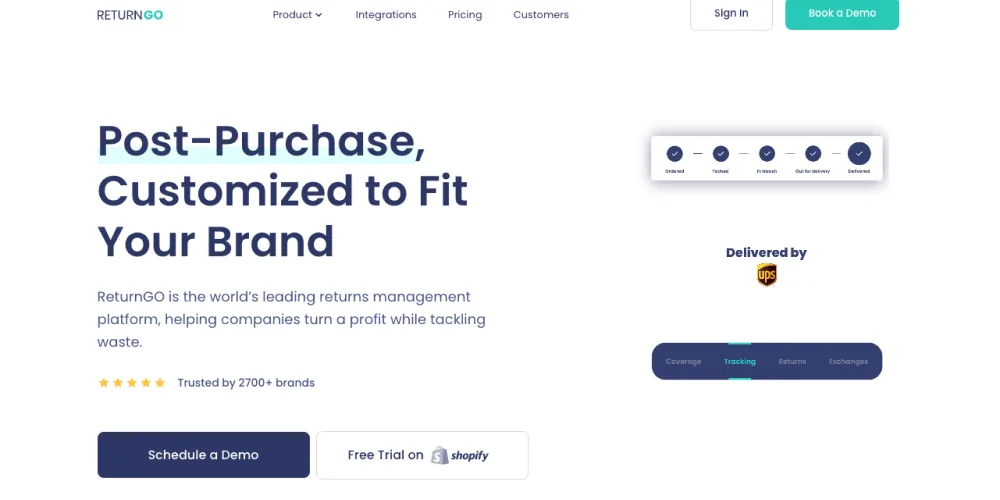
4. ReturnGO: Best Budget Option With AI Analytics
ReturnGO offers returns management with AI-powered analytics at a lower price point than most competitors.
Analytics capabilities
- AI-powered return reason analysis and categorization
- Product return rate tracking with trend visualization
- Return cost calculations and financial reporting
- Customer behavior analytics
- Automated reporting and alerts
Strengths
- Affordable starting price for smaller brands
- AI return reason analysis included in lower tiers
- Good Shopify and WooCommerce integration
- Automation features for reducing manual processing
Limitations
- Supplier analytics are basic compared to specialized platforms
- AI features are more limited than enterprise tools
- Warranty claim workflows are not as deep
- Analytics depth scales with pricing tier
Who it is best for
Small to mid-size Shopify and WooCommerce brands that want AI-assisted return analytics without enterprise pricing.
Pricing: Starts at $23/month for basic plans. Analytics features are more robust in higher tiers.

5. Returnly (Affirm): Best for Instant Refund Analytics
Returnly, now part of Affirm, pioneered the "instant refund" model where customers get credit before the return is processed.
Analytics capabilities
- Return reason tracking
- Refund and credit analytics
- Customer return behavior patterns
- Revenue impact reporting
Strengths
- Unique instant-credit model improves customer experience
- Good integration with Affirm's broader fintech ecosystem
- Return reason data collected during the return flow
Limitations
- Analytics is not the platform's primary focus
- No warranty or supplier analytics
- Limited AI features for return analysis
- Product quality insights are basic
Who it is best for
Brands that prioritize customer experience and want return analytics within an instant-credit return flow.
Pricing: Custom pricing.

6. Happy Returns (PayPal): Best for In-Person Return Analytics
Happy Returns, owned by PayPal, focuses on in-person return drop-offs through its Return Bar network.
Analytics capabilities
- Return volume and reason tracking across online and in-person channels
- Return Bar performance analytics
- Cost savings from box-free, label-free returns
- Geographic return pattern data
Strengths
- Unique data on in-person vs. online return patterns
- Cost reduction analytics from aggregated shipping
- PayPal integration for payment processing
Limitations
- Analytics focused on return logistics, not product quality
- No warranty or supplier analytics
- Limited AI capabilities
- Return Bar network is primarily U.S.-based
Who it is best for
U.S.-based brands that want to offer in-person returns and need analytics on the cost savings and customer behavior of that channel.
Pricing: Custom pricing.
Key Returns KPIs to Track
Regardless of which platform you choose, these are the returns KPIs every ecommerce brand should monitor:
Operational KPIs
- Return rate: Total returns / total orders (track by product, category, and channel)
- Return reason distribution: Percentage breakdown of why customers return
- Processing time: Average time from return initiation to resolution
- Auto-approval rate: Percentage of returns handled without human intervention
- First-contact resolution: Percentage of claims resolved in one interaction
Financial KPIs
- Cost per return: Total return processing cost / number of returns
- Revenue retained via exchanges: Revenue saved by converting refunds to exchanges
- Supplier recovery rate: Percentage of warranty costs recovered from suppliers
- Net return cost: Total return costs minus supplier recoveries and resale value
Product quality KPIs
- Defect rate by SKU: Warranty and defect claims / units sold per product
- Supplier claim rate: Claims per supplier as a percentage of their products sold
- Repeat defect rate: How often the same defect appears across product batches
- Time to defect detection: How quickly quality issues are identified after product launch
📦 Operational
- Return RateReturns / orders by product, category, channel
- Reason Distribution% breakdown of why customers return
- Processing TimeAvg. time from initiation to resolution
- Auto-Approval Rate% handled without human intervention
💰 Financial
- Cost Per ReturnTotal processing cost / number of returns
- Revenue RetainedRevenue saved via exchanges
- Supplier Recovery Rate% of warranty costs recovered from suppliers
- Net Return CostTotal costs minus recoveries and resale
🔍 Product Quality
- Defect Rate by SKUWarranty claims / units sold per product
- Supplier Claim RateClaims per supplier as % of products sold
- Repeat Defect RateSame defect frequency across batches
- Time to DetectionSpeed of identifying quality issues post-launch
How to Choose the Right Returns Analytics Platform
The right choice depends on your business model and what you need most from return data.
Choose Claimlane if:
- You sell products from multiple suppliers and need warranty analytics
- Supplier performance tracking and claim management is a priority
- You want AI-powered image analysis and auto-approval
- Product quality insights are as important as return rate reduction
- You need to track the full claims lifecycle including supplier credit notes
Choose Loop Returns if:
- You are a Shopify-native DTC brand
- Your main goal is converting refunds to exchanges
- You want a simple, clean analytics dashboard
- Warranty and supplier analytics are not a priority
Choose Narvar if:
- You are an enterprise brand with a large existing tech stack
- You want returns analytics as part of a full post-purchase platform
- Industry benchmarking matters to your reporting
- You need predictive analytics on return likelihood
Choose ReturnGO if:
- You are a smaller brand with a limited budget
- You want AI analytics at an affordable price point
- Basic warranty support is sufficient
- You are on Shopify or WooCommerce
Building a Returns Analytics Strategy
Buying the software is step one. Getting value from it requires a strategy.
Step 1: Define your baseline
Before you can improve, you need to know where you stand:
- What is your overall return rate?
- What are the top 5 return reasons?
- Which products have the highest return rates?
- How much does each return cost to process?
Step 2: Set up structured data collection
The quality of your analytics depends on the quality of your input data:
- Use a self-service claims portal that collects structured reasons, not just free text
- Require photo uploads for warranty and defect claims
- Tag returns with product, category, supplier, and channel data
- Separate return reasons into actionable categories (defect, sizing, preference, description mismatch)
Step 3: Build reporting cadences
Make return data part of regular business reviews:
- Weekly: Review return volume trends and new defect patterns
- Monthly: Analyze return rates by product and category, review supplier performance
- Quarterly: Deep dive into financial impact, policy optimization, and supplier negotiations
Step 4: Act on the data
Analytics without action is just reporting. Use insights to:
- Update product descriptions and sizing guides for high-return products
- Negotiate with suppliers based on defect and claim data
- Adjust return policies based on financial impact analysis
- Improve quality control processes for products with recurring defects
- Optimize inventory planning based on return rate predictions
Davidsen, one of Scandinavia's largest DIY retailers, used returns analytics to identify supplier quality issues and went from needing 5 agents to handle claims down to 1-2 agents while improving resolution quality.