
.webp)
Customer feedback is the raw material for every improvement in ecommerce. Better products, better service, better policies, better experiences. But feedback comes from dozens of sources: post-purchase surveys, product reviews, support tickets, social media, return reasons, warranty claims, and direct conversations. The challenge isn't collecting feedback. It's collecting the right feedback, from the right channels, at the right moments, and turning it into action.
The best customer feedback tools for ecommerce don't just gather data. They organize it, analyze it, surface patterns, and connect insights to business outcomes. A product with a 4.5-star rating but a 25% return rate has a feedback problem that reviews alone can't explain. The returns data tells the rest of the story.
This guide reviews the best customer feedback tools across every category, from reviews and surveys to returns analytics and AI-powered sentiment analysis.
TL;DR
- Customer feedback comes from six channels: reviews, surveys, support, returns/claims, social media, and behavioral data.
- Returns data is the most underused feedback source. Every return includes a structured reason tied to a specific product and order.
- The minimum viable feedback stack is four tools: reviews, NPS surveys, returns feedback (Claimlane), and support analytics.
- Claimlane captures structured feedback at the moment of return, including categorized reasons, photo evidence, and AI-powered categorization.
Types of Customer Feedback in Ecommerce
The Feedback Ecosystem
Customer feedback in ecommerce comes from six main channels:
- Product reviews: Star ratings and written reviews on the website, marketplaces, and third-party platforms
- Surveys: Post-purchase, post-delivery, and post-return surveys measuring NPS, CSAT, and CES
- Support interactions: Customer service tickets, chat transcripts, and phone call data
- Returns and claims: Return reasons, warranty claim descriptions, and damage reports
- Social media: Brand mentions, comments, and direct messages
- Behavioral data: What customers do (browse, buy, return, repeat) vs what they say
The most complete feedback picture combines all six. No single tool covers them all, which is why the best brands build a feedback stack.
Review and UGC Platforms
Trustpilot
Best for: Building trust through verified reviews, especially in European markets
Trustpilot is the dominant review platform in Europe and growing globally. Its third-party status (reviews live on Trustpilot, not the brand's site) adds credibility.
Strengths:
- High consumer trust (reviews are verified and moderated by Trustpilot)
- Strong SEO value (Trustpilot reviews appear in Google search results)
- Good for building brand credibility, especially for newer brands
- Free basic tier
Weaknesses:
- Limited control over negative reviews
- Can't easily display reviews on the product page (site reviews, not product reviews)
- Paid plans get expensive
- Less useful for product-level feedback
Pricing: Free tier, paid from $225/month

Yotpo
Best for: Integrated reviews + loyalty + referrals for Shopify brands
Yotpo is a suite that combines reviews, loyalty programs, SMS marketing, and subscriptions. The reviews product is strong, but the real value is the integration between modules.
Strengths:
- Product-level reviews with photos and video
- AI-powered review request optimization
- Integrates with Shopify and other platforms natively
- Loyalty and referral programs included in higher tiers
Weaknesses:
- Expensive for the full suite
- The individual modules (reviews only, loyalty only) are less compelling than the bundle
- Can be complex to set up
Pricing: Free for reviews only, paid from $79/month for the full suite
Judge.me
Best for: Budget-friendly product reviews for Shopify
Judge.me does one thing well: product reviews. It's simple, affordable, and effective.
Strengths:
- Very affordable (free tier includes most features)
- Fast loading (doesn't slow down the site)
- Photo and video reviews
- Good Shopify integration
Weaknesses:
- Limited beyond reviews (no loyalty, no referrals)
- Less brand recognition than Trustpilot or Yotpo
- Basic analytics
Pricing: Free tier, paid at $15/month
Survey and NPS Tools
Delighted
Best for: Simple, beautiful NPS and CSAT surveys
Delighted (owned by Qualtrics) makes surveying easy. Clean interface, high response rates, and straightforward reporting.
Strengths:
- Beautiful survey design that gets high response rates
- Multi-channel delivery (email, web, SMS, link)
- Automatic trend analysis
- Easy setup (no technical skills needed)
Weaknesses:
- Limited customization for complex survey logic
- Gets expensive at higher volumes
- Basic compared to full-featured survey platforms
Pricing: Free tier (50 responses/month), paid from $224/month
Typeform
Best for: Engaging, conversational surveys with complex logic
Typeform's conversational interface drives higher completion rates than traditional surveys. Good for detailed feedback collection where you need more than a number.
Strengths:
- Beautiful, engaging survey experience
- Complex branching logic
- Integrates with most marketing and CRM tools
- Good for qualitative feedback
Weaknesses:
- Not purpose-built for ecommerce
- Expensive at higher response volumes
- Response data needs manual analysis or integration with BI tools
Pricing: Free tier, paid from $25/month
Hotjar
Best for: On-site feedback + session recordings + heatmaps
Hotjar combines feedback collection with behavioral analytics. See what customers do (heatmaps, session recordings) and ask them why (surveys, feedback widgets).
Strengths:
- Unique combination of feedback + behavioral data
- On-site feedback widgets catch visitors in the moment
- Session recordings help understand frustration points
- Affordable for mid-market brands
Weaknesses:
- Not designed for post-purchase feedback
- Limited survey capabilities compared to dedicated survey tools
- Data volume limits on lower tiers
Pricing: Free tier, paid from $32/month
Returns Feedback: The Missing Piece
Why Returns Data Is Customer Feedback
Most brands treat returns as an operational cost center and reviews as the feedback channel. This misses the most actionable feedback source in ecommerce.
Every return is a piece of feedback:
- "Wrong size" tells the product team the sizing chart needs work
- "Not as described" tells the content team the product page is misleading
- "Defective" tells the quality team there's a supplier or manufacturing issue
- "Changed my mind" tells the marketing team the purchase wasn't driven by genuine need
The difference between a review and a return: reviews are optional, returns are necessary. The return rate captures feedback from customers who would never write a review.
Claimlane as a Feedback Tool
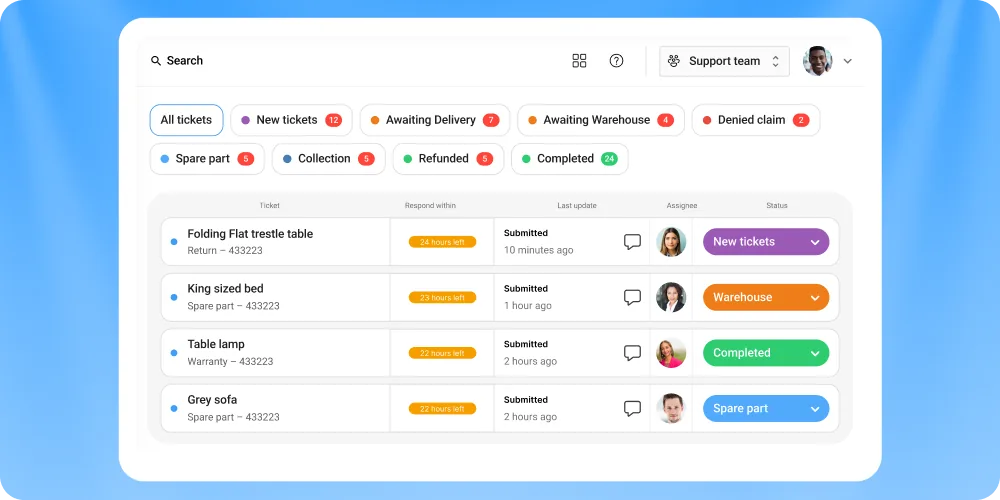
Claimlane captures structured feedback at the moment of return:
- Categorized return reasons through the self-service portal (not free-text guessing)
- Photo evidence showing exactly what went wrong
- Product-level return analytics showing which items have the highest return rates and why
- Trend analysis identifying emerging quality issues before they become widespread
- Supplier performance data showing which suppliers produce the most defective products
- AI-powered categorization that automatically classifies return reasons from customer descriptions
This data is more actionable than reviews because it's structured, consistent, and tied to specific products and orders. Rated 4.8/5 on G2 (read reviews), Claimlane turns every return into a structured data point that feeds product and operational improvements.
Before Claimlane, every case required manually digging around to find the best solution. Now we move faster and with real confidence. You can feel the impact within our support team and in every customer interaction.
Nick Magnusson, Head of Customer Service — MaxGaming
AI-Powered Feedback Analysis
Sentiment Analysis Tools
For brands receiving hundreds or thousands of feedback data points monthly, manual analysis is impossible. AI sentiment analysis tools process feedback at scale:
- MonkeyLearn: Customizable text analysis for reviews, surveys, and support tickets
- Medallia: Enterprise voice-of-customer platform with advanced AI
- Qualtrics XM: Full experience management suite with predictive analytics
What AI Does Well in Feedback
- Theme extraction: Identifying common topics across thousands of reviews or return reasons
- Sentiment scoring: Rating feedback as positive, negative, or neutral automatically
- Trend detection: Flagging emerging issues before they show up in aggregate metrics
- Cross-channel synthesis: Combining feedback from reviews, surveys, returns, and support into a unified view
What AI Doesn't Do Well (Yet)
- Understanding sarcasm and nuance in written reviews
- Replacing human judgment on subjective feedback
- Generating action plans from insights (AI identifies the problem, humans solve it)
Comparison Table: Customer Feedback Tools
| Tool | Type | Best For | Price |
|---|---|---|---|
| Trustpilot | Reviews | Brand trust, EU | Free/$225 |
| Yotpo | Reviews+loyalty | Shopify suite | Free/$79 |
| Judge.me | Reviews | Budget Shopify | Free/$15 |
| Delighted | NPS/CSAT | Simple surveys | Free/$224 |
| Typeform | Surveys | Qualitative | Free/$25 |
| Hotjar | Feedback+behavior | On-site + heatmaps | Free/$32 |
| Claimlane | Returns | Product quality | Contact |
| Zendesk | Support | CS analytics | $19/agent |
Building a Customer Feedback Stack
The Minimum Viable Feedback Stack
For most ecommerce brands:
- Product reviews: Judge.me or Yotpo (captures purchase satisfaction)
- NPS survey: Delighted or built into email platform (captures overall brand sentiment)
- Returns feedback: Claimlane (captures product quality and service issues)
- Support analytics: Built into helpdesk (Zendesk, Gorgias, etc.)
This four-tool stack covers the essential feedback channels without overcomplicating the system.
Connecting Feedback to Action
Feedback without action is waste. The feedback stack should drive specific improvements:
- Product team: Review themes + return reasons inform product design changes
- Content team: "Not as described" returns + negative reviews about product descriptions inform content updates
- Quality team: Defect claim patterns + supplier performance data inform supplier conversations
- CX team: NPS trends + support themes inform process improvements
- Marketing team: Customer sentiment data informs messaging and targeting
Closing the Feedback Loop
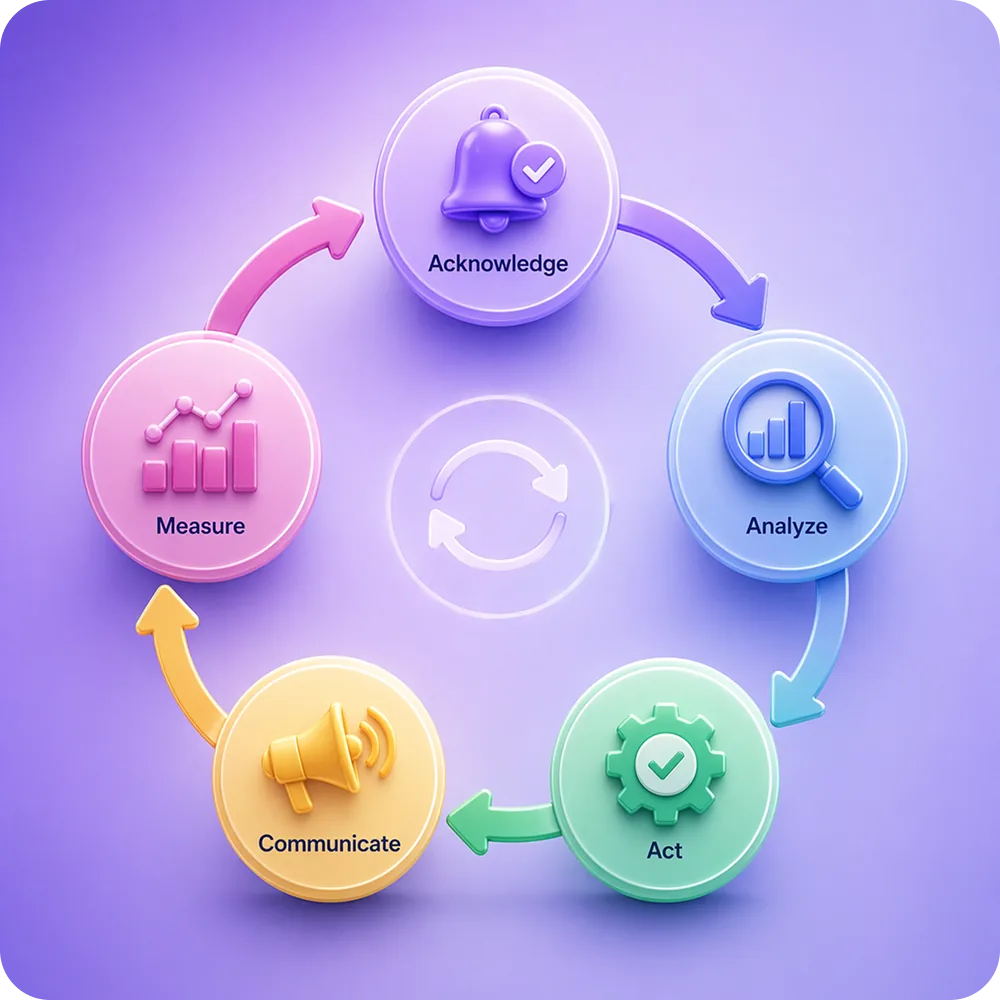
The best brands don't just collect feedback. They close the loop:
- Acknowledge: Thank customers for feedback (automated for reviews, personal for detailed complaints)
- Analyze: Identify patterns across channels (AI helps here)
- Act: Make specific changes based on the patterns
- Communicate: Tell customers what changed because of their feedback
- Measure: Track whether the changes improved the relevant metrics
Issuing refunds and replacements without switching between systems has been a huge time saver for our team.
Patrick Zangenberg, Head of Customer Service — Onyx Cookware
Measuring Feedback Program Effectiveness
Key Metrics
- Review collection rate: What percentage of customers leave a review? (Industry average: 5-10%)
- NPS score: Above 50 is excellent for ecommerce
- CSAT score: Above 80% is strong
- Return reason coverage: What percentage of returns have categorized reasons? (Target: 95%+)
- Feedback-to-action cycle time: How quickly do feedback insights become product/process changes?
- Repeat return rate: Are feedback-driven changes actually reducing returns for specific products?