
On 2 August 2026, the EU AI Act's transparency rules start to apply to the AI-generated imagery brands publish every day. For most of the last two years the fashion and retail conversation treated AI imagery as a production question: how fast, how cheap, how many SKUs from one shoot. Article 50 quietly makes it a provenance and disclosure question too.
Three things change from August. The file has to carry a machine-readable mark. The shopper has to see a visible label where the image could pass for a photograph. And the vendor that generates the image and the brand that publishes it are both on the hook.
What Article 50 actually requires
Article 50 covers transparency for AI systems that interact with people or generate content. For product imagery, two paragraphs do the work. Article 50(2) puts a marking duty on the provider that builds the generation system. Article 50(4) puts a disclosure duty on the deployer that publishes the content.
The two duties are separate and neither substitutes for the other. A marked file with no visible label fails the deployer duty. A visible label on an unmarked file leaves the provider exposed.
One framing that clears up most confusion: the deployer is the merchant. Not the AI vendor, not the platform. A brand that takes AI-generated or AI-modified content and puts it on a storefront where a shopper could mistake it for a traditional photo owns the disclosure.
Marked at the source
Whoever generates a synthetic image or video has to embed a machine-readable mark, so the file itself can be detected as AI-generated. That obligation lands on the provider of the generation system, not on the brand using it.
In practice this is a vendor question before it is a brand question. Either the imagery tool outputs marked files, or that job quietly falls back on the brand. It is worth putting in writing to every image vendor before August.
There is a timing detail. Generative systems already on the market before 2 August get until 2 December 2026 to meet the marking requirement, under the transitional arrangement agreed earlier in 2026. A tool adopted fresh after August does not get that grace.
Why metadata and watermarks are not enough
The tempting technical answer is provenance metadata: C2PA manifests, IPTC source fields, invisible watermarks. Useful, and part of the marking story, but they do not satisfy the disclosure duty on their own, for two operational reasons.
First, platform image pipelines re-encode uploads, and embedded metadata often gets stripped or corrupted before the image reaches the storefront. Second, shoppers do not read metadata. The deployer duty is about a person on a phone recognising the disclosure at a glance, and no invisible signal does that.
Visible watermarks baked into pixels have their own failure mode: they crop out in theme ratios, vary across image sizes, and tend to be too subtle to pass as clear and distinguishable.
Disclosed to the shopper, at first exposure
Where AI-generated content could be taken for a real photograph, people have to be told. Article 50(4) asks for a clear, visible label, not a metadata tag nobody opens.
The bar is first exposure. No hovering, no clicking through, no digging into a policy page. The Commission's Code of Practice on transparency of AI-generated content goes further on implementation: its user testing found text labels outperform icon-only badges, contrast matters, and accessibility matters. A tiny sparkle icon in the corner does not cut it.
A transparency policy page in the footer is a supporting document, not a substitute. Disclosure ties to the content itself, visible where the content appears.
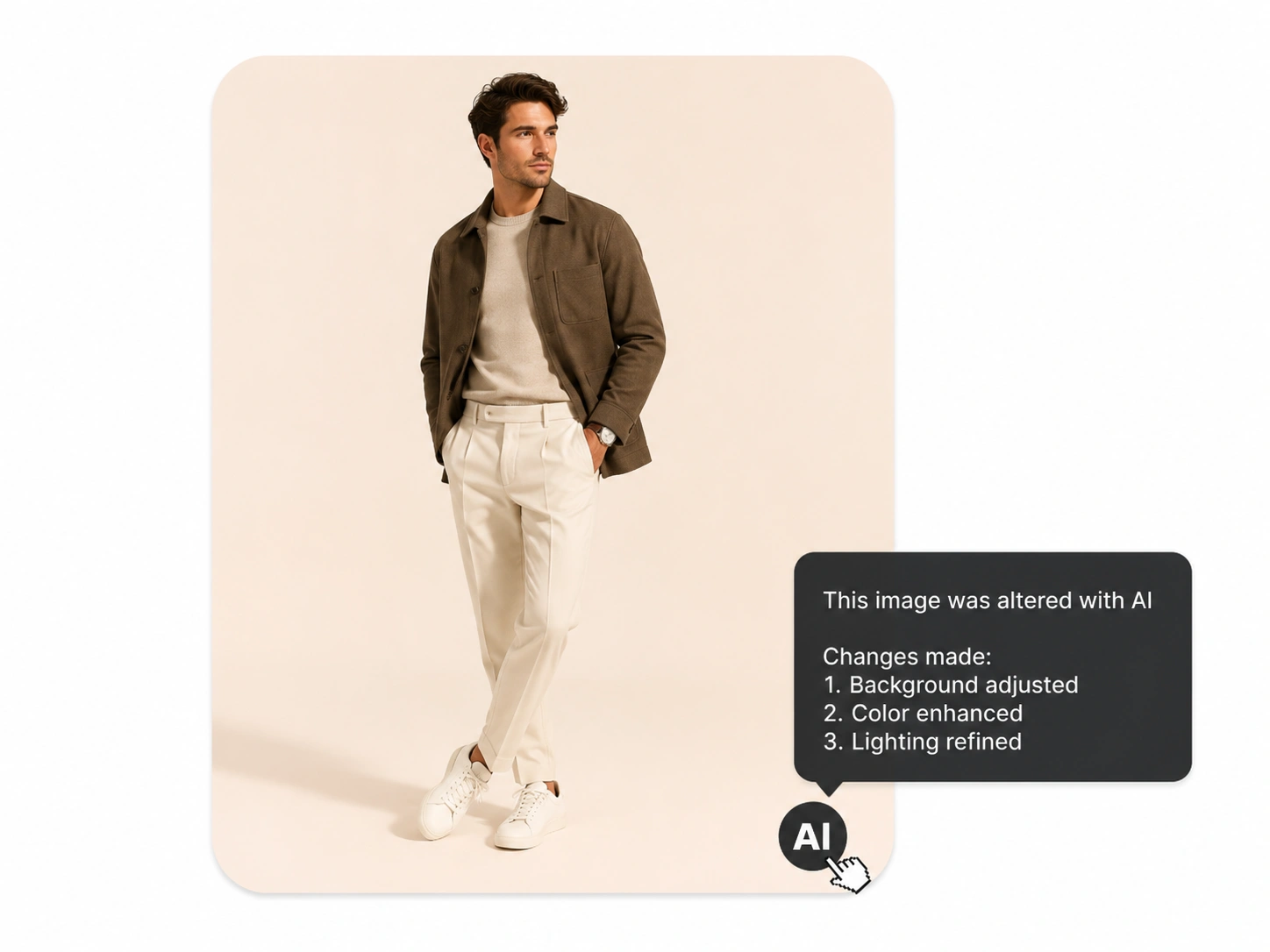
On a product page, that means the on-model image
If the model, the fit, or the scene is generated, that is the image a shopper reads as a photograph, and that is where disclosure lands.
Two practical details follow from the guidance. Labelling is image-level, not product-level: a PDP can carry six gallery images where only two are AI-generated, and the label follows those two. And "AI-generated" and "AI-modified" are different statements: a full synthetic render and a real photo with a synthetic background are not the same disclosure.
Teams producing AI imagery at scale can find the production side in the guide to AI product photography. The compliance layer above it is new, and it rewards brands that already track where each asset came from.
What labelling actually looks like per platform
On Shopify
Labels render through a theme app extension, so nothing touches the original uploads and nothing survives-or-breaks with a theme change. Product photos get tagged as AI-generated or AI-modified, or carry a short "AI" label with a tooltip explaining more. Tagging runs single or bulk from a dashboard, because a catalogue refresh can drop hundreds of AI images at once.
The label layer follows the Code of Practice: EU icon templates, WCAG-oriented contrast checks, screen-reader support, and badge copy localised across EU locales. Behind it sits a metadata audit log with timestamps and user IDs, and a public compliance page at /pages/ai-transparency that names the deployer, switched on with one toggle.
One Shopify-specific warning: the image pipeline re-encodes uploads, so embedded C2PA or IPTC metadata often does not survive to the storefront. Provenance metadata cannot be the disclosure plan on Shopify even if the generation tool writes it correctly.
On WordPress and WooCommerce
More pipeline control, same duty. Labels apply through a shortcode or block that works with any theme, and the WooCommerce reality is the reason site-wide plugins fail here: product pages carry featured images, gallery images, and variation images, and the label has to follow the specific AI image across all three, not just the featured image. Bulk labelling, AI detection assist, and the same audit log and multilingual copy standards apply as on Shopify. Free open-source tooling for the basics already exists on GitHub, with the same rule underneath: a GDPR plugin checkbox or a footer disclaimer is not per-image Article 50 disclosure.
What no serious setup does on either platform
No image file editing or re-encoding, no C2PA or IPTC signing, no Merchant Center feed overrides, no AI product description labelling, and no compliance guarantees. The tool runs the labelling workflow. Legal counsel gets the final word on interpretation.

The language detail that is not a nitpick
Disclosure has to be understandable to the person seeing it, which in practice means the shopper's language. In French, AI is "IA." In German, "KI." An English "AI-generated" badge on a French storefront is the wrong disclosure string for that market.
For brands running localised storefronts across the EU, label copy becomes one more localised asset to manage per market, the same as size charts and legal footers.
A shared obligation
The provider who builds the system and the deployer who publishes the content are both accountable, each for their own part. Neither one gets to point at the other.
What non-compliance costs
The exposure for getting the transparency duties wrong runs up to 15 million euro or 3 percent of worldwide annual turnover, whichever is higher. Small merchants are not exempt by size. That is the finance-readable version of why this reaches past the content team and into legal and the CFO's office.
The scope question, answered on 20 July
How far standard on-model imagery sits inside these rules, as opposed to content built to deceive, was an open question through the spring. That has moved. The European Commission adopted the final Article 50 guidelines on 20 July 2026, and they lean toward inclusion rather than away from it.
The guidelines confirm that a realistic synthetic depiction of a natural-looking person counts as a deep fake under the Act's definition, even when no real individual is depicted and even when nobody set out to deceive. That pulls a lot of ordinary AI on-model imagery into the disclosure question.
There is a lighter touch for content that is evidently artistic or creative, where the origin still has to be disclosed but without spoiling the work. Whether a clean commercial on-model shot qualifies for that lighter treatment is the part still open to interpretation. The safe assumption is that it does not.
Nobody's platform is doing this for them
The quiet part of the August deadline is the tooling gap. There is no native Article 50 feature in Shopify or WordPress, no app store category for it, and the promo badge apps merchants already own are built for conversion stickers, not regulatory disclosure. Generation tools do not label storefronts. Platforms are not sending readiness emails.
So the workflow falls to the brand: an inventory of which live assets are AI-generated or AI-modified, image-level tags, localised label copy, and a record of who tagged what and when. Early tools for this are appearing from independent builders, but the accountable party stays the same either way. The deployer duty does not transfer to a plugin.
Provenance is the discipline underneath all of it
Marking and disclosure look like a content problem. Underneath, they are a provenance problem: being able to show how a given output was made, keep a record of it, and stand behind it.
That discipline is not unique to marketing imagery. It is the same requirement that decides whether AI can be trusted deeper in the post-purchase operation, where images are evidence rather than advertising and an unexplainable decision is a liability.
Where this meets warranty claims and returns
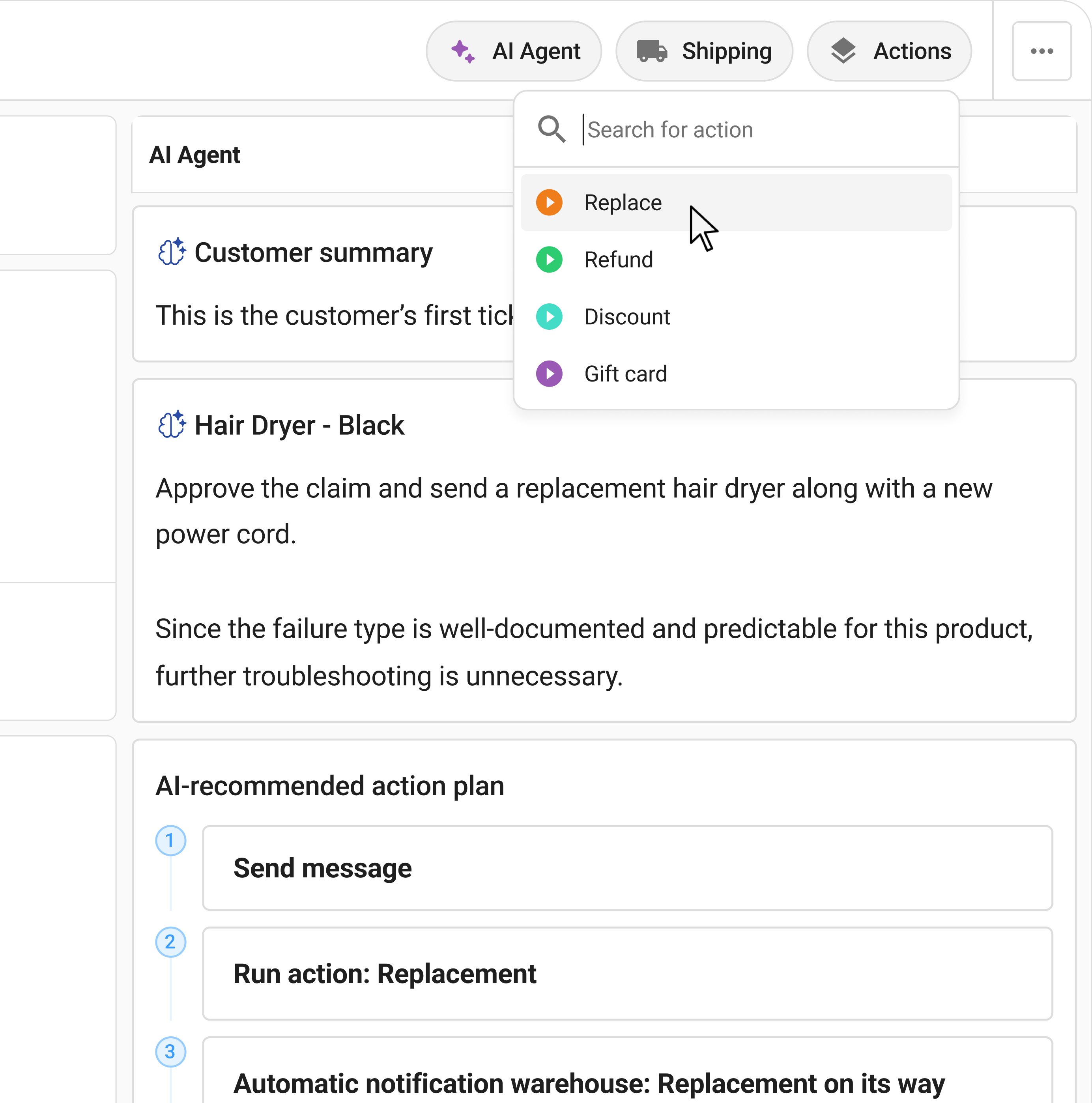
Claimlane's AI Agent, the first AI agent purpose-built for warranty claims and returns, is built on that principle. It analyses claim images and video, applies warranty rules per product and supplier, and recommends or auto-approves a resolution. High-value cases keep a human in the loop, the rules are configurable rather than pure AI, thresholds and override controls stay with the team, and every decision leaves an audit trail. The full picture is on the Claimlane AI Agent page.
Component: proof-point pull-quote
Simple size-and-fit returns run fine on a returns app such as Loop or Narvar. Complex warranty, repair, and supplier claims, where image evidence and audit trails decide the outcome, are where Claimlane sits. The provenance habit Article 50 now forces on imagery is the same habit that separates a defensible AI claims process from a risky one.
Claimlane is rated 4.8 out of 5 on G2 by warranty and returns teams.
Worth asking internally this week
Component: readiness checklist
Frequently asked questions
Conclusion
The production race was mostly won on speed. The next stretch is won on provenance: knowing where every image came from, which label it carries in which market, and who signs off on it. Brands that can answer "how was this made" without hesitation walk into August with nothing to change.