.webp)
What Is a Restocking Fee?
A restocking fee is a charge that a retailer deducts from a customer's refund when a returned product needs to be inspected, repackaged, or processed before it can be resold. It's typically expressed as a percentage of the item's purchase price, ranging from 10% to 25% depending on the product category and condition.
Restocking fees exist because returns aren't free for the seller. Every return involves shipping costs, labor for inspection, repackaging materials, and the risk that the product can't be resold at full price. The restocking fee offsets some of that cost.
For ecommerce brands, the decision to charge a restocking fee is a balancing act. Charge too much and customers hesitate to buy. Charge nothing and return costs eat into margins. The right approach depends on the product, the customer segment, and the competitive landscape.
How Restocking Fees Work in Ecommerce
The mechanics are straightforward. A customer initiates a return, the brand receives the product, inspects it, and processes the refund minus the restocking fee.
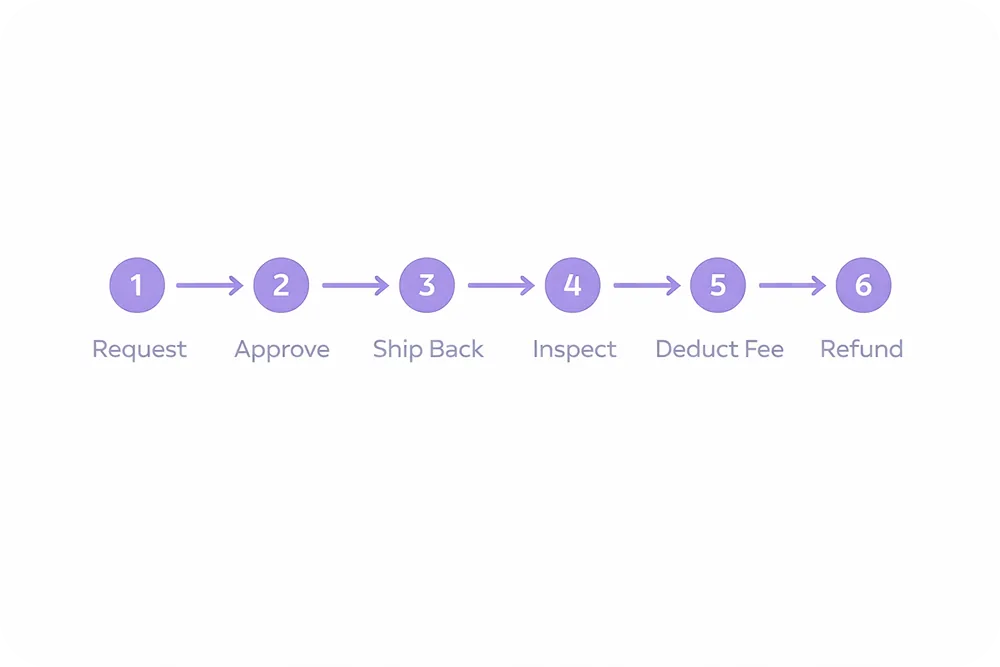
Here's a typical flow:
- Customer requests a return through the brand's return portal or support team.
- The brand approves the return and issues a return label (or the customer ships at their own cost).
- The product arrives at the warehouse or fulfillment center.
- Staff inspects the item for damage, missing parts, opened packaging, or signs of use.
- If the item qualifies for a restocking fee per the return policy, the fee is deducted from the refund.
- The refund (minus the restocking fee) is processed to the original payment method.
The key word here is transparency. Customers need to know about restocking fees before they buy, not after they return. Burying the fee in fine print creates disputes, chargebacks, and negative reviews.
Restocking fees treat the symptom. The cause is returns cost.
See what returns are actually costing you — and what automation would save. Two minutes, your numbers.
How Much Should a Restocking Fee Be?
There's no universal standard, but the market has settled into some common ranges by product category.
| Product Category | Typical Fee | Why |
|---|---|---|
| Electronics | 15-25% | High depreciation once opened, difficult to resell as new |
| Furniture & large items | 15-20% | High return shipping costs, risk of damage in transit |
| Specialty equipment | 10-20% | Calibration, testing, and repackaging required |
| Apparel & accessories | Rarely charged | High return rates expected; fees deter purchases |
| Software & digital | N/A | No physical restocking; typically non-refundable |
| Custom / personalized | 25-50% | Can't be resold to another customer |
The fee should reflect the actual cost of processing the return. A 15% fee on a $500 item ($75) is defensible if the brand spends $20 on return shipping, $15 on inspection labor, $10 on repackaging, and risks selling the item at a 20% discount.
If you want to test your own numbers, the calculator below shows the customer refund and brand recovery for any combination of order value, fee percentage, and return shipping.
Restock fee calculator
Enter the order value, the restocking fee percentage, and any return shipping cost the customer pays. The calculator shows the estimated refund and the brand's net recovery.
Restocking fee
$75.00
Total deductions
$75.00
Customer refund
$425.00
Note: this is a transparency tool, not a legal compliance check. Restocking fees in the EU and UK can only reflect diminished value, not be applied as a flat percentage on all returns.
When Restocking Fees Make Sense
Not every ecommerce brand needs restocking fees. They work best in specific situations.
High-value products with packaging-sensitive resale
Electronics, appliances, and premium goods lose significant value once the packaging is opened. A restocking fee helps recover some of that loss. If a customer opens a $1,200 laptop, uses it for two days, and returns it, the brand often can't resell it as new. The restocking fee accounts for the markdown.
Products that require inspection or testing
Items that need to be tested, recalibrated, or sanitized before resale justify a restocking fee. Think fitness equipment, outdoor gear, or medical devices. The labor and time involved in making the product resale-ready is a real cost.
High return-rate categories with buyer's remorse
Some product categories see return rates above 30%, often driven by impulse purchases or "try before you decide" behavior. A modest restocking fee can discourage frivolous returns without punishing legitimate ones.
B2B and wholesale orders
Business customers ordering in bulk expect restocking fees. It's standard practice in wholesale and distribution. Fees typically range from 15% to 25% and are spelled out in the purchase agreement.
When to Skip the Restocking Fee
There are situations where charging a restocking fee does more harm than good.
Competitive categories where free returns are the norm
In fashion, beauty, and general consumer goods, customers expect free returns. Charging a restocking fee puts the brand at a disadvantage against competitors who absorb the cost. If the top five competitors all offer free returns, adding a fee is a conversion killer.
Defective or incorrect items
Never charge a restocking fee when the return is the brand's fault. If the product arrived damaged, defective, or wasn't what the customer ordered, the full refund should be immediate and hassle-free. Charging a fee in these cases leads to chargebacks and regulatory complaints.
First-time buyers you want to convert
For brands focused on customer acquisition, the first purchase is an audition. A restocking fee on a first-time buyer's return can permanently end that relationship. Some brands waive restocking fees for new customers and introduce them only for repeat return behavior.
Low-cost items where the fee creates friction
If the product costs $25 and the restocking fee is $5, the customer's frustration outweighs the brand's savings. For low-ticket items, a returnless refund often makes more financial sense than processing the return at all.
✅ When to charge
- High-value electronics or appliances
- Products needing inspection or testing
- High return-rate categories with impulse buys
- B2B and wholesale orders
❌ When to skip
- Competitive categories where free returns are standard
- Defective or incorrectly shipped items
- First-time buyers you want to convert
- Low-cost items where friction exceeds savings
Legal Considerations for Restocking Fees
Restocking fees are legal in most jurisdictions, but there are rules.
United States
No federal law prohibits restocking fees, but they must be clearly disclosed before purchase. Several states (including California and New York) require the return policy, including any fees, to be displayed at the point of sale. Failure to disclose can make the fee unenforceable.
European Union
Under the EU Consumer Rights Directive, consumers have a 14-day cooling-off period for online purchases. During this window, the seller can only deduct fees for diminished value if the customer handled the product beyond what was necessary to establish its nature and characteristics. Blanket restocking fees on all returns may violate EU consumer protection law.
United Kingdom
Similar to the EU, the UK Consumer Contracts Regulations give customers a 14-day right to cancel. Restocking fees are allowed only if the product's value has been reduced by the customer's handling.
Australia
Australian Consumer Law requires sellers to offer refunds for defective products regardless of their return policy. Restocking fees can apply to change-of-mind returns, but not to faulty goods.
The takeaway: always have a legal review of the return policy, especially when selling internationally. What's acceptable in one market may be illegal in another.

Restocking Fees vs. Return Fees: What's the Difference?
These terms get confused, but they cover different costs.
A restocking fee is deducted from the refund amount. It covers the cost of receiving, inspecting, and repackaging the returned product.
A return fee (or return shipping fee) is the cost of shipping the product back to the seller. It can be charged separately (the customer pays for return shipping) or deducted from the refund.
Some brands charge both: the customer pays return shipping, and a restocking fee is deducted from the refund. This double hit can feel excessive and typically only works for high-value, low-frequency purchase categories.
How Restocking Fees Affect Customer Behavior
Research from the Baymard Institute shows that 11% of cart abandonments are caused by unsatisfactory return policies. Restocking fees contribute to that number.
But the relationship isn't always negative. Here's what the data suggests:
They reduce frivolous returns
A 15% restocking fee on electronics reduces return rates by an estimated 8% to 12%, according to industry benchmarks. Customers think twice before returning a product they bought on impulse.
They don't significantly deter planned purchases
Customers who have researched a product and know what they want are less sensitive to restocking fees. The fee matters most for impulse and try-before-you-buy purchases.
They increase customer service contacts
Customers who see a restocking fee on their refund often contact support to dispute it. This creates additional labor costs that can partially offset the fee's revenue. Clear pre-purchase disclosure reduces (but doesn't eliminate) these contacts.
Alternatives to Restocking Fees
Brands that want to protect margins without the friction of restocking fees have other options.
Offer exchanges instead of refunds
Encourage customers to exchange for a different size, color, or product rather than returning for a refund. Exchanges keep the revenue in the business and often cost less to process than a full return.
Use returnless refunds for low-value items
For items where the cost of processing the return exceeds the product value, skip the return entirely. Refund the customer and let them keep (or donate) the item. This sounds counterintuitive, but it's often the cheapest option. Brands using Claimlane can set up automated rules that trigger returnless refunds based on item value, category, or customer history.
Implement tiered return windows
Instead of a flat restocking fee, use time-based tiers. Full refund within 14 days, 90% refund within 30 days, 80% refund within 60 days. This encourages faster returns (when products are easier to resell) without the negative perception of a "fee."
Charge for return shipping instead
Deducting a flat return shipping cost ($5 to $10) from the refund is perceived as fairer than a percentage-based restocking fee. Customers understand shipping costs; they're less accepting of abstract "restocking" charges.
11% of cart abandonments are caused by unsatisfactory return policies.
Baymard Institute
How to Communicate Restocking Fees Clearly
The number-one mistake brands make with restocking fees is hiding them. Here's how to do it right.
Put it on the product page
Don't wait for the FAQ or return policy page. If a product has a restocking fee, state it on the product page near the price. "15% restocking fee applies to opened returns" is clear and sets expectations before checkout.
Include it in order confirmation
Reiterate the policy in the order confirmation email. Customers who see it twice are far less likely to dispute it later.
Explain the why
A brief explanation reduces pushback. "Because we inspect and recertify every returned item before reselling, a 15% restocking fee applies" feels more reasonable than "15% restocking fee" with no context.
Make the return portal transparent
When a customer starts a return, show the estimated refund amount (after the fee) before they confirm. No surprises. Platforms like Claimlane's self-service portal can display conditional refund amounts based on the product, return reason, and policy rules.
How to Set Up Restocking Fee Rules
Most ecommerce brands don't need a single blanket restocking fee. A rules-based approach works better.
By product category
Electronics get a 15% fee. Apparel gets no fee. Furniture gets a 20% fee. Match the fee to the actual cost of processing returns in each category.
By return reason
Defective items and wrong-item-shipped returns get full refunds, always. Change-of-mind returns get the restocking fee. This is fair and legally sound in most jurisdictions.
By product condition
Unopened, factory-sealed returns get full refunds. Opened but unused items get a reduced fee (10%). Used or damaged items get the full fee (20% to 25%) or no refund at all.
By customer segment
VIP customers, first-time buyers, or loyalty program members can be exempted from restocking fees as a retention tool.
Claims management platforms like Claimlane let brands set up these conditional rules and automate the refund calculation, so support agents don't have to make judgment calls on every return.