.webp)
Ecommerce keeps growing, and warranty claim volumes grow right alongside it. More products sold means more potential defects, more transit damage, and more customer expectations to manage. For retailers and brands selling physical goods, the question is no longer whether warranty claims will scale. They will. The real question is whether the operations behind them can scale without doubling headcount every 18 months.
Most support teams are already feeling the pressure. Tickets stack up, the same issues come through every week, and the tools built for general customer service weren't designed for the specifics of a warranty claim. This article is about how to scale warranty operations the right way: by changing the system, not adding more people to it.
Why warranty volume keeps climbing faster than teams can hire
The numbers behind the volume increase are simple, but the implications aren't.
Typical claim volume increase for a brand 3 years post-launch
Average ecommerce return rate, with warranty claims a growing share
Of customers expect online self-service for claim submission
Resolution window before customer satisfaction drops measurably
Volume isn't the only thing that grew. Customer expectations grew faster. Shoppers expect a self-service return flow, instant status updates, and a refund or replacement within days, not weeks. If the process takes longer than that, the frustration shows up in support tickets, negative reviews, and lost repeat purchases.
A defective product is going to be defective regardless of how good the product page is. What the operations team controls is how fast and cleanly the claim gets handled once it lands.
The hiring trap most teams fall into
When claim volume goes up, the default response is to hire more support agents. This works for a quarter or two, then it stops working. Here's why:
Adding agents to a manual workflow is like adding lanes to a road that ends in a single-file bridge. The bottleneck moves but doesn't disappear.
What scaling warranty operations actually requires
The teams that handle volume well share four operating habits. None of them involve more headcount.
A self-service portal collects every required field upfront: order number, photos, video, issue category, serial. The claim arrives complete or it doesn't arrive. This single change cuts time per claim by 50% on average.
A meaningful share of claims are clear-cut: in-warranty, photo evidence, standard resolution. Auto-approve them. Save the human review for edge cases. AI-assisted claim platforms can typically auto-resolve 30 to 60% of incoming volume.
Status check tickets are the single biggest waste of agent time. Customers ask because they can't see what's happening. Self-service status removes 40 to 60% of inbound tickets without changing anything else.
If 30% of claims come from one product or supplier, the structural fix isn't faster claim handling. It's product or supplier intervention. Claim data points directly at the next root cause to fix, which then reduces future volume.
These four habits compound. Cleaner intake makes automation possible. Automation reduces volume. Visible status reduces tickets further. Data closes the loop on the claims that shouldn't have happened in the first place.
The economics of automation versus headcount
For most retail and ecommerce brands, the math is straightforward. Below is what the same volume looks like under each approach.
Davidsen made exactly this transition: from 5 agents handling claims to 1 to 2 using Claimlane, without sacrificing customer experience. The savings showed up in headcount, but the bigger gain was that the team stopped spending time on admin and started spending it on the claims that actually needed human judgement.
Where customer experience improves when operations scale right
Better operations isn't just an internal win. The customer feels the difference too.
Days instead of weeks. The frustration window stays shorter. Customers move on with their day.
Status updates without having to ask. The customer sees what's happening, when it's happening, and what's next.
Information collected once, available everywhere. 66% of customers say repeating themselves is the worst part of customer service.
90% of customers expect to start their claim online. The portal handles intake without forcing the customer through a phone tree.
These outcomes don't show up because the team got smarter. They show up because the team stopped being the bottleneck.
What changes when you switch to a purpose-built platform
A dedicated warranty claims platform isn't about piling more tools onto the team. It's about replacing email threads and spreadsheets with a system built for this specific job.
A portal collects every required field upfront. No email back-and-forth chasing photos, order numbers, or serials.
Warranty terms, purchase date, and product status checked against business rules. Clear-cut cases auto-approve. Edge cases route to a human with full context already attached.
Customer, support team, supplier, and warehouse all see the same case in the same status. No status check tickets.
Refunds, replacements, repairs, return labels, supplier reimbursement requests. All from the same case, no manual handoffs.
Every claim becomes a data point on product quality, supplier performance, and recurring defects. The next product cycle uses what the last one taught you.
Each of these alone has measurable impact. Combined, they change what's possible at scale.
How Claimlane handles volume
Claimlane is the platform Davidsen, MaxGaming, Sebra, BabySam, Black Diamond, and 8,000+ other brands use to scale warranty operations without scaling headcount.
What it does at high volume:
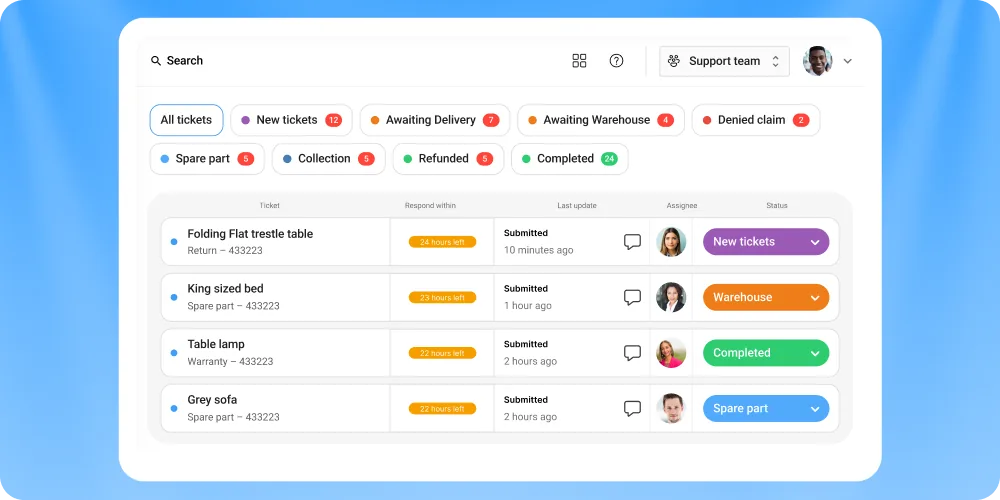
- Self-service portal that handles intake for every claim, regardless of volume
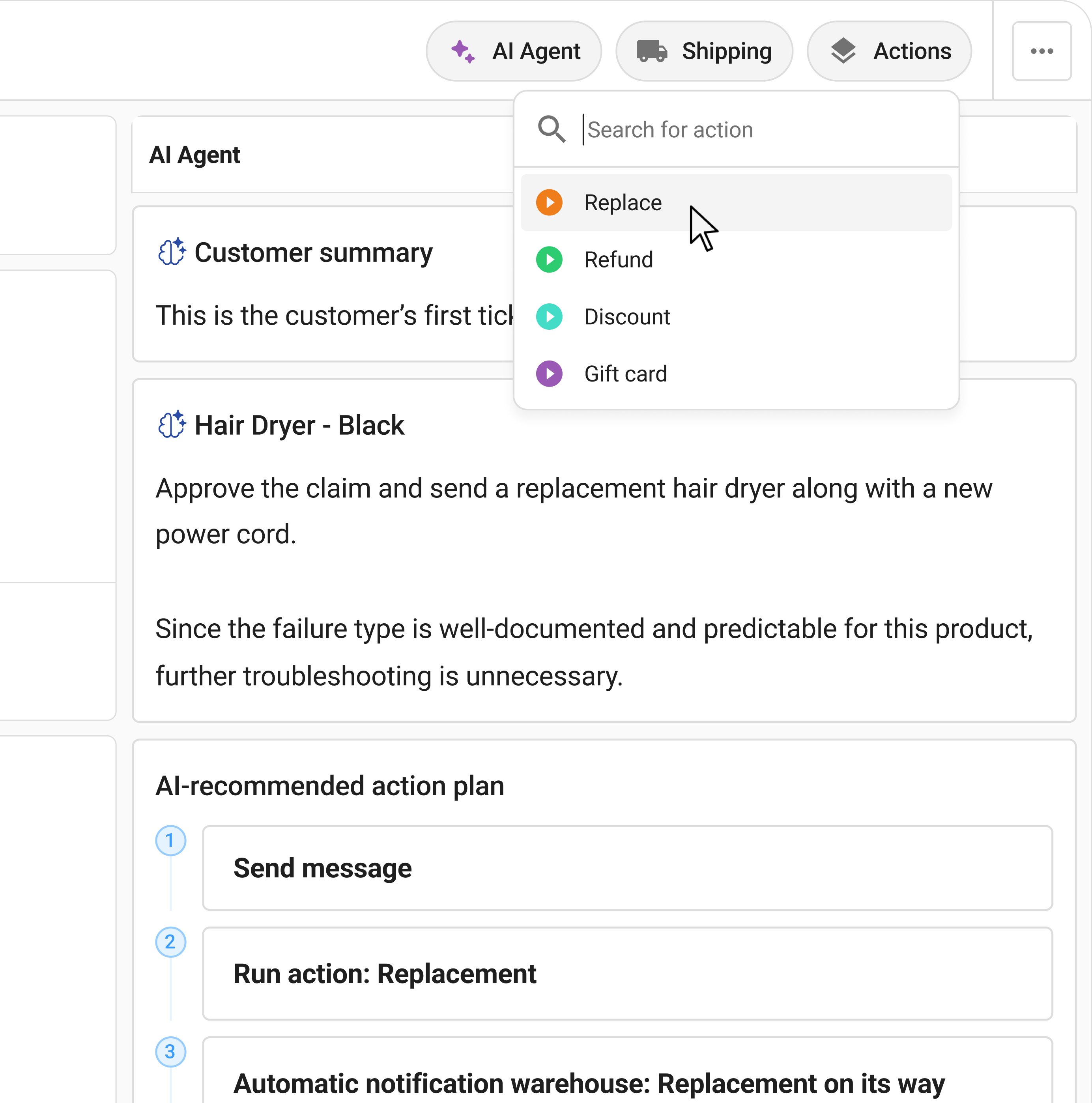
- AI Agent that reviews images, applies warranty rules per product, and recommends or auto-approves resolutions.
- Automated workflows that route, approve, and resolve clear-cut cases without human touch
- Supplier coordination built in for cases that need supplier involvement
- Analytics that surface which products and suppliers are driving disproportionate claim volume
- Integrations with Shopify, ERPs, help desks, and shipping providers
MaxGaming, the largest gaming and esports ecommerce in Scandinavia with 30,000+ SKUs across 200+ brands, uses Claimlane's AI Agent to resolve complex RMA cases 77% faster. Manual review wasn't possible at that catalogue size. The AI Agent reviews images, checks business rules, and recommends actions, so support agents don't need months of product training to handle a claim.
That's the operational pattern: technology absorbs the routine work, humans handle the hard cases.
The takeaway
Warranty claim volume isn't going to slow down. The teams that handle it well aren't necessarily bigger or better staffed. They've just stopped trying to run the process through tools that weren't built for it. A purpose-built platform takes pressure off your team, delivers faster outcomes to customers, and gives you the data to keep improving.
If any of this sounds like your current situation, it's worth a conversation.Warranty claim volume isn't going to slow down. The teams that handle it well aren't bigger or better staffed. They've stopped trying to run the process through tools that weren't built for it.
A purpose-built platform takes pressure off the team, delivers faster outcomes to customers, and gives you the data to keep improving. The math works because the cost of the platform is a fraction of the headcount it replaces.
If the team is already feeling the pressure, the path forward isn't more hiring. It's better operations.
If you want to see what scaling warranty operations looks like for your specific setup, book a Claimlane demo and we'll walk through it.