
A clear policy needs a working process
A customer requests a return. Support approves it, the warehouse receives the product and the customer waits for a refund. Somewhere between those steps, the case stops moving.
Returns and refunds involve both a promise to the customer and operational work behind it. A policy explains what should happen. Teams and systems need to carry out each action and confirm the result.
For retailers handling furniture, electronics and other durable goods, the process can also involve inspections, repairs, spare parts and supplier claims. Clear rules and ownership help the business handle each request according to its actual circumstances.
- A return concerns the product coming back; a refund concerns money being returned to the customer.
- A return and refund policy should explain eligibility, instructions, costs, timing and how product problems are handled.
- Unwanted items, faulty goods and commercial exceptions need distinct assessments, with applicable customer rights considered.
- Claimlane helps teams connect returns and refunds through case workflows and actions across operational systems.
What is the difference between a return and a refund?
A return is the process of sending or handing a product back to the business. A refund is a financial transaction that returns an amount paid by the customer.
The two often happen together, but they are separate events. A product might come back for repair or exchange. A business may also approve a refund without requesting a physical return in a particular case.
This distinction matters in the case record. “Return approved”, “Item received” and “Refund issued” should describe different milestones.
Closing the return record should not imply that a payment succeeded unless the financial result has been confirmed.
What should a return and refund policy include?
A useful policy answers the questions customers need to act on. Internally, each promise should connect to a rule or task the team can carry out.
| Policy area | Customer question | Operational requirement |
|---|---|---|
| Eligibility | Which purchases can be returned? | Identify the item, reason, channel and applicable rules |
| Time limits | When must the request and return happen? | Use clearly defined dates and maintain separate deadlines |
| Condition and contents | What needs to come back? | Give specific instructions for products and accessories |
| Shipping or collection | How is the item returned, and who pays? | Arrange the appropriate transport and explain permitted costs |
| Refund amount | How much will be refunded? | Check the transaction, discounts and previous adjustments |
| Refund timing and method | When and how will the money arrive? | Distinguish initiation, payment status and customer receipt |
| Product problems | What happens if the item is faulty or incorrect? | Route the issue to the appropriate assessment |
| Help and review | Who can help with an exception? | Assign an owner and preserve the case history |
Separate unwanted items from faulty products
The reason for the request determines which questions need answering. An unwanted lamp, a damaged lamp and a lamp that stops working describe different cases.
The return flow should establish that reason before applying conditions. A single rejection based on the standard returns window can send a product complaint down the wrong path.
For example, EU consumer guidance describes remedies for faulty goods separately from an additional commercial warranty. The relevant remedy can involve repair or replacement, with refund rights arising under specified conditions.
Agents need the purchase context and applicable rules. Customers should be able to report the problem without first deciding whether it belongs under returns, warranty or another internal category.
Can a business have a no refund policy?
A no refund policy cannot be assessed without the market, purchase circumstances and reason for the request. Restrictions on voluntary change-of-mind returns are different from statutory remedies.
In the UK, official guidance warns businesses against restricting or misleading customers about their refund rights. Its returns and refunds guidance distinguishes in-person purchases, distance sales and faulty goods.
A blanket “no refunds under any circumstances” statement is therefore unsuitable for a UK consumer policy. For other markets, the proposed wording needs review against local requirements.
The practical approach is to describe the specific restriction and explain the separate route for product problems or other protected requests.
Define dates and conditions precisely
A policy that says “returns within the return window” leaves important questions unanswered. Does the period start at purchase, dispatch or delivery? Must the customer notify the business or must the parcel arrive by then?
Record notification and shipment deadlines separately where relevant. The portal and agent instructions should use the same definitions as the published policy.
Conditions should also reflect the type of request. UK guidance allows customers exercising applicable distance-sale cancellation rights to inspect goods as they could in a shop, so a blanket unopened-packaging condition can misstate those rights.
Operationally, packaging instructions should help the product travel safely. They should not become an automatic rejection rule across every case type.
A return policy example to adapt
The following is an illustrative structure for an additional voluntary returns offer. Bracketed fields require business decisions and market-specific review before publication. Statutory cancellation and faulty-goods rights need their own accurate sections.
Illustrative wording: voluntary returns
“Our additional voluntary returns offer applies to [eligible purchases]. Requests must be submitted within [number] days of [defined starting event]. The return must then be sent within [number] days of [defined event]. Eligible items must meet [clearly stated condition requirements].”
“Start a request through [portal or contact route] using [purchase details]. Return instructions will explain which items and accessories to include, the destination and any applicable return shipping cost.”
“This voluntary offer is additional to applicable legal rights. Faulty, damaged, incorrect or incomplete purchases can be reported through [support route] for assessment under the relevant rules.”
Before using the example, test whether staff can answer each bracketed field consistently. A published condition is difficult to enforce fairly when the team cannot explain it.
A refund policy example to adapt
A refund policy example should explain the amount, method and timing without suggesting that every case follows identical rules. The following wording is an editable outline rather than a complete legal policy.
Illustrative wording: refund processing
“For eligible refunds, the amount is calculated from the original transaction, including relevant discounts, previous refunds and the applicable treatment of delivery charges. Any permitted adjustment will be explained.”
“Refunds are issued through [applicable payment method]. For [defined case type], the processing period is [timeframe] from [trigger], subject to any earlier legal deadline. A confirmation is sent when the refund has been issued.”
“The payment provider may need additional time to display the funds. If the refund has not appeared within [verified provider timeframe], contact [support route] with the case reference.”
The business should confirm the actual payment process before publishing these statements. An internal approval is not the same as a refund being issued.
Calculate refunds from the original purchase
The refund calculation should begin with what the customer paid. A current catalogue price may differ from the original transaction because of a discount, promotion or price change.
For partial returns, identify the specific items and quantities involved. Check previous refunds and how any bundle discount was recorded before calculating the remaining amount.
Delivery charges, taxes and permitted adjustments need explicit treatment. Agents should not improvise a deduction simply because the standard workflow cannot handle the case.
A clear breakdown also helps customers understand the result. The amount in the message should match the amount submitted to the payment system.
Make bulky and complex returns practical
A standard parcel label may suit a small accessory. A sofa or large appliance can require collection, packing guidance and access information.
Return instructions should name the product and any accessories expected. If only one component is authorised for return, the warehouse needs that same scope.
Consider an illustrative damaged-desk case. The team may need photos to assess whether a replacement panel is appropriate or whether the whole desk must come back. The customer should receive instructions after that assessment.
Repairs and spare parts can be suitable outcomes for some product problems, subject to applicable rights and the agreed remedy. They should not be imposed simply to avoid a refund that is due.
Inspect against the authorised return
The receiving team should know what was approved before checking the parcel. An authorised partial return is not incomplete just because the original order contained other items.
Record received quantities, condition and relevant product identifiers. Document discrepancies with evidence and assign any follow-up to a named person.
Inspection findings should feed the appropriate decision, rather than automatically triggering a deduction. A mismatch may need clarification from the customer or a check of the original return instructions.
Keep the stock outcome separate from the refund outcome. An item may require repair or disposal even when the customer receives a refund.
Confirm refunds across connected systems
Support, the warehouse and finance may each see a different part of the case. Shared references help them connect the approved return with receipt, inspection and payment.
Define which system owns the refund action. Other systems should record the result without independently creating another refund.
If an action times out, check its result before retrying. An uncertain response does not establish that the payment failed.
Customer messages should follow confirmed events. “Refund approved” can explain an internal decision; “Refund issued” should reflect the actual financial action.
Make the policy easy to find and apply
The return and refund policy should be accessible before purchase and easy to find afterwards. Product pages, checkout information, order messages and the returns portal should use consistent terms.
When a policy changes, retain the version relevant to earlier purchases. Agents should be able to identify the applicable terms without relying on the current website alone.
Prepare internal guidance for exceptions, missing order details and unusual products. A customer-facing paragraph cannot explain every operational decision.
Test the wording with actual scenarios. If different team members interpret the same sentence differently, revise it before turning it into an automated rule.
Measure the work behind returns and refunds
Return volume identifies how much work arrives. It does not show whether customers receive timely outcomes or whether cases require repeated manual attention.
Suggested measures include time from request to decision, time from refund approval to issuance, cases awaiting inspection and refunds needing manual recovery.
Track reasons and outcomes together. A rise in damaged-product claims calls for a different investigation from a rise in unwanted purchases.
Compare similar case types and define the start and end event for each metric. These are proposed operational measures, not industry benchmarks or claims about built-in reports.
Connect the process with Claimlane
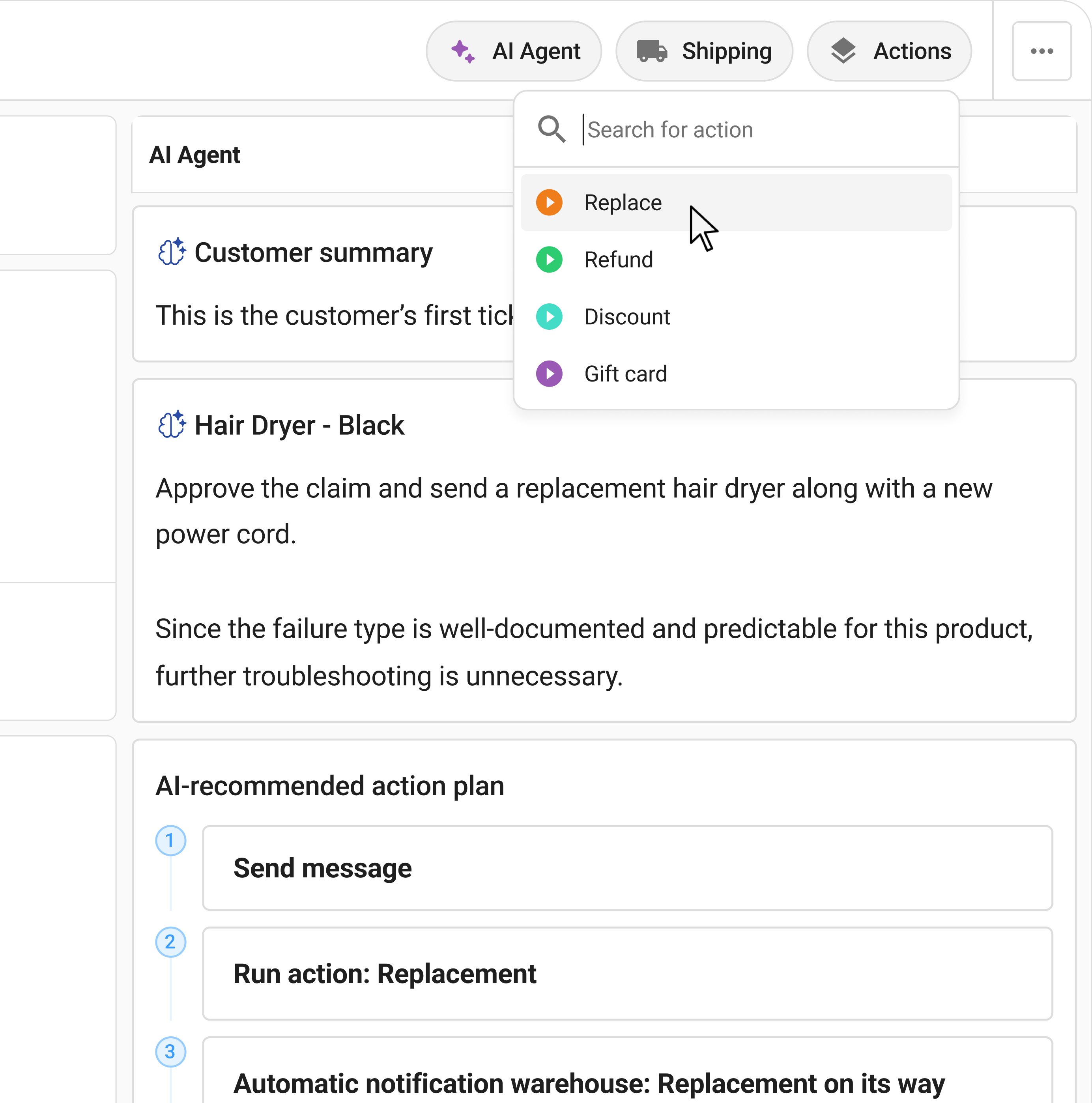
Claimlane's returns and claims workflows support case ownership, routing and custom statuses. Teams can organise requests and see which action is needed next.
Published capabilities include refunds, replacement orders and connected actions across ecommerce, ERP, shipping, warehouse and helpdesk systems. The available actions should be checked for the retailer's specific setup.
Issuing refunds and replacements without switching between systems has been a huge time saver for our team.
Patrick Zangenberg, Head of Customer ServiceA useful demonstration should follow a standard return and a product-fault case. That shows how the platform supports the published policy and the exceptions that need review.
Frequently asked questions about returns and refunds
Keep the promise connected to the outcome
Clear returns and refunds start with understandable terms. They finish when the agreed action is completed and the customer knows the result.
Connecting requests, inspections, decisions and payments gives each team the context needed to finish its part of the work.
Book a Claimlane demo to explore how returns, refunds and complex product claims can work across the retailer's teams and systems.