
A useful policy answers what happens next
A customer wants to return a product. They check the policy for a deadline, but still cannot find where to send the item, who pays for transport or when the refund will be issued.
Return policy examples are most useful when they explain the whole process. A short statement of eligibility leaves the customer and support team to work out the details later.
The examples below provide editable wording for products, stores, online orders and services. Replace every bracketed field, adapt the conditions to the markets you serve and review the relevant rights before publication.
- Useful return policy examples explain eligibility, instructions, costs and outcomes.
- Separate voluntary change-of-mind offers from applicable customer rights.
- Adapt product, service, cancellation and Shopify templates to the actual business.
- Claimlane helps teams organise the work required to carry out the policy.
How to write a return policy
Start with the purchases the policy covers: product categories, sales channels, customer types and markets. A store policy example for voluntary in-person returns may not be suitable for online cancellation or B2B terms.
Separate the business’s voluntary offer from rights customers have independently of that offer. A 30-day change-of-mind window should not become a blanket deadline for reporting every fault.
Then explain how to start a request, what evidence is useful, where the item goes and how costs and outcomes are handled. Describe the process the team can actually carry out.
The checklist below applies to both a product return policy template and a refunds policy template. The completed wording needs to explain these points in the context of the business.
Check customer rights before choosing restrictions
The UK government’s returns and refunds guidance distinguishes in-person change-of-mind requests from distance sales and faulty-goods remedies. It also explains that sale purchases retain relevant rights.
That is one market-specific starting point. The conditions for other markets, products and service contracts need their own assessment.
A line saying “statutory rights are unaffected” cannot fix conflicting restrictions elsewhere in the policy. The operative clauses must respect those rights too.
The samples here are drafting aids, not complete legal documents. Keep mandatory disclosures and market-specific terms in the final published policy rather than relying on a general exception statement.
| Contract detail | Question to answer |
|---|---|
| Scope | Which products, channels and markets does it cover? |
| Eligibility | What is the voluntary offer and what rights apply separately? |
| Request | How does the customer contact the business? |
| Transport | Where does the item go and who pays under each route? |
| Outcome | Is the agreed remedy a refund, exchange, repair or credit? |
| Payment | When is the refund issued and how is it confirmed? |
1. General return and refund policy sample
Use this baseline for a product business offering voluntary change-of-mind returns. Define the actual window, condition requirements and transport terms before publishing.
Example wording: At [Business name], we offer voluntary change-of-mind returns for [eligible products] requested within [number] days of [delivery or in-store purchase]. This offer is additional to applicable consumer rights.
To request a return, contact [email or portal] with your purchase reference and the items you want to return. If you cannot locate the reference, contact us so we can discuss alternative purchase evidence. For this voluntary offer, items must meet [specific condition requirements].
We will provide the return destination and available return methods. For eligible voluntary returns, [state who pays and any disclosed label or collection cost]. Once [defined assessment event] is complete, we will issue an approved refund through [payment route] within [seller processing period]. We will notify you when it has been submitted; payment-provider processing may take additional time.
Faulty, damaged or incorrectly supplied items are handled separately under the applicable rights and terms. Contact [route] so we can assess the appropriate remedy. For refunds due under mandatory rules, those rules govern timing, costs and payment arrangements.
2. 30-day return policy template
This is a concrete voluntary offer to adapt, rather than a universal 30-day legal deadline. Add product exclusions and the financial details appropriate to the business.
Example wording: We offer a voluntary 30-day change-of-mind return window. Please notify us within 30 days of receiving your product, or within 30 days of purchase for items bought in store. After notification, return the item within [return shipment period].
For this voluntary offer, items must be unused and include the supplied accessories. Use the original packaging where possible; if it is unavailable, contact us for suitable packing instructions. Contact [route] to arrange the return. Our transport charges and refund arrangements are [insert details].
These voluntary conditions do not apply automatically to statutory cancellation or faulty-goods requests. Those requests are handled according to the applicable rights.
3. Return policy template for small business stores
Small business return policy examples can be concise while still naming the outcome. Make clear whether the voluntary offer provides a refund, exchange or store credit.
Example wording: For eligible change-of-mind purchases made in our store, we offer [refunds, exchanges or store credit] within [number] days of purchase. Please bring the item and proof of purchase to [store location]. If proof is missing, ask our team about alternative evidence.
Our voluntary condition requirements are [requirements], and the products excluded from this additional offer are [specific categories]. These conditions do not restrict rights for faulty, misdescribed or otherwise non-conforming goods.
Purchases made online follow the online-order section of our policy. If an exchange item is unavailable, the available options under this voluntary offer are [options].
4. Ecommerce return policy template
An online store needs usable instructions as well as eligibility wording. Review cancellation rights and required disclosures for every market served before completing this example.
Example wording: For an online order, submit your request through [portal or email]. Tell us which items are involved and whether the request concerns cancellation, a fault or our additional change-of-mind offer. A reason is not required where the applicable cancellation right does not require one.
We will explain the return method and destination. For voluntary returns, the shipping arrangements are [details]. For statutory cancellation and faulty-goods requests, costs, permitted deductions and refund deadlines follow the applicable rules described in [market-specific policy section].
Please use the packing instructions for the product. For bulky goods, contact [route] to discuss collection arrangements and the relevant disclosed costs. We will confirm when the refund is submitted and explain any payment-provider processing estimate.
Online store policies examples should also say how partial returns, gifts and bundles are handled. Do not leave those decisions to an agent’s interpretation of a general refund sentence.
5. Refund and cancellation policy template for services
A refund policy sample for services needs to address bookings and work performed, rather than product packaging. Early service commencement, deposits and cancellation charges require terms suitable for the actual contract.
Example wording: To cancel or reschedule [service], contact [route] with your booking reference. Our voluntary rescheduling offer is [conditions]. Any cancellation charge is [amount or calculation], applies in [circumstances] and will be disclosed before booking.
If you ask us to begin work during an applicable statutory cancellation period, we will explain the required consent and any lawful consequences before starting. Refund treatment for work already performed will follow the applicable rights and the agreed service terms.
If we cancel the service, we will explain [refund or rescheduling options]. If you believe the service was not supplied as agreed, contact [route] so we can assess the appropriate remedy.
Complete the actual legal cancellation notice and consent process where required. The wording above does not itself establish a right to retain a deposit or charge for unfinished work.
6. All sales final policy template
An all-sales-final statement needs narrow, accurate scope. It should identify the voluntary offer being excluded rather than imply that every remedy has disappeared.
Example wording: We do not offer voluntary change-of-mind returns or exchanges on [clearly identified products] purchased [specified channel]. This restriction applies only where permitted and does not limit applicable cancellation or faulty-goods rights.
If an item is faulty, misdescribed or incorrectly supplied, contact [route] with purchase details and a description of the issue. We will assess the appropriate remedy under the applicable rules.
Check that the restriction is valid for the product, market and sales channel. A clearance label or discounted price does not, by itself, remove consumer rights.
7. Shipping and return policy template
This section can supplement the eligibility and refund clauses. Keep delivery information and return arrangements distinct.
Example wording: Our delivery options, charges and estimated times are [details]. If your delivery is missing or damaged, contact [route] so we can investigate and explain the next step.
For an authorised return, use [available method] and the instructions we provide. The return destination is [address or process for obtaining it]. Return transport costs for our voluntary offer are [details]; statutory requests follow the relevant rules.
For collections, we will confirm [booking arrangements and preparation requirements]. Contact us if the agreed collection does not take place. Please retain the return reference and any handover confirmation.
How to adapt a Shopify refund policy template
Shopify’s current help documentation describes managing return and refund policies under Settings > Policies. Supported automated policies can use store settings, but the merchant remains responsible for the published content.
A return policy template for Shopify therefore needs the same review as a manually written policy. Check product exclusions, market-specific rights, contact details and the actual return instructions.
If a returns app is involved, compare its rules and customer messages with the policy. A published free-return promise should not conflict with a fee shown during the request.
Preserve custom wording before activating policy automation, and review each relevant language. Treat generated text as a starting point rather than proof of compliance.
How to write a refund policy that the team can follow
Define what triggers the financial action and who owns it. Separate a request awaiting assessment from an approved refund and a payment actually submitted.
Test the draft against real scenarios: a partial return, a damaged delivery, an unavailable exchange and a failed refund action. Each should leave the customer and team with a clear next step.
Keep the policy, internal guidance and system rules aligned. Assign an owner to review changes when products, markets or operational arrangements change.
You can use the examples here as a free return policy template starting point. Their value comes from adapting the wording and completing the process details, not from copying every clause unchanged.
Turn the policy into a connected workflow
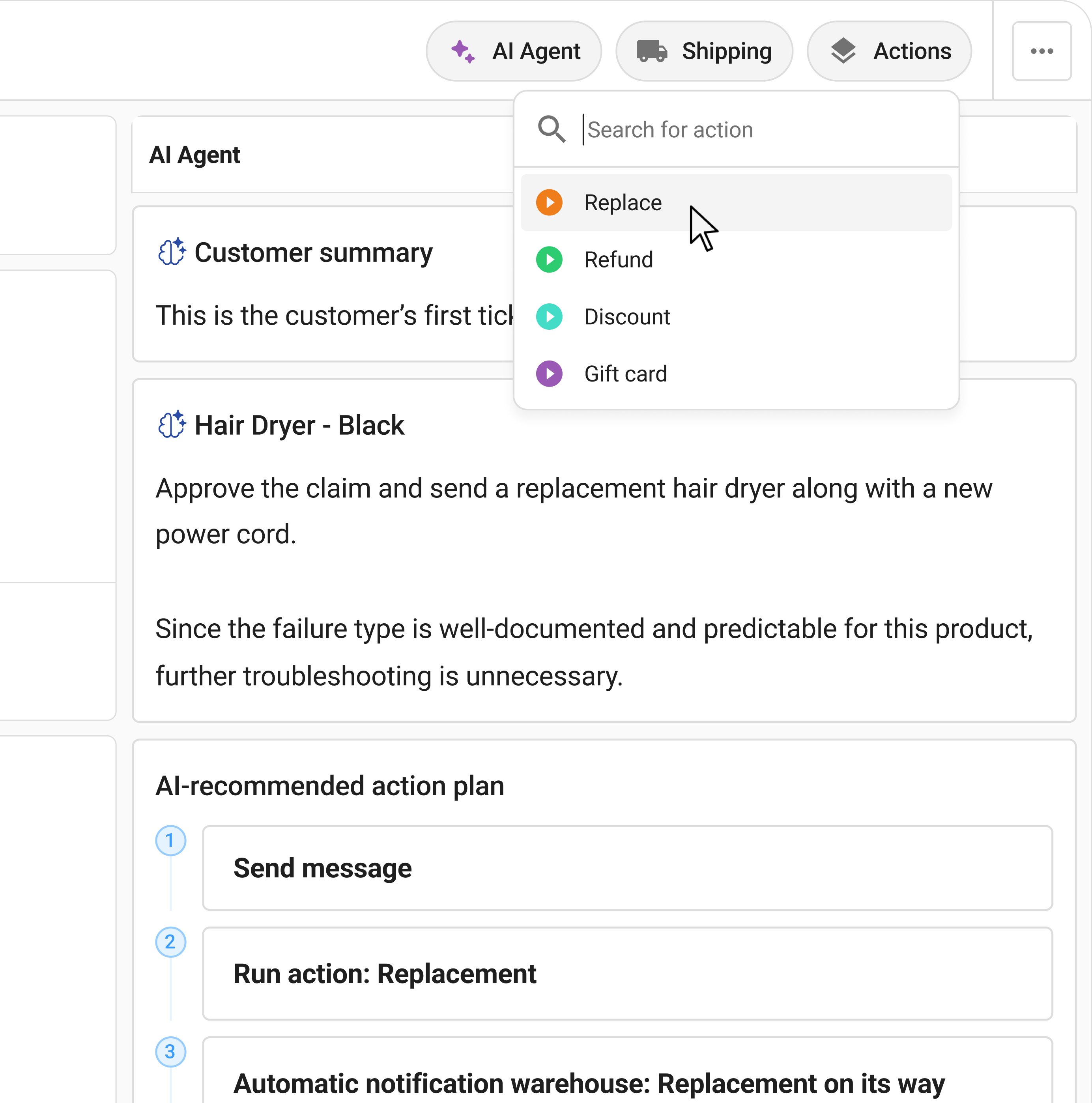
Claimlane’s case workflows support ownership, routing, custom statuses and customer updates. Published capabilities include refunds, replacement orders and connected business-system actions.
Issuing refunds and replacements without switching between systems has been a huge time saver for our team.
Patrick Zangenberg, Head of Customer Service
A useful demonstration starts with the business’s actual policy and follows a routine return plus an exception. Confirm how evidence is reviewed, how the next action is assigned and which outcomes can be executed in the selected setup.
Frequently asked questions
Publish the policy customers can actually use
A good return policy sample makes the rules and next steps understandable. The final version needs accurate eligibility, transport and financial details for the business’s products and markets.
Remove every placeholder, review the relevant rights and make sure the team’s workflow delivers what the policy promises.
Book a Claimlane demo to explore workflows that connect return requests, assessment and confirmed customer outcomes.