
A short restriction still needs a clear scope
A store puts “no refunds” beside its checkout. A customer later reports a faulty product, and the support team uses the same message to reject the request.
The problem is the scope. Declining an optional change-of-mind return is different from refusing a remedy the customer is entitled to receive.
This guide provides an example of a no refund policy and editable alternatives for stores and selected product categories. The wording needs to match the actual market, sales channel and offer before publication.
- A no-refund statement should identify the voluntary offer it restricts.
- Store, online, service and digital-content requests need appropriate treatment.
- The examples below preserve a route for applicable cancellation and faulty-goods remedies.
- Claimlane helps teams organise assessment and actions around the business’s rules.
What does a no refund policy mean?
A no refund policy describes circumstances in which a business does not offer money back. It should identify those circumstances clearly rather than claim that no purchase can ever produce a refund.
A no return policy concerns accepting products back. The two terms are related, but a business might allow an exchange while declining a voluntary cash refund.
A useful policy states whether it limits change-of-mind refunds, exchanges, store credit or all voluntary returns. It also gives customers a separate route for faults, incorrect items and applicable cancellation requests.
For many retailers, a precise statement about the voluntary offer is more informative than the headline “all sales final”.
Can a business refuse every refund?
That cannot be assumed from a store policy. The answer depends on the applicable rules and circumstances of the purchase.
The UK government’s returns and refunds guidance distinguishes in-person change-of-mind requests from distance sales and faulty-goods remedies. It also warns against misleading customers about their rights.
Other markets have their own requirements. The rules for an online order, a store purchase and a service contract should not be treated as interchangeable.
The samples below are drafting aids for a defined voluntary offer. They are not complete legal documents, and a general rights statement cannot repair contradictory restrictions elsewhere in a policy.
Choose what the policy actually restricts
Decide whether the business will accept voluntary exchanges, issue store credit or decline optional change-of-mind returns altogether.
Then define the eligible products and sales channel. A store-counter restriction should not silently carry over to an online order with a separate cancellation route.
The table below shows wording choices to consider. Each needs review against the actual offer and relevant requirements.
| Contract detail | Question to answer |
|---|---|
| No voluntary refund | Explain whether exchange or credit is available |
| No voluntary return | Identify the purchases excluded from an additional offer |
| Category restriction | Specify the products and assess any statutory exception |
| Final-sale label | Match the label with the precise voluntary restriction |
1. Example of a no refund policy for in-store purchases
This version describes a business that does not offer optional change-of-mind refunds or exchanges for specified purchases made in person. Replace the fields and confirm the scope before use.
Example wording: For [specified products] purchased in person at [Business name], we do not offer voluntary change-of-mind refunds or exchanges. Please check the product details before purchasing.
If an item is faulty, misdescribed or incorrectly supplied, contact [email or service desk] with purchase details and a description of the issue. We will assess the request and provide the remedy required by the applicable rules.
This restriction concerns our voluntary change-of-mind offer only. Purchases made through [online or other channel] follow the relevant section of our policy.
Complete the actual complaint and remedy process in the full policy. Do not use this short sample as a universal refusal message.
2. No refund policy template with exchanges
Use this version where the business offers a voluntary exchange rather than money back. Explain what happens if the requested replacement is unavailable.
Example wording: For eligible change-of-mind purchases of [products] made [channel], we offer exchanges within [number] days of [purchase or receipt]. We do not offer cash refunds under this voluntary exchange scheme.
To request an exchange, contact [route]. The voluntary scheme requires [specific item conditions] and purchase evidence. If the requested product is unavailable, the options are [state options]. Any price difference is handled as follows: [details].
This voluntary scheme does not replace a refund or other remedy due under applicable consumer or cancellation rights. Contact [route] for those requests.
Do not describe store credit as a cash refund or make it the only remedy where the customer has a right to receive money back.
3. Sample no return policy for selected products
A category-specific example can be clearer than a blanket restriction across the store. Check whether the category is actually exempt from the relevant cancellation or return right.
Example wording: We do not offer additional voluntary change-of-mind returns for [clearly specified product category]. This restriction is disclosed with the product information before purchase.
Where a statutory cancellation right applies, it is handled under [applicable cancellation section]. If an item is faulty, misdescribed or incorrectly supplied, contact [route] so we can assess the appropriate remedy.
Any product-specific restrictions and their legal basis are explained in [section]. We will provide the applicable preparation or collection instructions if a return is required.
Naming a product “special order” is not enough to establish an exception. Confirm the actual product characteristics and rules before deciding which rights apply.
4. Template no return no refund policy sample for final-sale items
This example keeps “final sale” tied to a voluntary offer. It does not treat a discount as removing other rights.
Example wording: Items marked [Final sale label] are excluded from our additional change-of-mind return and refund offer for [specified channel], where permitted. The restriction is displayed before purchase.
The label does not restrict applicable cancellation rights or remedies for faulty, misdescribed or incorrectly supplied goods. Please contact [route] with purchase details if the request concerns one of those issues.
If an item has a known condition issue disclosed at purchase, the description is [where shown]. Any later request will be assessed against that description and the applicable rules.
Check the final-sale label, checkout message and complete policy together. They should describe the same restriction.
Why online orders need separate wording
A no return policy template for a physical store should not be copied directly into an online checkout. Distance-contract rules may provide cancellation rights independently of the business’s voluntary offer.
For example, Business Companion’s guidance for England, Scotland and Wales explains cancellation rights and product exceptions under the relevant consumer-contract rules. Whether an exception applies requires more than a seller choosing a final-sale label.
An online policy should state the applicable cancellation process, required notices and relevant exceptions clearly. Keep those sections distinct from any additional change-of-mind offer.
Check how the policy appears before purchase and in the information supplied afterwards. Customers need usable instructions, not only a heading saying refunds are unavailable.
Services, deposits and digital products need their own terms
A sample no refund policy for retail goods does not determine how service cancellations or digital purchases should be handled.
For services, define what has been booked, when work starts and what happens if either party cancels. Any cancellation charge or retained deposit needs a valid basis in the relevant contract and rules.
For digital content, check the applicable information and consent requirements before making claims about losing a cancellation right. A download button or a no-refund sentence should not be assumed to complete that process.
Write dedicated terms for these offers and review them for the market served. Avoid extending a product-return restriction to every payment the business receives.
How to write a no refund policy customers understand
Name the purchase and request covered. “No voluntary change-of-mind refunds for these in-store purchases” gives the customer more useful information than “no refunds under any circumstances”.
State any alternative offer accurately: exchange, store credit or neither. Explain conditions and timing for that offer, and provide the route for other requests.
Place the information where the customer can find it before purchasing. Product descriptions, store signage, checkout wording and the complete policy should agree.
Remove every placeholder and test the final text against a fault, an incorrect item and an online cancellation. The team should be able to identify the appropriate route without improvising.
Give the team a review route, not a blanket refusal
At intake, establish the purchase, issue and relevant channel. A customer selecting “return” may be reporting a fault rather than changing their mind.
Ask for information relevant to that assessment. Keep missing records or alternative purchase evidence on a review path rather than automatically treating them as grounds for refusal.
Record the decision, reason and any exception approved. If a refund is due, track the financial action through confirmation instead of closing the request at approval.
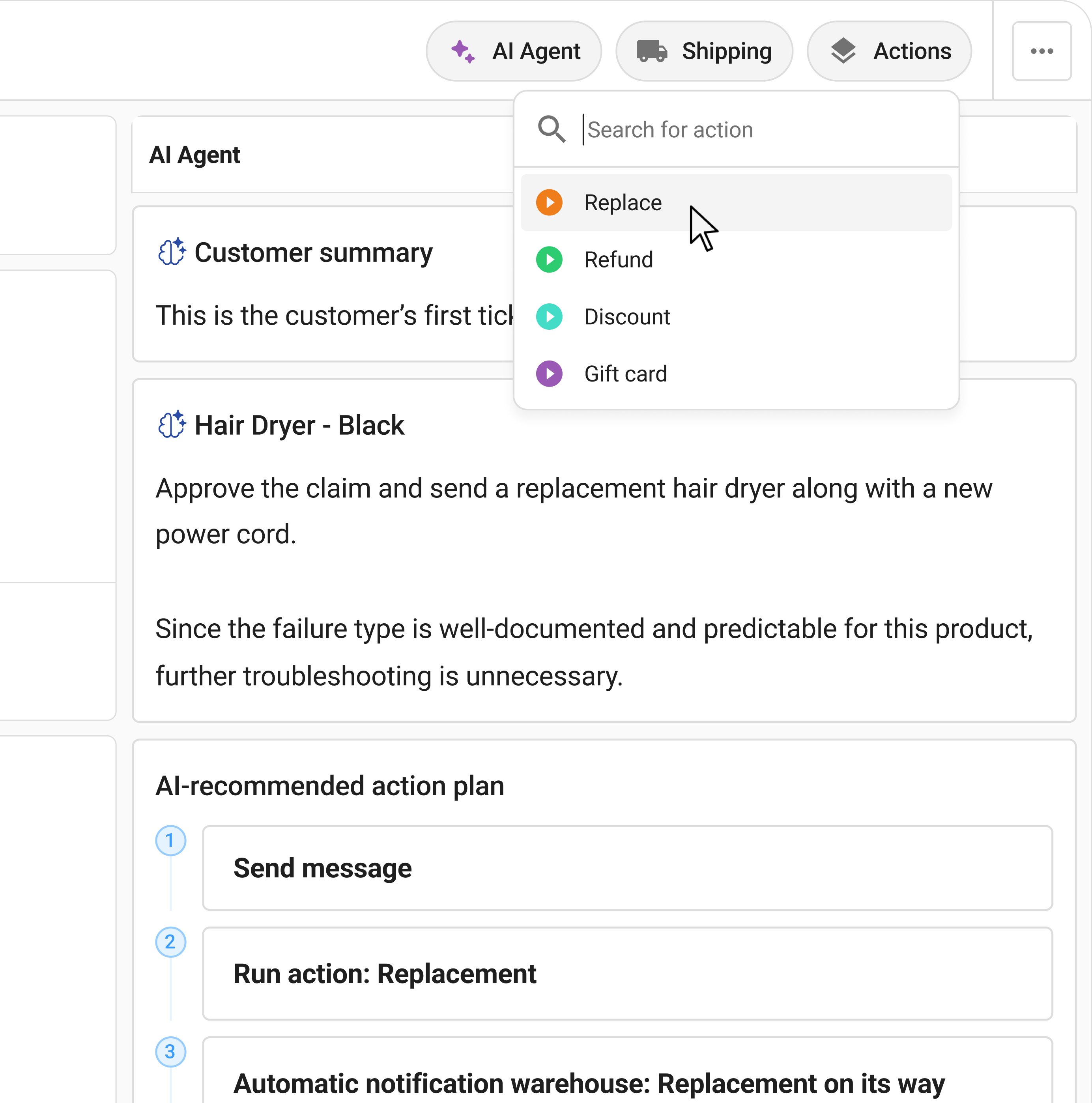
Claimlane’s case workflows support ownership, routing, custom statuses and customer updates. Published capabilities include refunds, replacement orders and connected system actions, with availability checked for the selected setup.
Issuing refunds and replacements without switching between systems has been a huge time saver for our team.
Patrick Zangenberg, Head of Customer Service
A useful demonstration starts with the business’s policy and tests both a voluntary return and a fault report. The route should follow the circumstances rather than one label applied to every case.
Frequently asked questions
Use precise wording and keep the remedy route open
A no refund policy template is useful when it describes a valid, limited offer. It becomes misleading when customers or staff read it as a universal ban on remedies.
Choose the wording that matches the business, review the relevant requirements and connect it to a process the team can follow.
Book a Claimlane demo to explore how return and warranty workflows can keep assessment, ownership and confirmed outcomes connected.