Warranty claims handling is one of those processes that can look simple from the outside. In reality, a single warranty claim can involve customer service, logistics, suppliers, product data, photos, serial numbers, warranty rules, approvals and several systems. That complexity is also why simply adding more automation does not necessarily make the process better.
Michael Kruse Sørensen, co-founder of Claimlane, spoke about this at Dansk Erhverv's network group for customer service leaders. The session was built around three ideas:
- A warranty claim is not a return.
- You cannot automate a decision you do not have the data to make.
- AI and automation should replace the paperwork, not the customer relationship.
What follows is what those three ideas look like in daily operations.
1. A warranty claim is not a return
Returns and warranty claims are often grouped together. From a systems perspective, that makes sense. Both happen after a purchase. Both may involve sending a product back. Both may involve customer service.
Operationally, however, they can be very different.
A normal return typically follow a predictable workflow. The customer finds their order, selects the product, chooses a reason, generates a label and sends the item back. In most cases, that happens without an customer service getting involved.
A warranty claim is different. The customer may be reporting a broken component, a manufacturing defect or an issue that only appears after months of use.
Before you can decide what to do, you may need to know:
- What exactly is wrong?
- Which part of the product is affected?
- When was it purchased?
- What is the serial number?
- What documentation is required?
- Does the supplier need to approve the warranty claim?
- Is a spare part available?
- Should the product be repaired, replaced or refunded?
To put the difference between returns and claims in perspective, a prospect recently put it this way; roughly 85% of normal returns could run through a self-service process. A warranty claim, on the other hand, could require four or five manual steps and take place over several days.
Supplier communication makes warranty claims even more complex
The supplier side of warranty claims is easy to underestimate. If you sell products from many suppliers, you effectively have many different warranty claims processes.
One supplier wants three photos. Another wants the serial number and the purchase date. A third wants the product back before approving anything. A fourth lets the retailer decide alone under a certain value.
When those rules are known by experienced agents, or can be found in PDFs and old email threads, every claim ends up slightly different. Customer service then spends time gathering information, forwarding it, waiting for a reply and following up again.
The result is exactly what we often see in warranty claims handling: photos, order data and defect descriptions spread across back-and-forth communication, with very little overview of which suppliers are taking the most time. Retailers we spoke to at the Outdoor Trade Show described it the same way: too many emails, too many spreadsheets, too many delays. The goal should therefore not simply be to “automate returns and warranty claims.”
First, understand that they are different workflows, then assign each one accordingly.
2. You cannot automate a decision you do not have the data to make
Automation gets treated as a software project. It starts as a data project.
The customer's description refers to a specific detail. Product data says something different and it might require supplier approval rather than a standard repair.
Neither piece of information is sufficient on its own, but together they allow you to take the correct decision.
Fix intake before anything else
Before asking how much of the process can run automatically, look at what actually arrives when a claim is created.
- Is the order number always there?
- Do the photos show the defect, or the box?
- Can the customer be asked for a serial number when it is relevant?
- Is it clear which product or which component is affected?
- Is there enough to decide what happens next?
Every missing field turns into another question. Every question turns into another day.

Your own master data matters just as much
Your own master data matters just as much. You also need good information about your own products and processes.
That could include:
- Product categories
- SKUs and variants
- Supplier information
- Warranty periods
- Dimensions and weight
- Spare parts
- Repair options
- Supplier-specific requirements
- Previous case history
Without that foundation, rules can still be written. They will just run on incomplete information. Automating an incomplete decision does not make it a better decision. It makes a worse one arrive faster.
Not every warranty claim should be automated in the same way
Another mistake is treating all warranty claims according to value alone.
For example:
“Everything below €50 is automated.”
That can be useful, but monetary value is only one dimension. The type of inquiry matters just as much.
A better question would be "which types of cases are predictable enough to automate?".
3. AI should replace the paperwork, not the customer relationship
AI naturally comes up in almost every conversation about customer service right now. There are good reasons for that.
Warranty claims handling contains a lot of work that AI is well suited to helping with.
- It can summarize a long case history.
- It can compare a warranty claim with product information and business rules.
- It can suggest a response.
- It can identify patterns that look unusual.
And it can help make sure two employees looking at similar warranty claims reach similar conclusions. Those are meaningful improvements.
The presentation highlighted four areas in particular where AI can help: consistency, faster processing, fraud detection and scaling without having to increase headcount at the same rate as warranty claim volume. But there is a big difference between using AI to help someone make a decision and giving AI complete control over the customer relationship.
We believe the first is the better place to start.
Think co-pilot before autopilot
For many warranty claims teams, a useful division of work looks something like this.
AI can:
- Summarize the case history
- Suggest a response to the customer
- Flag suspicious patterns
- Bring relevant information together
The employee can:
- Decide in uncertain cases
- Validate higher-value warranty claims
- Handle unusual situations
- Make the final decision
That is the basic principle behind treating AI as a co-pilot rather than an autopilot. The balance can change over time.
A low-value warranty claim with complete documentation might eventually be approved automatically. A medium-value case with partial documentation might get an AI recommendation that an employee approves or adjusts. A high-value or unusual case may still require a person to make the decision.
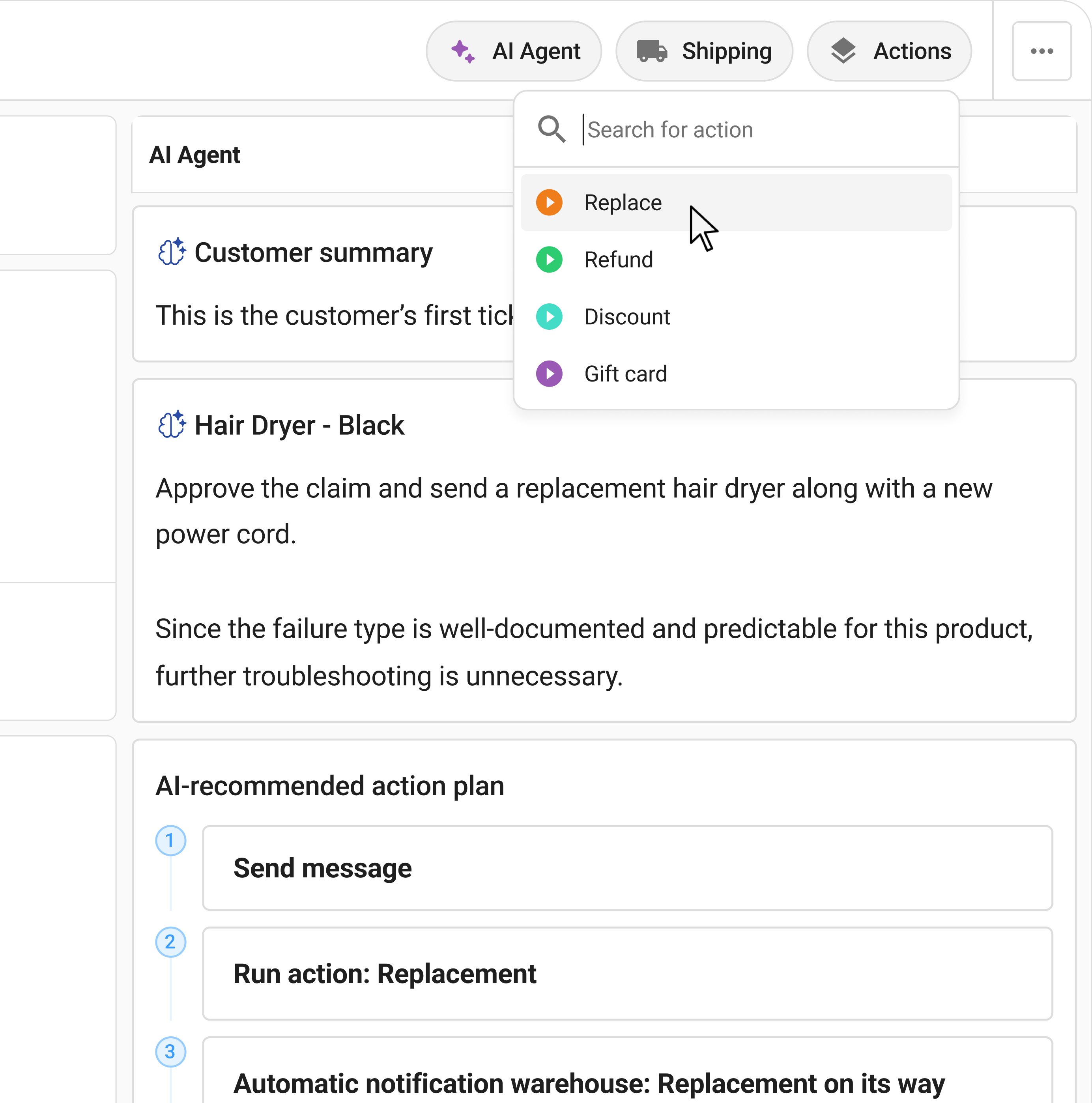
Claimlane's AI Agent, the first AI agent purpose-built for warranty claims and returns, is built around that pain point. It reviews images and video, applies warranty rules per product and per supplier, and recommends or auto-approves a resolution based on those rules.
MaxGaming, the largest gaming and e-sports e-commerce business in Scandinavia, uses it across 30,000+ SKUs from more than 200 brands. Complex RMA cases are resolved 77% faster, because agents no longer need months of product training to know what a specific brand accepts.
Rules first, AI second
AI becomes much more useful when it operates inside the rules of your business. A generic AI model does not know how you want a particular warranty claim handled. It does not automatically know which supplier requirements apply to a certain product.
And it does not inherently know which cases your company wants to escalate. Those are business decisions and need to be defined first.
Once they exist, a recommendation can be explained. This rule, this data, this outcome. That is a very different conversation from "the AI decided this."
Start narrow and build trust
You do not need to go directly from a manual warranty claims process to autonomous AI.
Step 1: Suggest. AI suggests what should happen. The employee reviews and approves the recommendation. At this stage, you can see where the AI performs well and where it struggles.
Step 2: Execute with confirmation. AI prepares the action, a person confirms before anything is sent. This removes more administrative work while still keeping a human checkpoint.
Step 3: Run independently. Once the same types of warranty claims have been handled correctly again and again, some actions can run without manual approval. The employee only becomes involved when something unusual happens.
A short checklist before automating warranty claims
- Returns and warranty claims run as separate workflows
- Intake collects the order number, the right photos, the serial number and the affected component
- Supplier requirements are written down per supplier, not stored in one person's memory
- Product, warranty and spare part data is current
- Case types are separated by predictability, not only by value
- Business rules are defined before AI is switched on
FAQ