Office furniture claims need more than an order number
Office furniture returns and warranty claims can involve an individual chair, a damaged desk or a fault reported across an entire installation. The buyer, person using the furniture and person arranging the repair may all be different.
A facilities manager needs to know which asset is affected and whether it can remain in use. A dealer needs the product details and evidence. The manufacturer needs enough information to assess the claim and identify a compatible part.
Good office furniture warranty management keeps those records connected. It gives every case an owner, a decision and a clear next step without making the customer coordinate the whole process.
- Separate commercial furniture returns from defect claims, delivery damage and paid spare-part requests.
- Check the applicable contract and warranty document rather than applying a consumer policy to every business purchase.
- Connect each affected asset to its location, product label, evidence and approved repair or replacement part.
- Claimlane helps furniture brands and retailers connect customer intake, supplier decisions and case follow-up.
What makes commercial furniture returns different?
A commercial furniture order may contain products for meeting rooms, individual workstations and shared spaces. A return request needs to identify which order lines and quantities are involved rather than treating the whole project as a single item.
The reason also matters. A buyer changing an office layout creates a different assessment from a damaged desktop or a chair mechanism that no longer works as intended.
The team should establish the purchasing entity, contract, product specification and reason for the request before promising collection or credit. A public online return policy may not describe the terms agreed for a commercial project.
Keep contract records with the case
Useful records include the purchase order, accepted specification, delivery documents and any agreed installation or service terms. These help the team distinguish a product supplied incorrectly from a product the customer no longer wants.
For institutional accounts, a framework agreement or project schedule may contain relevant obligations. The case owner should locate the applicable documents rather than assume that every account has identical terms.
Classify the issue before choosing an outcome
A return label shouldn't be the default response to every furniture complaint. A missing fitting may need a component shipment, while a recurring mechanism fault may require technical assessment before further use.
Classification should describe the reported issue without deciding its cause too early. A loose component might result from a product fault, installation or another condition that needs checking.
| Request | Information to check | Possible next step |
|---|---|---|
| Change-of-mind commercial return | Agreed return terms, specification, condition and quantities | Assess eligibility and any agreed collection or restocking charges |
| Delivery damage or shortage | Affected order lines, delivery record, packaging and issue photos | Assess replacement items, missing parts and carrier follow-up |
| Product fault | Product label, purchase details, symptom and applicable warranty | Technical review followed by an appropriate remedy |
| Installation or adjustment issue | Fitting record, approved instructions and technical assessment | Arrange the appropriate adjustment or corrective work |
| Paid replacement part | Product version, compatible part, price and availability | Confirm supply terms and arrange the approved part |
Check the office furniture supplier warranty that applies
An office furniture supplier warranty needs to be checked against the product, purchaser, market and purchase date. A headline warranty period doesn't explain every component, exclusion or service condition.
Steelcase's EMEA warranty page distinguishes commercial warranty documents from consumer warranties. It also separates regional and global product coverage. That is a practical reason to retain the correct document rather than rely on a general warranty claim.
Review components and service costs separately
The assessment should establish whether the affected frame, mechanism, upholstery or electrical component is covered. It should also check labour, transport, on-site service and any conditions attached to replacement parts.
Terms concerning the original purchaser, resale, relocation, usage or maintenance need their own review. An expired commercial guarantee also shouldn't be treated as a complete assessment of any separate contractual or statutory rights.
Avoid importing consumer terms into a business claim
A chair bought personally for a home office and furniture procured under a corporate programme may follow different terms. The team should establish who bought the product and under which agreement before selecting the claim route.
This is a document check, not a reason to assume that a business purchase has no rights. Disputed entitlement needs assessment under the applicable contract and law.
How do institutional furniture suppliers handle warranty and replacement parts?
A workable institutional process connects the purchasing organisation, affected asset, selling dealer and manufacturer. The supplier verifies the relevant purchase and product information, assesses the reported issue and confirms the approved action.
Institutional furniture replacement parts should be identified against the product version and manufacturer guidance. A part that looks similar isn't enough evidence that it fits or performs as intended.
Use the authorised service route where required
Steelcase directs customers seeking warranty information or replacement parts to a local authorised dealer. Its European store guidance also directs dealer purchasers back to the selling dealer for repair or replacement support.
The claim record should therefore identify the selling channel and the organisation responsible for arranging service. Procurement staff shouldn't have to work out that route again each time a new fault is reported.
Close the loop with the site contact
Shipping a part doesn't establish that the asset has been repaired. The process should capture delivery, any required fitting and confirmation that the reported issue has been addressed.
Capture evidence without making the request difficult
The initial request should identify the product, affected quantity, site and reported symptom. Purchase evidence and a clear image of the product label can help the supplier find the correct model or production details.
Photos should show the affected area and enough surrounding detail to locate it. A short video may help explain a sticking drawer or an intermittent movement issue when it can be recorded safely.
The customer shouldn't need to dismantle a chair mechanism or open an electrical assembly just to submit a claim. Where inspection requires specialist work, the case should move to an appropriate service route.
Ask for evidence that changes the decision
A scratched surface and a desk that won't move need different questions. A tailored intake avoids asking every customer for the same generic photo set while still capturing the facts needed for assessment.
Missing information should be visible as an outstanding action, with a clear explanation of what is needed and why.
Connect each claim to the right asset and location
An order number may identify a project without identifying the chair or desk that needs attention. Teams should connect the claim to an asset reference, product identifier and current location where those records exist.
The location record should distinguish the purchasing address from the service address. An organisation may buy centrally and deploy furniture across offices, campuses or branches.
Keep purchase history separate from asset movements
Furniture can move between rooms or sites while its original purchase details remain unchanged. Both records matter: the purchase helps establish the claim, while the current location helps arrange service.
Recording a move doesn't establish that warranty cover transfers or continues. That question still depends on the applicable terms.
Match replacement parts before arranging delivery
Part matching should use the product label, version and manufacturer reference wherever available. Chair arms, castors, drawer runners and desk controls can differ between ranges or generations.
The supplier should confirm compatibility before an alternative part is offered. A case record should preserve that confirmation so another agent can understand why the part was selected.
Check visible finishes and discontinued ranges
A replacement panel or upholstered component may need a finish check as well as a mechanical fit check. The customer should receive clear information about any proposed visible difference before accepting it.
If the original component is unavailable, the team should document the supplier's approved alternative and the agreed outcome. Substitution should follow an assessment rather than a guess based on an image.
Choose repair, component replacement or collection
The appropriate outcome depends on the fault assessment, applicable obligations, approved parts and access requirements. A repair may keep usable furniture on site, but it needs to address the reported issue properly.
Collection may be necessary where assessment or repair can't be completed at the location. The instructions should identify the authorised items and explain any packaging or preparation the parties have agreed.
Route potential safety concerns for prompt review
Reports of instability, unexpected movement or damaged electrical components need an appropriate escalation path. The team should follow manufacturer guidance and the site's safety procedures rather than issue improvised repair instructions.
A proposed part shipment shouldn't close a case that still needs a technical decision.
Handle repeated faults across an installation
When similar symptoms appear across several assets, the supplier needs a view of the individual items and the wider pattern. A shared project reference can connect related cases without losing asset-level evidence.
The record should distinguish affected quantity from total installed quantity. A report involving part of an installation shouldn't automatically be described as a fault across the whole project.
Preserve individual outcomes
Some assets may need inspection while others await parts or completed repairs. Each should retain its own status even when the customer receives a consolidated project update.
Recurring reports should also be shared with the appropriate product or quality team. Similar symptoms are a reason to investigate, not proof of a common root cause.
Coordinate service visits with facilities teams
Commercial furniture warranty support needs to account for the working site. The service plan should confirm the contact, access arrangements, approved work and parts required before a visit is booked.
Facilities staff may need to arrange room access or temporarily move furniture out of use. A tentative parts arrival should be clearly distinguished from a confirmed service appointment.
Agree responsibilities before the visit
The record should show who is supplying parts, arranging the technician and approving any chargeable work. Labour and travel costs shouldn't be left implicit simply because a component has been approved.
Completion notes should describe what was inspected or replaced and any action still required. An attempted visit and a completed repair need different statuses.
Keep dealers, manufacturers and buyers working from the same case
A dealer may receive the complaint while the manufacturer assesses the component and a service partner completes the work. The customer still needs an identified contact who can explain progress.
Supplier submissions should include the product reference, evidence, requested action and relevant purchase details. Decisions, questions and follow-up should remain attached to the case rather than scattered across separate email threads.
Visibility across locations is a useful service principle beyond furniture. Claimlane customer Cameron Darnell describes that visibility:
For the first time, we can see every warranty claim across all our stores and webshops in one place.
Cameron Darnell, Warranty Manager, Angling DirectThe quote describes Angling Direct's experience. It isn't a claim about measured results for an office furniture supplier.
Separate customer outcomes from supplier reimbursement
The customer-facing record should show what has been agreed and what remains outstanding. The supplier-facing record should show which parts, labour, freight or credits have been approved.
Supplier approval and money recovered are different stages. A credit note promised by email shouldn't be recorded as received until it has been reconciled.
Keep partial returns and credits traceable
A project may involve a replacement component, a returned item and an unaffected balance on the same order. The financial record should identify which action belongs to each order line.
The customer's contractual entitlement needs its own assessment. It shouldn't be decided solely by whether the manufacturer has agreed to reimburse the dealer.
What software supports office furniture warranty management?
The relevant software needs to connect the request, product evidence, supplier communication and agreed outcome. Teams should also establish how asset references, site information and project records will be available to the case owner.
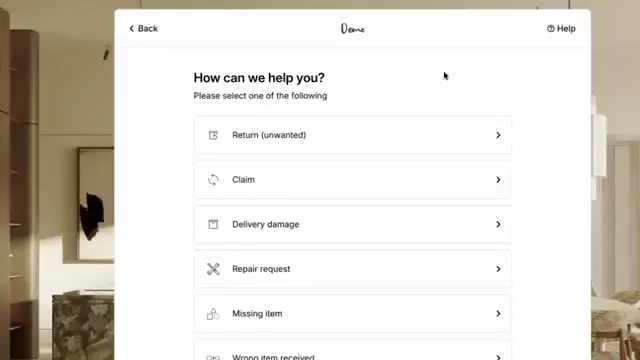
Claimlane supports structured intake, configurable workflows, supplier communication and claims reporting. Its furniture returns and warranty management page explains the platform's approach for furniture brands and retailers.
Test the workflow against an actual service scenario
A useful demonstration follows a chair fault from a site request through product identification, supplier review, an approved part and customer follow-up. Another case can test a partial return from a larger project order.
The assessment should verify how required ERP, asset-register and service-scheduling connections will work. A general integration capability doesn't establish that a particular system or automated handoff is already available.
Keep permissions and ownership clear
Site contacts, dealers, service teams and suppliers need access appropriate to their role. The retailer should confirm who can approve an outcome, view customer details and change a case status.
Measure delays and repeat work
Useful measures include time awaiting evidence, supplier decisions, part availability and service completion. Separating these stages helps a team identify the source of delay rather than treat every long case as the same problem.
Teams can also track incorrect-part shipments, repeat visits, reopened cases and credits received. These are proposed measures, not industry benchmarks.
Results should be compared using consistent definitions and suitable product or account groups. A stocked chair component and a made-to-order desk panel may follow different service paths.
Use claim records to inform procurement
Product references and assessed causes can help procurement and quality teams review recurring issues. The aim is a record that explains what happened and what fixed it, rather than a list of complaints without context.
Claimlane has a 4.8/5 rating on G2.
Frequently asked questions about office furniture claims
Give commercial furniture claims a clear owner
Office furniture aftersales works better when the team can identify the affected asset, check the relevant terms and follow the agreed action through to completion. That applies whether the outcome is a return, a compatible replacement part or a service visit.
Claimlane connects customer requests, product evidence and supplier decisions in a shared process. Furniture brands and retailers can book a demo to discuss their returns and warranty workflows.