Choosing Returns Software Without Shopify
Shopify brands have plenty of returns management apps to choose from. But what happens when an ecommerce brand runs on Magento, WooCommerce, BigCommerce, Shopware, or a custom-built platform?
Many returns tools are designed around Shopify's order data, refund processing, and app integrations. Brands using other ecommerce systems need software that connects with their existing technology and supports the way they handle returns, warranty claims, and customer issues.
The best returns management platform depends on the products being sold, the systems already in place, and what happens after a customer submits a return. Some brands only need return labels and refunds. Others need repairs, replacement parts, supplier approvals, and more advanced workflows.
- Non-Shopify brands should prioritize returns platforms with verified integrations for Magento, WooCommerce, BigCommerce, Shopware, or their custom ecommerce setup.
- AfterShip Returns and ReturnGO are strong candidates for standard ecommerce returns, exchanges, and self-service portals.
- Narvar and ReverseLogix are worth evaluating for enterprise retail operations and more complex reverse logistics requirements.
- Claimlane is particularly relevant for brands managing returns alongside warranty claims, repairs, spare parts, and supplier communication.
1. Why Non-Shopify Brands Need Different Returns Software
Many popular ecommerce returns applications are built primarily for Shopify merchants. They use Shopify's order management, payment, and fulfillment systems to automate returns and exchanges.
Brands operating on other platforms may not have access to the same integrations or functionality.
For example, a Magento retailer might manage inventory through Microsoft Dynamics 365 Business Central, customer service through Zendesk, and shipping through several logistics providers.
A standalone returns app needs to work with these systems rather than require employees to copy information between them.
Common challenges for non-Shopify brands
- Returns software with limited ecommerce integrations.
- Manual order lookups and refund processing.
- Difficulty connecting returns to ERP and warehouse systems.
- Separate tools for warranty claims and ordinary returns.
- Limited support for retail stores and B2B customers.
- Custom integration work for headless ecommerce platforms.
- Returns data scattered across multiple systems.
The starting point is finding a platform that supports the existing technology stack and the actual returns process.
2. What Are the Best Returns Management Platforms for Non-Shopify Brands?
Several returns management platforms support ecommerce businesses beyond Shopify. However, they differ in their approach to returns, warranty handling, integrations, and reverse logistics.
The following five platforms are worth comparing based on their published capabilities as of November 2026.
| Platform | Best suited for | Key capabilities |
|---|---|---|
| Claimlane | Brands managing returns, warranty claims, repairs, and supplier-related issues | Self-service, warranty workflows, repairs, spare parts, B2B claims, ERP integrations |
| AfterShip Returns | Brands needing standard returns, exchanges, and shipping workflows | Return portals, labels, exchange rules, notifications, carrier connections |
| ReturnGO | Ecommerce brands prioritizing configurable returns and exchanges | Return rules, exchanges, store credit, self-service, multiple ecommerce integrations |
| Narvar | Enterprise retailers with broad post-purchase experience requirements | Returns, order tracking, customer notifications, enterprise integrations |
| ReverseLogix | Enterprise operations handling complex reverse logistics and warehouse processing | RMA management, inspection, disposition, repairs, ERP and WMS integrations |
This is a use-case comparison rather than an independent performance ranking. Integration depth, pricing, and available functionality should be confirmed directly with each provider.
3. Claimlane: Best for Complex Returns and Warranty Claims
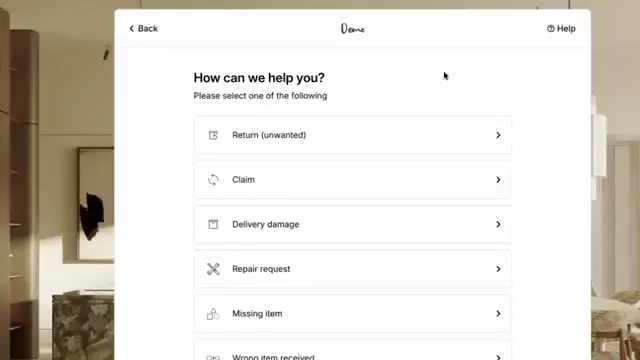
Claimlane is a returns and warranty management platform designed for brands and retailers handling different types of post-purchase issues.
Unlike returns tools focused mainly on sending products back and issuing refunds, Claimlane also supports defective product claims, repairs, spare parts, and supplier collaboration.
This makes it particularly relevant for non-Shopify brands selling electronics, furniture, sporting equipment, baby products, appliances, and other durable goods.
Supported ecommerce environments
Claimlane's published integrations include Magento, WooCommerce, Shopware, BigCommerce, PrestaShop, Commercetools, and Salesforce Commerce Cloud, alongside ERP and custom integration options.
Key capabilities
- Customer self-service portals for returns and warranty claims.
- Product-specific forms with photographs, videos, and serial numbers.
- Automated claim routing, approvals, and notifications.
- Refunds, replacements, repairs, and spare parts workflows.
- Retailer, dealer, and supplier claim management.
- Integrations with ecommerce, ERP, helpdesk, and shipping systems.
- Centralized reporting on returns and product issues.
Best fit: Brands where defective products, warranty claims, repairs, and supplier decisions are an important part of the returns workload.
Consideration: Businesses that only require a basic return label and refund portal may find a simpler returns application more suitable.
4. AfterShip Returns: Best for Standard Ecommerce Returns
AfterShip Returns is a returns management platform focused on customer self-service, returns automation, exchanges, and reverse shipping.
It is a relevant option for non-Shopify ecommerce brands that need customers to request returns, generate shipping labels, and receive updates without contacting support.
AfterShip's official documentation lists support for Magento, WooCommerce, BigCommerce, Shopware, and several other ecommerce environments.
Key capabilities
- Branded returns portals.
- Return authorization rules.
- Return shipping labels and tracking.
- Exchanges and store credit.
- Customer return notifications.
- Returns reporting and reason tracking.
Best fit: Ecommerce brands primarily handling standard returns and exchanges across different storefronts.
Consideration: Brands with detailed warranty assessments, technical repairs, and complex supplier claims should test those workflows separately rather than assuming standard returns functionality will cover them.
5. ReturnGO: Best for Configurable Returns and Exchanges
ReturnGO is another returns management platform worth evaluating for brands using ecommerce systems beyond Shopify.
Its published integration directory includes WooCommerce, BigCommerce, Salesforce Commerce Cloud, SAP Commerce Cloud, and other ecommerce platforms.
ReturnGO focuses on customer-facing return requests, exchange options, and configurable return policies.
Key capabilities
- Self-service returns and exchanges.
- Configurable return eligibility rules.
- Exchange and store credit workflows.
- Return status tracking.
- Return reason analytics.
- Connections to supported ecommerce and logistics tools.
Best fit: Ecommerce brands prioritizing exchanges and flexible return policies across supported storefronts.
Consideration: ReturnGO's integration capabilities and feature availability can vary by platform and plan. Non-Shopify brands should verify the exact functions available for their storefront before purchasing.
6. Narvar: Best for Enterprise Post-Purchase Experiences
Narvar is an enterprise post-purchase platform covering order tracking, customer communication, and returns.
It is particularly relevant for larger retailers that want a connected experience from shipment tracking through returns and exchanges.
Narvar works with enterprise retail technology environments, although integration requirements depend on the specific ecommerce and operational systems involved.
Key capabilities
- Customer-facing returns experiences.
- Order tracking and delivery notifications.
- Returns and exchange workflows.
- Customer communication throughout the post-purchase journey.
- Enterprise ecommerce and operational integrations.
Best fit: Larger omnichannel retailers looking for returns as part of a broader post-purchase experience platform.
Consideration: Brands focused specifically on technical warranty claims, supplier reimbursements, and spare parts should confirm whether their requirements are supported directly or require additional systems.
7. ReverseLogix: Best for Enterprise Reverse Logistics
ReverseLogix focuses on returns management and reverse logistics operations, including RMA processing, warehouse receiving, inspection, product disposition, and repair workflows.
Its published integration documentation covers Magento, WooCommerce, BigCommerce, major ERP systems, and warehouse management systems.
This makes it a candidate for larger businesses where the operational complexity continues after a product arrives at the warehouse.
Key capabilities
- RMA creation and authorization.
- B2B and B2C returns.
- Warehouse receiving and inspections.
- Product grading and disposition tracking.
- Warranty and repair workflows.
- ERP and warehouse management integrations.
- Reverse logistics reporting.
Best fit: Enterprise retailers, manufacturers, and distributors requiring detailed control over returned goods and their final disposition.
Consideration: Businesses should evaluate the implementation scope, integration work, and operational requirements. A comprehensive reverse logistics platform may be more than a smaller retailer needs for basic customer returns.
8. Which Returns Platform Works With Different Ecommerce Systems?
Compatibility should be one of the first criteria when comparing non-Shopify returns management software.
However, a published integration doesn't necessarily guarantee support for every refund, exchange, order update, or inventory action.
The following table summarizes documented integrations or integration routes worth evaluating.
| Ecommerce environment | Platforms to evaluate | Important consideration |
|---|---|---|
| Magento / Adobe Commerce | Claimlane, AfterShip Returns, ReverseLogix | Verify order synchronization, refund actions, and Adobe Commerce configuration |
| WooCommerce | Claimlane, AfterShip Returns, ReturnGO, ReverseLogix | Confirm compatibility with existing plugins, payments, and order statuses |
| BigCommerce | Claimlane, AfterShip Returns, ReturnGO, ReverseLogix | Test refunds, exchanges, and inventory updates |
| Shopware | Claimlane, AfterShip Returns | Verify integration depth and supported Shopware versions |
| Salesforce Commerce Cloud | Claimlane, ReturnGO, AfterShip Returns | Confirm the implementation route and supported enterprise workflows |
| Custom or headless ecommerce | Claimlane, AfterShip Returns, ReverseLogix | Review API coverage, webhooks, developer effort, and ongoing maintenance |
The table is a shortlist, not an exhaustive integration directory. ReturnGO and Narvar may also support additional configurations that require direct confirmation.
Brands should request a demonstration using their exact ecommerce environment rather than a provider's standard Shopify demonstration.
9. Consider Whether the Business Needs Returns or Warranty Management
One of the most important distinctions when selecting returns software is the difference between ordinary product returns and warranty claims.
A customer returning a shirt because it doesn't fit usually needs a straightforward return authorization, shipping label, and refund or exchange.
A customer reporting a defective washing machine, bicycle, or sofa may require a completely different process.
Standard returns typically involve
- Return eligibility checks.
- Reason selection.
- Return shipping labels.
- Warehouse receiving.
- Refunds or exchanges.
Warranty claims may also require
- Photographs and videos of the reported defect.
- Serial numbers and product registration information.
- Technical troubleshooting.
- Warranty coverage assessment.
- Manufacturer or supplier approval.
- Spare parts and repairs.
- More complex replacement decisions.
A brand selling relatively simple products may only need returns software. Businesses selling durable or technical products should compare returns and warranty management capabilities together.
10. Prioritize Integrations With ERP and Customer Service Systems
Non-Shopify ecommerce brands often rely on several connected business systems rather than managing everything inside the ecommerce platform.
For example, a retailer might use Magento for sales, Business Central for inventory and finance, Zendesk for customer service, and a separate shipping provider for returns.
The returns management platform should connect these processes.
Important integration questions
- Can order details be retrieved automatically?
- Can approved refunds and replacements trigger actions in the ERP?
- Can employees check product inventory and spare part availability?
- Can shipping labels be generated from the return case?
- Can customer service agents access return status without switching systems?
- Can warehouse inspections update the original return request?
- Are API and webhook options available for custom workflows?
For example, Claimlane's published ecommerce and ERP integrations include Magento, WooCommerce, Shopware, BigCommerce, Business Central, NetSuite, and other systems.
Brands should confirm which specific data and actions are supported for their particular setup.
11. Evaluate Automation Beyond Return Labels
Generating return labels automatically can remove a repetitive task, but it's only one part of returns management.
Brands should evaluate how the platform handles the complete process from customer submission to final resolution.
Examples of useful returns automation
- Retrieve orders and customer information.
- Check return eligibility against configured policies.
- Request missing documentation.
- Route cases according to product category or return reason.
- Approve predefined low-risk returns.
- Generate return shipping labels.
- Trigger refunds or replacements after approval.
- Notify customers when a return changes status.
- Escalate warranty claims for technical assessment.
- Forward supplier-related cases with supporting documentation.
Automation should be configurable to the company's policies and operational requirements.
Brands should also distinguish statutory return rights, commercial warranties, and voluntary return policies. Automated rules must account for the applicable jurisdiction and shouldn't automatically reject legally valid requests.
12. Test the Customer Returns Experience
A returns management platform should make the process easier for customers, regardless of the ecommerce system running behind the website.
The self-service experience should be clear, mobile-friendly, and consistent with the brand.
What to evaluate in the returns portal
- Can customers identify their original order easily?
- Can they submit requests without contacting support?
- Can the portal handle different return reasons?
- Can customers provide photographs or videos when necessary?
- Are repair and replacement options available where appropriate?
- Can customers track their return status?
- Does the portal support the required languages and markets?
- Can customers contact an employee when needed?
For brands selling through physical stores or retail partners, the platform should also support customers who don't have an order number from the brand's own ecommerce store.
13. Don't Overlook Supplier and B2B Returns
Returns become more complicated when retailers sell products from multiple manufacturers or brands sell through wholesale partners.
A retailer may need to contact a supplier before approving a warranty claim, while a manufacturer might receive RMA requests from hundreds of independent dealers.
These processes often require more than a customer-facing returns portal.
Important B2B capabilities
- Retailer and dealer claim submissions.
- Supplier-specific documentation requirements.
- Automatic forwarding of claim information.
- Tracking approvals and rejections.
- Credit note and reimbursement management.
- Communication linked to each case.
- Reporting by supplier, dealer, or product.
Brands handling both B2C and B2B claims should confirm that the platform supports different workflows without forcing employees to maintain separate records.
Claimlane enables us to centralize all our post-purchase operations. Instead of juggling multiple tools, everything from ticket intake to supplier collaboration is handled in one place.
Simone Andersen, Customer Service Director, Coolshop14. Compare Implementation and Total Costs
The price of a returns management platform depends on more than the advertised subscription.
For non-Shopify brands, integration requirements and implementation work can materially affect the total cost.
Costs to compare
- Monthly or annual software subscription.
- Included and additional return volumes.
- Integration setup and maintenance.
- Implementation and onboarding.
- Additional user or store fees.
- Shipping and label charges.
- Extra modules for warranty claims, repairs, or analytics.
- Support and training.
Some providers offer lower entry-level plans for basic returns, while enterprise platforms may require custom pricing.
Brands should request quotes based on the same return volumes, integrations, and workflows to make the comparison meaningful.
They should also measure the manual handling time and operational costs that the new platform is expected to reduce, rather than assuming the software will automatically produce savings.
15. How to Choose the Right Non-Shopify Returns Platform
The best returns management software depends on the business's main operational challenge.
Brands should narrow their shortlist based on the type of returns they handle most often.
| Business requirement | Platforms worth evaluating |
|---|---|
| Standard ecommerce returns and exchanges | AfterShip Returns, ReturnGO |
| Returns with warranty claims and repairs | Claimlane, ReverseLogix |
| Multi-brand retailer with supplier claims | Claimlane, ReverseLogix |
| Enterprise post-purchase customer experience | Narvar, AfterShip Returns |
| Warehouse inspection and product disposition | ReverseLogix, AfterShip Returns |
| Spare parts and product-specific warranty workflows | Claimlane, ReverseLogix |
The shortlist should be validated through practical demonstrations. Brands should test the same customer scenarios across providers, including refunds, exchanges, defective products, and any relevant supplier approvals.
The objective is to find a platform that works with existing technology and removes the most unnecessary manual work.
Claimlane helps us capture every customer issue, resolve it for the customer, and feed that back to the supply chain to drive continuous improvement.
Henry Currer, Head of Operations, Swoon Furniture16. What Non-Shopify Brands Should Check Before Buying
Before signing with a returns management provider, brands should make sure the software supports their operational requirements, not just their ecommerce platform.
The following checklist can guide the final evaluation:
- Verified support for the existing ecommerce platform.
- Order, product, and customer data synchronization.
- Integration with ERP, helpdesk, and logistics systems.
- Automated return authorization and routing.
- Refund, replacement, and exchange workflows.
- Warranty claim handling where required.
- Repair and spare parts support for durable products.
- Supplier and dealer collaboration.
- Warehouse receiving and return tracking.
- Reporting on return reasons and operational performance.
- Documented implementation requirements.
- Transparent pricing based on actual usage.
A platform that supports the ecommerce system but cannot handle the brand's real returns process is unlikely to solve its underlying operational problems.
For non-Shopify brands, integration depth and workflow flexibility are often more important than the number of features advertised.
Claimlane has a 4.8/5 rating on G2.
Frequently Asked Questions About Non-Shopify Returns Software
Manage Returns Beyond Shopify With Claimlane
Non-Shopify brands need returns management software that works with their ecommerce platform, existing business systems, and actual post-purchase processes.
Claimlane connects returns, warranty claims, repairs, spare parts, and supplier communication in one platform, with integrations for Magento, WooCommerce, Shopware, BigCommerce, and other ecommerce environments.
Brands looking to reduce manual work and manage more complex returns can book a personalized Claimlane demo to see how the platform works with their existing systems and products.