How AI agents are changing RMA management for Shopify Plus
Shopify Plus merchants can already automate straightforward returns using predefined policies. However, when a customer reports a defective product, submits conflicting documentation or requests an exception, the case often requires human intervention.
Agentic AI introduces another approach. Instead of relying exclusively on fixed conditions, AI agents can assess individual cases, interpret available evidence and perform permitted actions.
For ecommerce brands, the challenge is identifying which vendors provide genuine agentic capabilities and which primarily offer traditional returns automation.
- Traditional RMA automation uses predefined rules, while AI agents can assess case-specific information and recommend actions.
- Shopify Plus merchants can automate eligible approvals, refunds and shipping workflows through connected platforms.
- Fraud prevention requires risk assessment, appropriate escalation and safeguards against incorrect rejections.
- Claimlane's AI Agent is designed for complex returns, warranty claims, repairs and product resolution.
What is agentic AI in RMA management?
Agentic AI describes systems that can evaluate information, select an appropriate action and execute permitted tasks within defined constraints.
In RMA management, an AI agent could review a customer's order, examine submitted photographs, check warranty conditions and determine which resolution should be considered.
Depending on its permissions, the agent may recommend a refund, request additional documentation, arrange a replacement or escalate the case to a specialist.
Agentic AI versus traditional returns automation
Traditional automation remains useful for predictable return scenarios. AI agents introduce additional capabilities when decisions depend on unstructured information or product-specific knowledge.
| Traditional automation | Agentic AI |
|---|---|
| Checks predefined return conditions. | Evaluates available case context against configured policies. |
| Routes requests using selected return reasons. | Can interpret written issue descriptions and supporting evidence. |
| Executes predetermined workflows. | Can select between permitted actions based on the case. |
| Escalates configured exceptions. | Can identify missing information and cases requiring human review. |
| Works well for predictable returns. | Can also assist with complex product issues. |
AI agents don't eliminate the need for business rules. Those rules define the boundaries within which the agent can operate.
Best AI-powered RMA software for Shopify Plus compared
Several vendors offer AI, automated approvals or agent-assisted returns. Their capabilities differ depending on whether the main objective is customer support, reverse logistics, fraud prevention or technical warranty resolution.
| Vendor | Primary focus | Approach |
|---|---|---|
| Claimlane | Complex returns and warranty claims | AI case assessment, evidence analysis and permitted actions |
| Gorgias | Ecommerce customer service | Conversational AI agents with connected actions |
| Happy Returns | Returns logistics | Agent-assisted returns through documented integrations |
| Loop Returns | Returns, exchanges and fraud prevention | Workflow automation and AI-powered risk assessment |
| ReturnGO | Returns and exchange automation | Configurable approval, refund and exchange rules |
| Narvar | Enterprise returns and risk management | AI-supported returns decisioning and fraud prevention |
This comparison reflects publicly documented capabilities. Merchants should verify which actions are available autonomously under their specific plans and integrations.
1. Claimlane: AI agents for complex RMA approvals
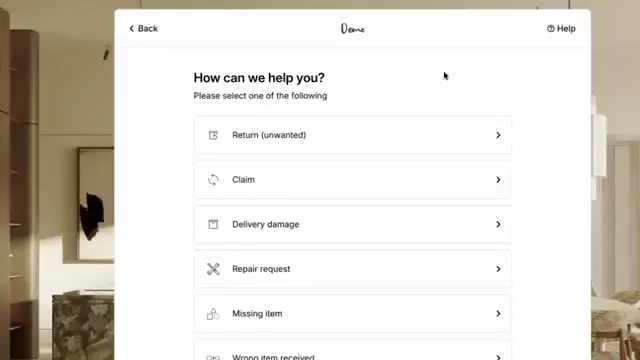
Claimlane's AI Agent, the first AI agent purpose-built for warranty claims and returns, helps service teams assess customer requests using product information, documentation and business rules.
Instead of relying entirely on a customer-selected return reason, the agent can evaluate photographs, videos, written descriptions and available case history.
Depending on the configuration, it can recommend or perform permitted actions within the brand's aftersales workflows.
Relevant capabilities include:
- Product and supplier-specific case assessment.
- Image and video analysis.
- Identification of missing documentation.
- Recommended refunds, replacements and other actions.
- Potential fraud and risk identification.
- Human approval and escalation rules.
- Connections with Shopify and operational systems.
Claimlane is particularly relevant for Shopify Plus merchants selling complex products where warranty claims and technical assessments are part of the returns process.
2. Gorgias: AI agents for ecommerce customer support
Gorgias provides an AI Agent that can respond to customer requests and perform supported actions in connected ecommerce systems.
Its published documentation describes Shopify order actions and integrations with returns platforms such as Loop.
Gorgias is worth considering when conversational customer service is the primary automation requirement.
Merchants should confirm which refund and return actions are supported directly and which require an additional returns management integration.
3. Happy Returns: agent-assisted reverse logistics
Happy Returns publishes an agentic returns integration based on the Model Context Protocol.
The integration allows compatible AI agents to guide customers through returns, including item selection, return reasons, refund method selection and return initiation.
This is relevant for businesses looking to connect an existing AI assistant with a dedicated returns logistics provider.
Agent-assisted return initiation shouldn't be confused with independent warranty assessment or unrestricted refund execution.
4. Loop Returns: AI-powered returns fraud prevention
Loop Returns combines ecommerce returns and exchange workflows with fraud prevention capabilities.
Its published fraud offering uses risk signals to identify potentially suspicious returns and allows merchants to define appropriate follow-up actions.
Loop is worth evaluating for Shopify Plus brands focused on standard returns, exchange retention and returns abuse prevention.
5. ReturnGO: automated RMA approvals and refunds
ReturnGO supports configurable return eligibility conditions, automated RMA approvals, refund workflows and exchanges.
Its automation capabilities are suited to merchants that can define most return decisions through predictable business rules.
Businesses requiring autonomous interpretation of technical warranty documentation should evaluate those capabilities separately rather than assuming that all automated workflows are agentic AI.
6. Narvar: enterprise returns and fraud decisioning
Narvar's Shield offering combines returns management, configurable policies and fraud prevention for retailers.
Its published capabilities include AI-supported decisioning and reverse logistics routing.
Narvar is worth considering for larger retail operations where returns risk and coordinated post-purchase experiences are central requirements.
How Shopify Plus stores can automate RMA approvals and refunds
A Shopify Plus merchant can connect an RMA platform with order information, return policies and permitted financial actions.
An illustrative AI-supported workflow could operate as follows:
- A customer submits a return or warranty request.
- The platform identifies the relevant Shopify order and product.
- The AI agent reviews documentation and applicable policies.
- Potential fraud signals and missing information are identified.
- The agent recommends an appropriate resolution.
- Eligible cases proceed automatically within configured permissions.
- Exceptions are escalated to a human reviewer.
- Connected systems execute and record the approved refund, replacement or return shipment.
Each merchant should define when a refund can be released, such as after return approval, shipment receipt or warehouse inspection.
Returns management software with RMA approvals and fraud prevention
Automated approvals can reduce processing times, but they also create risks when customer documentation is incomplete or inconsistent.
An AI-supported fraud prevention process can highlight cases that need additional assessment.
| Potential risk signal | Appropriate follow-up |
|---|---|
| Repeated claims for the same order | Check existing case and refund records. |
| Product does not match submitted documentation | Request clarification or additional evidence. |
| Serial number mismatch | Verify product identity before approval. |
| Unusually high-value refund | Apply additional approval requirements. |
| Inconsistent claim information | Route the case for human assessment. |
| Suspicious return history | Review relevant evidence and legitimate explanations. |
A risk flag is not proof of fraud. Merchants should avoid automatically rejecting legitimate claims solely because an AI system identifies unusual behaviour.
Particularly sensitive decisions should receive appropriate human oversight, with relevant consumer rights and data protection requirements taken into account.
What safeguards should an RMA AI agent have?
Businesses should control which actions an AI agent can perform and which decisions require manual approval.
Important safeguards include:
- Maximum refund values.
- Product-specific eligibility rules.
- Human review for high-risk cases.
- Mandatory escalation for product safety concerns.
- Prevention of duplicate refund execution.
- Records of the evidence and actions associated with each decision.
- Monitoring of incorrect approvals and rejections.
Merchants can start with AI-generated recommendations and gradually introduce automatic execution for suitable cases once the workflow has been tested.
How MaxGaming resolves complex RMA cases faster with AI
MaxGaming is an electronics retailer with a large catalog of gaming equipment and accessories.
According to Claimlane's published case study, the business now resolves RMA cases 77% faster after introducing structured claim intake and AI-generated recommendations.
Now we move faster and with real confidence. You can feel the impact within our support team and in every customer interaction.
Jacob Bay, Chief Operating Officer, MaxGamingMaxGaming collects product information and supporting documentation through a portal. The AI Agent evaluates the case and presents recommended actions to human service agents.
This example demonstrates the value of AI-assisted decision-making without requiring every warranty decision to be fully autonomous.
How to evaluate agentic AI vendors for Shopify Plus
Vendor demonstrations should include realistic return scenarios rather than only straightforward policy checks.
Merchants should ask each provider to demonstrate a standard refund, a defective product claim with photographs, a high-value exception and a failed downstream system action.
It should be clear which decisions are made by the AI agent, which are handled by fixed rules and which require human approval.
Claimlane has a 4.8/5 rating on G2.
Frequently asked questions about AI RMA software
Automate complex RMA decisions with Claimlane
Shopify Plus merchants selling complex products need more than automated return labels and fixed refund rules.
Claimlane combines AI-assisted product assessments, warranty workflows, supplier communication and connected refund and replacement processes.
Book a personalized demo to see how AI agents can support RMA management and warranty decisions.